外匯的槓桿是什麼?
槓桿讓您能控制遠大於入金金額的部位。在 1:100 的槓桿下,每 $1 保證金可以持有 $100 的貨幣,所以 $110,000 的部位需要 $1,100。槓桿決定的是要佔用多少保證金,而不是每點值多少錢。您真正的風險,來自您選擇的部位大小。

沒有槓桿的話,1 標準手 EUR/USD 需要帳戶裡有超過 $100,000。有了槓桿,幾百美元就能開出同一筆交易。這正是它全部的吸引力,也是它全部的危險所在。
槓桿如何運作?
槓桿以 1:100 這樣的比例表示。意思是您拿出的每 $1 保證金,可以控制 $100 的部位。交易未平倉期間,經紀商會把這筆保證金當作押金保管。
以示意價格 1.10000 的 0.10 手 EUR/USD 為例。部位價值是 10,000 × 1.10000 = $11,000。在 1:100 下,開倉需要 $11,000 ÷ 100 = $110 的保證金。
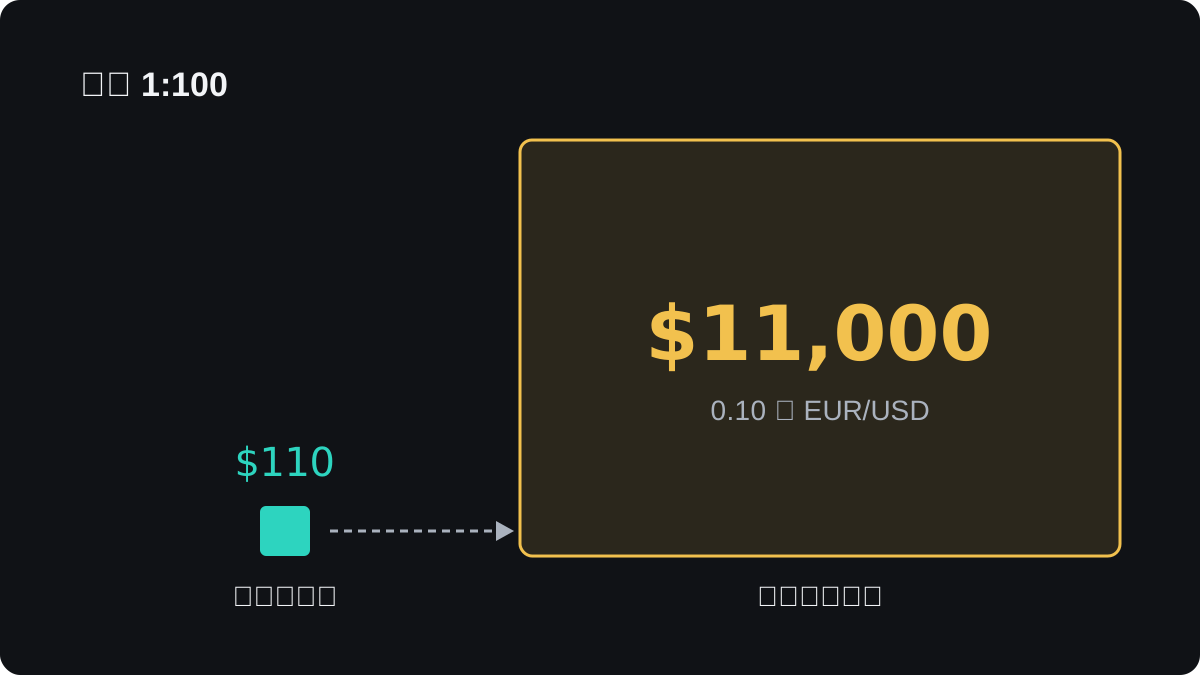
您永遠不會真的拿到另外的 $10,900。散戶外匯交易以現金結算,所以只有損益會進出您的帳戶。
槓桿、保證金與部位大小
這三個數字由同一個公式串在一起:
保證金 = 部位價值 ÷ 槓桿
因此保證金比率就是 100 ÷ 槓桿倍數,以百分比表示。在 1:100 下,經紀商要求部位價值的 1%;在 1:500 下則是 0.2%。
以下是報價 1.10000、價值 $110,000 的 1 標準手 EUR/USD,在不同槓桿設定下所需的保證金:
| 槓桿 | 保證金比率 | 1.00 手所需保證金 |
|---|---|---|
| 1:30 | 3.33% | $3,666.67 |
| 1:100 | 1% | $1,100 |
| 1:500 | 0.2% | $220 |
| 1:2000 | 0.05% | $55 |
您帳戶的設定不一定就是您實際拿到的槓桿。許多經紀商對非常大的部位、某些商品,或重大新聞與週末前後的時段,會套用較低的槓桿。
槓桿計算機可以替任何貨幣對、交易量與帳戶幣別計算這些數字。保證金是什麼、不足時會發生什麼事,則是保證金與強制平倉這一課的主題。
槓桿不會改變每點價值
這是大多數新手忽略的部分。不論您的槓桿是 1:30 還是 1:2000,1 手 EUR/USD 每點都是 $10。槓桿只會改變交易未平倉期間佔用多少保證金。
您的損益來自手數。較高的槓桿讓您能用同樣的錢開出更大的手數,危險就是從這裡開始的。
實際槓桿:真正重要的數字
實際槓桿比較的是您開了多少部位,以及您實際擁有多少資金:
實際槓桿 = 總部位價值 ÷ 帳戶淨值
假設您有 $1,000,以 1.10000 買進 0.50 手 EUR/USD。部位價值是 $55,000,所以不論帳戶設定是多少,您的實際槓桿都是 55,000 ÷ 1,000 = 55:1。
在 55:1 下,價格變動 1% 就會讓您損失帳戶的 55%。從 1.10000 變動 1% 就是 110 點,110 點 × 每點 $5 = $550。
這樣的波動並不罕見。2026 年 10 月 29 日,截至 16:35 UTC,EUR/USD 當天已經在 1.11152 到 1.11710 之間交易,波動區間約 0.5%。
下圖顯示同一個 $1,000 的帳戶,在四種部位大小下,遇到同樣 50 點反向波動的結果。
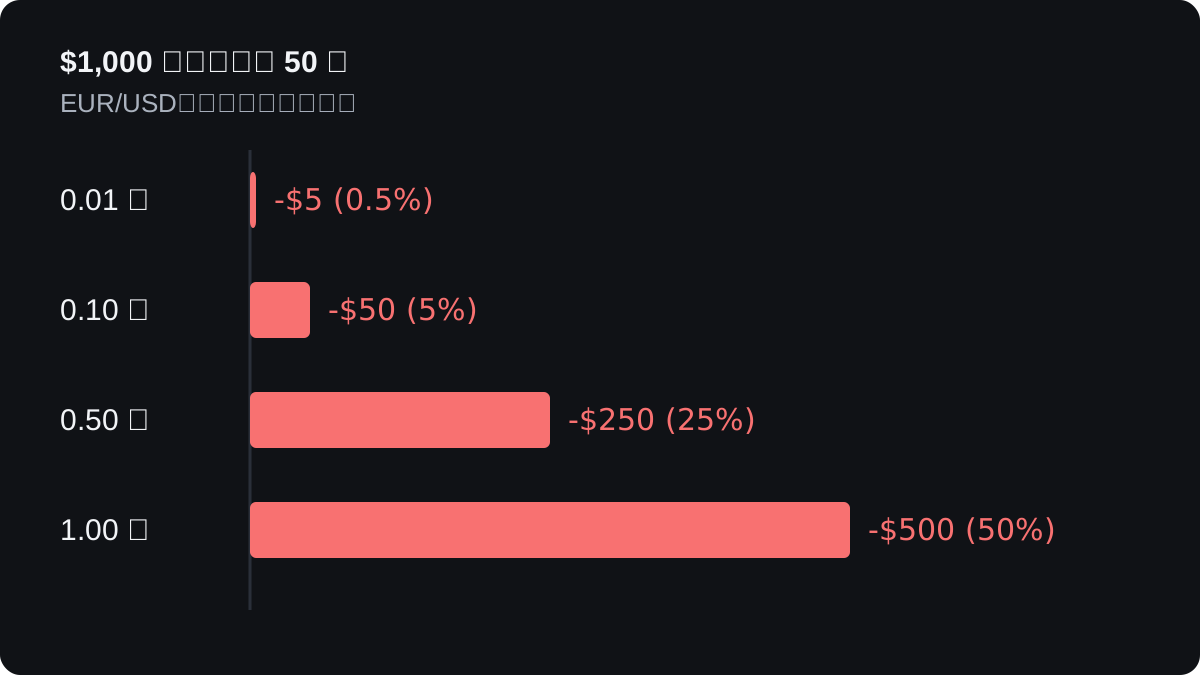
請注意最後一根長條。在 1:100 下,1.00 手需要 $1,100 的保證金,比帳戶裡的錢還多。只有槓桿設定高得多,這筆交易才開得出來。
為什麼槓桿有風險?
槓桿放大虧損的比例,和放大獲利的比例完全相同。對帳戶來說太大的部位,一次普通的波動就可能虧掉一大部分資金。
在快速變動的市場中,停損也可能以比設定價位更差的價格成交,這稱為滑價。部位越大,每多滑一點的成本就越高。
正因如此,部分監管機構會限制散戶客戶的槓桿。例如在歐盟,散戶交易主要貨幣對的槓桿上限是 1:30,在美國則是 1:50。
這些地區以外的許多經紀商提供高得多的槓桿。也請詢問是否有負餘額保護:在適用的情況下,您的虧損不會超過帳戶裡的資金。
如何選擇槓桿設定
請把槓桿當作上限,而不是目標。先依照風險決定每筆交易的規模,再確認扣掉它所需的保證金之後,還留有充足的可用保證金。
用數字來看是這樣的。$1,000 的帳戶冒 1% 的風險,也就是 $10,在 EUR/USD 上設定 25 點的停損,所以規模是 $10 ÷ (25 × $10) = 0.04 手。
在 1.10000 的價格下,這筆交易在 1:100 時佔用 $44 的保證金,在 1:500 時則是 $8.80。兩種情況下,觸及停損都剛好虧損 $10。槓桿改變的是保證金,不是風險。
同一筆交易,槓桿越高佔用的保證金越少,就留下越多空間承受連續虧損。問題只會在您把這些空間拿去開更大的部位時才出現。
一個實用的習慣:保持低的實際槓桿,並在開任何交易之前就知道您的強制平倉水平。保證金計算機會在您下單前顯示這筆交易會佔用多少保證金。
常見問題
1:500 的槓桿是什麼意思?
每 $1 的保證金可以控制 $500 的部位。報價 1.10000、價值 $110,000 的 1 標準手 EUR/USD,需要 $220 的保證金。
槓桿越高風險就越高嗎?
本身並不會,因為每點價值取決於手數,而不是槓桿。當多出來的空間誘使您開出超過帳戶承受能力的部位時,風險才會變高。
新手應該用多少槓桿?
沒有單一正確的設定。真正保護您的是低的實際槓桿,也就是相對於淨值很小的部位,再加上每筆交易都設停損。
我會虧損超過入金金額嗎?
這取決於您的經紀商與您居住的地區。有負餘額保護時,您的帳戶不會跌破零;沒有的話,價格劇烈跳空可能讓帳戶變成負餘額,而這筆欠款要由您補足。
繼續學習
 第 6 章What is margin trading?Margin trading means opening a position worth more than the money in your account. The broker sets aside part of your balance, the margin, as a deposit while the trade is open. Profit and loss are counted on the full position size, so small price moves change your balance much faster than the margin suggests.
 第 6 章What is account balance in forex?Your account balance is the money in your trading account from deposits, withdrawals and closed trades, after booked costs such as commission and swap. It does not include open positions. While a trade is open the balance stays the same, and the floating profit or loss shows up in your equity instead.
 第 6 章What is floating (unrealized) profit and loss?Floating profit and loss is the result your open trades would show if you closed them at the current price. It changes with every tick and moves your equity, while your balance stays the same. It becomes realized, and is added to or taken from your balance, only when the trade closes.
 第 6 章外匯的保證金、保證金水平與強制平倉是什麼?保證金是槓桿交易未平倉期間,經紀商把您的資金鎖住、當作押金的部分。保證金水平等於淨值除以已用保證金,再乘以 100%。當它跌到經紀商的追繳保證金水平時,您的帳戶會被標記警示;跌到強制平倉水平時,經紀商就會開始自動平掉您的部位。
 第 6 章What is used margin?Used margin is the total amount your broker sets aside to keep all your open positions open. Each position's margin is its notional value divided by your leverage, and used margin adds them up. It is not a fee: the money returns to free margin when you close the trades.
 第 6 章What is equity in a trading account?Equity is your account balance plus or minus the floating profit or loss of your open trades. It shows what the account would be worth if you closed everything at current prices. With no trades open, equity equals balance. Brokers use it to work out free margin, margin level and stop outs.
 第 6 章What is free margin?Free margin is the money in your trading account that is not locked up as margin for open trades. It equals equity minus used margin. You need free margin to open new positions, and it falls as open trades lose and rises as they gain. At zero, your margin level is 100%.
 第 6 章What is margin level?Margin level is your equity divided by your used margin, multiplied by 100 and shown as a percentage. It tells you how much cushion your open trades have. At 100%, equity equals used margin and free margin is zero. Brokers set their margin call and stop out levels on this number, and the levels differ between brokers.
 第 6 章What is a margin call?A margin call is your broker's warning that your margin level, equity divided by used margin, has fallen to a set threshold such as 100%. You usually cannot open new trades from that point. The call closes nothing by itself. If losses continue, the broker's stop out level is where positions start to be closed for you.
 第 6 章What is a stop out level?The stop out level is the margin level at which your broker starts closing your open positions automatically, often beginning with the largest loss. If your stop out level is 50%, closing begins when equity falls to half your used margin. It is meant to stop your account sinking further, though a price gap can still push it below zero.
 第 6 章Margin call example: margin call at 100% with no separate stop out.When a broker sets the margin call and the stop out both at 100%, the warning and the forced close happen at the same moment. In this example, a $1,000 account buys 0.50 lot of EUR/USD with $550 of margin at 1:100, and the trade is closed after a 90 pip fall, a $450 loss.
 第 6 章Margin call and stop out example: 100% and 50%.In this example a $2,000 account buys 1 lot of EUR/USD at 1.10000 with $1,100 of used margin. The margin call at 100% arrives when equity falls to $1,100, 90 pips lower at 1.09100. The stop out at 50% closes the trade when equity reaches $550, at 1.08550, a loss of $1,450.
 第 6 章What happens if you trade forex with $100?With $100 and 1:100 leverage, 0.01 lot of EUR/USD at 1.10000 uses $11 of margin and can move about 890 pips against you before a 100% margin call. At 0.05 lot the margin call comes after 90 pips, and 0.10 lot cannot be opened at all. Trade size decides how much room you have.
 第 6 章Why margin call and stop out levels differ between brokers.Margin call and stop out levels are set by each broker, often per account type, within any rules from the regulator that licenses the account. In this lesson's example, one trade is closed after 90 pips at one broker and after 178 pips at another, so look up your own levels before you trade.
 第 6 章Margin cheat sheet.Balance is the cash from deposits, withdrawals and closed trades. Equity is balance plus the floating profit or loss on open trades. Used margin is the deposit your open trades hold, and free margin is equity minus used margin. Margin level is equity divided by used margin, times 100. A margin call warns; a stop out closes trades.
 第 6 章How can you avoid a margin call?Margin level is your equity divided by your used margin, and a margin call comes when it falls to your broker's threshold. To stay clear, keep positions small compared with your equity, set stop losses that close losing trades long before that point, and leave plenty of free margin unused.

