Market narratives and why they matter.
A market narrative is the main story traders use to explain price moves, such as the belief that a central bank will soon cut rates. It shapes which economic data get attention and how strongly prices react, so the same surprise can move a currency a lot in one month and barely at all in another.
هذا المحتوى متاح حاليًا باللغة الإنجليزية فقط.

Two months in a row, a country reports inflation slightly above forecast. The first time, its currency barely moves. The second time, it jumps sharply.
Both numbers were similar. The difference lay in the story traders used to read them, and that story is the market narrative.
What is a market narrative?
Picture a month when every market headline says the same thing: inflation in the United States is cooling, so the Federal Reserve will soon cut interest rates.
Traders and analysts repeat it in their comments. Prices move as if it were already true.
A market narrative is the story most participants use to explain recent price moves and to judge what comes next. It is usually one simple idea, such as where interest rates are heading.
In forex, many narratives revolve around interest rates, because rate expectations shift money between currencies. Others are about growth or fear, as in the risk-on and risk-off swings.
A narrative is a belief, and it can be wrong. It still matters, because traders place orders based on it, so it shapes prices whether or not it turns out to be true.
Several stories can run at the same time. Usually one is dominant, and that is the one prices respond to most.
Why can the same data move prices by different amounts?
Prices react to the gap between a number and its forecast, as the lesson on expectations versus actual explains. The narrative decides how much that gap matters.
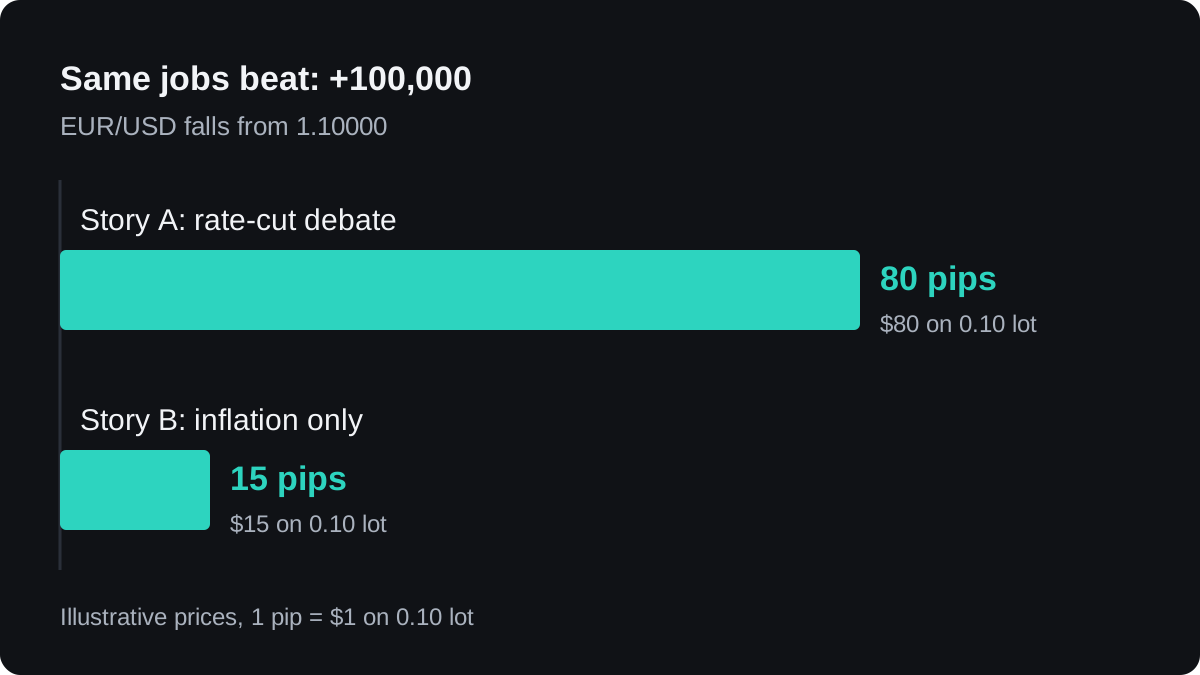
Take a hypothetical US jobs report. It is forecast to show 150,000 new jobs and shows 250,000, a beat of 100,000. The prices and moves below are illustrative, and the sums ignore the spread.
In both cases you already hold a short position of 0.10 lot of EUR/USD, which is 10,000 euros. A pip on this pair is 0.0001, so each pip is worth 10,000 × 0.0001 = $1.
Scenario A: a rate-cut debate
The dominant story is whether the Federal Reserve should cut rates soon. Strong hiring argues against a cut, so traders buy dollars and EUR/USD falls.
- EUR/USD falls from 1.10000 to 1.09200.
- The move is 1.10000 minus 1.09200 = 0.00800, which is 80 pips.
- The short gains 80 × $1 = $80.
Scenario B: inflation is all that matters
The dominant story is that inflation alone will decide the next rate move, and jobs are a side issue. The same beat gets far less attention.
- EUR/USD falls from 1.10000 to 1.09850.
- The move is 1.10000 minus 1.09850 = 0.00150, which is 15 pips.
- The same short gains 15 × $1 = $15.
The surprise was identical. In scenario A it answered the question traders cared about, so the move was more than five times larger: 80 ÷ 15 = 5.3.
Real reactions are messier. Other news, the time of day and how traders were already positioned all change the size of a move, so treat these numbers as a picture of the mechanism.
How a narrative picks which data matter
A narrative works like a short list of questions. If the story is about inflation, inflation reports get the attention, and a strong retail sales figure may pass with little effect.
The story also shapes the forecasts. When most traders believe rate cuts are coming, consensus forecasts and current prices already lean that way, so data that fits the story is largely priced in.
Data that breaks the story lands differently. Traders who bet on the narrative may have to close or reverse their positions, and that rush can add to the move.
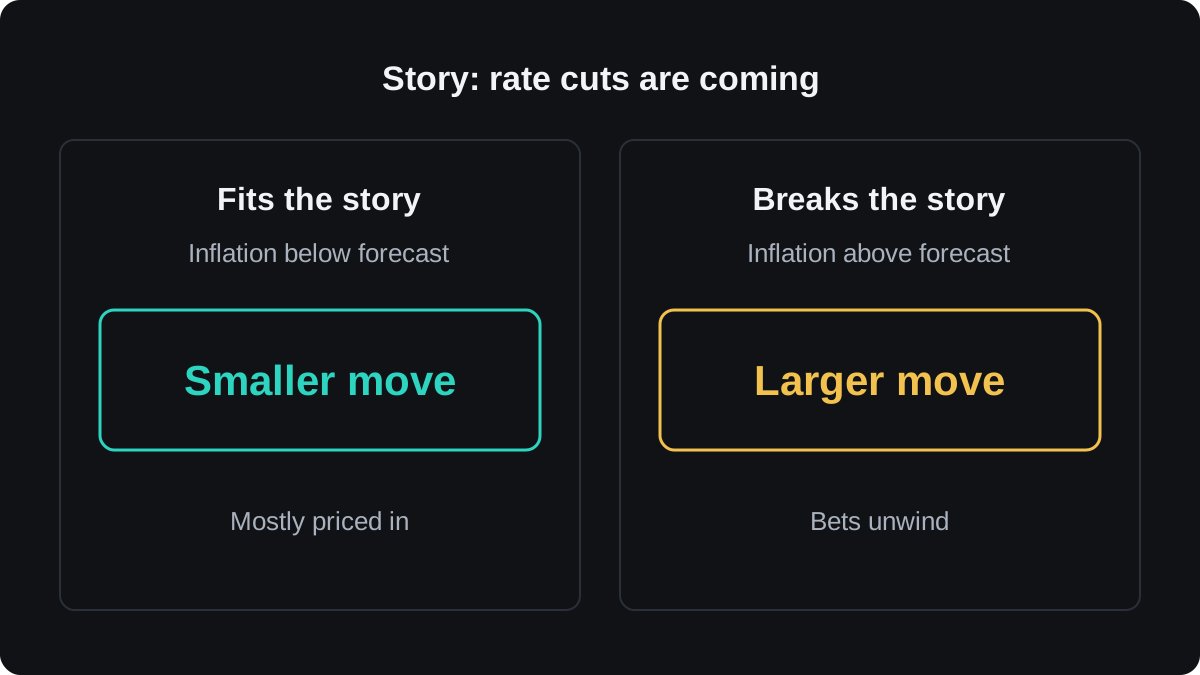
This gives a rough pattern: data that contradicts a widely held narrative often moves prices more than data of similar size that confirms it. It is a tendency with many exceptions, and you cannot count on it.
A narrative can even change the direction of a reaction. In a calm market, weak US growth data tends to weigh on the dollar through lower rate expectations.
In a global growth scare, the same weak data can add to a risk-off mood. At times money has then flowed into currencies seen as safe, including the dollar and the yen, so the dollar rose on bad US news.
How do you find the current narrative?
No one publishes the narrative. You build a picture of it from what is said and from how prices behave.
Start with central bank statements and press conferences, since rate expectations drive so many forex stories. The lesson on how central banks move currencies covers what to listen for.
After big releases, go back to the economic calendar. Note which reports moved prices strongly and which barely registered, because the ones that moved prices show what the market is asking about.
Financial news repeats the dominant story often. Read it for what traders believe, and remember that a headline explaining a move is written after the move.
One habit makes this concrete: write the narrative in one sentence, then list the data that would confirm it and the data that would break it.
For example: US inflation is cooling, so rate cuts are coming. Lower inflation and softer hiring confirm it. Inflation above forecast, or a run of strong jobs reports, would break it.
Checking that note after each release shows whether the story is holding. It is also the starting point for spotting a narrative shift and for building a fundamental view of a currency.
Where narrative thinking goes wrong
Stories are easy to fit after the fact. Once you know which way prices went, almost any move can be explained by some narrative, and that makes the explanation feel stronger than it is.
A narrative is also hard to test. There is no agreed way to measure one, so a rule such as trade with the narrative cannot be backtested the way a moving average crossover can.
For the same reason, there is little public evidence that reading narratives alone gives a trader an edge.
Narratives can survive long after the data turns against them, and they can collapse in a single session. Knowing the story tells you what the market cares about, and it says nothing about when the story will end.
Use the narrative as context. It explains why a release mattered and helps you judge which events carry the most risk for an open position, while your entries and stops still need their own rules.
أسئلة شائعة
What is a market narrative in forex?
It is the main story traders use to explain price moves, such as an expected change in interest rates. It shapes which data they watch and how strongly prices react.
Why did the market ignore good economic data?
Often the data was already expected, or it did not touch the question the narrative is focused on. Prices move most on surprises that change the story.
Can you trade a market narrative?
You can use it as background, for example by being careful around releases that could break it. There is no reliable evidence that following a narrative alone produces profits, so treat it as context alongside clear rules and risk limits.
How long does a market narrative last?
There is no fixed length. Some last for months, while others change within a day after a central bank surprise or a major data release.