The Swiss franc.
The Swiss franc (CHF) is the currency of Switzerland, a small economy with a currency that investors often buy in times of stress. That safe-haven demand can push the franc too high, so the Swiss National Bank has fought it with negative rates and currency intervention, including a 1.20 floor on EUR/CHF that it dropped without warning in 2015.
Ce contenu n'existe pour l'instant qu'en anglais.

Switzerland is home to roughly nine million people, yet its currency often moves when trouble starts far away. When investors get nervous about a debt crisis or a market crash, money tends to flow into Swiss francs.
That habit makes the franc a safe-haven currency: one that investors buy for safety in times of stress, even when it pays little or no interest.
It also explains why the Swiss National Bank (SNB), the country's central bank, has spent years trying to stop its own currency from getting too strong.
Why do investors run to the franc?
The code is CHF, from Confoederatio Helvetica, the Latin name of Switzerland. The SNB issues the franc, and Liechtenstein uses it as well.
Switzerland has a long record of political neutrality and low inflation. It has also run current account surpluses for many years, meaning it earns more from the rest of the world than it spends there.
Swiss households, firms and pension funds own large assets abroad. In a crisis, some of that money comes home and is converted back into francs, adding demand just as foreign investors are buying for safety.
The Japanese yen shows a similar pattern for related reasons. The lesson on risk-on and risk-off explains how these flows swing between fear and confidence across markets.
Safe-haven buying is a tendency seen in many past stress episodes, and it does not happen every time.
How does the Swiss National Bank steer the franc?
The SNB's main job is price stability, which it defines as consumer price inflation of less than 2% a year. A franc that rises too fast makes imports cheaper and can push inflation down toward zero or below.
A strong franc also hurts Swiss exporters and tourism, because Swiss goods and holidays become more expensive for foreign buyers.
Two SNB tools reach the exchange rate directly. It sets its policy interest rate, and it buys or sells foreign currency in the market, which is currency intervention.
To weaken the franc, the SNB creates francs and sells them for euros, dollars and other currencies. Over the years this built up a very large stock of foreign reserves on its balance sheet.
It has also used negative interest rates. From January 2015 it charged banks 0.75% a year on part of the money they held with it, which made holding francs less attractive. Its rates stayed below zero until September 2022.
Intervention can run the other way. When inflation rose in 2022, the SNB at times sold foreign currency, which supports the franc. The policy rate changes, so check the SNB's own website for the current figure.
The lesson on how central banks move currencies covers these tools for any currency.
The EUR/CHF floor and the day it broke
During the euro area debt crisis, money poured into francs. By August 2011, EUR/CHF had fallen close to 1.00, so one euro bought barely more than one franc.
On 6 September 2011 the SNB announced a minimum exchange rate of 1.20 francs per euro and said it would buy foreign currency in unlimited amounts to defend it. For more than three years, EUR/CHF traded above that line, often only slightly.
On 15 January 2015, without warning, the SNB dropped the floor. It also cut the rate on banks' deposits with it to minus 0.75%.
EUR/CHF fell from about 1.20 to below 1.00 within minutes. For a short time there were almost no prices to trade on.
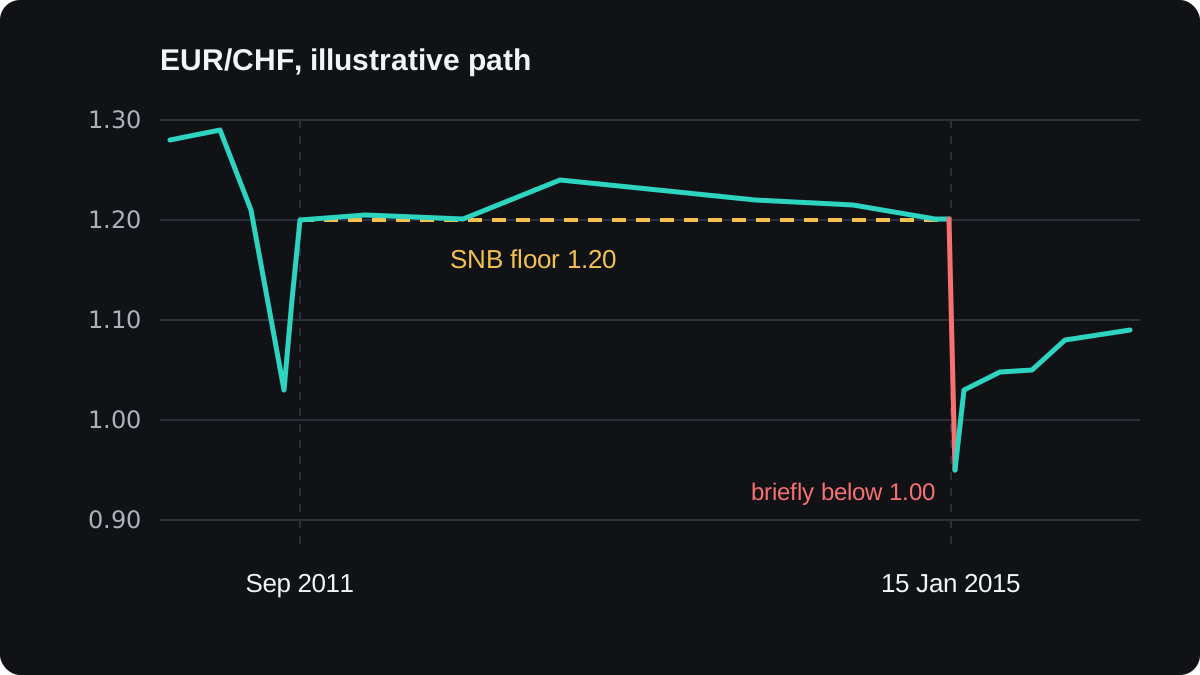
The SNB said the floor was no longer justified as monetary policy in the large currency areas drifted apart. For a trader, the lasting point is the speed: a level held for more than three years was gone within minutes.
What does the 2015 shock mean for a stop loss?
A stop loss closes a trade once price reaches a set level. In most cases it then becomes a market order, so in a fast market the fill can be far worse than the level. That gap is slippage.
Say you bought EUR/CHF just above the floor, expecting the SNB to defend it. The prices are illustrative, and the account is held in francs:
- You buy 1 standard lot of EUR/CHF at 1.2010, a notional of 100,000 euros.
- The pip on EUR/CHF is 0.0001 and the quote currency is the franc, so one pip on one lot is 100,000 × 0.0001 = CHF 10.
- Your stop sits at 1.1960, 50 pips below entry. The planned loss is 50 × CHF 10 = CHF 500.
- The floor goes. Price jumps past 1.1960 with no trades near it, and your stop fills at 1.0500.
- The real move is 1.2010 minus 1.0500 = 0.1510, which is 1,510 pips.
- The loss is 1,510 × CHF 10 = CHF 15,100, about 30 times the plan.
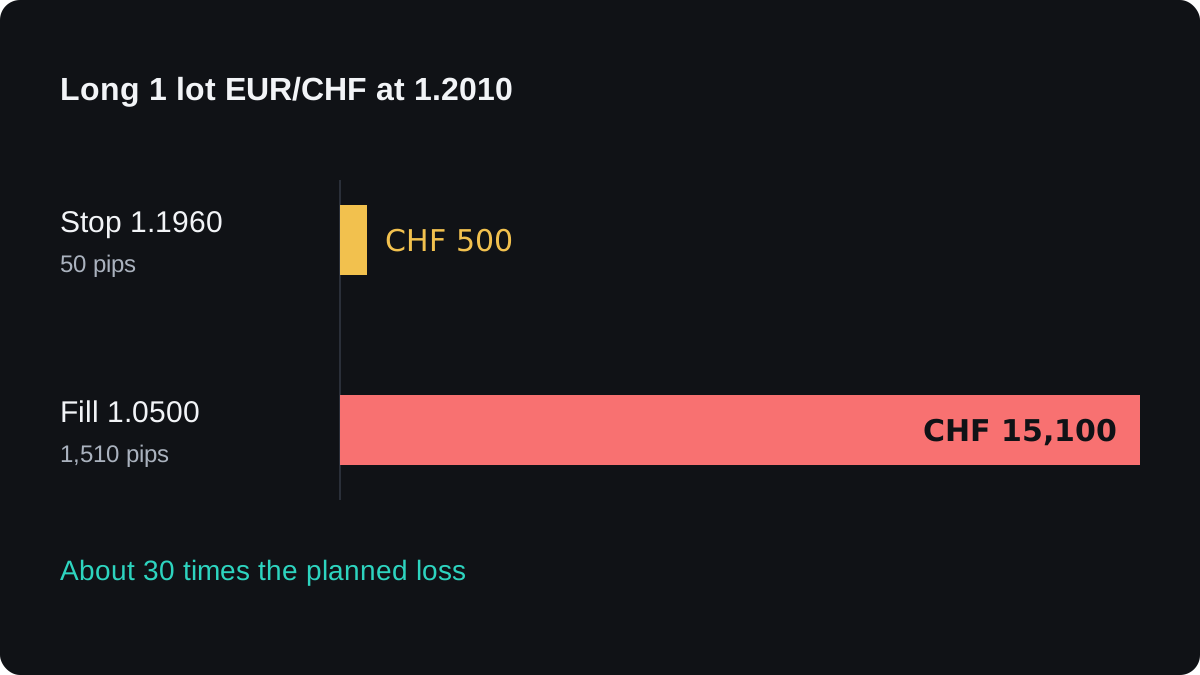
On a CHF 10,000 account, that one trade leaves a balance of minus CHF 5,100. Whether you owe it depends on your broker's terms and any negative balance protection where you live, so read the client agreement.
The fill of 1.0500 is invented for the example. Real fills that day varied widely between brokers, and some brokers took losses large enough to threaten their survival.
How do the franc pairs trade?
Most retail platforms list three franc pairs:
- USD/CHF, one of the seven major pairs, often nicknamed the Swissie.
- EUR/CHF, a cross that reacts to euro area news and SNB policy.
- CHF/JPY, which sets two safe-haven currencies against each other.
On USD/CHF and EUR/CHF the franc is the quote currency, so one pip on one lot is 100,000 × 0.0001 = CHF 10. In a US dollar account the broker converts at USD/CHF: at an illustrative 0.8000, that is 10 ÷ 0.8000 = $12.50.
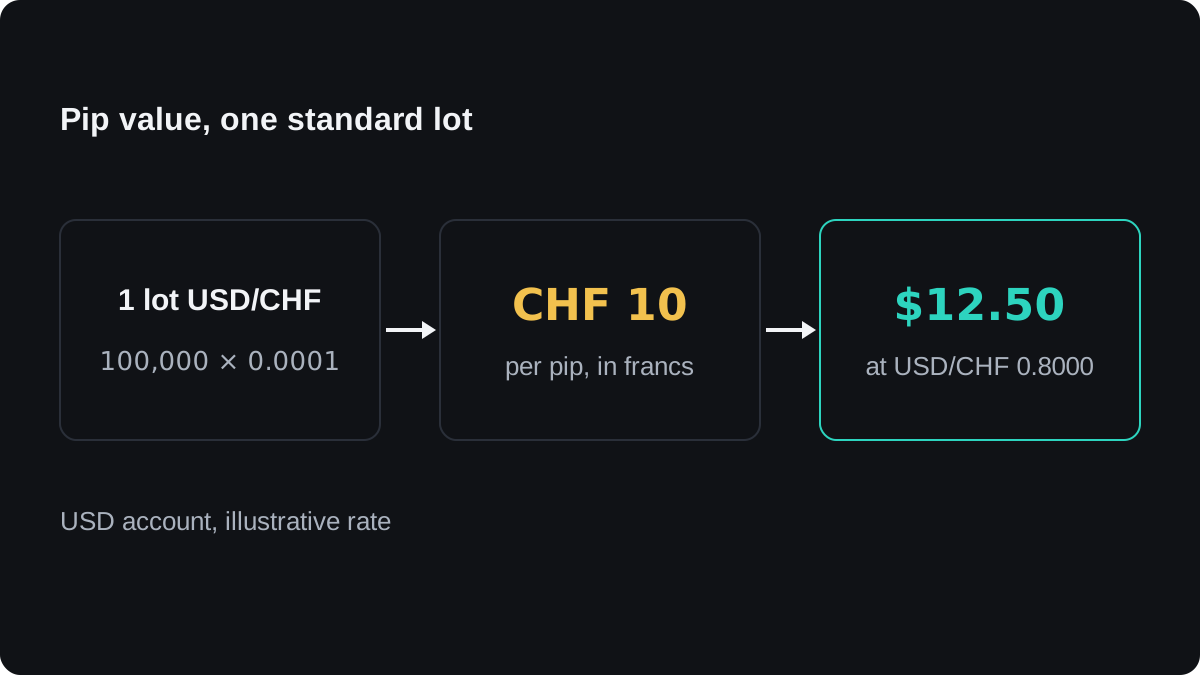
With round illustrative rates of USD/CHF at 0.8000 and USD/JPY at 150.00, pip values in a dollar account look like this:
| Pair | 1.00 lot | 0.10 lot | 0.01 lot |
|---|---|---|---|
| USD/CHF at 0.8000 | $12.50 | $1.25 | $0.125 |
| EUR/CHF (via USD/CHF 0.8000) | $12.50 | $1.25 | $0.125 |
| CHF/JPY (via USD/JPY 150.00) | $6.67 | $0.67 | $0.07 |
CHF/JPY has the franc as the base currency and the yen as the quote, so its pip is 0.01. One lot gives 100,000 × 0.01 = 1,000 yen per pip, which is 1,000 ÷ 150.00 = $6.67.
Because the franc is the quote currency on its two main pairs, a stronger franc shows up as a lower price: USD/CHF and EUR/CHF fall when the franc rises. The pip value calculator handles other rates and account currencies.
Where does the safe-haven idea fail?
The franc does not rise in every crisis. If the SNB is leaning against it, buyers meet a central bank that can create and sell francs in any amount, and the move can stall.
The type of scare matters too. A shock that starts in Europe tends to lift the franc against the euro, while a scramble for US dollar funding can send money into the dollar instead.
The evidence for safe-haven behaviour comes from looking back at past episodes, and the size of the effect shifts from one to the next. Treat it as a tendency to weigh against the current situation, and a weak signal on its own.
Low Swiss interest rates have at times made the franc a funding currency, borrowed to buy higher-yielding assets. When fear hits and those positions close, the franc can jump, as the lesson on carry trade risks explains.
Questions fréquentes
Why is the Swiss franc a safe haven?
Switzerland has a record of political stability, low inflation and large assets held abroad. In a crisis, investors buy francs for safety and Swiss money abroad tends to flow home, which pushes the franc up.
What happened to the Swiss franc in 2015?
On 15 January 2015 the SNB removed its minimum rate of 1.20 francs per euro. EUR/CHF fell below 1.00 within minutes, and many stop losses filled far from their set levels.
Does the SNB still intervene in the currency market?
The SNB lists foreign exchange intervention as one of its policy tools and has used it in both directions. Its latest monetary policy assessment states its current stance.
What is the pip value of USD/CHF?
One pip on one standard lot is CHF 10. In a dollar account you divide by the USD/CHF rate, so at an illustrative 0.8000 it is $12.50.
Why does USD/CHF fall when the franc gets stronger?
The franc is the quote currency, so the price says how many francs one dollar costs. When the franc strengthens, one dollar buys fewer francs and the number drops.
Continuer à apprendre
 Chapitre 4The US dollar.The US dollar is on one side of most forex trades because it is the main reserve, trade and funding currency. Its value moves largely on what traders expect from the Federal Reserve, and those expectations shift with US jobs, inflation and growth data. In a global panic it often rises.
 Chapitre 4The euro.The euro is the shared currency of 21 European Union countries, managed by the European Central Bank in Frankfurt. The ECB sets one interest rate for economies that can need different ones, aiming for 2% inflation across the whole area. EUR/USD, the euro against the US dollar, is the world's most traded currency pair.
 Chapitre 4The Japanese yen.The Japanese yen is shaped by decades of very low interest rates set by the Bank of Japan, which made it a popular funding currency for carry trades. It often rises when markets panic, though not always. Japan's Ministry of Finance sometimes intervenes, and on yen pairs a pip is 0.01.
 Chapitre 4The British pound.The British pound, or sterling (GBP), moves mainly on Bank of England interest rate expectations and on data from a services-heavy UK economy. GBP/USD, nicknamed cable, is one of the most traded pairs. The pound has often swung further in a day than the euro, so a trade on it may need a wider stop and a smaller position.
 Chapitre 4The Australian, Canadian and New Zealand dollars.The Australian, Canadian and New Zealand dollars are called commodity currencies because their countries export large amounts of raw materials. The Aussie tends to follow metals and Chinese demand, the loonie oil and the US economy, and the kiwi dairy prices. Interest rates and global risk appetite also move all three, and can outweigh commodities.
Courtiers partenaires

