What is account balance in forex?
Your account balance is the money in your trading account from deposits, withdrawals and closed trades, after booked costs such as commission and swap. It does not include open positions. While a trade is open the balance stays the same, and the floating profit or loss shows up in your equity instead.
Ce contenu n'existe pour l'instant qu'en anglais.

You deposit $1,000 into a new trading account. Before you place a single trade, your balance is $1,000. It changes only when money is booked into or out of the account.
Your account balance is the money in your account from deposits, withdrawals and closed trades. Open positions are not counted until you close them.
What does your account balance include?
Think of the balance as a ledger of finished business. Every entry is something that has already happened and can no longer change.
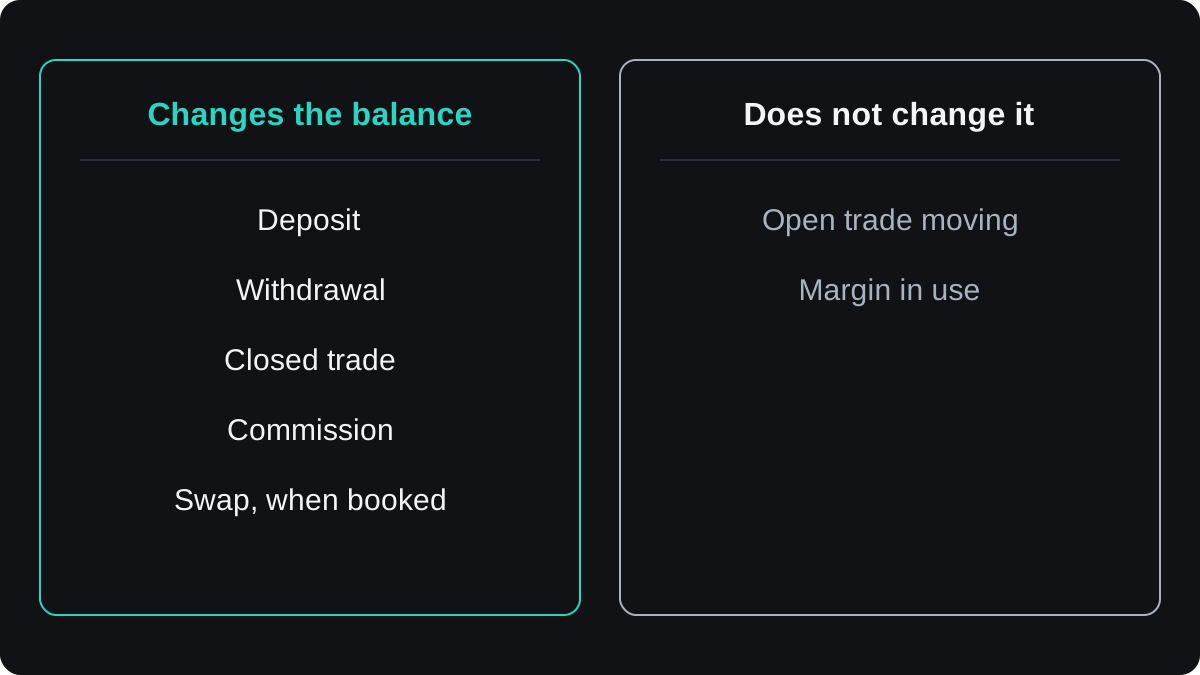
These entries move it:
- Deposits add to it.
- Withdrawals take from it.
- A closed trade adds its profit or takes its loss.
- Trading costs such as commission and swap are taken from it once they are booked.
An open trade does none of this. Its result is still moving, so the platform shows it separately as floating profit or loss, which the next lesson on floating P/L covers.
The lesson on margin trading showed that a broker reserves part of your money as margin while a trade is open. That reserve is not taken out of the balance.
How the balance changes, step by step
The prices below are round and illustrative. Each one is the price your order filled at, so the spread is already inside it. A pip on 0.10 lot of EUR/USD or GBP/USD is worth $1.
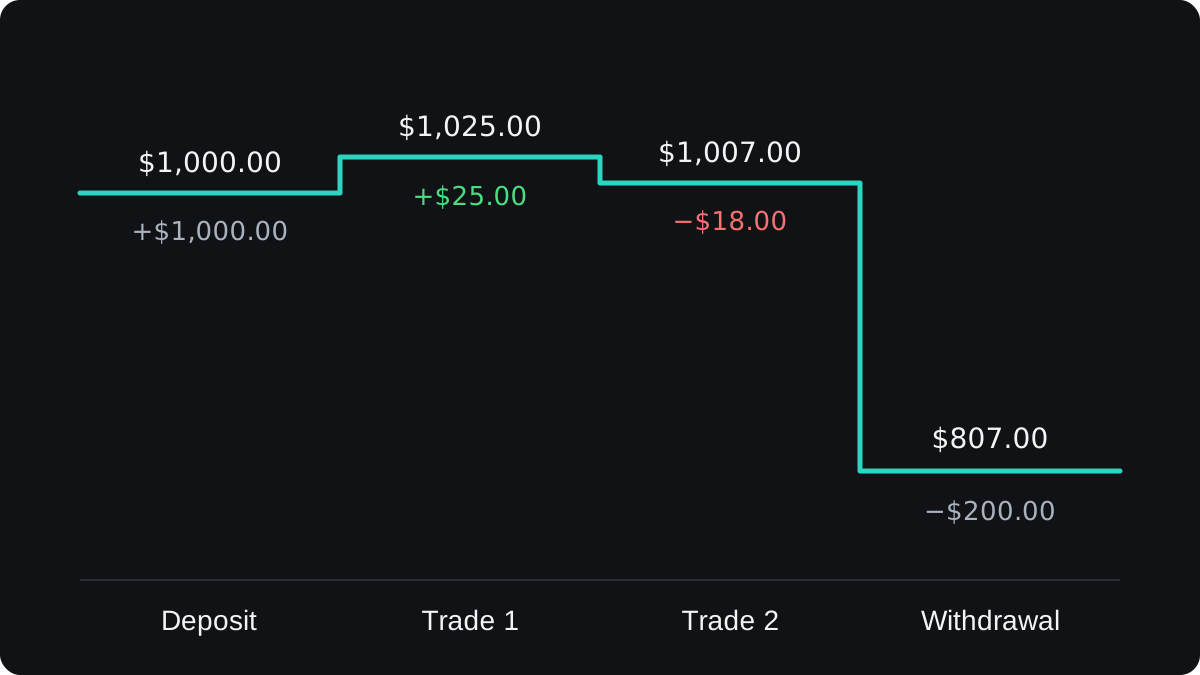
- You deposit $1,000. Balance: $1,000.00.
- You buy 0.10 lot of EUR/USD at 1.10000 and close at 1.10250. The move is 0.00250, or 25 pips, so 25 × $1 = +$25.00. Balance: $1,025.00.
- You sell 0.10 lot of GBP/USD at 1.30000 and buy it back at 1.30180. The sum is 1.30000 − 1.30180 = −0.00180, or −18 pips, so −$18.00. Balance: $1,007.00.
- You withdraw $200. Balance: $807.00.
| Event | Change | Balance after |
|---|---|---|
| Deposit | +$1,000.00 | $1,000.00 |
| EUR/USD buy closed | +$25.00 | $1,025.00 |
| GBP/USD sell closed | −$18.00 | $1,007.00 |
| Withdrawal | −$200.00 | $807.00 |
You can check the total in one line: $1,000 deposited, minus $200 withdrawn, plus closed results of $25 − $18 = $7, gives $807.
The withdrawal makes the biggest drop on the chart below, yet it says nothing about your trading. The $200 has moved to your bank account and is still yours.
Why the balance stays still while a trade is open
Go back to step 3. While the GBP/USD sell was open, the ask first rose to 1.30400 before it fell back.
At 1.30400 the trade was 40 pips against you, a floating loss of 40 × $1 = $40.00. Your balance still read $1,025.00, because nothing had closed yet.
What did change was your equity, the balance plus the floating result of all open trades. At that moment equity was $1,025.00 − $40.00 = $985.00.
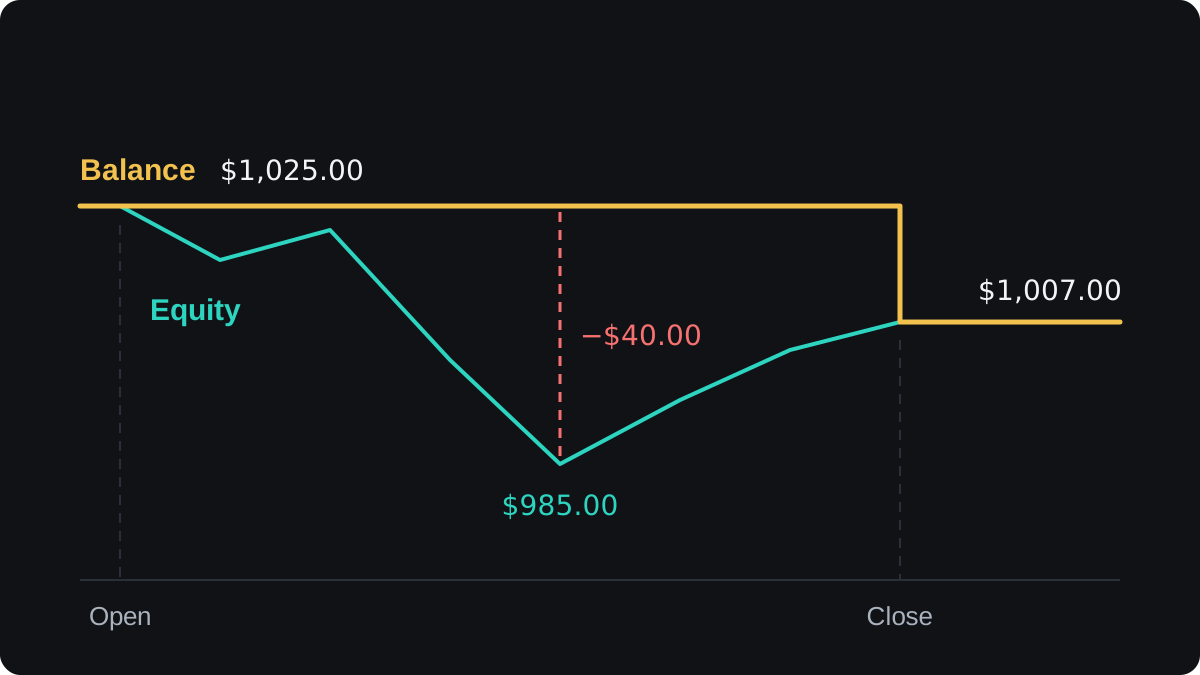
When you closed at 1.30180, the floating loss of $18.00 became a realised loss. The balance dropped to $1,007.00, and with no trade open, equity matched it again.
The balance tells you where you stood after your last closed trade. Equity tells you where you stand right now.
Where commission, swap and bonuses fit
Costs reach the balance too. On an account that charges commission per lot, the fee is taken from the balance at the open or at the close, depending on the broker and platform.
Swap is interest charged or paid for holding a position overnight. On common platforms it builds up on the open position and is booked into the balance when you close.
Suppose each trade in the example also cost $0.70 commission, and the GBP/USD sell was charged $0.50 swap for one night. These figures are illustrative.
The costs add up to $0.70 + $0.70 + $0.50 = $1.90. The final balance becomes $807.00 − $1.90 = $805.10.
A trading bonus is handled differently. On many MetaTrader accounts it appears on a separate line called Credit, and the balance stays where it was.
Credit usually counts towards equity, and the broker's terms decide whether it can ever be withdrawn.
Where to find your balance on the platform
In MetaTrader 4 and 5, the Trade tab at the bottom of the screen shows a summary line with balance, equity, margin, free margin and margin level. Phone apps show the same figures, though the labels vary by app.
The account history tab lists every entry that changed the balance. Deposits and withdrawals appear as balance operations next to your closed trades, so you can rebuild the total yourself, as in the example.
If the history and the balance do not agree, look for a commission, swap or fee entry you missed. Your broker's statement is the record to rely on.
Why your balance alone can mislead you
A healthy balance can hide a bad position. A trader with a $1,000 balance and an open trade losing $600 has only $400 of equity.
Brokers judge your margin on equity. Your margin level is equity divided by used margin, times 100, so falling equity can trigger a margin call while the balance has not moved at all.
Leaving a losing trade open does not protect the balance. It only delays the moment the loss is booked, and the loss can grow in the meantime.
The balance is still the right number for some jobs, such as comparing your account with what you deposited.
If you use a risk per trade rule such as 1%, decide whether it means 1% of balance or of equity. The two differ whenever trades are open.
Questions fréquentes
Is balance the same as equity?
Only when no trades are open. With open positions, equity is the balance plus their floating profit or loss, so it can be higher or lower than the balance.
Does my balance change when I open a trade?
No, unless your broker books commission at the open. The margin for the trade is reserved, which lowers your free margin, but the balance stays the same.
Can I withdraw my whole balance?
With no trades open, you can usually request the full balance, subject to your broker's withdrawal rules. With trades open, brokers normally limit withdrawals to money not needed as margin.
Can an account balance go negative?
Yes, if a fast move or a price gap closes a trade at a loss bigger than your balance. Some brokers offer negative balance protection and reset the balance to zero, so check your broker's terms.
Continuer à apprendre
 Chapitre 6What is margin trading?Margin trading means opening a position worth more than the money in your account. The broker sets aside part of your balance, the margin, as a deposit while the trade is open. Profit and loss are counted on the full position size, so small price moves change your balance much faster than the margin suggests.
 Chapitre 6What is floating (unrealized) profit and loss?Floating profit and loss is the result your open trades would show if you closed them at the current price. It changes with every tick and moves your equity, while your balance stays the same. It becomes realized, and is added to or taken from your balance, only when the trade closes.
 Chapitre 6Que sont la marge, le niveau de marge et le stop out sur le forex ?La marge est la part de votre argent que le courtier bloque en garantie tant qu'un trade à effet de levier est ouvert. Le niveau de marge est égal aux fonds propres divisés par la marge utilisée, multipliés par 100%. Quand il tombe au seuil d'appel de marge du courtier, votre compte est signalé, et au seuil de stop out, le courtier commence à clôturer automatiquement vos positions.
 Chapitre 6What is used margin?Used margin is the total amount your broker sets aside to keep all your open positions open. Each position's margin is its notional value divided by your leverage, and used margin adds them up. It is not a fee: the money returns to free margin when you close the trades.
 Chapitre 6What is equity in a trading account?Equity is your account balance plus or minus the floating profit or loss of your open trades. It shows what the account would be worth if you closed everything at current prices. With no trades open, equity equals balance. Brokers use it to work out free margin, margin level and stop outs.
 Chapitre 6What is free margin?Free margin is the money in your trading account that is not locked up as margin for open trades. It equals equity minus used margin. You need free margin to open new positions, and it falls as open trades lose and rises as they gain. At zero, your margin level is 100%.
 Chapitre 6What is margin level?Margin level is your equity divided by your used margin, multiplied by 100 and shown as a percentage. It tells you how much cushion your open trades have. At 100%, equity equals used margin and free margin is zero. Brokers set their margin call and stop out levels on this number, and the levels differ between brokers.
 Chapitre 6What is a margin call?A margin call is your broker's warning that your margin level, equity divided by used margin, has fallen to a set threshold such as 100%. You usually cannot open new trades from that point. The call closes nothing by itself. If losses continue, the broker's stop out level is where positions start to be closed for you.
 Chapitre 6What is a stop out level?The stop out level is the margin level at which your broker starts closing your open positions automatically, often beginning with the largest loss. If your stop out level is 50%, closing begins when equity falls to half your used margin. It is meant to stop your account sinking further, though a price gap can still push it below zero.
 Chapitre 6Margin call example: margin call at 100% with no separate stop out.When a broker sets the margin call and the stop out both at 100%, the warning and the forced close happen at the same moment. In this example, a $1,000 account buys 0.50 lot of EUR/USD with $550 of margin at 1:100, and the trade is closed after a 90 pip fall, a $450 loss.
 Chapitre 6Margin call and stop out example: 100% and 50%.In this example a $2,000 account buys 1 lot of EUR/USD at 1.10000 with $1,100 of used margin. The margin call at 100% arrives when equity falls to $1,100, 90 pips lower at 1.09100. The stop out at 50% closes the trade when equity reaches $550, at 1.08550, a loss of $1,450.
 Chapitre 6What happens if you trade forex with $100?With $100 and 1:100 leverage, 0.01 lot of EUR/USD at 1.10000 uses $11 of margin and can move about 890 pips against you before a 100% margin call. At 0.05 lot the margin call comes after 90 pips, and 0.10 lot cannot be opened at all. Trade size decides how much room you have.
 Chapitre 6Why margin call and stop out levels differ between brokers.Margin call and stop out levels are set by each broker, often per account type, within any rules from the regulator that licenses the account. In this lesson's example, one trade is closed after 90 pips at one broker and after 178 pips at another, so look up your own levels before you trade.
 Chapitre 6Qu'est-ce que l'effet de levier sur le forex ?L'effet de levier vous permet de contrôler une position bien plus grande que votre dépôt. À 1:100, chaque $1 de marge tient $100 de devises : une position de $110,000 demande donc $1,100. Le levier détermine la marge bloquée, pas la valeur d'un pip. Votre risque réel vient de la taille de position que vous choisissez.
 Chapitre 6Margin cheat sheet.Balance is the cash from deposits, withdrawals and closed trades. Equity is balance plus the floating profit or loss on open trades. Used margin is the deposit your open trades hold, and free margin is equity minus used margin. Margin level is equity divided by used margin, times 100. A margin call warns; a stop out closes trades.
 Chapitre 6How can you avoid a margin call?Margin level is your equity divided by your used margin, and a margin call comes when it falls to your broker's threshold. To stay clear, keep positions small compared with your equity, set stop losses that close losing trades long before that point, and leave plenty of free margin unused.
Courtiers partenaires

