 Glossaire · Les bases du trading sur marge
Margin
Ce contenu n'existe pour l'instant qu'en anglais.
Margin is the part of your account set aside as a deposit for an open leveraged trade. It equals the position's value divided by your leverage. It is not a fee, and it is released when the trade closes.
Margin is the money that leverage locks while a trade is open. The margin and stop out lesson follows one account to a stop out, and the leverage lesson shows how the ratio sets the amount.
How margin is calculated
Margin depends on the position's value and your leverage:
Required margin = position value ÷ leverage
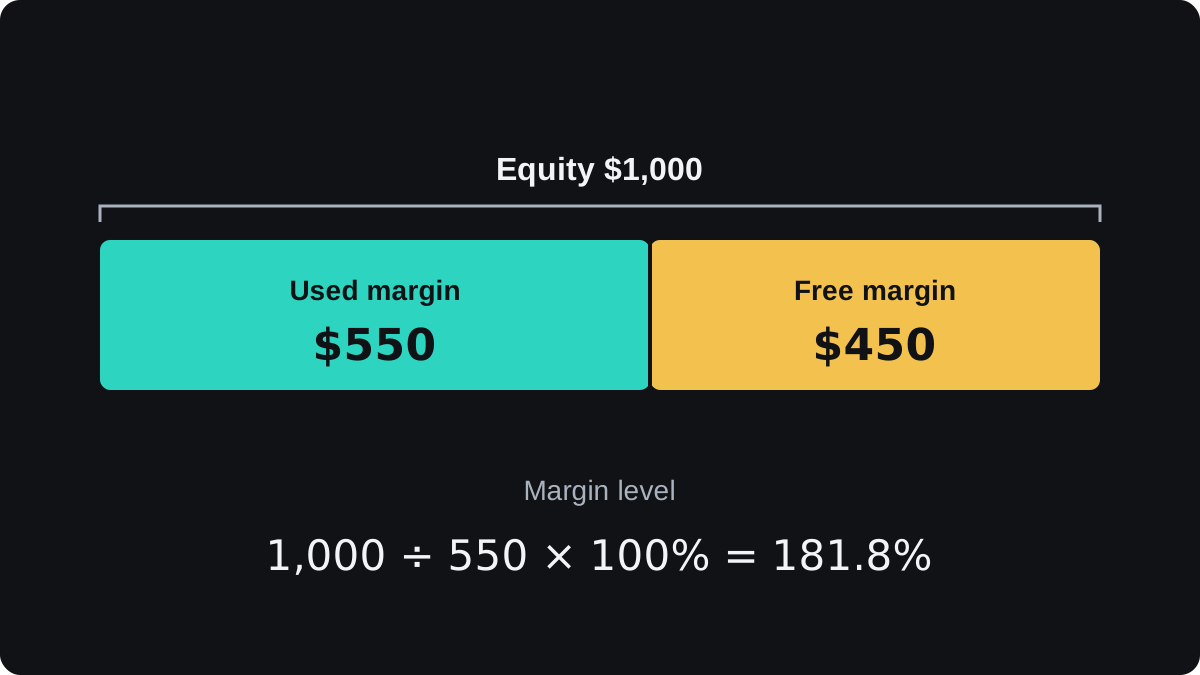
Here is a worked example with round illustrative prices. A $1,000 account at 1:100 buys 0.50 lot of EUR/USD at 1.10000. The position is worth 50,000 × 1.10000 = $55,000, so the margin is $55,000 ÷ 100 = $550.
What margin does while the trade is open
MetaTrader shows the locked amount as Margin, often called used margin. What is left of your equity is free margin, here $1,000 minus $550 = $450.
The broker also tracks margin level, equity divided by used margin times 100%, which here is 181.8%.
If losses push it down to the broker's stop out level, positions start closing automatically. Each broker and account type sets its own level.
The margin calculator shows what a trade will lock before you place it.
Questions fréquentes
Is margin a fee?
No. Margin is a deposit held while a trade is open and released when it closes; the costs of trading are things like the spread, commission and swap.
How much margin do I need for 1 lot?
It depends on the price and your leverage. One standard lot of EUR/USD at 1.10000 is worth $110,000, so it needs $1,100 at 1:100 and $220 at 1:500.
Leverage multiplies losses as well as gains; only trade money you can afford to lose.
Autres termes de ce chapitre
 EquityEquity is your account's value right now: balance plus or minus floating profit or loss. It counts every open position. Free margin and margin level are both worked out from equity, not from the balance.
 Account balanceYour balance is the money in your account from deposits, withdrawals and closed trades. It does not move with open positions. Their floating profit or loss is counted in equity instead, so balance and equity differ while trades are open.
 Margin callA margin call is a warning that your margin level has hit the broker's threshold. Your open trades are thinly covered, but it does not close them by itself. If losses continue to the stop out level, the broker closes them.
 Stop outStop out is the margin level at which your broker starts closing your positions. The biggest loser usually goes first, because equity no longer covers the margin they need. The exact level depends on the broker and the account type.