 Glosarium · Dasar trading margin
Margin level
Konten ini baru tersedia dalam bahasa Inggris.
Margin level is your equity divided by the margin used by open trades, times 100%. It shows how well those trades are covered. Brokers compare it with their margin call and stop out levels, which differ by broker and account type.
Margin level tells you how close the account is to a forced close. The margin and stop out lesson follows it from a new trade down to a stop out.
How margin level is calculated
Margin level = equity ÷ used margin × 100%
Equity includes the floating result of open trades, so the level moves with price. With no open positions there is no used margin, and the platform shows no margin level.
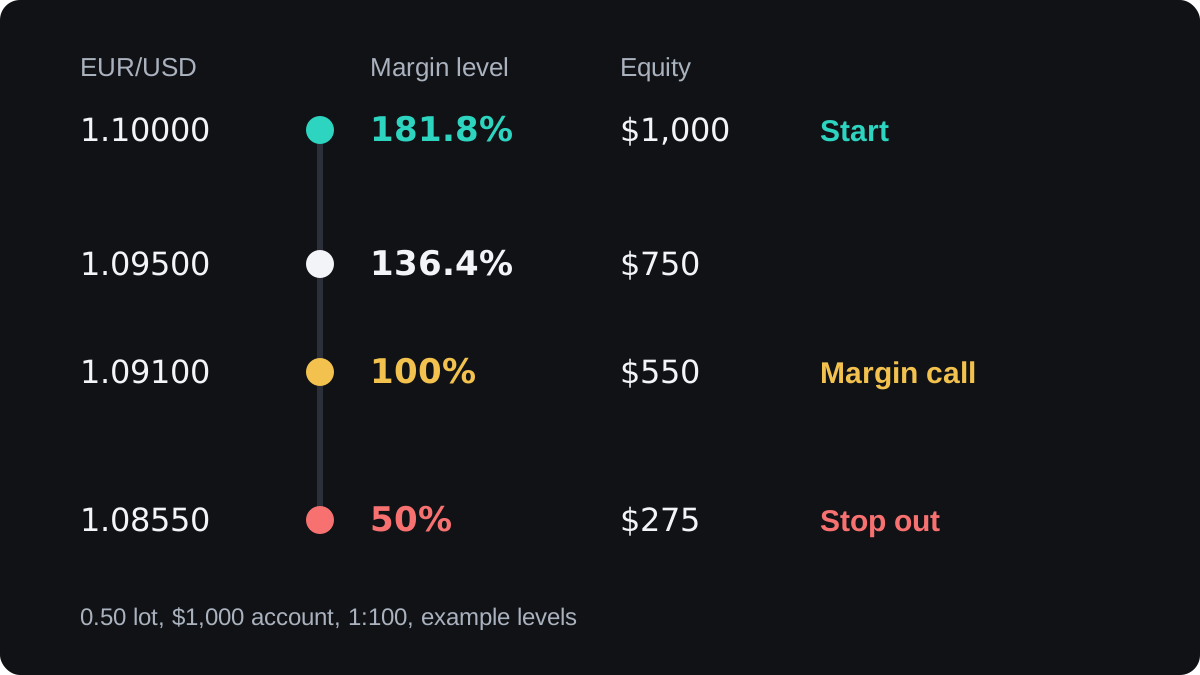
With round illustrative prices, a $1,000 account at 1:100 buys 0.50 lot of EUR/USD at 1.10000, locking $550. Margin level is $1,000 ÷ $550 × 100% = 181.8%.
If the pair falls 90 pips, the trade is down 90 × $5 = $450, and equity is $550. Margin level is now $550 ÷ $550 × 100% = 100%.
What the broker does with it
Brokers compare margin level with two thresholds: a margin call warning and a lower stop out level, where positions are closed. The 100% and 50% above are only examples; each broker and account type sets its own.
It also falls when you open more trades, because used margin rises. The margin calculator shows what a new trade will lock.
Pertanyaan
What is a good margin level?
There is no official target. The higher it is, the more room your trades have, and a level just above your broker's margin call leaves almost none.
What happens when margin level hits the stop out level?
The broker's system deletes pending orders and closes open positions, usually starting with the largest loss, until margin level is back above that level.
Leverage multiplies losses as well as gains; only trade money you can afford to lose.
Istilah lain di bab ini
 LeverageLeverage is the ratio between the size of a position and the margin needed to open it. At 1:100, each $1 of margin controls $100 of position. Leverage sets how much margin a trade locks, not how much each pip is worth.
 MarginMargin is the part of your account set aside as a deposit for an open leveraged trade. It equals the position's value divided by your leverage. It is not a fee, and it is released when the trade closes.
 Free marginFree margin is the part of your equity not tied up as margin by open trades. It equals equity minus used margin. You need free margin to open new positions, and it shrinks as open trades lose money.
 Account balanceYour balance is the money in your account from deposits, withdrawals and closed trades. It does not move with open positions. Their floating profit or loss is counted in equity instead, so balance and equity differ while trades are open.
Pelajari selengkapnya
Istilah terkait