Prop firm rules and risks.
Prop firm accounts usually end on a rule breach, typically a daily loss limit or a maximum drawdown, and floating losses often count. Trailing drawdown rules move the floor up as you profit. The firm itself also carries risk: funded accounts are often simulated, payouts can be refused and rules can change.
Konten ini baru tersedia dalam bahasa Inggris.

A prop firm account ends the moment you break one rule, even if it is in profit overall. Most of those rules are about losses: how much you may lose in one day, and how far the account may fall in total.
This lesson works through those rules on a $100,000 account with round illustrative numbers. Every firm writes its own version, so treat the percentages as examples. The previous lesson covered how the challenge stages work.
How does a daily loss limit work?
Say a firm sets a daily loss limit, the most you may lose in one trading day, of 5% of the starting account size. On a $100,000 account that is $5,000 a day.
The limit is often measured from your balance when the firm's trading day resets. Your day starts at $102,000 with no open trades, so the floor for the day is 102,000 minus 5,000 = $97,000.
- You close a losing trade for $3,000. Your balance is now $99,000.
- A second trade is still open, showing a floating loss of $2,500.
- Your equity, the balance plus any open profit or loss, is 99,000 minus 2,500 = $96,500.
- That is below the $97,000 floor, so the account breaks the rule while the balance still reads $99,000.
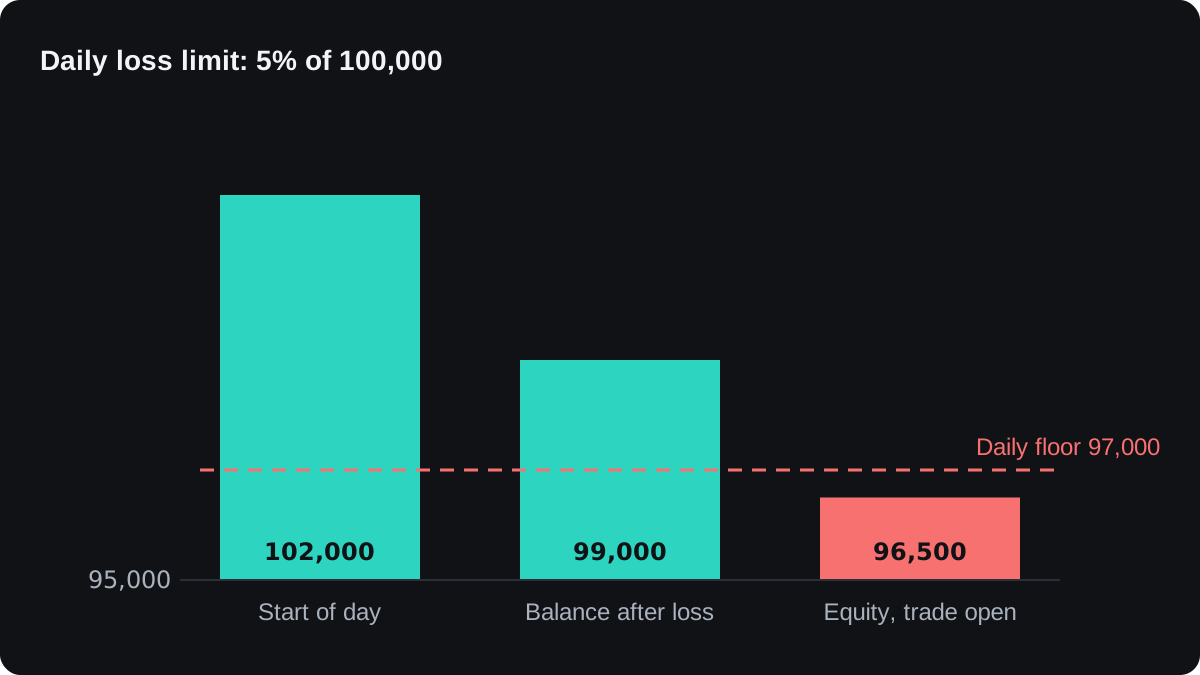
Many firms check the limit against equity while trades are open. A price spike that reverses a minute later can still end the account.
Some firms take 5% of the start-of-day balance instead of the starting size. Here that would give a limit of $5,100 and a floor of $96,900, so read which version your firm uses.
What is the difference between static and trailing drawdown?
The second loss rule caps the total fall. With a 10% maximum loss on $100,000, a static rule puts the floor at $90,000 and leaves it there for the life of the account.
A trailing rule moves the floor up as the account makes new highs, keeping it $10,000 below the peak. Firms differ on whether the peak is measured on balance or equity.
Some firms also stop the trailing floor once it reaches the starting balance. Here is one equity path under both rules:
- Equity rises to $102,000. The trailing floor rises with it to $92,000.
- Equity dips to $101,000, and the trailing floor stays at $92,000.
- Equity climbs to a new peak of $106,000. The trailing floor is now $96,000.
- Equity falls to $95,500.
Under the static rule the account is still $5,500 above its $90,000 floor. Under the trailing rule it has dropped below $96,000 and failed.
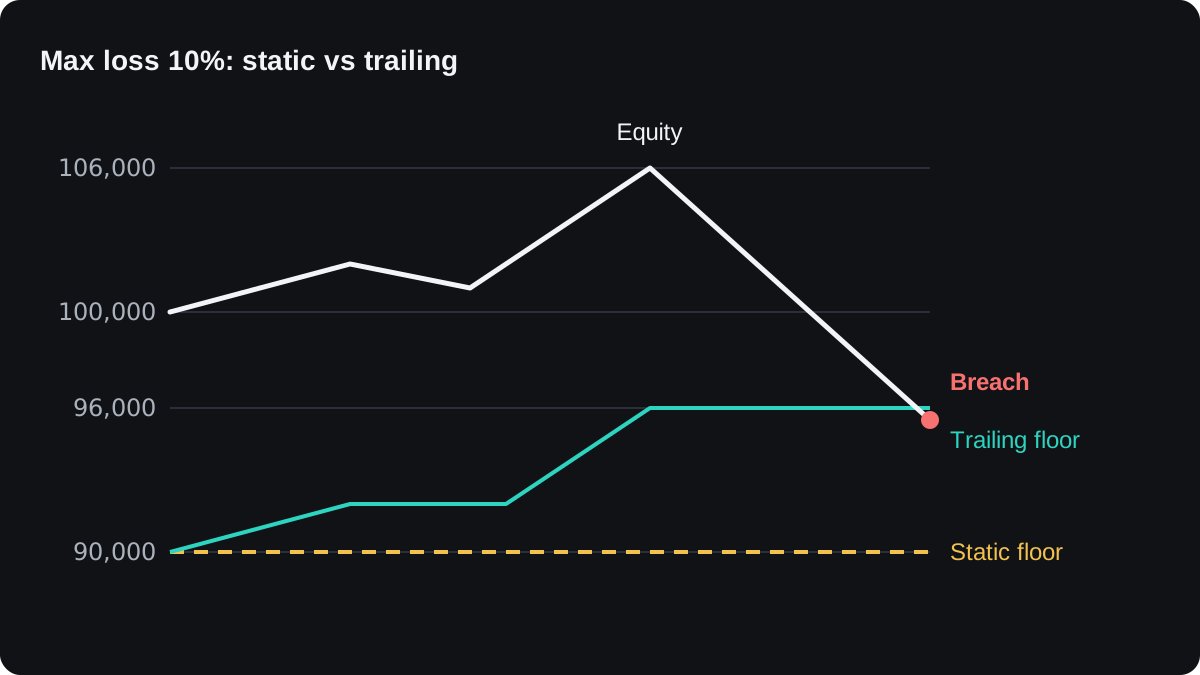
A trailing floor punishes giving back profit. After a good run, your real room can be far smaller than the headline 10%, so recalculate it from the current peak each day.
The drawdown lesson explains why deep falls take so long to recover.
Which other rules can end an account?
Loss limits are the rules people expect. The terms usually add others, and they vary widely between firms. Common examples include:
- A ban on opening or closing trades in a window of a few minutes around major news releases.
- A rule against holding trades over the weekend on some account types.
- A consistency rule that caps how much of your total profit may come from a single day or trade.
- A minimum number of trading days before you can pass a stage or request a payout.
- Caps on lot size or on the number of open trades.
- Banned methods, often including trading on delayed prices, copying trades from another account, hedging between two accounts and some expert advisors.
- An inactivity rule that closes the account after a stretch with no trades.
A consistency rule can delay a payout. Say one day may supply at most 40% of total profit. If you made $4,000 and $2,000 of it came on one day, that day is 50%.
You would need total profit of at least $5,000 before that $2,000 day falls to 40%, because 2,000 ÷ 0.40 = 5,000.
Banned-method rules are often written loosely, with words such as "abusive" or "not reflecting real market conditions". That gives the firm wide room to judge after the fact, usually when it reviews your trades before a payout.
How do you size trades to fit the rules?
The daily limit decides how large your trades can be. Start from the risk per trade, then count how many full losses fit inside one day.
On $100,000, risking 0.5% means $500 a trade, and ten such losses take you to the full $5,000 limit. At 1% five losses do the same. At 2% the third loss breaks the rule.
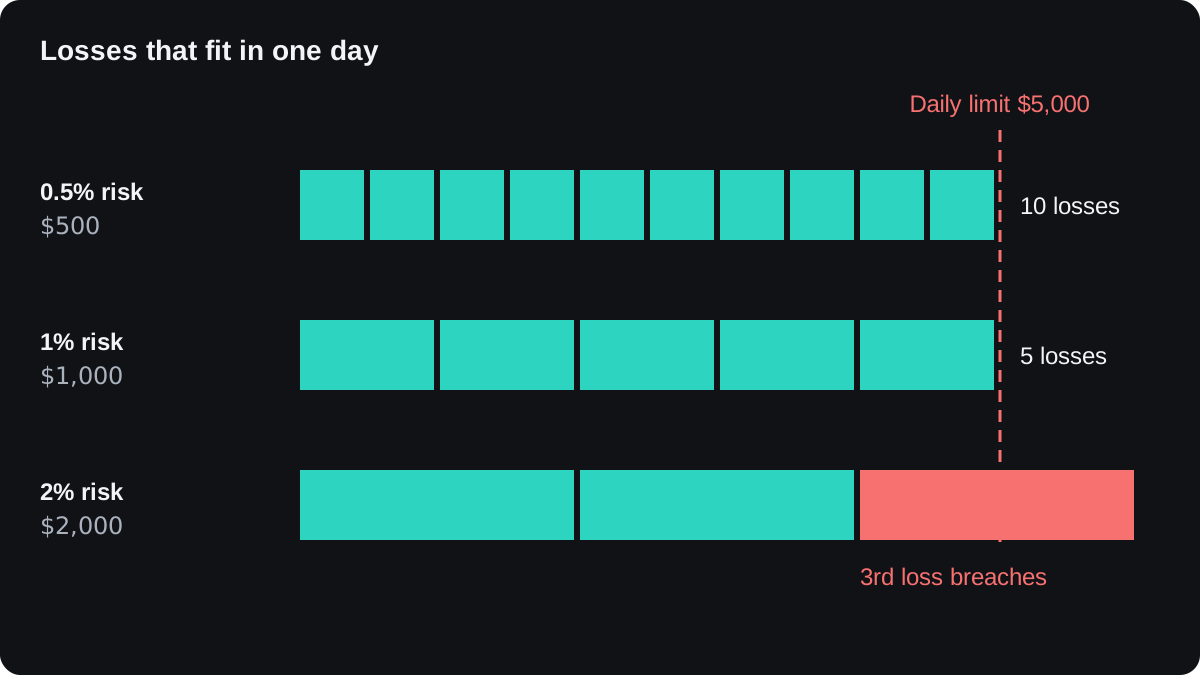
Firms word the edge differently, and some treat reaching the limit exactly as a breach. Real losses also run a little larger than planned, because spread, commission and slippage add to them, so leave a gap below the limit.
To turn $500 of risk into a position size, divide by the stop distance:
- Your stop on EUR/USD is 25 pips from entry.
- You need 500 ÷ 25 = $20 per pip.
- One standard lot of EUR/USD is worth $10 a pip in a USD account, so $20 a pip is 2.00 lots.
- Check: 2.00 lots × $10 × 25 pips = $500.
The lot size calculator repeats this sum for other pairs and account currencies.
What risks come from the firm itself?
Following every rule protects you from a breach. It does nothing about the firm's own health.
Many firms of this kind run funded accounts on a demo or simulated server. Your payout is then a payment from the firm's own funds, and the terms usually say so somewhere.
That makes the firm's income worth thinking about. If most of it comes from challenge fees, the firm needs a steady flow of new buyers to pay the traders who pass.
When that flow slows, the firm may tighten rules, delay payouts or close. Other risks to weigh:
- Many terms let the firm change its rules at any time, sometimes for accounts already running.
- A payout can be refused after a review under a vague rule on trading style.
- A firm can lose access to its trading platform or price provider, which can freeze accounts.
- Your fee is spent the day you pay it, and getting it back from a firm that closes may be hard.
Many prop firms hold no financial licence, because they sell evaluations and take no client deposits for trading. Protections you might expect from a regulated broker, such as a complaints scheme, may then not apply.
How can you judge a prop firm before paying?
Treat the purchase like any contract with a company you cannot visit. A short check before paying:
- Find the legal company name and country in the terms, and look it up in that country's official company register.
- Search the firm's name together with words such as payout refused, closed or lawsuit.
- Read the full terms and conditions, since the FAQ page is usually a summary.
- Confirm how each loss limit is measured: balance or equity, static or trailing, and when the day resets.
- Read the payout section: minimum days, profit split, frequency, identity checks and whether the fee is refunded.
- Look for a clause allowing the firm to change rules on active accounts.
- Check whether the firm says the funded account is simulated, and which platform it uses.
- Pay only a fee you could lose in full.
Run the numbers with the fee included. With an illustrative 80% split, a $4,000 profit pays $3,200, and a $500 fee that is not refunded leaves $2,700.
The scam lessons cover warning signs that apply here too.
Pertanyaan
Can a prop firm refuse to pay out?
Yes. Many terms allow the firm to refuse a payout for any rule breach, including loosely worded rules on trading style, so read the payout section before you start.
Do floating losses count toward the daily loss limit?
At many firms they do, because the limit is checked against equity, which includes open trades. Check your firm's exact wording.
What is a trailing drawdown in a prop firm?
It is a maximum loss floor that rises with the account's peak and keeps a fixed gap below it. A static floor stays at the same level from the first day.
Are prop firms regulated?
Many are not licensed as financial firms, since they sell evaluations and do not take trading deposits. Look up the company and any licence yourself in the country where it is registered.
Is a funded account real money?
Often it is simulated, and payouts come from the firm's own funds. The terms usually state this.
Lanjut belajar
 Bab 1What is a prop trading firm?A prop trading firm trades its own money. Online prop firms sell an evaluation, called a challenge: you pay a fee, trade under a profit target and loss limits, and if you pass you trade a firm account and keep a share of the profit. Many funded accounts are simulated, so read the terms.
 Bab 1How prop firm challenges work.A prop firm challenge is a paid test on a firm's account. You must reach a profit target, such as 10%, without breaking a daily loss limit or a maximum loss limit, and follow rules on trading days and news. Pass and you trade a funded account for a share of profits. Fail and the fee is usually gone.

