What is traded in the forex market?
The forex market trades currencies, always two at a time: every deal buys one and pays with another. Eight are known as the majors, and the US dollar was on one side of 89% of turnover in April 2025. A retail trader receives no currency and instead holds a cash-settled contract with a broker.
Konten ini baru tersedia dalam bahasa Inggris.

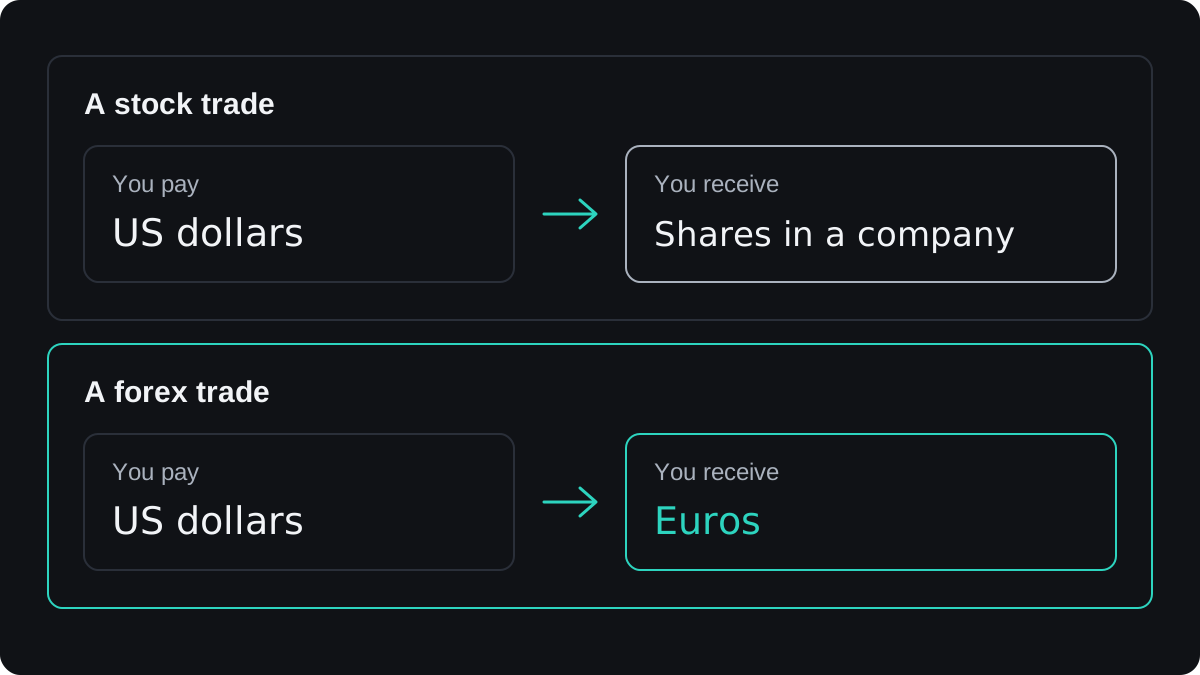
On a stock exchange you buy a share, a part of one company, and you pay for it with money. The share has a single price, quoted in the currency of its market.
Foreign exchange, or forex, has no company and no share. The product is money itself: you buy one currency and pay for it with another.
What you receive and what you pay with are the same kind of thing, so every price is one currency measured in another.
How are currencies named?
Each currency has a three-letter code from ISO 4217, an international standard first published in 1978. The first two letters usually name the country and the third names the currency.
USD is US for the United States plus D for dollar. JPY is JP for Japan plus Y for yen, and GBP is GB for the United Kingdom plus P for pound.
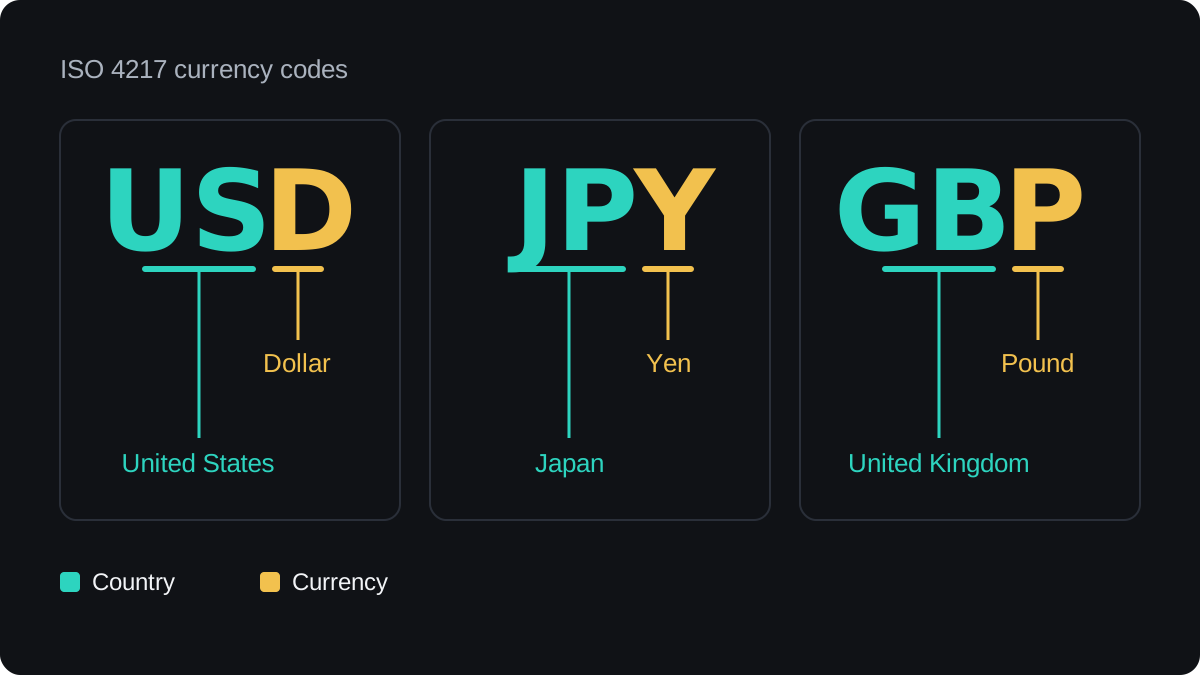
EUR is the exception among the currencies in this lesson, because EU names a union rather than a country.
The code matters because a name alone can mislead. USD, CAD, AUD and NZD are all dollars, so the word "dollars" on its own does not say which.
A trading platform, the software on which you place trades, joins two codes to name a pair, such as EUR/USD, the euro priced in US dollars.
The first code is the base currency, the one being priced. The second is the quote currency, the one the price is written in, so a price of 1.08510 means one euro costs 1.08510 US dollars.
Why does every trade involve two currencies?
A currency has no price on its own, only a value against another currency: one euro is worth so many dollars, or so many yen.
You cannot buy "the euro" in isolation. You buy euros and pay with something else, and the pair names both sides of the deal.
An open trade is called a position. A long position gains when the price rises and a short position gains when it falls.
A long position in a pair is long the base currency and short the quote currency. Those two sides are the legs of the position.
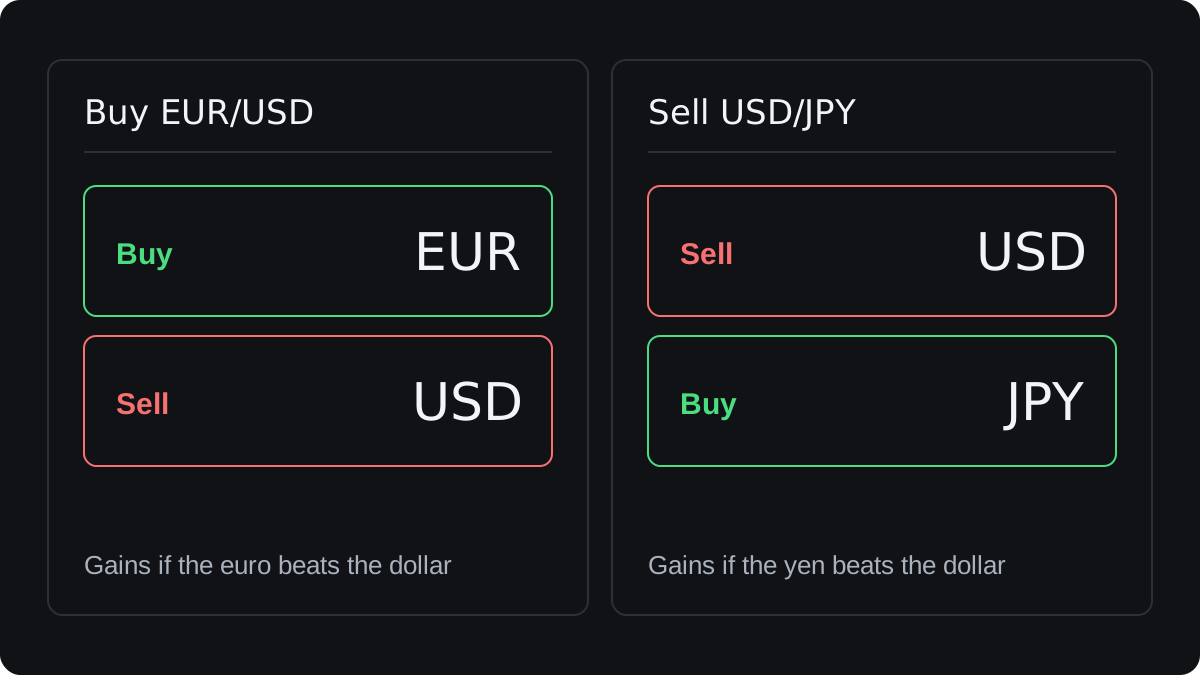
Buying EUR/USD means buying euros and selling dollars. Selling USD/JPY means selling dollars and buying yen. Either way, the position gains if the currency you bought appreciates against the one you sold: each unit then buys more of it.
The carmaker in the first lesson made the same kind of deal when it sold euros for South Korean won through its bank. A trade on EUR/USD has the same two sides.
What gives a currency its value?
An exchange rate is one currency's price in another, so it depends on how two economies compare. A healthy economy can still see its currency fall against a healthier one.
Four forces tend to shift that comparison, and each works only relative to the economy on the other side of the pair.
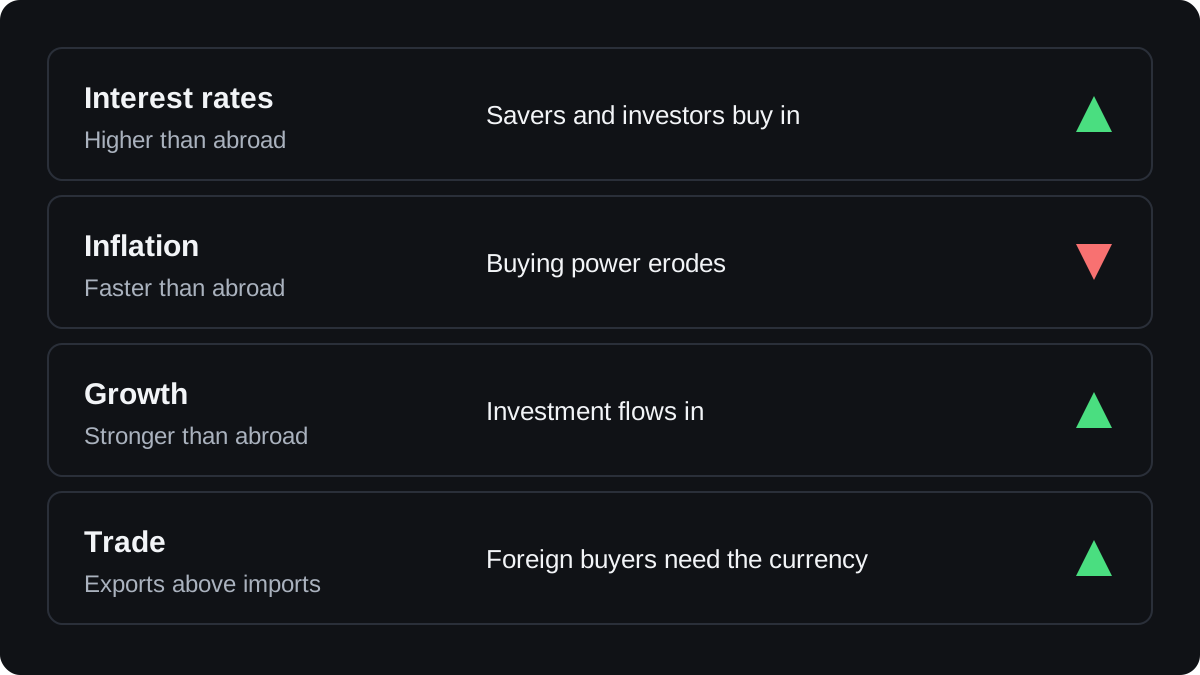
Central banks set interest rates, and a level higher than abroad tends to make a currency appreciate, because savers and investors move money to where it earns more.
Inflation, the pace at which prices rise, pushes the other way. When prices climb faster than abroad, the currency's buying power at home erodes and it tends to depreciate, meaning each unit buys less of another currency.
Growth stronger than abroad tends to lift a currency. It draws foreign investment, and a foreign buyer of local shares or bonds must first buy the local currency.
Trade works through the same demand. A country that exports more than it imports tends to see its currency appreciate, because foreign buyers need that currency to pay for its goods.
All four are tendencies. Prices reflect what traders expect, so an interest rate rise they already foresaw may be in the exchange rate before it is announced, and the currency can fall on the day.
The forces also collide. Faster inflation can lead a central bank to raise interest rates, so the same inflation report can send a currency either way.
Which currencies count as majors?
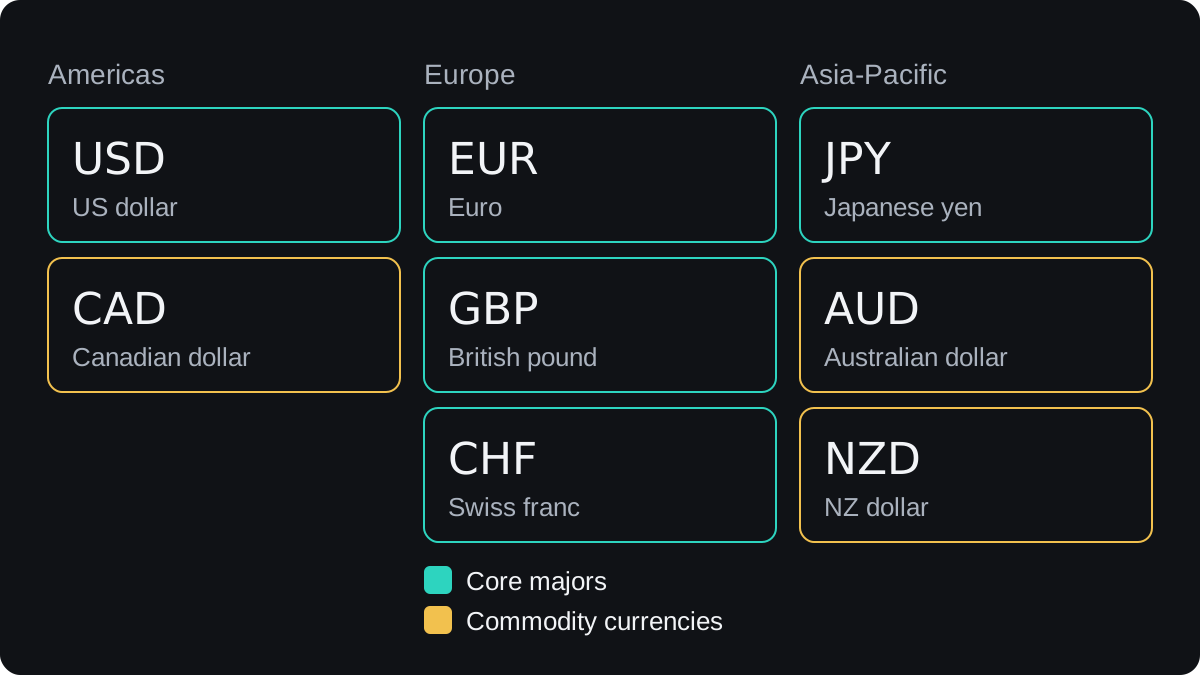
Most traders call eight currencies the majors, the main currencies of the market: USD, EUR, JPY, GBP, CHF, CAD, AUD and NZD. The list rests on custom, and no exchange or regulator publishes it.
Two of the eight belong to the Americas, three to Europe and three to Asia-Pacific. The market hours tool shows which trading centres are open at any moment.
Some traders keep the word major for the first five on that list and call AUD, CAD and NZD commodity currencies, whose value leans on export prices. The chart labels those five core majors.
Australia's main exports are iron ore and coal, Canada's is crude oil and New Zealand's is dairy.
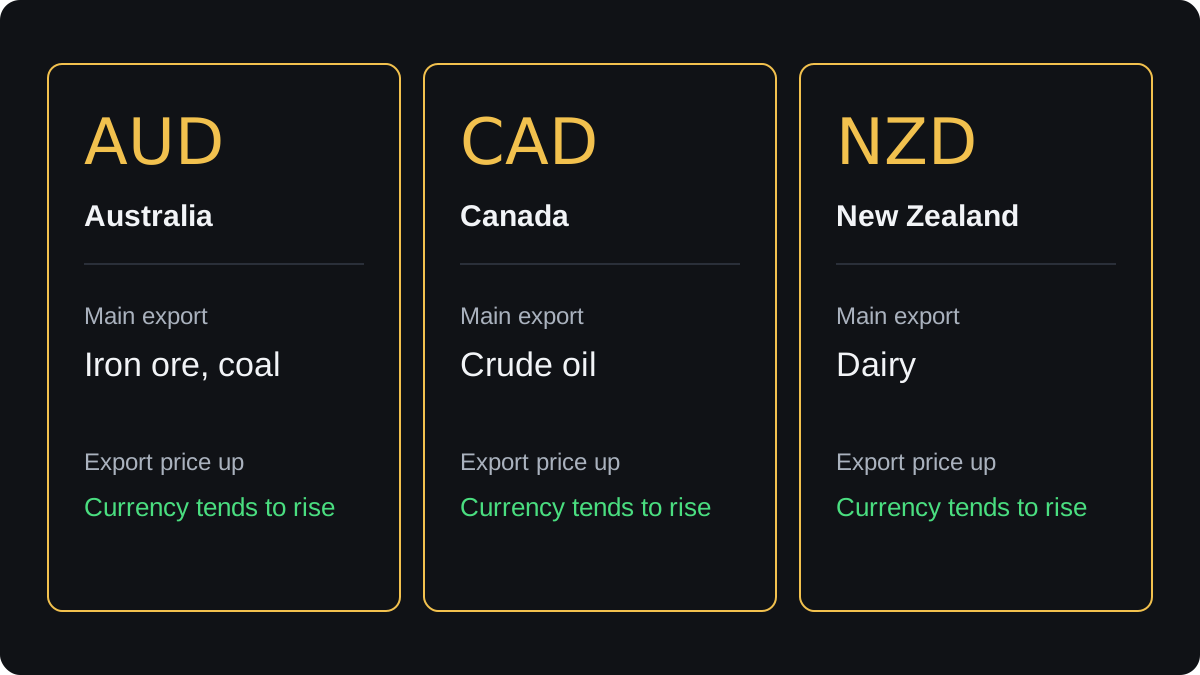
When the price of a country's main export rises, each shipment costs more, so buyers need more of that country's currency.
Where the invoice is in US dollars, the exporter makes the same purchase itself when it converts its receipts to pay wages and suppliers.
A fall in the export price works the same way in reverse. Like the four forces above, this is a tendency, and interest rates or growth can outweigh it for long stretches.
Traders also use short names: cable for GBP/USD, fiber for EUR/USD, and the Swissy, the Loonie, the Aussie and the Kiwi for CHF, CAD, AUD and NZD.
The word major applies to pairs too. A major pair sets the US dollar against one of the other seven, as EUR/USD does, and a cross pairs two majors without the US dollar, such as EUR/JPY.
The grouping has a practical use: pairs that trade heavily tend to have narrower spreads, the gap between the buying and selling price.
Which currencies are traded most?
The Bank for International Settlements (BIS) surveys the forex market every three years. Its 2025 survey measured each currency's share of turnover in April 2025. Turnover is the total notional value (the full face amount) of new deals.
The US dollar was on one side of 89% of turnover, the euro 29%, the yen 17%, the pound 10% and the Chinese renminbi 9%. The Swiss franc and the Australian and Canadian dollars had 6% each.
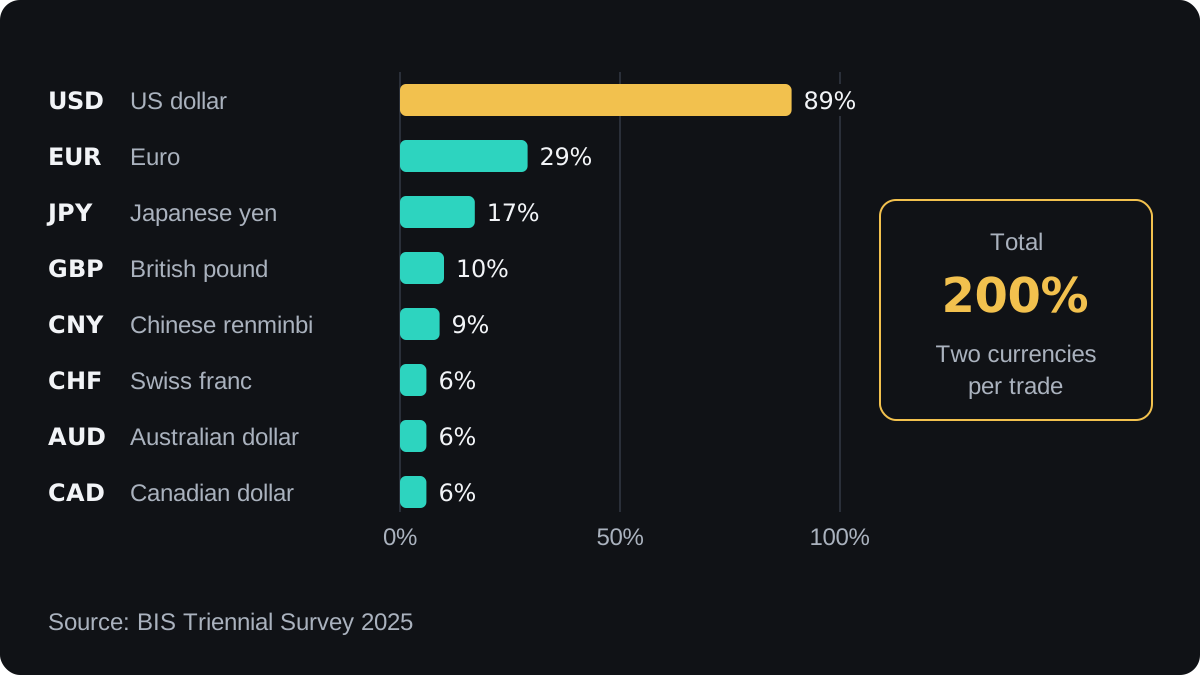
These are the eight currencies that traded most in April 2025, with the codes you will see on a trading platform:
| Code | Currency |
|---|---|
| USD | US dollar |
| EUR | Euro |
| JPY | Japanese yen |
| GBP | British pound |
| CNY | Chinese renminbi |
| CHF | Swiss franc |
| AUD | Australian dollar |
| CAD | Canadian dollar |
The shares add up to 200% because every trade has two currencies and the survey counts both. Take three trades: one on EUR/USD, one on USD/JPY and one on EUR/GBP.
- Count each currency once for every trade it appears in: USD 2, EUR 2, JPY 1, GBP 1.
- That makes six counts from three trades.
- As shares of the three trades: USD 67%, EUR 67%, JPY 33%, GBP 33%.
- Added together, the shares come to 200%.
The dollar's 89% works the same way: the dollar was on one side of deals making up 89% of turnover, and the other currency in each deal was counted as well.
The shares above are the final figures, published in June 2026. Forex market size and liquidity gives the total.
The Chinese renminbi (CNY, where the Y stands for yuan, its unit) is fifth by share, yet it is usually not called a major.
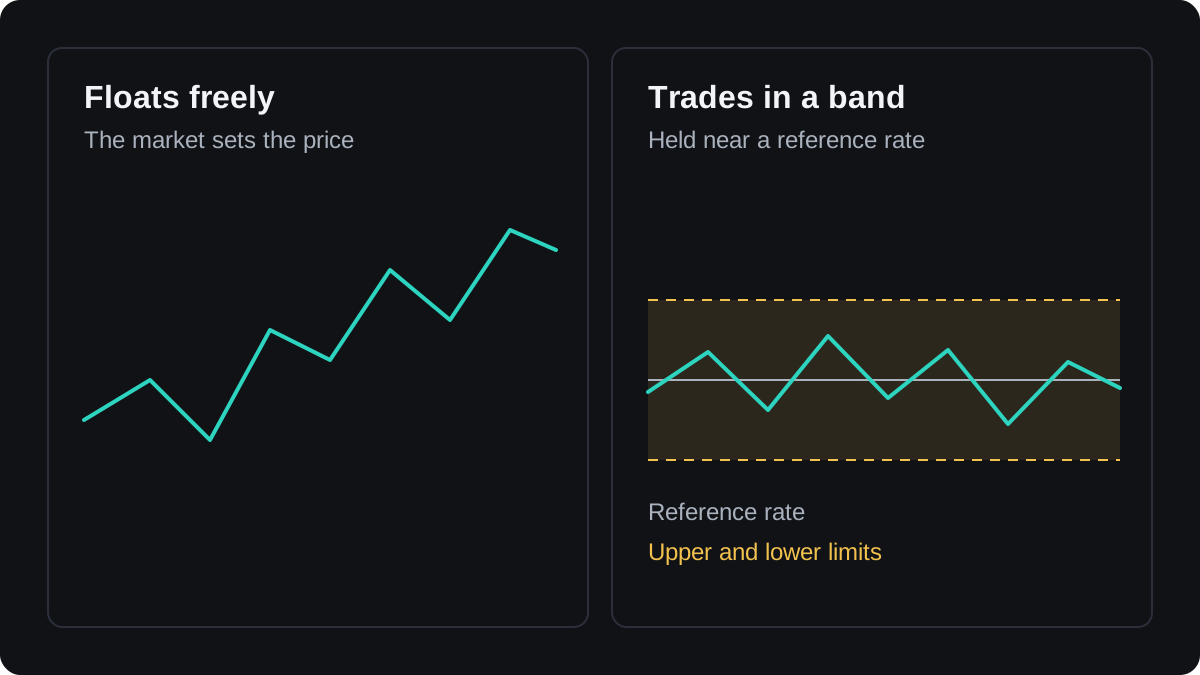
Inside mainland China it may move only within 2% either side of a reference rate, a benchmark price that the People's Bank of China sets each day. That range is its trading band.
New Zealand's dollar is not in the top eight, yet it stays a major by habit and because it floats freely: the market sets its price with no official band.
What does a retail trader hold?
The carmaker's bank pays out real won. On a retail forex account, the kind a private trader holds, no currency changes hands at all.
Your position is usually a contract for difference (CFD), an agreement under which your broker, the firm that runs your account, pays or charges you the change in price, in cash, whether you bought or sold.
Some brokers call the product rolling spot. A spot deal is an exchange at today's rate, settled within two business days on a date called the value date, when the currencies change hands.
A rolling spot position moves to the next value date every evening, so it never settles and the currencies never change hands.
Compare a bank and a broker for the same 10,000 euros at an exchange rate of 1.08510:
- At a bank, you pay $10,851 and receive 10,000 euros in your account.
- With a broker, you buy 0.10 lot of EUR/USD. A standard lot is 100,000 units of the base currency, so the position's notional is 10,000 euros, but none are delivered.
- You set aside only part of the position's value as margin, the deposit your broker holds while the trade is open, because CFDs are usually traded with leverage, which lets a small deposit hold a much larger position.
- Later you close with a profit of $36.00. A US dollar account is credited $36.00; in a euro account, your broker converts it to euros first.
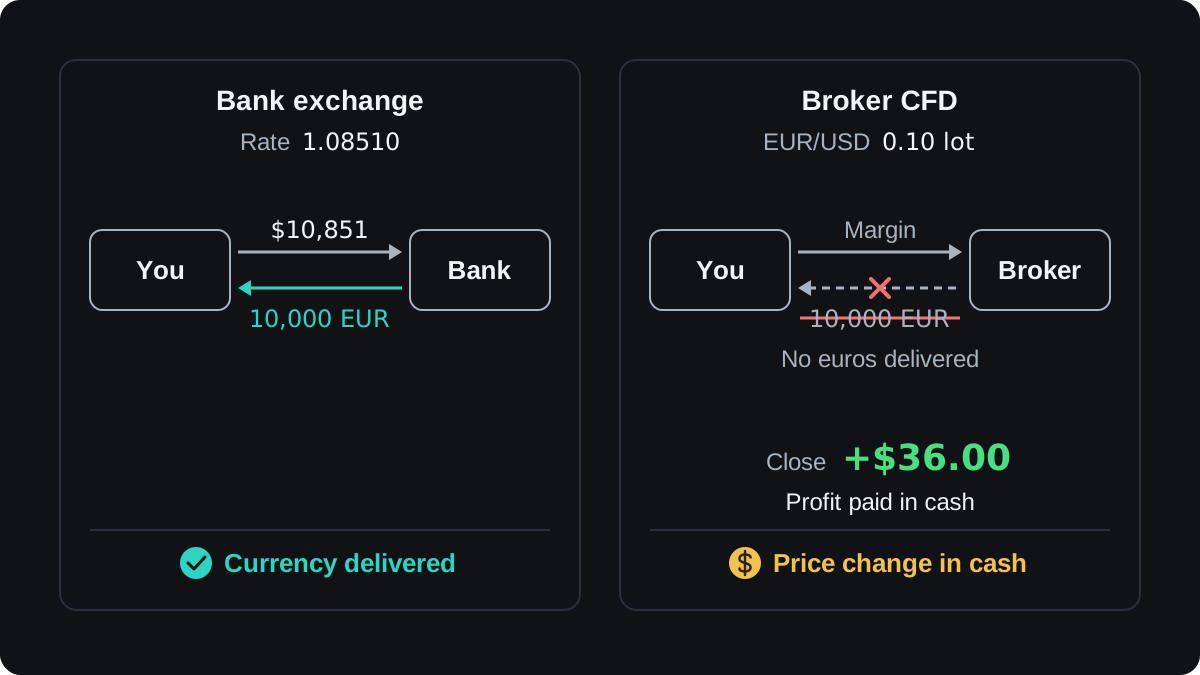
Because nothing is delivered, you do not need to own a currency to sell it. Selling EUR/USD on a retail account takes margin in your account currency, the one your balance is held in, and no euros at all.
The contract still follows the exchange rate, so everything in this lesson about what moves a currency applies to your position.
Buying and selling a currency pair shows how a change in the exchange rate becomes a profit or a loss. Ways to trade forex explains how EU regulators treat CFDs and rolling spot.
Pertanyaan
Do you get the actual currency when you trade forex?
Not on a retail forex account. Your position is a contract with your broker, settled in cash, so only the profit or loss moves, in your account currency.
Which currency is traded the most?
The US dollar. In the BIS survey for April 2025 it was on one side of 89% of turnover, far ahead of the euro at 29%.
Why do currency shares add up to 200%?
Every trade involves two currencies, and the survey counts both. A EUR/USD trade adds to the euro's share and to the dollar's.
What are the major currencies?
Most traders name eight: USD, EUR, JPY, GBP, CHF, CAD, AUD and NZD. Some keep the word for the first five and treat the Canadian, Australian and New Zealand dollars as commodity currencies.
What are commodity currencies?
AUD, CAD and NZD, whose value leans on the price of their countries' main exports. When those prices rise, the currency tends to appreciate.
Lanjut belajar
 Bab 1What is forex trading?Forex trading is exchanging one currency for another, either because a business needs the currency or to profit from a change in the exchange rate. Prices are quoted in pairs such as EUR/USD, with a bid to sell at and an ask to buy at. Forex turnover averaged $9.5 trillion a day in April 2025.
 Bab 1How does buying and selling a currency pair work?Buying a currency pair buys the first currency and sells the second, so you gain if the price rises. Selling does the opposite and gains if it falls. A buy opens at the ask and closes at the bid, and a sell does the reverse. Profit and loss land in the quote currency.
 Bab 1How big is the forex market, and what is liquidity?Forex turnover averaged $9.5 trillion a day in April 2025, in the final results of the BIS Triennial Survey. The figure adds up the face value of new deals. Liquidity is how easily you can trade without moving the price. In AutoFXRebate's measurements, EUR/USD spreads held steady through the sessions and widened sharply at the daily rollover.
 Bab 1Ways to trade forex: spot, forwards, swaps, futures, options and CFDs.Currencies change hands as spot deals, outright forwards, FX swaps, currency swaps, options and futures. Spot settles within two business days, a forward fixes a rate for a later date, and an FX swap pairs an exchange now with its reverse later. Retail traders usually trade CFDs or rolling spot, cash-settled contracts with a broker.

