Position sizing across different pairs.
The same stop in pips risks different money on different pairs because pip value changes. On one standard lot, a 25-pip stop is $250 on EUR/USD, $166.67 on USD/JPY at 150.00 and $25 on gold, in a US dollar account. Divide your risk by the stop times that pair's pip value per lot to get the lot size.
ខ្លឹមសារនេះមានតែជាភាសាអង់គ្លេសសិន។

A stop of 25 pips sounds like a fixed amount of risk. On one standard lot it costs $250 on EUR/USD, $166.67 on USD/JPY at 150.00 and $25 on gold, all in a US dollar account.
The position size lesson gave the formula: lots = money at risk ÷ (stop in pips × pip value per lot). Pip value changes between pairs, so a lot size that fits one pair can be far too big on another.
Why does a 25-pip stop cost different amounts?
A pip is a price step, and a price is written in the quote currency, the second currency in the pair. One pip times the units you trade gives the pip value in that currency.
If your account is in US dollars, any pip value in another currency has to be converted. Gold differs again, because one lot is usually 100 ounces rather than 100,000 units of a currency.
Here is a 25-pip stop on 1.00 lot of four instruments, with round illustrative prices of 150.00 for USD/JPY and 1.27000 for GBP/USD:
- EUR/USD: 25 × $10.00 = $250.00.
- USD/JPY: 25 × 1,000 yen = 25,000 yen, and 25,000 ÷ 150.00 = $166.67.
- EUR/GBP: 25 × £10 = £250, and £250 × 1.27000 = $317.50.
- XAU/USD: 25 × $1.00 = $25.00.
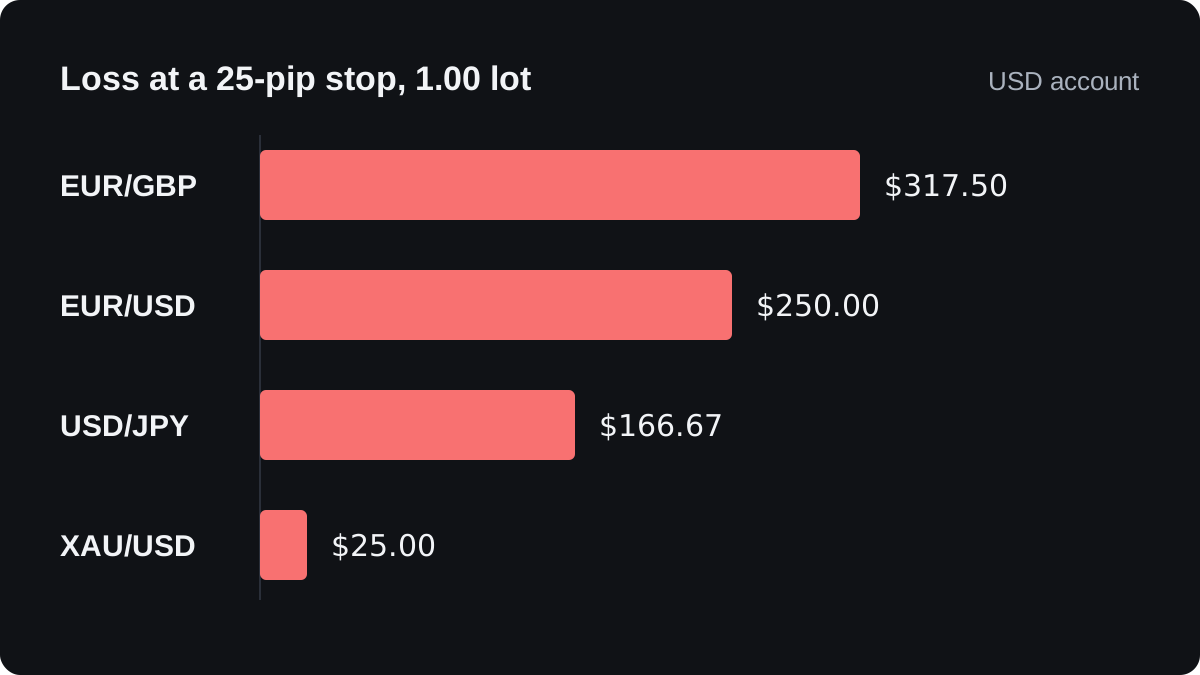
The largest loss is almost 13 times the smallest, for a stop that looks identical on the screen.
How do you find the pip value of a pair?
Start by asking where your account currency sits in the pair. The examples below assume a US dollar account and one standard lot.
Your currency is the quote currency
On EUR/USD, GBP/USD, AUD/USD and NZD/USD the pip value is already in dollars: 0.0001 × 100,000 = $10. It stays the same whatever the price does.
Your currency is the base currency
On USD/JPY, USD/CAD and USD/CHF the pip value comes out in yen, Canadian dollars or francs. Divide it by the pair's own price. On USD/CAD at 1.35000, C$10 ÷ 1.35000 = $7.41.
Neither currency is yours
On a cross such as EUR/GBP the pip value is £10, so you need a third rate. Multiply by GBP/USD: at 1.27000, £10 is $12.70. On EUR/JPY you would divide 1,000 yen by the USD/JPY price instead.
Gold
Under this site's convention a gold pip is 0.01, one cent per ounce. Many brokers set one lot at 100 ounces, which makes a pip worth $1. Check your broker's contract specification, since the lot size and the pip label can both differ.
| Instrument | Pip per lot, quote currency | Conversion | Pip per lot in USD |
|---|---|---|---|
| EUR/USD | $10 | none | $10.00 |
| USD/JPY | ¥1,000 | ÷ 150.00 | $6.67 |
| USD/CAD | C$10 | ÷ 1.35000 | $7.41 |
| EUR/GBP | £10 | × 1.27000 (GBP/USD) | $12.70 |
| XAU/USD | $1 | none | $1.00 |
The pip value calculator does these conversions at live rates.
Sizing the same $50 risk on three pairs
Say your account holds $5,000 and you have chosen to risk 1% per trade, which is $50. Each trade has a 25-pip stop, and the prices are the same illustrative ones as above.
EUR/USD:
- Loss per lot at the stop: 25 × $10.00 = $250.00.
- Lots: $50 ÷ $250.00 = 0.20 lot.
USD/JPY at 150.00:
- Convert the risk into yen first: $50 × 150.00 = 7,500 yen.
- Loss per lot at the stop: 25 × 1,000 yen = 25,000 yen.
- Lots: 7,500 ÷ 25,000 = 0.30 lot.
Working in yen avoids a rounding trap. Dividing $50 by the rounded $166.67 gives 0.29999, which would round down to 0.29, although 0.30 is the exact answer.
EUR/GBP with GBP/USD at 1.27000:
- Loss per lot at the stop: 25 × $12.70 = $317.50.
- Lots: $50 ÷ $317.50 = 0.157 lot.
- Round down to 0.15 lot, since lot sizes usually move in steps of 0.01. The real risk is 0.15 × $317.50 = $47.63.
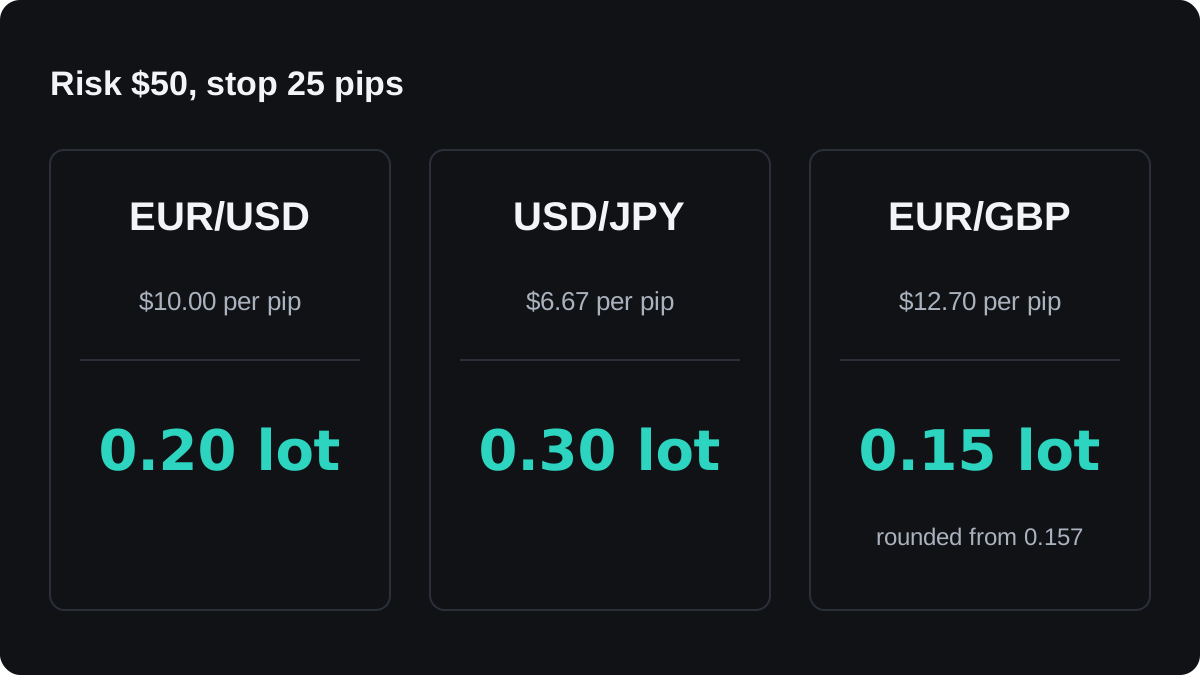
Always round down: rounding up to 0.16 lot would risk 0.16 × $317.50 = $50.80, a little over your limit. The lot size calculator runs these steps for any pair.
Why gold needs a wider stop as well as a different size
Put gold through the same formula with a 25-pip stop and you get $50 ÷ $25.00 = 2.00 lots. The arithmetic is correct, and the stop is what needs fixing.
A 25-pip stop on gold is a move of only $0.25 an ounce. With gold at an illustrative 4,000, moves of several dollars within a day are common, so a stop that close is easy to hit by ordinary noise.
The size makes that noise expensive. On 2.00 lots, every $1 move is 100 pips × $1.00 × 2 = $200.
It helps to set a gold stop by price distance first, then convert it to pips. A $5.00 stop below an entry at 4000.00 sits at 3995.00, which is 500 pips.
- Loss per lot at the stop: 500 × $1.00 = $500.00.
- Lots: $50 ÷ $500.00 = 0.10 lot.
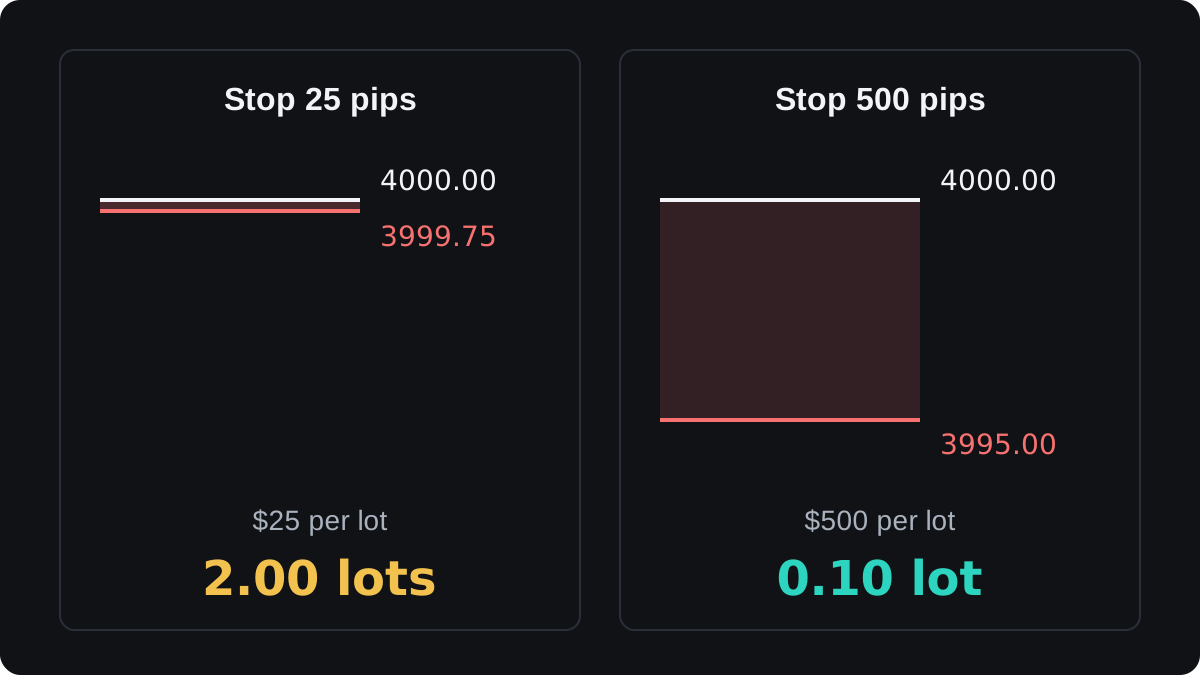
The same order of work applies to every pair: pick the stop from the chart, then let the lot size absorb its distance. A bigger pip count on gold than on EUR/USD says nothing on its own about which trade risks more money.
What changes the answer from one day to the next?
Pip values for pairs not quoted in your account currency move with the exchange rate. At 140.00, a USD/JPY pip on one lot is 1,000 ÷ 140.00 = $7.14.
The same $50 risk is then 50 × 140.00 = 7,000 yen, and with a 25-pip stop that gives 7,000 ÷ 25,000 = 0.28 lot instead of 0.30.
The loss is converted at the rate when the trade closes. A USD/JPY buy at 150.00 stopped at 149.75 loses 25,000 yen per lot, which is 25,000 ÷ 149.75 = $166.94, slightly more than the $166.67 you planned.
Your account currency matters too. In a euro account, convert the risk into the quote currency first: at EUR/USD 1.10000, €50 is $55. With a 25-pip stop on EUR/USD, $55 ÷ $250 = 0.22 lot.
Where per-trade sizing falls short
The formula assumes your stop fills at its price. A weekend gap or a fast news move can fill it worse, so slippage can make the real loss larger than the plan.
A short position's stop is a buy order, so it triggers on the ask price. Many platforms, MetaTrader included, draw the chart from the bid by default, so a widening spread can close a tight stop before the chart line reaches your level.
The formula also sizes each trade alone. EUR/USD and GBP/USD often move in the same direction, so 0.20 lot of each with 25-pip stops could lose $50 + $50 = $100 if the dollar strengthens against both.
The lesson on correlation and portfolio risk covers that problem. The position sizing worked examples take full trades from account balance to final lot size.
សំណួរ
Why is a pip on USD/JPY not worth $10?
The pip is 0.01 yen per dollar, so one lot gains or loses 1,000 yen per pip. At 150.00 that converts to $6.67, and the dollar value shifts as USD/JPY moves.
Can I use the same lot size on every pair?
You can, but the money at risk will differ unless the stop in pips times the pip value comes out the same. Sizing each trade from its own stop and pip value keeps the money at risk equal.
How do I size a gold trade?
Measure the stop in dollars per ounce and convert it to pips, where $1 is 100 pips under the 0.01 convention. Then divide your risk by the stop in pips times the pip value per lot, after checking your broker's gold contract size.
Do I need to recalculate pip value before every trade?
For pairs quoted in your account currency, no, because the pip value is fixed. For other pairs, yes, since the conversion rate moves, although small rate changes shift the lot size only slightly.
បន្តរៀន
 ជំពូក 3How to calculate position size.To calculate position size, multiply your account by the percentage you will risk, then divide by the stop distance in pips times the pip value per lot. With $5,000, 1% risk and a 25 pip stop on EUR/USD, that is $50 ÷ (25 × $10) = 0.20 lot. Round down when the answer falls between lot steps.
 ជំពូក 3Position sizing worked examples.To size a trade, divide the money you are willing to lose by what one lot would lose at your stop. With $50 at risk and a 25 pip stop on EUR/USD, one lot loses $250, so you trade 0.20 lot. Pairs not quoted in your account currency need one extra step: converting the pip value.

