Position sizing worked examples.
To size a trade, divide the money you are willing to lose by what one lot would lose at your stop. With $50 at risk and a 25 pip stop on EUR/USD, one lot loses $250, so you trade 0.20 lot. Pairs not quoted in your account currency need one extra step: converting the pip value.

Position sizing turns a risk you have chosen into a lot size you can type into the platform. This lesson sizes three trades with the same method, each on a different kind of pair, using round illustrative prices.
The one formula behind every example
Each trade below needs four inputs: your balance, the share of it you accept losing at the stop, the stop distance in pips, and the pip value for one lot.
They fit into one sum:
Position size in lots = risk amount ÷ (stop distance in pips × pip value per lot)
The part in brackets is what one full lot would lose at your stop. Dividing your risk by it tells you what fraction of a lot fits the plan.
The risk percentages here are only for illustration. Choosing yours is covered in how much to risk per trade, and the formula itself is built in how to calculate position size.
Trade 1: EUR/USD in a dollar account
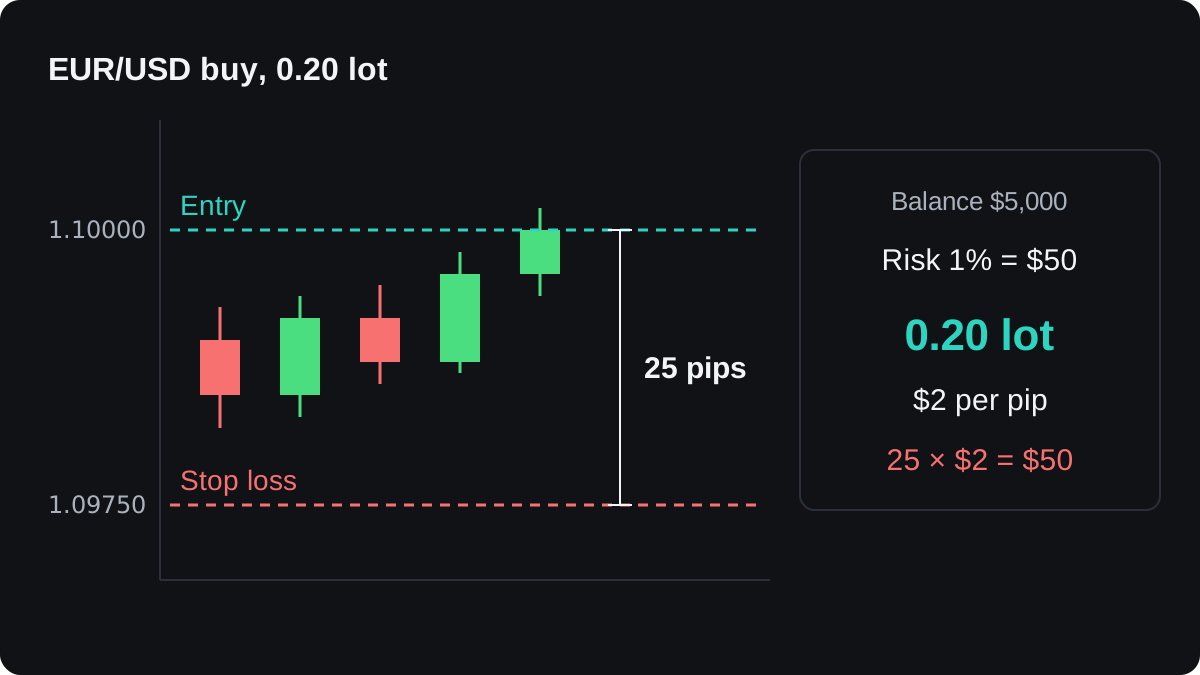
You have $5,000 in a US dollar account. You plan to buy EUR/USD at 1.10000 with a stop loss at 1.09750, and you will risk 1% of the balance.
- Risk amount: $5,000 × 1% = $50.
- Stop distance: 1.10000 minus 1.09750 = 0.00250, which is 25 pips.
- Pip value per lot: the quote currency is the US dollar, so one pip on one standard lot is 0.0001 × 100,000 = $10.
- Loss per lot at the stop: 25 × $10 = $250.
- Position size: $50 ÷ $250 = 0.20 lot.
Now check it. On 0.20 lot each pip is worth $2, so a 25 pip loss costs 25 × $2 = $50, exactly the plan.
Trade 2: USD/JPY, where the pip value needs converting
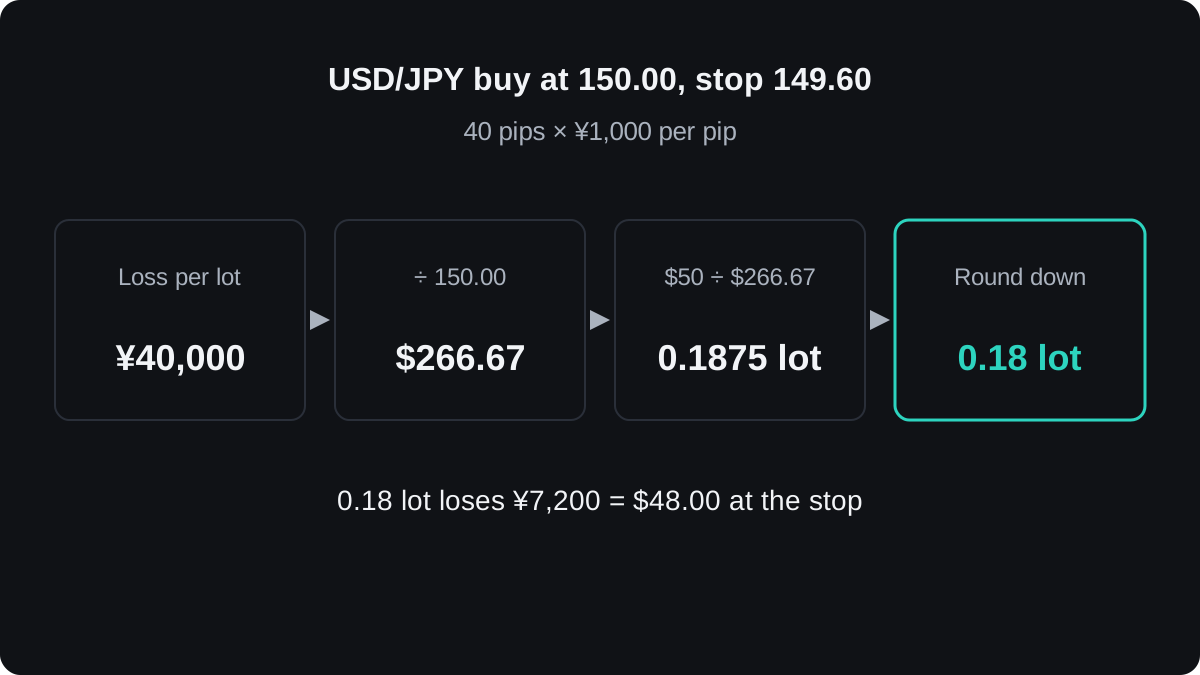
Same account, same 1% risk of $50. This time you buy USD/JPY at 150.00 with a stop at 149.60. On a yen pair a pip is 0.01.
- Stop distance: 150.00 minus 149.60 = 0.40, which is 40 pips.
- Pip value per lot in yen: 0.01 × 100,000 = ¥1,000.
- Loss per lot at the stop: 40 × ¥1,000 = ¥40,000.
- Convert at the current rate: ¥40,000 ÷ 150.00 = $266.67.
- Position size: $50 ÷ $266.67 = 0.1875 lot.
Many accounts take volume in steps of 0.01 lot, so 0.1875 has to be rounded. Check the volume step in your broker's contract specification.
Round down to 0.18 lot, because 0.19 lot would risk more than $50. At 0.18 lot the stop costs ¥40,000 × 0.18 = ¥7,200, and ¥7,200 ÷ 150.00 = $48.00.
A yen loss is converted near the rate at which the trade closes. At the stop that rate is about 149.60, and ¥7,200 ÷ 149.60 = $48.13, still inside the plan.
Trade 3: a short on EUR/GBP, a cross
Now take a $2,000 dollar account risking 2%. You sell EUR/GBP at 0.85000 with a stop at 0.85320. The stop sits above the entry, because a short trade loses when price rises.
- Risk amount: $2,000 × 2% = $40.
- Stop distance: 0.85320 minus 0.85000 = 0.00320, which is 32 pips.
- Pip value per lot in the quote currency: 0.0001 × 100,000 = £10.
- Convert with GBP/USD at an illustrative 1.25000: £10 × 1.25000 = $12.50.
- Loss per lot at the stop: 32 × $12.50 = $400.
- Position size: $40 ÷ $400 = 0.10 lot.
Check: on 0.10 lot each pip is worth £1, which is $1.25, and 32 × $1.25 = $40.
You multiplied here because GBP/USD gives dollars per pound. On USD/JPY you divided, because that rate gives yen per dollar. Position sizing across different pairs works through every combination.
The three trades side by side:
| Trade | Balance | Risk | Stop | Pip value per lot | Size | Loss at stop |
|---|---|---|---|---|---|---|
| EUR/USD buy | $5,000 | 1%, $50 | 25 pips | $10.00 | 0.20 lot | $50.00 |
| USD/JPY buy | $5,000 | 1%, $50 | 40 pips | ¥1,000 ($6.67 at 150.00) | 0.18 lot | $48.00 |
| EUR/GBP sell | $2,000 | 2%, $40 | 32 pips | £10 ($12.50 at 1.25000) | 0.10 lot | $40.00 |
Each position is a different size, and each loss at the stop stays at or below the plan set for that account.
What changes when the stop moves or the account is small
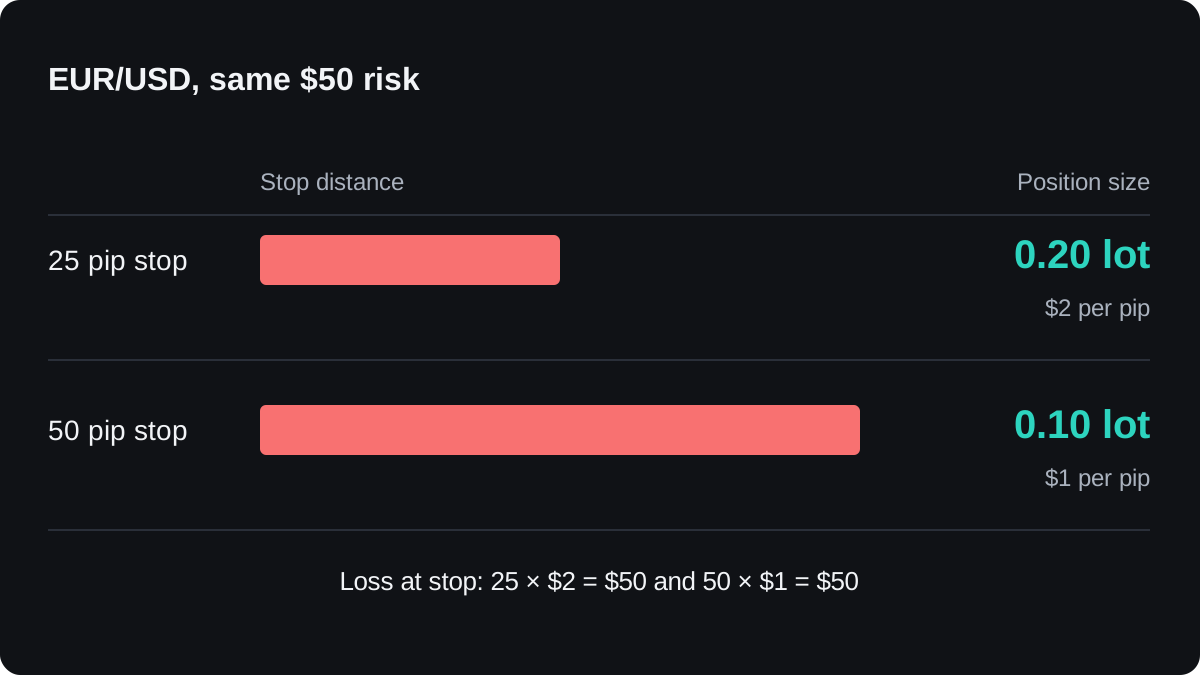
A wider stop means a smaller position
Go back to Trade 1, and say the chart puts your stop at 1.09500, 50 pips away. The risk is still $50. One lot now loses 50 × $10 = $500, so the size is $50 ÷ $500 = 0.10 lot.
Doubling the stop halved the position, and the money at risk stayed the same. The method places the stop from the chart first and sets the size second.
When the answer is below the minimum lot
Take a $200 account risking 1%, which is $2, on EUR/USD with a 30 pip stop. One lot loses 30 × $10 = $300, so the size is $2 ÷ $300 = 0.0067 lot.
Many brokers set the smallest trade at 0.01 lot. At that size each pip is worth $0.10, so the 30 pip stop costs $3, which is 1.5% of the account.
The plan does not fit the account. You can pass on the trade, or take it knowing the real risk is 1.5% of the balance.
Where these sums stop being exact
The formula sizes the loss at your stop price. A few things can make the real loss larger.
Measure the stop from the price you actually get. If the chart shows a bid of 1.10000 and you buy at an ask of 1.10010, the stop at 1.09750 is 26 pips away, and 0.20 lot then loses $52.
A stop turns into a market order when price reaches it. In a fast market or across a weekend gap it can fill beyond your level, which is slippage. Commission, where your account charges one, is also extra.
Leverage is missing from the formula on purpose. 0.20 lot of EUR/USD at 1.10000 is a position worth 20,000 × 1.10000 = $22,000. At an illustrative 1:100 leverage, the margin held is $220.
Margin decides whether the platform lets you open the trade. The stop and the size decide what you lose if the trade goes wrong.
The lot size calculator repeats these steps for other pairs and account currencies. Every sum here assumes a stop is really in the market, the subject of why use a stop loss.
Questions
What lot size should I use for a $1,000 account?
That depends on your stop as much as your balance. Risking 1% ($10) on EUR/USD with a 20 pip stop gives $10 ÷ (20 × $10) = 0.05 lot, and with a 40 pip stop it gives 0.025, rounded down to 0.02 lot.
Should I round my lot size up or down?
Round down. That keeps the loss at the stop at or below the amount you planned, while rounding up quietly adds risk.
Does leverage change my position size?
No. Leverage changes how much margin the trade ties up, while the size comes from your risk amount, your stop distance and the pip value.
Why is the pip value different on USD/JPY?
The profit and loss on USD/JPY is in yen, so it has to be converted into dollars. At 150.00 one pip on one lot is ¥1,000, or $6.67, and that dollar value changes as the rate moves.
Keep learning
 Chapter 3How to calculate position size.To calculate position size, multiply your account by the percentage you will risk, then divide by the stop distance in pips times the pip value per lot. With $5,000, 1% risk and a 25 pip stop on EUR/USD, that is $50 ÷ (25 × $10) = 0.20 lot. Round down when the answer falls between lot steps.
 Chapter 3Position sizing across different pairs.The same stop in pips risks different money on different pairs because pip value changes. On one standard lot, a 25-pip stop is $250 on EUR/USD, $166.67 on USD/JPY at 150.00 and $25 on gold, in a US dollar account. Divide your risk by the stop times that pair's pip value per lot to get the lot size.

