Ways to place a stop loss.
There are four common ways to place a stop loss: a fixed distance in pips or percent of price, a multiple of volatility such as 2 × ATR, a level just beyond a swing high or low, and a time limit. Choose the stop first, then size the trade so the stop risks the money you planned.
ខ្លឹមសារនេះមានតែជាភាសាអង់គ្លេសសិន។

Two traders can buy EUR/USD at the same price and put their stops in very different places. One uses a round 50 pips, while the other sits just below the last dip on the chart.
Both can be reasonable, provided the stop has a reason and the lot size follows from it. The previous lesson covered why you need a stop at all.
This one compares four ways to choose its level: a fixed distance, a volatility measure, the chart's structure and the clock. All prices here are round and illustrative.
Why does the stop come before the lot size?
Every method in this lesson answers one question: at what price is your trade idea wrong? The answer gives you a stop distance in pips, and only then do you pick a trade size.
Say your account holds $5,000 and you risk 1% per trade, which is $50. On EUR/USD, one standard lot is worth $10 per pip, so 0.10 lot is worth $1 per pip.
The sizing sum is the same for every method: lot size = money at risk ÷ (stop distance in pips × pip value per lot).
A wider stop means a smaller trade and a tighter stop allows a larger one, while the dollar risk stays near $50. The position size lesson runs this sum for other pairs.
Fixed distance stops in pips or percent
The simplest rule picks a distance in advance. You might always place the stop 50 pips from entry, or always 0.5% of the price away.
Take a buy at 1.10000. A 50 pip stop sits at 1.09500, and the size is $50 ÷ (50 × $10) = 0.10 lot.
A 0.5% stop is 1.10000 × 0.005 = 0.00550, or 55 pips, so it sits at 1.09450. The sum gives 0.0909 lot, which you round down to 0.09 lot so the risk stays within plan: 55 × $0.90 = $49.50.
Fixed stops are easy to repeat and easy to test. Their weakness is that the market ignores your number: 50 pips can be generous on a quiet day and far too tight after a major news release.
A percentage of price differs from the 1% account rule above. The first sets where the stop sits, and the second sets how much money hitting it may cost.
Volatility stops built on ATR
A volatility stop takes its distance from how far the pair has been moving. The usual measure is the Average True Range (ATR), the average size of recent candles, counting any gap from the previous close.
Each candle's true range is the largest of three distances: high to low, high to previous close, and low to previous close. ATR averages these, over 14 candles by default on most platforms.
MetaTrader shows ATR in price units. A reading of 0.00200 on EUR/USD means 20 pips, and 0.200 on USD/JPY also means 20 pips, because a yen pip is 0.01.
A common rule puts the stop 2 × ATR from entry. With ATR at 20 pips, a buy at 1.10000 gets a 40 pip stop at 1.09600.
The size is $50 ÷ (40 × $10) = 0.125 lot, rounded down to 0.12 lot. At $1.20 per pip, the stop risks 40 × $1.20 = $48.00.
When the market gets busier, the same rule widens the stop by itself. If ATR rises to 35 pips, the stop moves 70 pips away to 1.09300, and the size drops to 0.07 lot, risking 70 × $0.70 = $49.00.
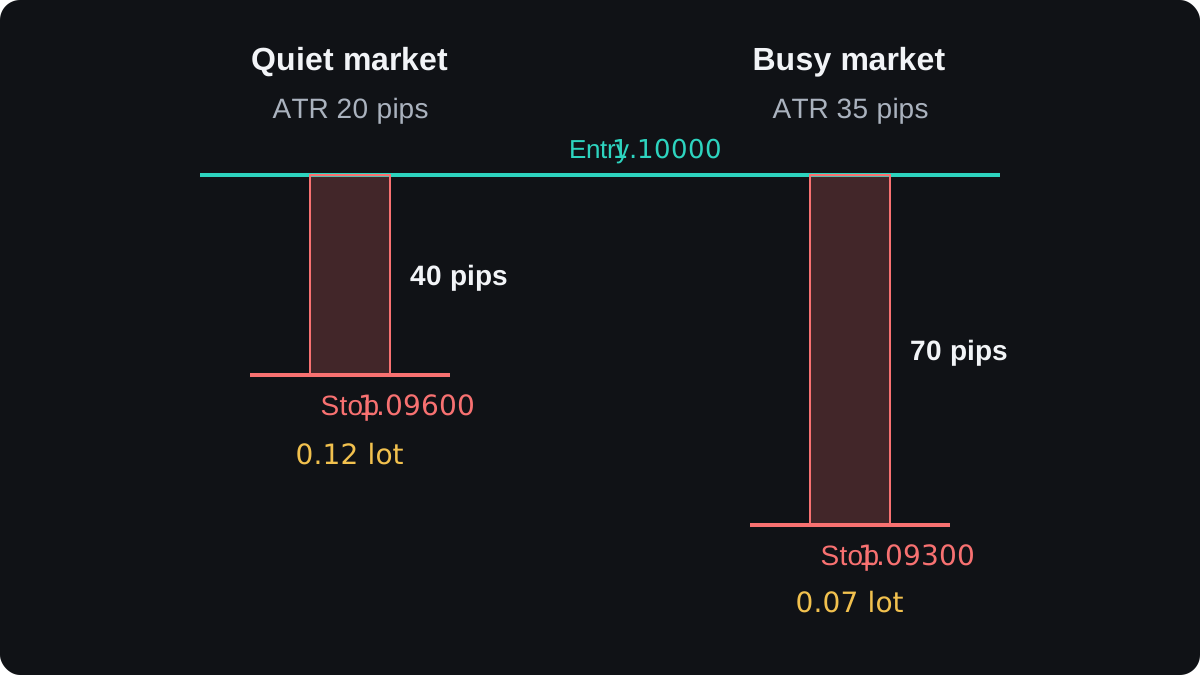
The multiple is your choice, and no value has been shown to be best for every pair. ATR also knows nothing about chart levels, so a 2 × ATR stop can land just above an obvious low.
The volatility lesson covers ATR and other measures in more depth.
Structure stops beyond a swing high or low
A structure stop uses the chart itself. For a buy it goes a little below the most recent swing low, and for a sell a little above the most recent swing high.
If price breaks that point, the pattern you traded has changed, so the stop marks the place where your idea is wrong.
Back to the buy at 1.10000. The last swing low is 1.09700, 30 pips below. A 5 pip buffer puts the stop at 1.09650, a distance of 35 pips.
The size is $50 ÷ (35 × $10) = 0.143 lot, rounded down to 0.14 lot. At $1.40 per pip, the stop risks 35 × $1.40 = $49.00.
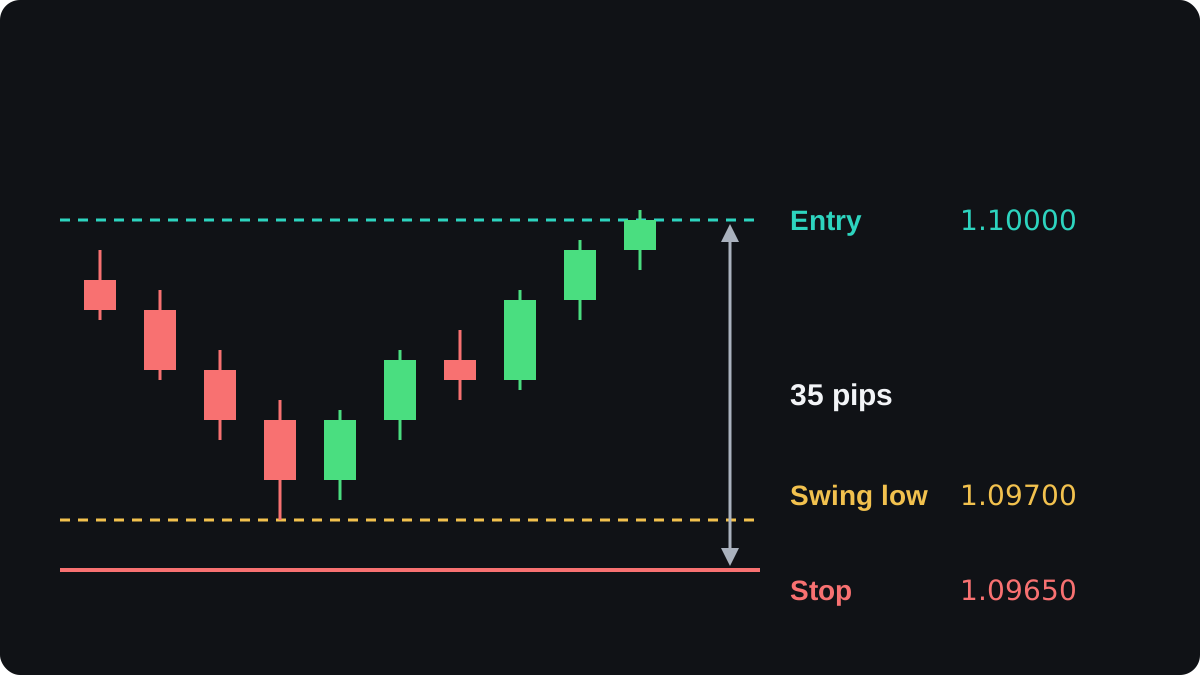
The buffer allows for how stops trigger. A buy closes at the bid, so its stop fires when the bid reaches the level.
A sell closes at the ask. Most charts plot the bid, so a sell stop can fire when the spread widens even though the chart never touched the level. Short stops above a high need that extra room.
Clear swing points are visible to everyone, so stops tend to gather just beyond them. A brief spike through the level can trigger them before price turns back, and a buffer gives yours a little more room.
A structure stop can also be far away. If the nearest real swing low is 120 pips below, the honest stop is 120 pips, and the answer is a smaller trade (0.04 lot for $50 of risk) or no trade.
Time stops for trades that go nowhere
A time stop closes a trade after a set period, whatever the price. For example, if a buy has not gained 20 pips within ten four-hour candles, you close it.
The reasoning is that a trade idea has a shelf life. A flat position still ties up margin, and holding it past the daily rollover may add swap charges.
A related habit is closing before risks you cannot measure, such as the weekend. Prices can open on Monday far from Friday's close, and a stop inside that gap usually fills at the first available price, which can be well beyond the level.
On its own, a time stop lets a loss grow until the clock runs out. Use it alongside a price stop, as an extra exit.
Comparing the four methods on one trade
The table puts the same buy at 1.10000 through each price rule, with $50 at risk and $10 per pip per standard lot.
| Method | Stop distance | Stop price | Lot size | Risk |
|---|---|---|---|---|
| Structure: 5 pips below 1.09700 | 35 pips | 1.09650 | 0.14 | $49.00 |
| Volatility: 2 × ATR of 20 pips | 40 pips | 1.09600 | 0.12 | $48.00 |
| Fixed: 50 pips | 50 pips | 1.09500 | 0.10 | $50.00 |
| Fixed: 0.5% of price | 55 pips | 1.09450 | 0.09 | $49.50 |
A time stop has no price level, so it sits on top of any of these rows.
The stops sit 35 to 55 pips away, yet every version risks between $48 and $50. The method changes how much room the trade gets and how much each pip is worth to you.
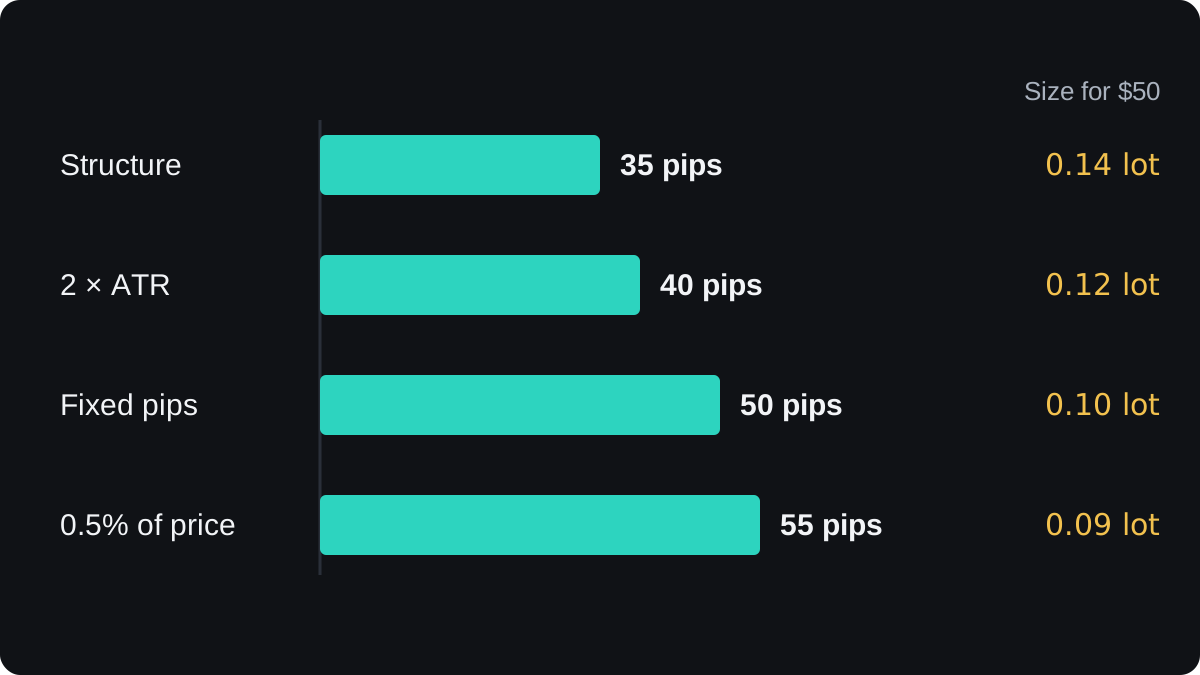
A tighter stop is reached by smaller moves, so it tends to be hit more often. A wider stop survives more noise but needs a smaller lot.
Fixed stops are the easiest to test. ATR and structure stops adapt to the market but ask for more judgement. You can combine them, for example a structure stop that must sit at least 1 × ATR from entry.
Whichever rule you pick, write it down before you enter and check the size with the lot size calculator.
A stop becomes a market order once hit, so a fast market can fill it beyond the level. That gap is called slippage, and it can make the real loss larger than planned.
Once a trade moves your way, the next question is whether the stop should follow it, which the trailing stops lesson covers.
សំណួរ
Where should I put my stop loss?
At the price that would show your trade idea is wrong, plus a small buffer for the spread and normal noise. Then size the trade so that distance risks only the amount you planned.
What is a good ATR multiplier for a stop loss?
No single multiple has been shown to be best. This lesson uses 2 as an illustration, so test any multiple on your own pair and timeframe, on a demo account or historical data, before using real money.
Should I use a fixed pip stop loss?
It is simple and easy to test, which suits a first system. Its weakness is that the same distance can be too wide in a quiet market and too tight in a busy one.
Is a 1% stop loss the same as risking 1%?
No. A 1% stop sits 1% of the price away from entry, while risking 1% means the stop, wherever it is, can cost 1% of your account through the lot size you choose.
What is a time stop?
An exit that closes a trade after a set period if it has not moved as expected. Use it together with a price stop, never on its own.
បន្តរៀន
 ជំពូក 4Why use a stop loss?A stop loss is an order that closes your trade at a price you set in advance if the market moves against you. It caps the loss in normal conditions, even while you are offline, and lets you size the position from a fixed risk. A gap or fast market can still fill it at a worse price.
 ជំពូក 4Trailing stops.A trailing stop is a stop loss that follows the price as a trade moves in your favour, staying a set distance behind it and never moving back. It shrinks the possible loss and locks in profit once it passes your entry, but it always gives back its distance from the peak and can fill worse after a gap.

