Trailing stops.
A trailing stop is a stop loss that follows the price as a trade moves in your favour, staying a set distance behind it and never moving back. It shrinks the possible loss and locks in profit once it passes your entry, but it always gives back its distance from the peak and can fill worse after a gap.
ខ្លឹមសារនេះមានតែជាភាសាអង់គ្លេសសិន។

You buy EUR/USD at 1.10000 with a stop loss at 1.09700. A day later the price is 1.10600 and you are 60 pips up.
If the stop is still at 1.09700, a full reversal can turn that gain into a 30 pip loss.
A trailing stop is a stop loss that follows the price as a trade moves your way, a set distance behind. It never moves back, so the risk shrinks, and once it passes your entry it locks in some profit.
How does a trailing stop move?
On a buy, the stop follows the highest price the trade has reached. When the price makes a new high, the stop rises by the same number of pips. When the price falls, the stop stays where it is.
On a sell, everything flips. The stop sits above the price and follows the lowest price reached, moving down only.
You choose the distance. It can be a fixed number of pips, a multiple of recent volatility, or a chart level.
The ways to place a stop loss lesson covered these for the first stop. Trailing keeps applying one of them as the trade runs.
A worked example with a 30 pip trail
The prices below are round and illustrative, and the example ignores the spread so the sums stay clean.
- You buy 0.50 lot of EUR/USD at 1.10000. A standard lot is 100,000 euros, so 0.50 lot is 50,000 euros and one pip is 50,000 × 0.0001 = $5.
- You trail the stop 30 pips behind the price. The first stop is 1.09700, so the starting risk is 30 × $5 = $150.
- The price rises to 1.10200, and the stop moves up to 1.09900.
- The price dips to 1.10120. The stop stays at 1.09900.
- The price climbs to 1.10400 and then 1.10600. The stop follows to 1.10100 and then 1.10300.
- The price falls back to 1.10300 and the stop closes the trade: 1.10300 − 1.10000 = 0.00300, which is 30 pips, or 30 × $5 = $150 profit.
The table shows what each stop level would have meant if the price had turned there.
| Highest price so far | Trailing stop | Result if the stop is hit |
|---|---|---|
| 1.10000 (entry) | 1.09700 | −30 pips, −$150 |
| 1.10200 | 1.09900 | −10 pips, −$50 |
| 1.10400 | 1.10100 | +10 pips, +$50 |
| 1.10600 | 1.10300 | +30 pips, +$150 |
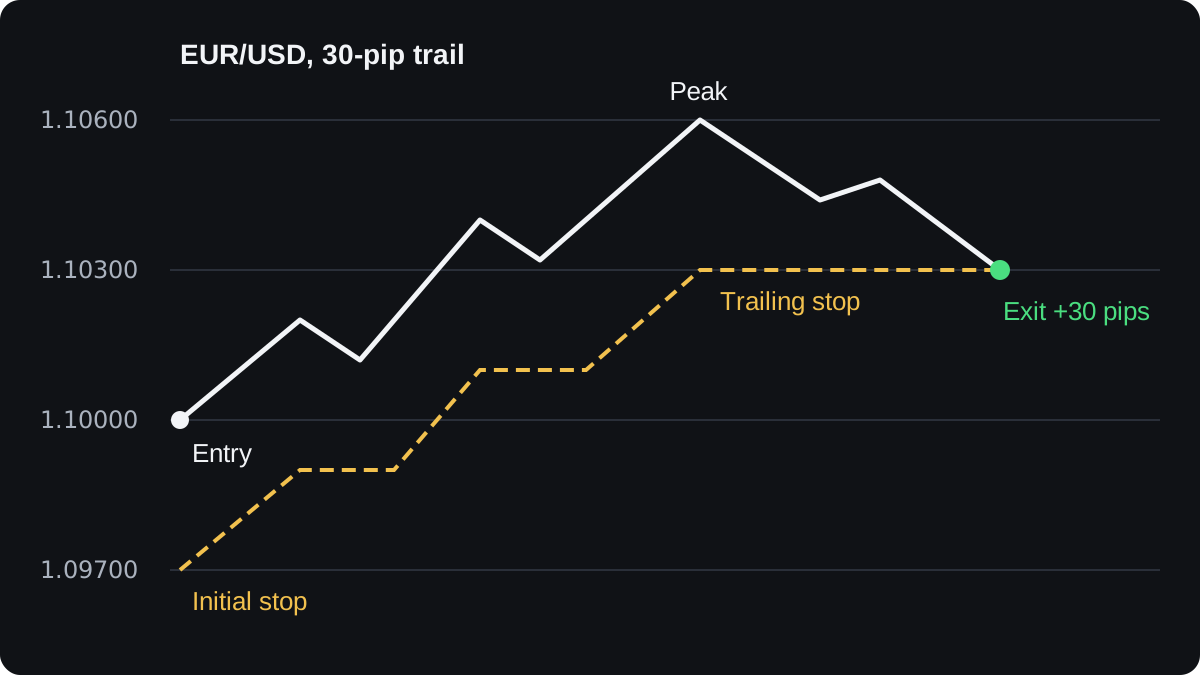
Look at what the trail cost. At the peak the trade was 60 pips up, worth $300, and it closed at $150.
A trailing stop can only fire after the price has turned, so a fixed trail always gives back at least its own distance from the top.
Setting a trailing stop in MetaTrader
MetaTrader 4 and 5 both have a built-in trailing stop. You set it on an open position from its right-click menu in the Trade tab, and the distance is in points.
On a five-decimal quote, 10 points make one pip, so a 30 pip trail is 300 points.
The built-in version waits until the trade is in profit by the trailing distance before it moves anything. In the example it would leave the stop at 1.09700 until the price reached 1.10300, then move it to 1.10000.
From there it follows the price as before, so the final stop at 1.10300 comes out the same.
A bigger catch is where it runs: MetaTrader's trailing stop works inside the platform on your own device. If you close the platform or lose the connection, the stop stops moving.
Its last level stays on the broker's server and still protects the trade. Some traders run the platform on a VPS, a remote computer that stays on, for this reason.
Other platforms keep trailing stops on the server, so check your platform's help pages for how yours works.
Other ways to trail a stop
A fixed pip distance ignores what the chart is doing. One alternative on a buy is to move the stop just below each new higher low once it forms, so the stop follows the swing points in jumps.
Another is to set the distance from volatility, such as two times the average true range (ATR). The trail then widens when the pair gets jumpier and tightens when it calms, as the measuring volatility lesson explains.
Some traders keep the stop beneath a moving average, treating it as dynamic support. This trails smoothly, but the average lags, so the stop can sit far from the price after a fast move.
A breakeven stop is the simplest version: one move of the stop to your entry price once the trade is up by a set amount. Commission and swap still count, so a trade stopped at entry can close slightly negative.
No method or setting is best for every pair and every market. A setting that looks good when tested on past prices can do worse on new ones, so treat any rule of thumb as a starting point to test on demo.
Tight or wide: the trade-off
A tight trail keeps more of a gain when the price turns, but normal back-and-forth can hit it early. A wide trail survives pullbacks and gives back more at the end.
Take the same entry at 1.10000 with a 15 pip trail and a 40 pip trail. In the first path, the price rises to 1.10300, dips to 1.10120, runs to 1.10800 and then falls back.
The 15 pip trail sits at 1.10150 when the price is at 1.10300, so the dip to 1.10120 closes the trade for +15 pips.
The 40 pip trail is at 1.09900 at that point, so the dip misses it. After the peak at 1.10800 it sits at 1.10400, and the fall closes the trade there for +40 pips.
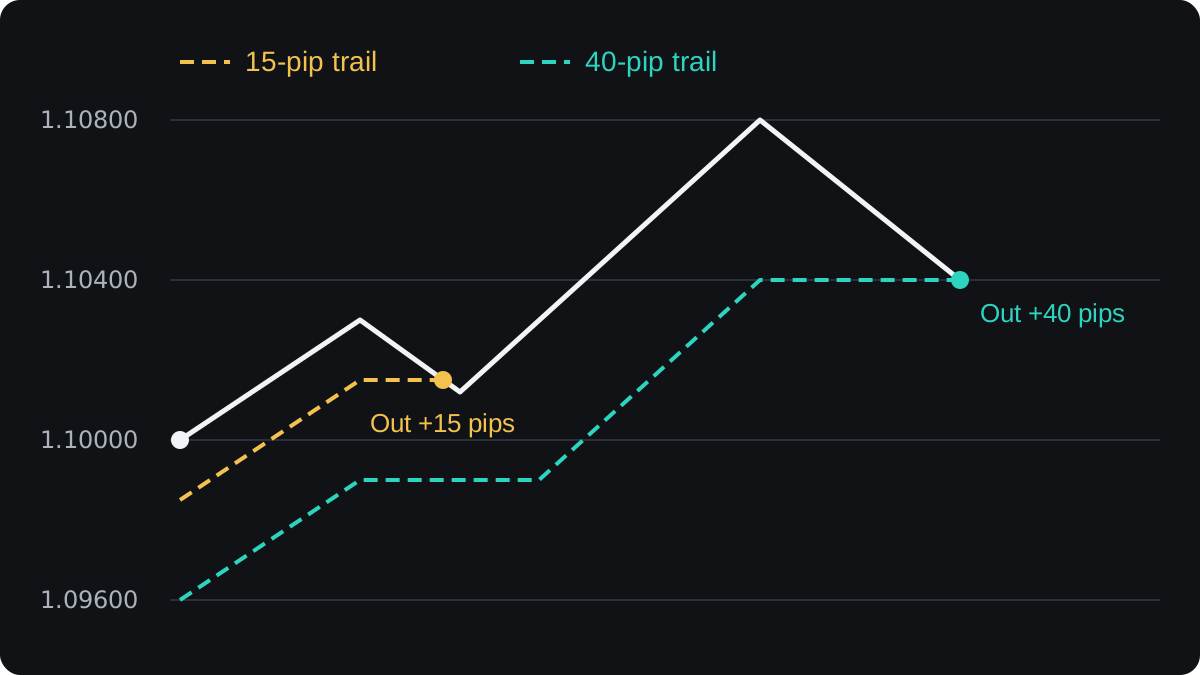
In a second path, the price rises to 1.10300 and falls straight back, and this time the tight trail does better.
| Price path after entry | 15 pip trail | 40 pip trail |
|---|---|---|
| Up to 1.10300, dip to 1.10120, up to 1.10800, then down | +15 pips | +40 pips |
| Up to 1.10300, then straight down | +15 pips | −10 pips |
A wider trail also means a wider first stop, so it risks more per lot. To keep the starting risk at $150 with a 40 pip stop, you need $150 ÷ 40 = $3.75 per pip.
That is 0.375 lot, which rounds down to 0.37 lot in place of 0.50. The position size lesson shows this step for any stop distance.
Where trailing stops fail
A stop that is hit becomes a market order, filled at the next price available. When the market jumps past your level, the fill can be worse than the stop.
Say the example trade peaked at 1.10600 on Thursday, so the stop sits at 1.10300. Friday closes at 1.10450, above the stop, and on Monday the market opens at 1.10050.
The stop fills near 1.10050. That is a gain of 5 pips, or $25 on 0.50 lot, against the $150 the stop level pointed to.
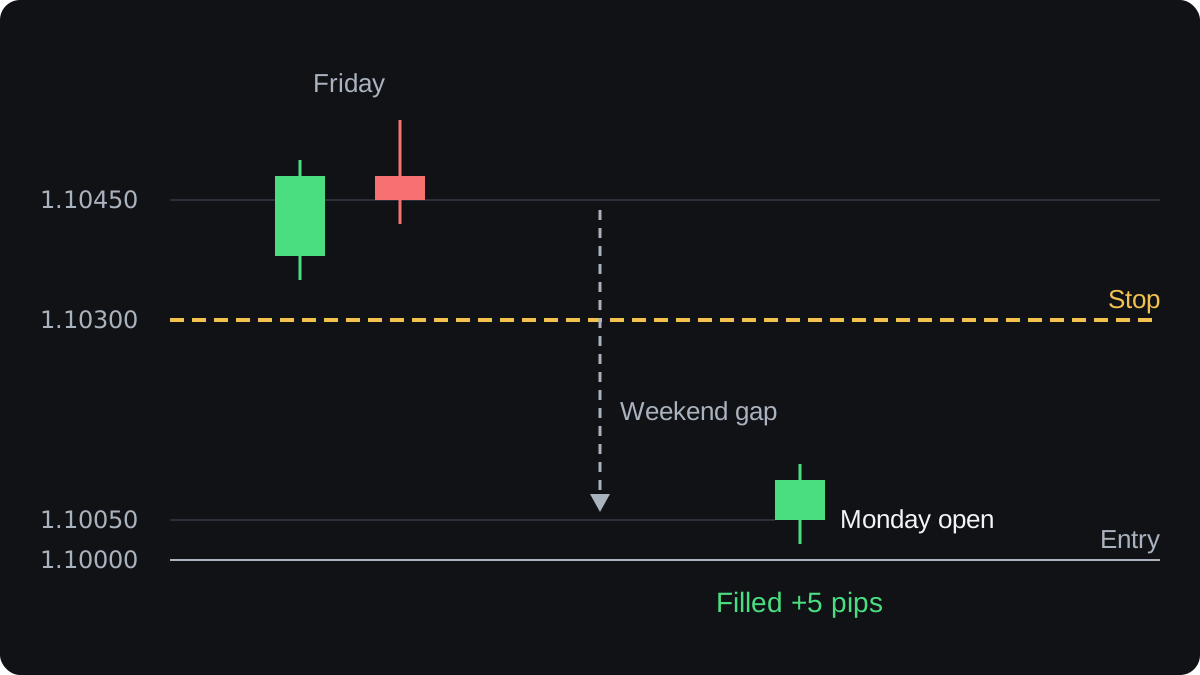
Fast news can do the same during the week. The slippage lesson covers why fills differ from the price you asked for.
In a sideways market, a trail tends to close trades for small gains and small losses. Its advantage shows only when the price travels far in one direction.
You cannot know in advance which kind of move you are in.
On most platforms a buy closes at the bid and a sell at the ask. A spread that widens at quiet hours or around news can therefore trigger a sell's trailing stop even though the bid on the chart never reached it.
The method also holds only if the stop moves one way. Pulling it back to give a losing trade more room turns a trailing stop into an ordinary stop with a bigger loss.
សំណួរ
Does a trailing stop guarantee a profit?
No. Until the stop passes your entry price it only limits the loss, and a gap or fast move can fill it at a worse price than the stop level.
Does a trailing stop work when MetaTrader is closed?
MetaTrader's built-in trailing stop stops moving when the platform closes. The last stop level stays on the broker's server, so the trade is still protected at that level.
What is a good trailing stop distance?
There is no single right number. A distance based on how far the pair normally moves, such as a multiple of ATR, is a common starting point, and testing it on demo shows how it behaves.
Is a breakeven stop the same as a trailing stop?
A breakeven stop is one move of the stop to your entry price. A trailing stop keeps moving as long as the price makes new highs on a buy or new lows on a sell.
បន្តរៀន
 ជំពូក 4Why use a stop loss?A stop loss is an order that closes your trade at a price you set in advance if the market moves against you. It caps the loss in normal conditions, even while you are offline, and lets you size the position from a fixed risk. A gap or fast market can still fill it at a worse price.
 ជំពូក 4Ways to place a stop loss.There are four common ways to place a stop loss: a fixed distance in pips or percent of price, a multiple of volatility such as 2 × ATR, a level just beyond a swing high or low, and a time limit. Choose the stop first, then size the trade so the stop risks the money you planned.

