Why use a stop loss?
A stop loss is an order that closes your trade at a price you set in advance if the market moves against you. It caps the loss in normal conditions, even while you are offline, and lets you size the position from a fixed risk. A gap or fast market can still fill it at a worse price.
ខ្លឹមសារនេះមានតែជាភាសាអង់គ្លេសសិន។

Say you buy EUR/USD at 1.10000 and tell your broker to close the trade automatically if the price falls to 1.09700. If the market drops while you sleep, the trade closes at that level and the loss stops growing.
That instruction is a stop loss: an order that closes an open position at a price you choose in advance, once the market moves against you. It lets you decide what a trade can cost before you enter it.
What does a stop loss do to a trade?
On EUR/USD a pip is 0.0001, so the distance from 1.10000 to 1.09700 is 0.00300, or 30 pips. All prices in this lesson are round illustrative numbers.
On 0.10 lot, which is 10,000 euros, each pip is worth 10,000 × 0.0001 = $1. If the stop is hit, the trade loses about 30 × $1 = $30.
On MetaTrader and most other platforms, the stop is held on your broker's server. It still works when your phone is off or your platform is closed, so you do not have to make the exit decision under pressure.
On a long trade the stop is a sell order below your entry. On a short trade it is a buy order above your entry. When price reaches that level, the order closes the position.
How does a stop turn risk into a number you choose?
Position sizing starts from the distance between your entry and your stop. With that distance you can work backwards from the money you are willing to lose to the lot size.
Here is the same trade, sized from risk:
- Your account holds $3,000 and you plan to risk 1% per trade: 3,000 × 0.01 = $30.
- Your stop is 30 pips below the entry, at 1.09700.
- The most you can afford per pip is $30 ÷ 30 = $1.00.
- On EUR/USD, $1.00 per pip is 0.10 lot.
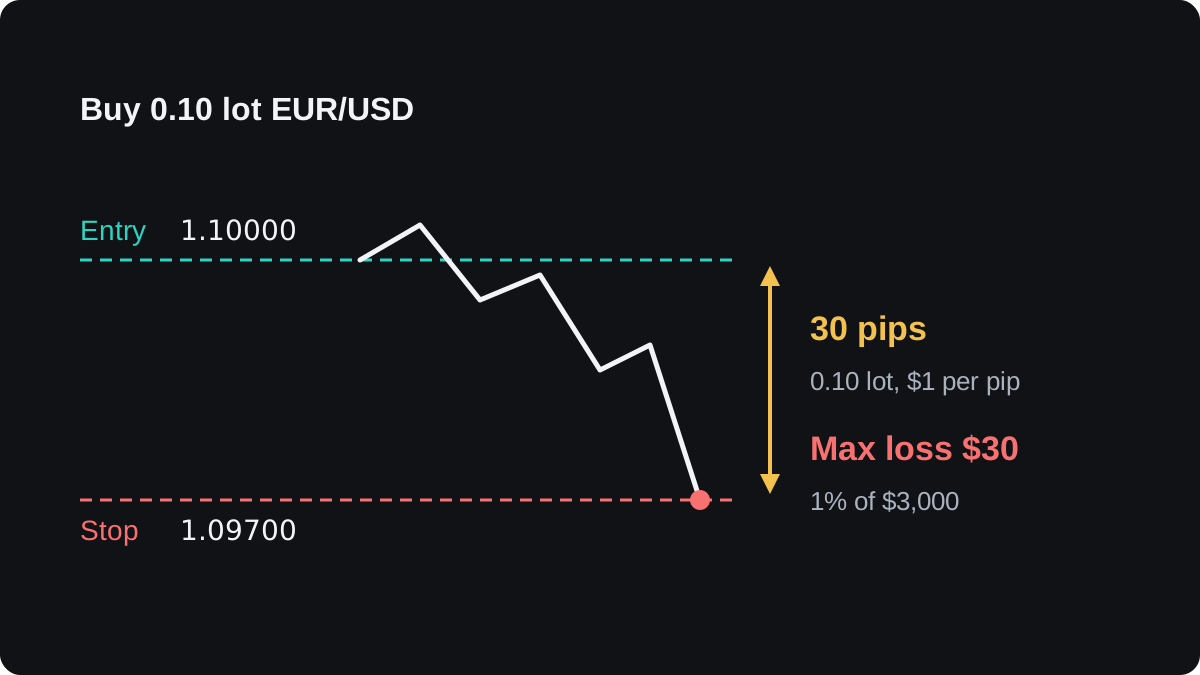
A stop does not have to be tight to keep risk small. A 60 pip stop with 0.05 lot, worth $0.50 per pip, risks the same 60 × $0.50 = $30.
Without a stop, step 3 has nothing to divide by. You can still pick a lot size, but you no longer know what the trade can cost.
The position size lesson covers the method, and the lot size calculator runs it for any pair.
What does trading without a stop cost?
Take the same 0.10 lot trade with no stop. Over a few weeks EUR/USD drifts from 1.10000 to 1.08500, a fall of 150 pips. That is $150, or 5% of the account, five times the planned risk.
Nothing forces you to close. Each day the loss is a little larger, and closing means accepting that the idea was wrong, so waiting for a bounce feels easier than acting.
A large loss also takes an even larger percentage gain to repair. A $3,000 account that loses 50% has $1,500 left, and getting back to $3,000 needs a $1,500 gain, which is 100% of what remains.
| Loss | Balance left from $3,000 | Gain needed to recover |
|---|---|---|
| 10% | $2,700 | 11.1% |
| 25% | $2,250 | 33.3% |
| 50% | $1,500 | 100% |
| 75% | $750 | 300% |
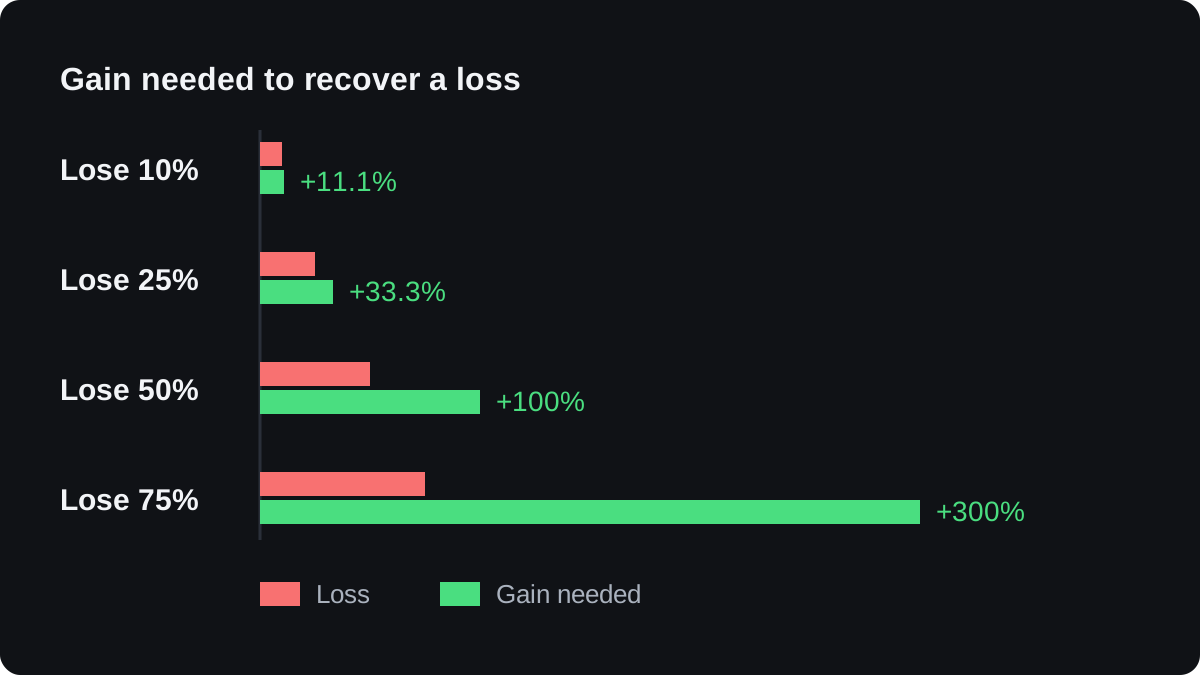
Small capped losses keep you in the top rows of that table. The drawdown lesson works through the recovery maths in more detail.
If a losing trade with no stop keeps running, your broker's stop out level eventually ends it. A stop out closes positions when your margin level falls to the broker's limit.
That can happen after much of the account is already gone. The margin and stop out lesson shows where that limit sits.
Where can a stop loss fail?
Once your level is reached, a stop closes the trade at the next price available. In a calm market that is at or very near your stop. In a fast market it can be worse.
The worst case is a gap, a jump from one price to another with no trading in between. Gaps tend to appear when the market reopens after the weekend and around major news releases.
Suppose your buy from 1.10000 is still open on Friday, with the stop at 1.09700. The market closes at 1.09850 and reopens on Monday at 1.09500. No price in between was ever available, so the stop fills at 1.09500.
The loss is 1.10000 minus 1.09500 = 0.00500, or 50 pips. On 0.10 lot that is 50 × $1 = $50, against the $30 you planned.
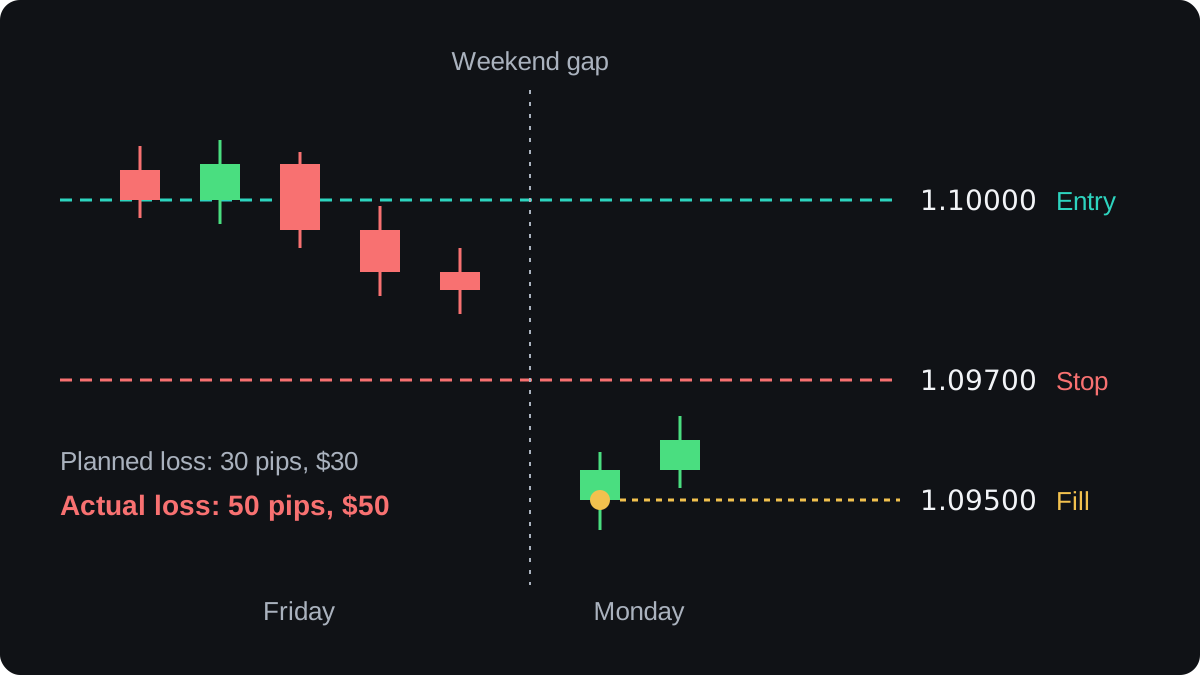
The difference between your stop price and your fill price is slippage.
Some brokers offer a guaranteed stop that fills at your exact level even through a gap, usually for an extra charge. Check your broker's terms if that matters to you.
The spread can also trigger a stop. A stop on a long trade is a sell, so it fires when the bid reaches your level. A stop on a short trade is a buy, so it fires on the ask.
Many platforms, MetaTrader included, draw the chart from the bid. If the spread widens around news, a short trade's stop can fire although the chart line never reached it. The bid and ask lesson shows both prices.
A stop placed very close to entry can be hit by ordinary price swings just before the market moves your way. That is a placement problem, which the next lesson, ways to place a stop loss, deals with.
Is a mental stop good enough?
A mental stop is an exit price you plan to use but never enter as an order. Some traders prefer it because they want to judge the exit themselves when price gets there.
It only protects you if you are watching and willing to act. A lost connection or an overnight move leaves the trade open, and the decision arrives when you are least ready for it.
Moving a real stop further away after a trade turns against you has much the same effect as having none. If you write a trading plan, one simple rule is that a stop may move to reduce risk and never to increase it.
សំណួរ
Does a stop loss guarantee my maximum loss?
No. It closes near your price in normal conditions, but a gap or fast market can fill it worse, as when the 30 pip stop above lost 50 pips. A guaranteed stop, where a broker offers one, fixes the exit price.
Where should I put my stop loss?
At a price where the market would show your trade idea is wrong, then size the position to fit that distance. The next lesson compares the common ways to choose that price.
Can a stop loss trigger if the chart never touched it?
Yes, on a short trade. Its stop fires on the ask, while charts usually show the bid, so a wide spread can trigger it.
What is the difference between a stop loss and a stop out?
You set a stop loss on one trade at a price you choose. A stop out is your broker closing positions because your margin level fell to its limit.
Can I trade without a stop loss?
You can, and some traders rely on a mental stop instead. Without a real stop you cannot size a position from a fixed risk, and a single trade can grow into a large loss.
បន្តរៀន
 ជំពូក 4Ways to place a stop loss.There are four common ways to place a stop loss: a fixed distance in pips or percent of price, a multiple of volatility such as 2 × ATR, a level just beyond a swing high or low, and a time limit. Choose the stop first, then size the trade so the stop risks the money you planned.
 ជំពូក 4Trailing stops.A trailing stop is a stop loss that follows the price as a trade moves in your favour, staying a set distance behind it and never moving back. It shrinks the possible loss and locks in profit once it passes your entry, but it always gives back its distance from the peak and can fill worse after a gap.

