Why do people trade forex?
People trade forex because the market runs around the clock from Sunday evening to Friday evening, New York time, major pairs are liquid with usually narrow spreads, and selling a pair you expect to fall is as simple as buying one you expect to rise. Small trade sizes and leverage add access, and leverage also makes losses larger.
เนื้อหานี้ยังมีเฉพาะภาษาอังกฤษ

People come to forex for practical reasons. The market is open on weekdays around the clock, and a falling currency is as easy to trade as a rising one.
Each of those features also has a limit, and the limit is easy to miss when you are starting out. Every benefit below comes with its catch.
When is the forex market open?
Currencies are traded between banks and dealers in many countries, with no single exchange that opens and closes. As one financial centre winds down, another is already trading.
On retail platforms the week usually starts around 17:00 New York time on Sunday and ends around 17:00 New York time on Friday. Your platform may show other clock times, because many brokers use their own server time zone.
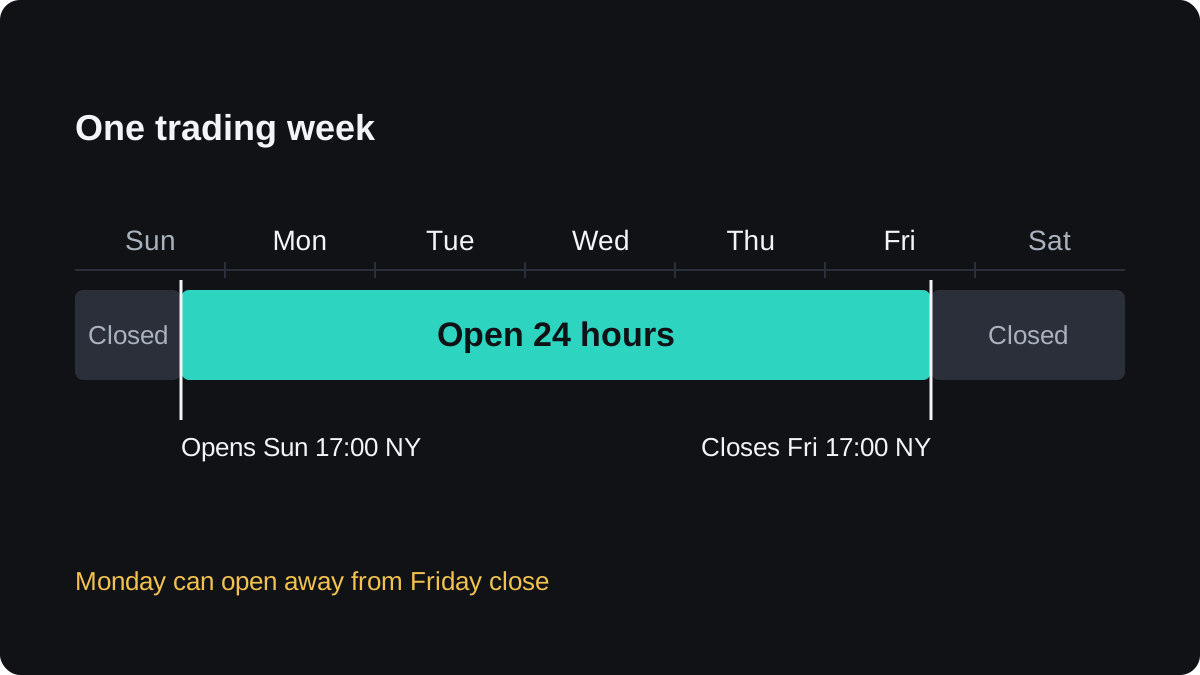
These hours suit people with day jobs, since you can study charts and place trades in the evening. The trading sessions lesson shows which hours are busy and which are quiet.
Quiet hours are still open hours, but they bring smaller moves and often wider spreads.
The weekend matters too. News can break on Saturday, and Monday's first price can sit well away from Friday's close, past any stop loss you had set.
Why does liquidity matter to you?
Liquidity is how easily you can buy or sell without moving the price. The major pairs, such as EUR/USD and USD/JPY, are among the most traded instruments in the world.
The Bank for International Settlements measures that trading in a survey every three years. The market size lesson covers its figures.
For a small trader, deep liquidity shows up in two ways. Spreads on major pairs are usually narrow, and at normal times a market order usually fills close to the price on screen.
The spread is a direct cost. Take an illustrative spread of 1.0 pip on EUR/USD. Each pip on 0.10 lot is worth $1, so entering and leaving that trade costs $1.
If the spread widens to 3.0 pips in a quiet hour, the same round trip costs $3.
Liquidity thins around the daily rollover near 17:00 New York time and around big economic releases, and exotic pairs have less of it at most hours.
At those times your fill can be worse than the price you saw. That gap is called slippage.
Can you make money when a currency falls?
Yes, and you use the same kind of order. Every pair is one currency priced in another, so selling EUR/USD means selling euros and buying dollars.
Short selling a share in an ordinary stock account usually needs your broker to lend you the stock first. A forex sell order has no separate borrowing step for you to arrange.
Here is a short trade with illustrative prices. To keep the sums clean, it ignores the spread.
- You sell 0.10 lot of EUR/USD at 1.10000. That is 10,000 euros, so one pip is 10,000 × 0.0001 = $1.
- The price falls to 1.09600 and you buy back: 1.10000 − 1.09600 = 0.00400, which is 40 pips.
- Your result is 40 × $1 = +$40.
- Had the price risen to 1.10400 instead: 1.10000 − 1.10400 = −0.00400, a loss of 40 pips, or −$40.
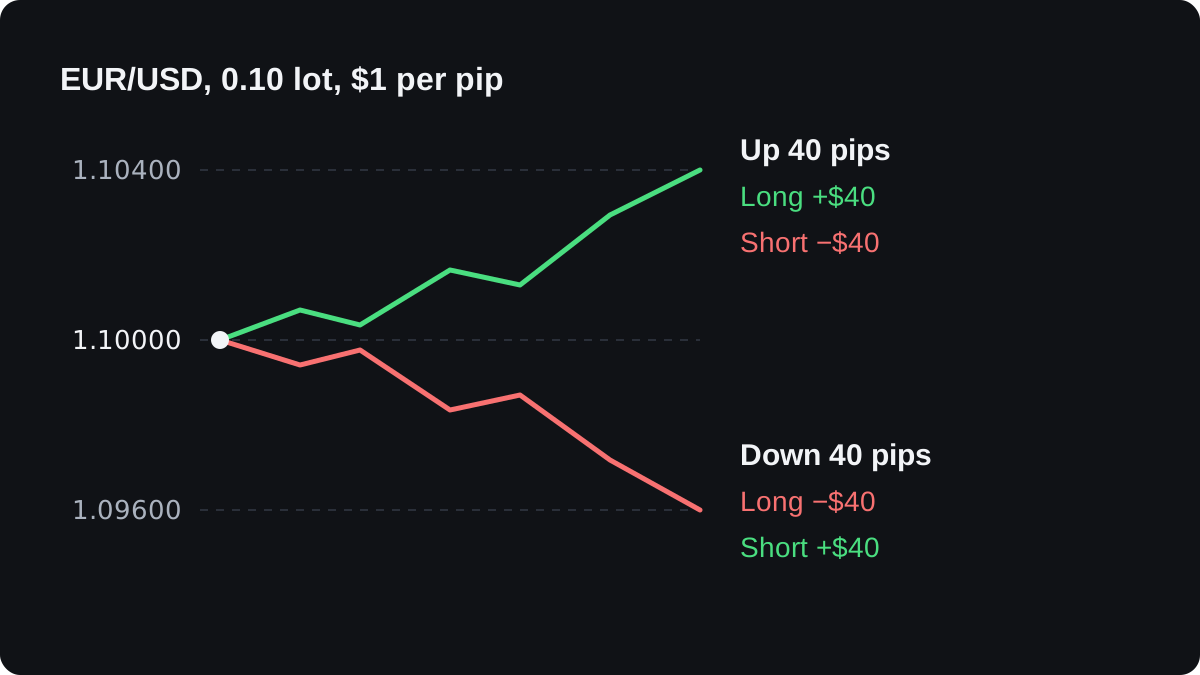
A short position loses as fast as a long one when the market moves against it. Being able to trade in both directions does nothing to make your view of direction more accurate.
The buying and selling lesson shows which price, bid or ask, opens and closes each side.
How small can a forex trade be?
Many retail brokers let you trade 0.01 lot, called a micro lot. That is 1,000 units of the base currency, against 100,000 units in a standard lot.
On EUR/USD in a dollar account, one pip on 0.01 lot is 1,000 × 0.0001 = $0.10. The 40 pip move from the short trade would be worth $4 at that size.
That lets you learn with real money at stakes where a mistake is cheap. The lot size lesson covers the other sizes.
Minimum trade sizes and minimum deposits are set by each broker, so check its contract specifications. Many brokers also offer demo accounts with virtual money, so you can practise on the platform before any money is at risk.
What does leverage add?
Forex brokers let you control a position larger than your deposit. With leverage of 1:100, you put up 1% of the trade's full value as margin, and the broker holds that money while the trade is open.
Take an illustrative EUR/USD price of 1.10000, a $1,000 account and leverage of 1:100.
- 0.10 lot is 10,000 euros, worth 10,000 × 1.10000 = $11,000. Margin is $11,000 ÷ 100 = $110.
- 0.50 lot is 50,000 euros, worth $55,000. Margin is $55,000 ÷ 100 = $550.
- A 40 pip move against you costs 40 × $1 = $40 on 0.10 lot, which is 4% of the account.
- On 0.50 lot each pip is $5, so the same move costs 40 × $5 = $200, which is 20% of the account.
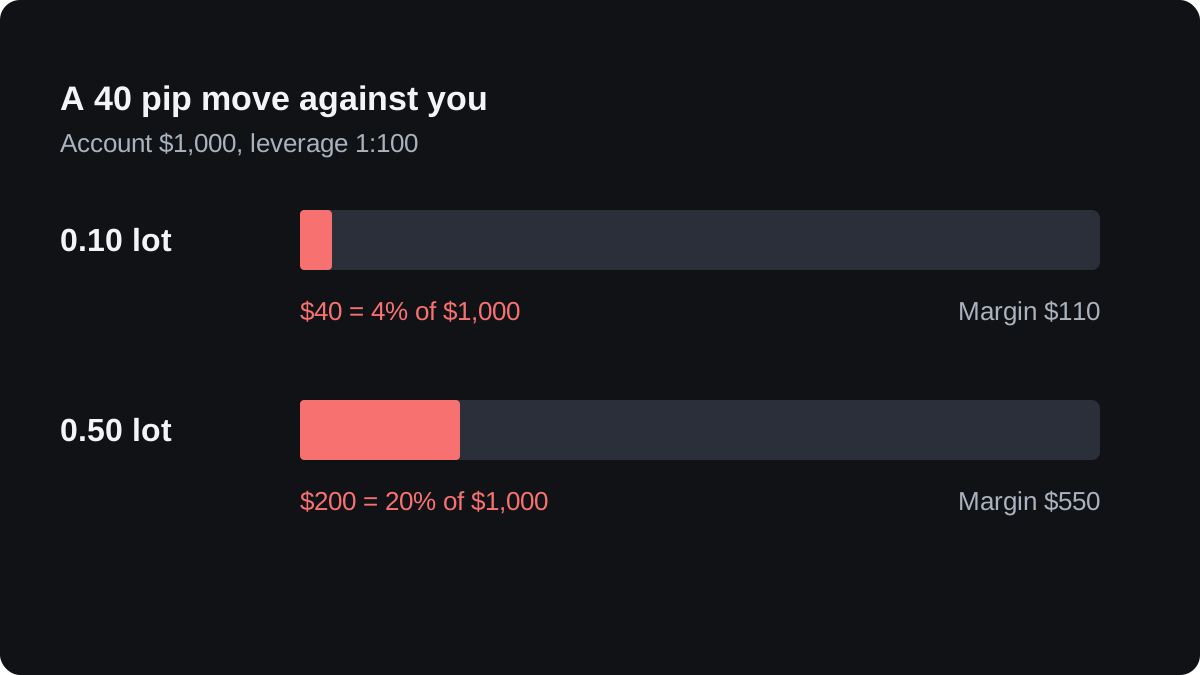
The market moved the same 40 pips in both cases. Only the position size changed, and the loss grew with it. Two such moves on 0.50 lot would cost $400, or 40% of the account.
Maximum leverage depends on where you live and which licence your broker holds, and regulators in several regions cap it for retail clients. The leverage lesson explains margin calls and stop outs.
What are the downsides people underrate?
Retail forex is traded over the counter. Your trade is a contract with your broker, so your result depends on the broker's prices and on the broker staying solvent.
The lesson on who is on the other side of your trade explains how that works.
Costs add up over many trades. You pay the spread on every round trip, some accounts charge commission as well, and positions held overnight pay or receive swap.
In some regions, regulators require brokers that offer CFDs to retail clients to publish the share of those accounts that lose money. Look for that figure on a broker's site, because it is often well above half.
Easy access to a market tells you nothing about whether you will profit from it. The forex vs stocks lesson compares these features with trading shares.
คำถามที่พบบ่อย
Is forex open 24 hours a day?
It is open around the clock on weekdays. Most retail brokers quote prices from about 17:00 New York time on Sunday to 17:00 on Friday, and some pause for a few minutes around the daily rollover.
Can you trade forex with a small amount of money?
Yes. At 0.01 lot, one pip on EUR/USD is worth $0.10 in a dollar account, but a small account still loses quickly if the position is too large for it.
Is short selling allowed in forex?
Yes. Selling a pair is an ordinary order that gains if the price falls and loses if it rises.
Do you need high leverage to trade forex?
No. Leverage sets how large a position you may open, and you choose the size. One 0.01 lot of EUR/USD at 1.10000 is $1,100 of currency, about 1.1 times a $1,000 account.
Is forex trading profitable for beginners?
There is no promise of profit, and loss figures published by brokers in some regions show many retail accounts lose money. Practise on a demo account first and trade small.
เรียนต่อ
 บทที่ 5Forex vs stocks: what is the difference?Stocks are shares in single companies, traded on exchanges with fixed hours. Forex is the trading of one currency against another, over the counter, about 24 hours a day on weekdays. Forex accounts usually offer more leverage and charge or pay overnight swap. Currency prices follow two economies at once, while a share price follows one company.
 บทที่ 5Forex vs futures: what is the difference?Spot forex and forex CFDs trade over the counter through a broker, in flexible sizes often down to 1,000 units, with no expiry and a nightly swap. Currency futures trade on an exchange in fixed contract sizes, expire on set dates, settle gains and losses every day and build the interest difference into their price.

