Your broker's hedging policy and why it matters.
A broker's hedging policy decides whether you can hold a buy and a sell on the same pair in one account, and how much margin that pair uses. Hedging accounts keep both positions open; netting accounts close or shrink the first one. Margin on a hedged pair can be full, one leg or zero.
เนื้อหานี้ยังมีเฉพาะภาษาอังกฤษ

Say you bought EUR/USD and it has fallen 50 pips. On some accounts you can open a sell of the same size on the same pair without closing the buy. You then hold both, and further price moves stop changing your result.
Whether your account allows this, and how much margin the two trades tie up, is your broker's hedging policy. It varies by broker and account type, and the country where the broker is licensed can restrict it.
What does hedging mean on a trading account?
In this lesson, hedging means holding a buy and a sell on the same instrument, in the same account, at the same time. When both are the same size, one gains exactly what the other loses.
An equal buy and sell like this is often called a locked position, with zero net exposure to the pair while the lock is in place.
In wider finance, hedging also means reducing risk on something you already own. This lesson covers only the account version.
Hedging accounts and netting accounts
Platforms record positions in one of two ways. A hedging account keeps every trade as its own position, so a buy and a sell on EUR/USD can both stay open.
A netting account keeps one position per instrument. A new order in the opposite direction shrinks or closes the position you already hold.
MetaTrader 5 supports both modes, and the broker chooses the mode for each account type. MetaTrader 4 records each order separately, so it behaves like a hedging account unless the broker restricts it.
Take a buy of 0.10 lot of EUR/USD that is 50 pips down, with each pip worth $1. In a netting account, a sell of 0.10 lot closes the buy and books a loss of −$50.
In a hedging account, both trades stay open with a floating loss of −$51. The extra dollar is the spread: a new sell starts 1 pip down, as every new trade does.
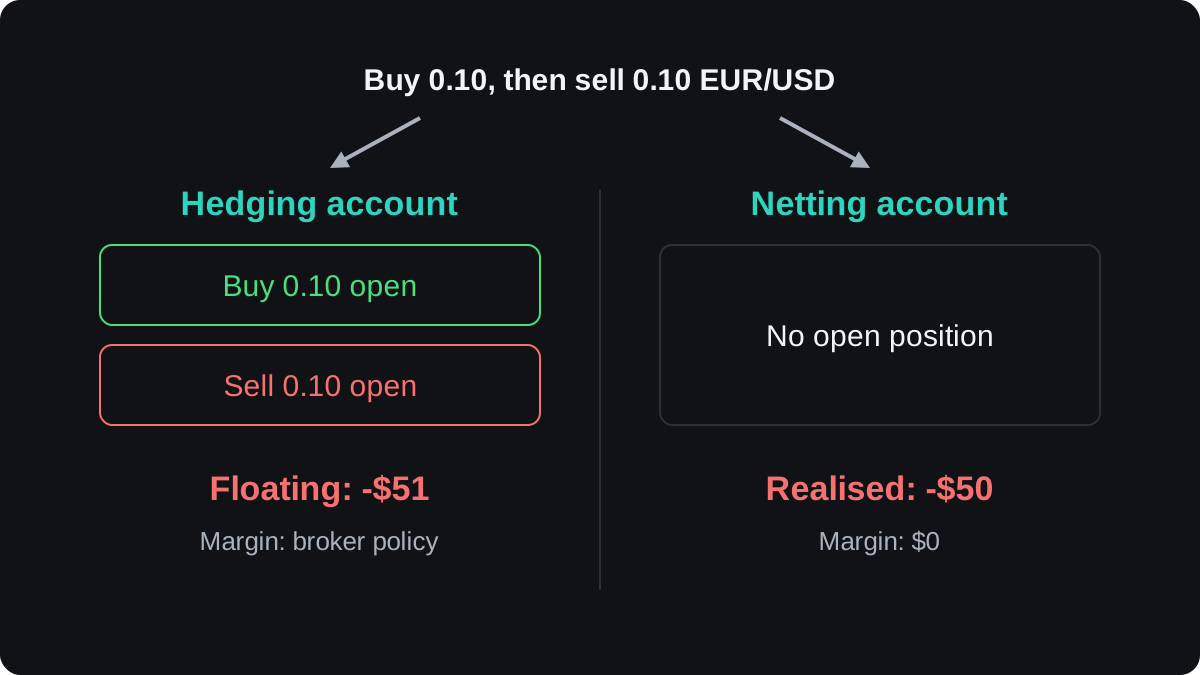
A smaller sell in a netting account shrinks the buy instead. Selling 0.04 lot against a buy of 0.10 lot leaves a buy of 0.06 lot, because 0.10 minus 0.04 is 0.06.
A demo account test shows which mode you have: open a small buy, then an equal sell on the same pair, and see whether two positions appear or the first one disappears.
How do brokers charge margin on a hedged pair?
Start with one leg, using round illustrative numbers. A lot of 0.10 on EUR/USD is 10,000 euros. At 1.10000 that is 10,000 × 1.10000 = $11,000 of notional value.
With leverage of 1:100, the margin for that leg is $11,000 ÷ 100 = $110. A sell of the same size at the same price needs the same $110 on its own.
When you hold both, brokers use one of a few methods to set the used margin:
| Margin policy | Buy 0.10 | Sell 0.10 | Total used margin |
|---|---|---|---|
| Full margin on both legs | $110 | $110 | $220 |
| Larger leg only | $110 | $0 | $110 |
| Zero hedged margin | $0 | $0 | $0 |
Some brokers use a reduced rate in between, such as half margin on each hedged leg. On equal legs that gives $55 + $55 = $110, the same total as the larger leg method.
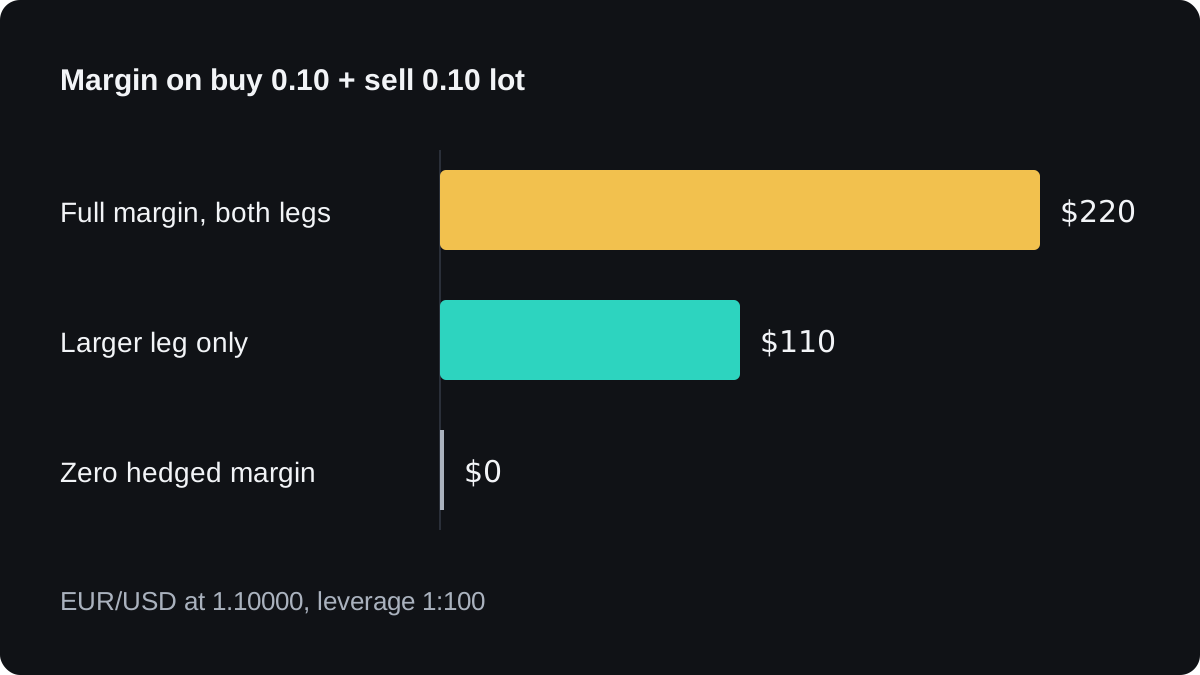
The same two trades can therefore tie up $220, $110 or nothing. That changes your free margin and how close the account sits to a margin call. The margin calculator gives the single-leg figure for other pairs and sizes.
On MetaTrader, the contract specification for a symbol may show a hedged margin value. If it is blank or unclear, ask the broker how hedged positions are charged.
A worked example: locking a losing trade
The prices below are illustrative. With a $1,000 balance and 0.10 lot of EUR/USD, each pip is worth $1.
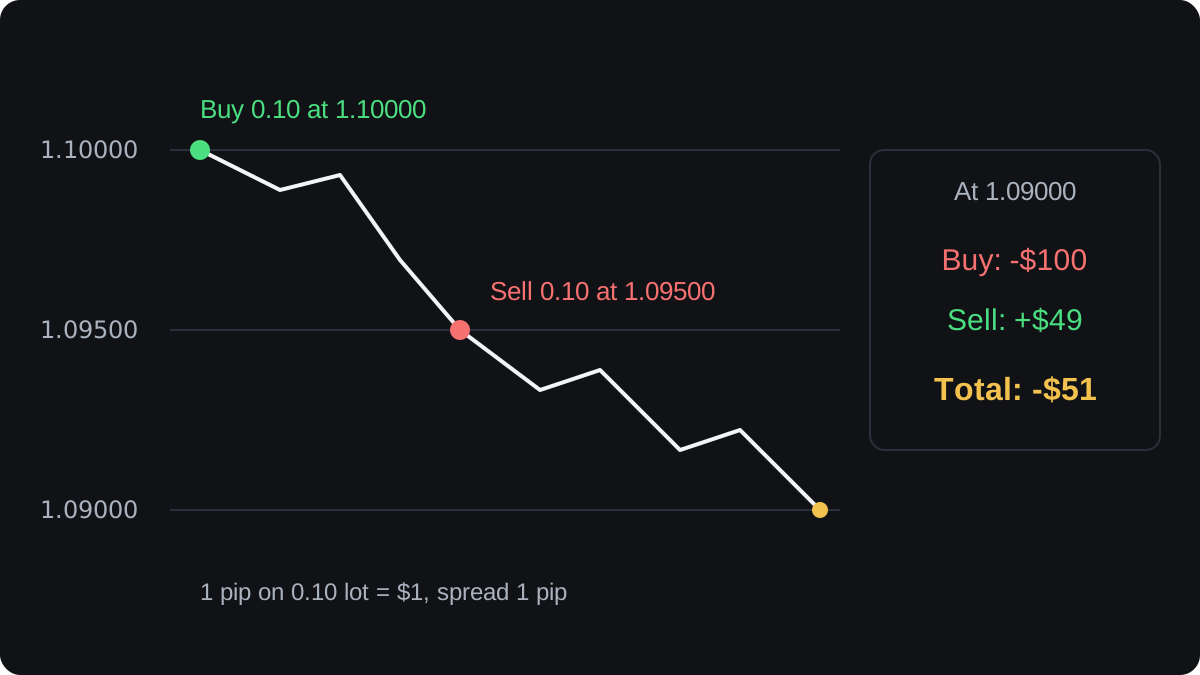
- You buy 0.10 lot at the ask of 1.10000.
- The price falls to a bid of 1.09500 and an ask of 1.09510, a 1 pip spread.
- The buy is valued at the bid: 1.09500 − 1.10000 = −0.00500, which is −50 pips, or −$50.
- You sell 0.10 lot at the bid of 1.09500. A sell closes at the ask, so it shows 1.09500 − 1.09510 = −1 pip, or −$1.
- The total floating loss is −$51, so equity is $1,000 − $51 = $949.
- The price falls again, to a bid of 1.09000 and an ask of 1.09010. The buy shows 1.09000 − 1.10000 = −100 pips, or −$100.
- The sell shows 1.09500 − 1.09010 = +0.00490, which is +49 pips, or +$49. The total is still −$51.
Margin level is equity divided by used margin, times 100. With full margin it is $949 ÷ $220 × 100 = 431%. With the larger leg method it is $949 ÷ $110 × 100 = 863%.
Strictly, a sell opened at 1.09500 needs $109.50 rather than $110, which moves the full margin result only to 432%.
Under zero hedged margin, used margin is $0, so the platform usually shows no margin level.
In a netting account, the same sell would have closed the buy at the bid of 1.09500 and booked −$50, leaving a balance of $950.
If you later close the two legs one at a time, the lock ends at −$51 with a 1 pip spread, because it paid the spread one extra time.
MetaTrader's Close By order closes the legs against each other at their own prices, which leaves −$50 instead.
What does a hedge still cost you?
A locked pair freezes the price result, but your equity can still move.
The first cost is the spread. The buy is valued at the bid and the sell at the ask, so a wider spread hurts the total.
If the spread widens from 1 pip to 5 pips, equity falls by 4 pips × $1 = $4 with no change in the middle price.
Spreads tend to widen around news and when market activity is thin. The next lesson, on where your broker's prices come from, explains why.
The second cost is overnight swap. Each leg is charged or credited separately, and the two rarely cancel. With an illustrative −$0.70 on the buy and +$0.20 on the sell, the lock costs $0.50 a night, or $10 over 20 nights.
On a commission account, each leg also pays its own commission, so a lock costs about twice the commission of a single trade.
The last cost appears when you lift the hedge. Closing the sell leaves the buy fully exposed again, and under zero hedged margin the used margin jumps from $0 to $110 at that moment.
In price terms, a lock is the same as closing the trade now and opening a new one when you lift it, plus extra swap and often extra spread. There is little evidence that locking improves results compared with closing or using a stop loss.
Where is hedging restricted, and how do you check?
Rules depend on where your broker is licensed. In the United States, retail forex dealers must close trades on a first in, first out basis and may not hold opposite positions on the same pair in one account.
Other regions allow it, but each broker still sets its own terms. Some client agreements forbid hedging between two accounts, or between accounts at different brokers, especially when a bonus is involved.
Before you rely on hedging, check these points:
- The account type page says whether hedging is allowed or the account uses netting.
- The contract specification, or support, says how margin on hedged positions is calculated.
- The client agreement says whether hedging across accounts is allowed.
- A demo test confirms that two opposite positions stay open side by side.
Ask support too whether the hedged margin rate can change, for example before weekends or major news, since that alters used margin on open positions.
คำถามที่พบบ่อย
Is hedging allowed in forex?
It depends on your broker, your account type and the country where the broker is licensed. Some accounts use netting, where an opposite order closes your position, and some regulators do not allow same-pair hedging for retail clients.
Does hedging remove the risk of a trade?
An equal buy and sell freezes the price result, but spread widening, swaps and commission still change your equity. When you close one leg, the other is fully exposed again.
What is the difference between hedging and netting in MT5?
A hedging account keeps each trade as a separate position, so a buy and a sell can both be open. A netting account holds one position per symbol, and an opposite order reduces or closes it.
Why did my used margin drop when I opened an opposite trade?
Your broker probably charges hedged positions at a reduced rate, such as the larger leg only or zero for the hedged part. The margin returns in full when you close one side.
Is locking a trade better than closing it?
In price terms the two are equal, and the lock adds overnight swap on both legs, plus an extra spread if you close the legs one at a time. It postpones the decision to exit without changing the loss already made.
เรียนต่อ
 บทที่ 1How to choose a forex broker.To choose a forex broker, check four things before you deposit. Confirm the licence on the regulator's own register, work out the full cost of a trade from spread, commission and swap, test how orders are filled, and make a small withdrawal to see how payouts work. A broker that fails the licence check needs no further study.
 บทที่ 1What does a forex broker actually do?A forex broker opens your trading account, streams buy and sell prices, accepts your orders and fills them, either with outside liquidity providers or by taking the other side itself. It also holds your deposit, sets aside margin while trades are open, applies leverage, charges or pays swap and closes positions at stop out.
 บทที่ 1Is your forex broker regulated? How to check a licence.A regulated forex broker holds a licence from a government authority such as the UK's FCA or Australia's ASIC. To check it, find the legal company name and licence number on the broker's site, then search them on the regulator's own register and confirm the website and contact details match.
 บทที่ 1Red flags of a fake or unsafe forex broker.A fake or unsafe forex broker usually shows itself in a few ways: no licence or a cloned one, promises of guaranteed profit, pressure to deposit, payments to personal or unrelated accounts, bonus terms that lock your money, and withdrawals that stall or need a fee paid first. Check the regulator's register and test a small withdrawal.
 บทที่ 1Who is on the other side of your forex trade?In retail forex, the other side of your trade is usually your broker. Spot forex has no central exchange, so deals are made over the counter, and your trade is most often a cash-settled CFD with the broker. The broker may keep that risk, hedge it with a liquidity provider, or match it against other clients.
 บทที่ 1How forex brokers make money.Forex brokers earn from the spread, the gap between the buy and sell price, often widened by a markup they keep. Many also charge commission per lot and add a margin to overnight swap. A broker that takes the other side of your trade can also profit when you lose.
 บทที่ 1A-book and B-book brokers explained.An A-book broker passes your trade to an outside liquidity provider and earns from a markup or commission, so your win or loss does not change its income. A B-book broker takes the other side itself, so it gains when you lose and pays when you win. Many brokers use both.
 บทที่ 1How A-book brokers earn, and what limits them.A pure A-book broker passes each client trade to a liquidity provider, so it earns nothing from your losses. Its income is a markup on the spread, a commission per lot, swap markups and fees. Income per lot is small after routing costs, so the broker needs high volume, and it can only offer the prices its providers quote.
 บทที่ 1STP and ECN execution explained.STP, straight-through processing, means your broker passes your order automatically to outside liquidity providers and usually earns by widening the spread. ECN, electronic communication network, means your order meets prices from many participants in a shared order book, usually with a raw spread plus a commission. Both are labels, so check how your broker actually routes orders.
 บทที่ 1Internalisation: how brokers net client orders.Internalisation is when a broker offsets client buy orders against client sell orders inside its own books. Opposite trades cancel, so only the leftover net position is left to hedge or keep. This cuts the broker's outside costs and risk, while each client's contract stays with the broker, who remains the counterparty.
 บทที่ 1Hybrid brokers and the C-book.A hybrid broker sends some client trades to liquidity providers (A-book) and keeps others in house, taking the other side itself (B-book). Routing usually depends on account results, trade size, style and total exposure. C-book has no fixed definition; it most often means splitting one trade, hedging part and keeping the rest.
 บทที่ 1Where your broker's prices come from.Your broker's prices start as quotes streamed by liquidity providers, mostly banks and non-bank trading firms. An aggregator keeps the highest bid and lowest ask from these streams, and the broker usually adds a markup before the price reaches your platform. Different providers, markups and timing mean two brokers can show different prices at the same moment.
 บทที่ 1How to judge a broker's order execution.Good order execution means your trades fill quickly, close to the price you asked for, with few requotes or rejections. To judge it, log the requested and filled price of every market order over dozens of trades. Slippage should run in both directions, with some fills better than requested, and news-time orders kept separate.

