How big is the forex market, and what is liquidity?
Forex turnover averaged $9.5 trillion a day in April 2025, in the final results of the BIS Triennial Survey. The figure adds up the face value of new deals. Liquidity is how easily you can trade without moving the price. In AutoFXRebate's measurements, EUR/USD spreads held steady through the sessions and widened sharply at the daily rollover.
เนื้อหานี้ยังมีเฉพาะภาษาอังกฤษ

The claim that forex is the largest financial market in the world rests on one survey of dealers. Whether you can trade a pair cheaply at a given hour is a separate question, and it depends on liquidity.
How big is the forex market?
The Bank for International Settlements (BIS) runs a survey of more than 1,100 dealers in 52 jurisdictions once every three years. A dealer is a firm that quotes both a buying and a selling price.
Its final results, published in June 2026, put turnover at $9.5 trillion a day, the daily average for April 2025. That is up 27% from $7.5 trillion in April 2022.
A preliminary estimate in September 2025 had said $9.6 trillion. April 2025 was a record for the survey, and BIS researchers tied part of that month's trading to US tariff announcements.
Turnover is the gross value of new deals in a period, counted at notional, the face amount each contract is written on. It measures a flow of deals, averaged per trading day.
Take 0.10 lot of EUR/USD at 1.08510. The contract is written on 10,000 euros, so its notional is $10,851, while the trade gains or loses $1 for each pip the price moves.
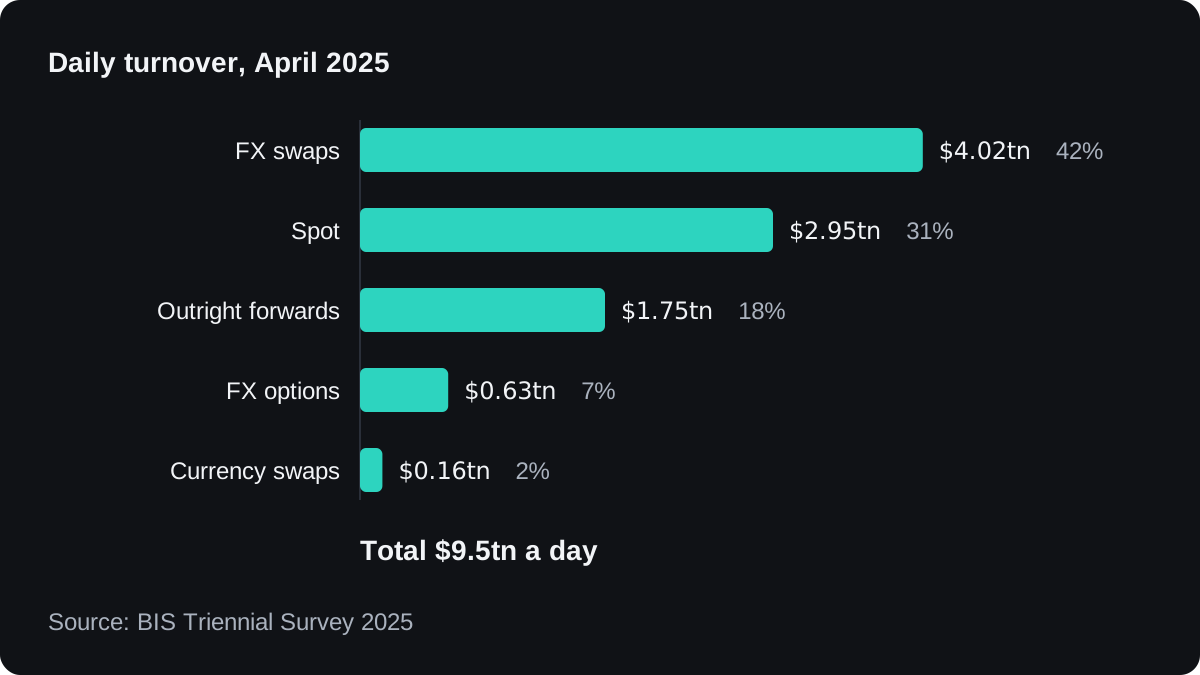
The largest instrument was the FX swap, an exchange now paired with the reverse exchange later, at $4.02 trillion a day (42%). Spot, an exchange at today's rate settled within two business days, came next at $2.95 trillion (31%).
Outright forwards, a rate fixed now for one exchange on a later date, were $1.75 trillion (18%). FX options were $0.63 trillion (7%) and currency swaps $0.16 trillion (2%). Ways to trade forex explains each instrument.
Dealers in the United Kingdom, the United States, Singapore and Hong Kong handled about 75% of turnover, the UK alone about 38%.
Dealers reported $242 billion a day as retail-driven, 2.5% of the total, of which $109 billion was spot.
BIS counts a trade as retail-driven when it comes from private individuals trading for their own account, and is speculative, leveraged and cash-settled. The figure covers what dealers identified, which may not be every retail trade.
What is liquidity?
Liquidity is how easily you can buy or sell without moving the price much. In a liquid market, many participants quote sizeable amounts close to the current price.
The best bid (where you sell) and the best ask (where you buy) then sit close together, and each can absorb a large order. The gap between them, the spread, stays narrow.

When fewer participants quote, liquidity thins. The spread widens, and a large order may fill at several prices instead of one.
Brokers get much of their pricing from liquidity providers: banks and non-bank firms that stream tradable prices to brokers and trading platforms.
When is the forex market open?
By market convention, the forex week opens on Sunday at 17:00 New York time and closes on Friday at 17:00. No regulator sets these hours.
In UTC that is 22:00 while New York is on standard time and 21:00 on daylight saving time. In between, the market trades around the clock.
Traders split the day into four sessions, each roughly a working day in its city:
| Session (roughly) | January, UTC | July, UTC |
|---|---|---|
| Sydney | 20:00 to 05:00 | 21:00 to 06:00 |
| Tokyo | 00:00 to 09:00 | 00:00 to 09:00 |
| London | 08:00 to 17:00 | 07:00 to 16:00 |
| New York | 13:00 to 22:00 | 12:00 to 21:00 |
| London and New York overlap | 13:00 to 17:00 | 12:00 to 16:00 |
The times shift because clocks change on different dates: in 2026, 8 March and 1 November in the US, 29 March and 25 October in the UK, 5 April and 4 October in Sydney. Tokyo has no clock change.
Between 25 October and 1 November 2026, for example, London runs 08:00 to 17:00 UTC and New York 12:00 to 21:00, a five-hour overlap.
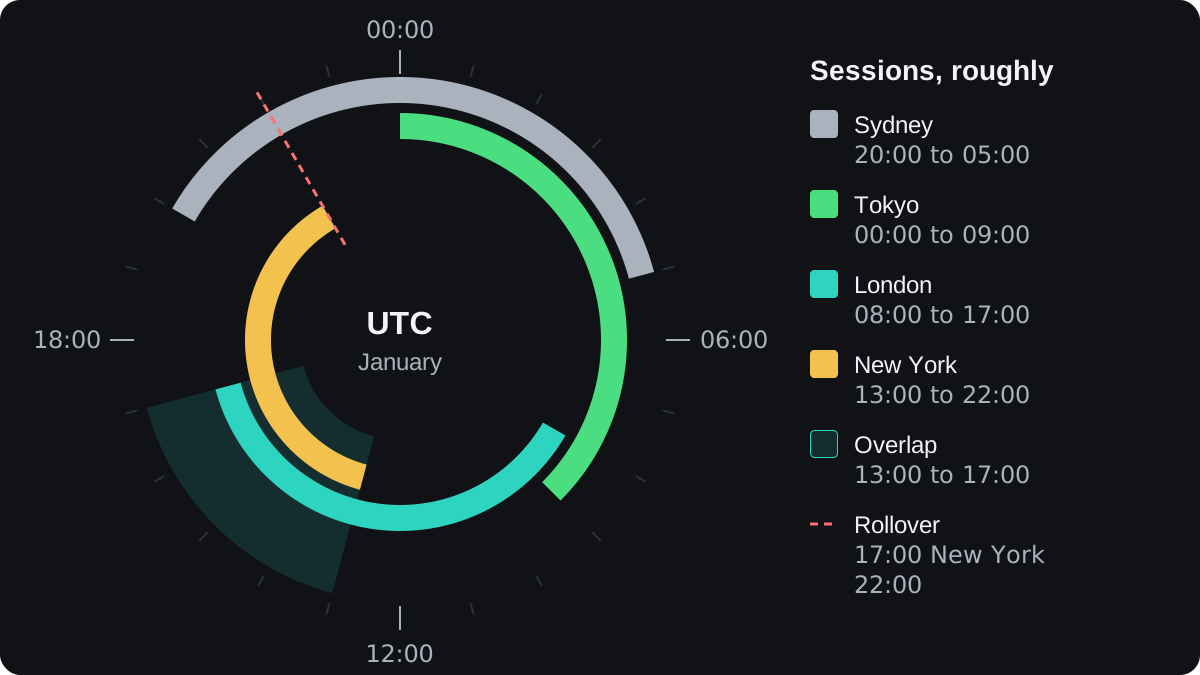
The market hours tool shows the sessions in your own time zone.
How do spreads change through the day?
AutoFXRebate recorded EUR/USD spreads about every five minutes on eight accounts at Exness and XM, from 01:08 UTC on Thursday 29 October to 01:08 UTC on Friday 30 October 2026.
In that sample, the trading sessions made little difference to the quoted spread. Exness Standard's hourly median was 0.8 pip in every UTC hour but one, and XM Standard's stayed between 1.9 and 2.2 pips.
The exception was 17:00 New York, the daily rollover. A position held past it moves to the next value date, the day its currencies would change hands.
At that point your broker charges or pays a swap based on the interest-rate gap between the two currencies. This overnight swap is a different thing from the FX swap in the BIS figures.
On 29 October New York was still on daylight saving time, so rollover fell at 21:00 UTC. Exness Standard quoted EUR/USD at 0.8 pip at 20:55 and 2.2 pips at 20:59.
The feed then had no reading until 21:10, when the spread was 9.2 pips. It held at 13.5 pips from 21:16 to 21:35 and read 0.8 again at 22:00. XM Standard reached 12.8 pips at 21:55.
Spreads were also wide at the week's open. On Sunday 25 October 2026, the last Exness Standard reading in the 21:00 UTC hour was 5.2 pips; in the next hour it was 0.8.
The accounts also differed from each other. Median spreads ran from 0.0 pip on Exness Raw Spread and Zero to 2.0 pips on XM Standard.
Exness Standard and Standard Cent sat at 0.8, Exness Pro at 0.6, and Exness Standard Plus and XM Ultra Low Standard at 1.1.
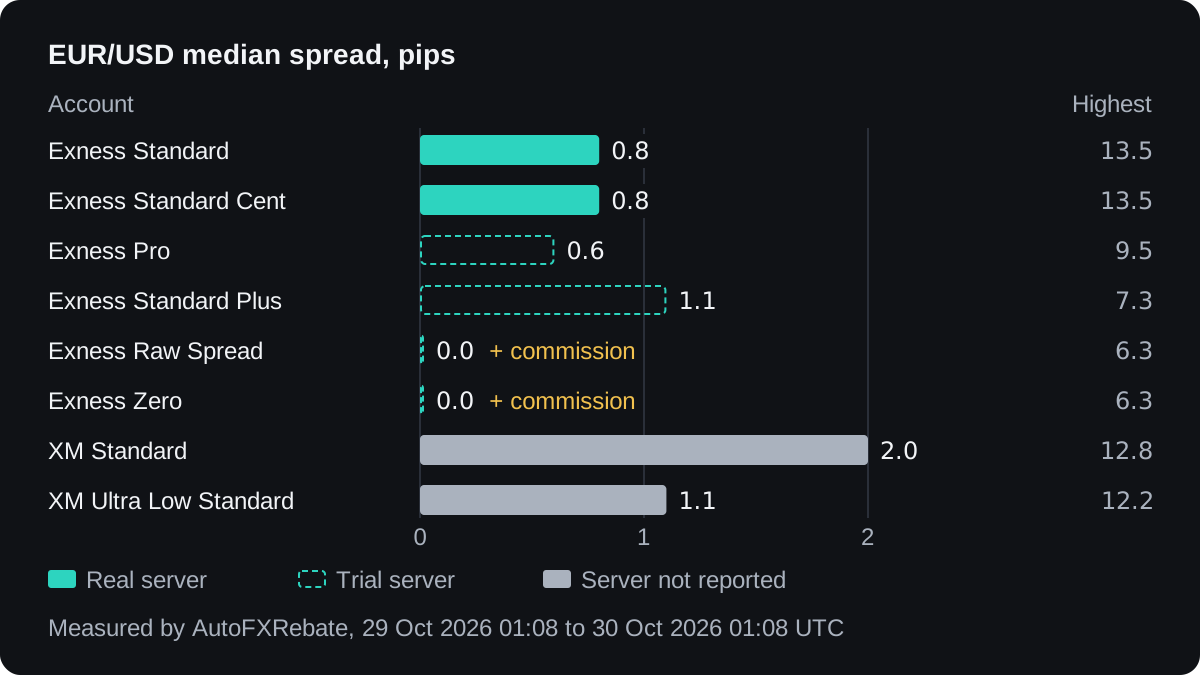
Raw Spread and Zero quote close to 0.0 because they charge a commission per lot, so a 0.0 spread does not make a trade free.
The highest single reading on each account ran from 6.3 pips on those two to 13.5 pips on Exness Standard and Standard Cent.
Only Exness Standard and Standard Cent ran on Real servers; the other four Exness accounts ran on Trial servers, used for demo accounts.
The feed does not record which XM servers were used, and the readings cover a single weekday. The spread comparison shows current readings.
คำถามที่พบบ่อย
How big is the forex market?
Average daily turnover was $9.5 trillion in April 2025, up 27% from 2022, in the final results of the BIS Triennial Survey.
Is the forex market open 24/7?
No. It trades around the clock from Sunday 17:00 to Friday 17:00 New York time and is closed at weekends, so Sunday's first price can differ from Friday's close.
What time does the forex market open on Sunday?
At 17:00 New York time: 21:00 UTC while New York is on daylight saving time and 22:00 UTC in winter. It closes at the same New York time on Friday.
What happens to spreads at 17:00 New York time?
That is the daily rollover, and spreads widen briefly around it. In AutoFXRebate's sample on 29 October 2026, Exness Standard's EUR/USD spread rose from 0.8 pip to 13.5 pips and was back at 0.8 by 22:00 UTC.
เรียนต่อ
 บทที่ 1What is forex trading?Forex trading is exchanging one currency for another, either because a business needs the currency or to profit from a change in the exchange rate. Prices are quoted in pairs such as EUR/USD, with a bid to sell at and an ask to buy at. Forex turnover averaged $9.5 trillion a day in April 2025.
 บทที่ 1What is traded in the forex market?The forex market trades currencies, always two at a time: every deal buys one and pays with another. Eight are known as the majors, and the US dollar was on one side of 89% of turnover in April 2025. A retail trader receives no currency and instead holds a cash-settled contract with a broker.
 บทที่ 1How does buying and selling a currency pair work?Buying a currency pair buys the first currency and sells the second, so you gain if the price rises. Selling does the opposite and gains if it falls. A buy opens at the ask and closes at the bid, and a sell does the reverse. Profit and loss land in the quote currency.
 บทที่ 1Ways to trade forex: spot, forwards, swaps, futures, options and CFDs.Currencies change hands as spot deals, outright forwards, FX swaps, currency swaps, options and futures. Spot settles within two business days, a forward fixes a rate for a later date, and an FX swap pairs an exchange now with its reverse later. Retail traders usually trade CFDs or rolling spot, cash-settled contracts with a broker.

