Is crypto an asset class of its own?
Crypto has its own markets and its own price drivers, two marks of an asset class. It differs from stocks and bonds in one basic way: most coins pay no income, so their price rests on demand alone. Some funds and investors now give it a separate slot, and whether that lasts is still debated.
Nội dung này hiện chỉ có bản tiếng Anh.

A pension fund does not pick investments one by one. It first splits its money into buckets, such as stocks, bonds, cash and property, then chooses what goes into each bucket.
The question for crypto is whether it gets a bucket of its own, or belongs in an existing one, such as commodities or technology stocks. The answer changes how much risk it adds and how it gets managed.
What makes an asset class?
An asset class is a group of investments that earn their return in a similar way and tend to react to the same news. Stocks are one class, and government bonds are another.
The quickest test is to ask what pays the holder. A share gives you a slice of company profits. A bond pays interest, and so does cash in a deposit.
Gold pays nothing. Its owner gains only if someone later pays a higher price. Bitcoin works the same way, which is why people often compare the two.
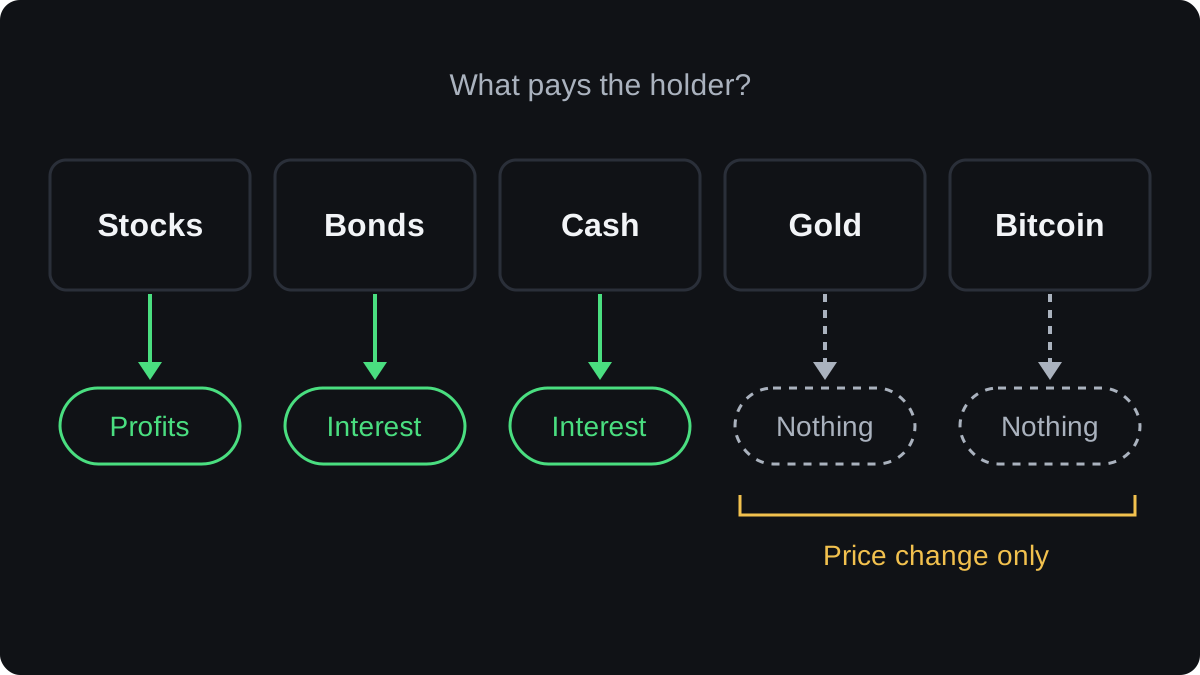
An asset with no income is harder to value. You cannot add up its future payments, as you would for a bond, so its price depends on how much the next buyer wants it.
The case for a separate class
Crypto has price drivers that stocks and bonds do not share. Supply rules such as the Bitcoin halving, how much a network is used, hacks and new crypto laws all move it.
It also has its own market plumbing. Coins trade on dedicated exchanges every day of the year and can be held in wallets that no bank runs.
Regulated funds have joined in. In some countries you can buy a spot Bitcoin ETF through an ordinary brokerage account, much as you would buy a stock index fund.
The last argument is behaviour. Bitcoin has moved in its own large boom and bust cycles, with swings several times larger than those of a major stock index.
The case against
Most coins earn no income, and there is no agreed way to value them. Two careful analysts can study the same coin and reach prices that are far apart.
The word "crypto" also covers assets that behave very differently, from dollar stablecoins to meme coins. One bucket for all of them hides more than it explains.
Its link to stock markets is not stable either. In some periods, such as 2022, crypto fell together with technology stocks while interest rates were rising.
An asset class earns its own bucket partly by behaving differently from the others. When it falls at the same time as stocks, that benefit disappears, as the correlation and portfolio risk lesson explains.
Finally, the history is short. Bitcoin has existed since 2009, which is not long enough to see how it behaves through many kinds of economy.
How deep can crypto falls go?
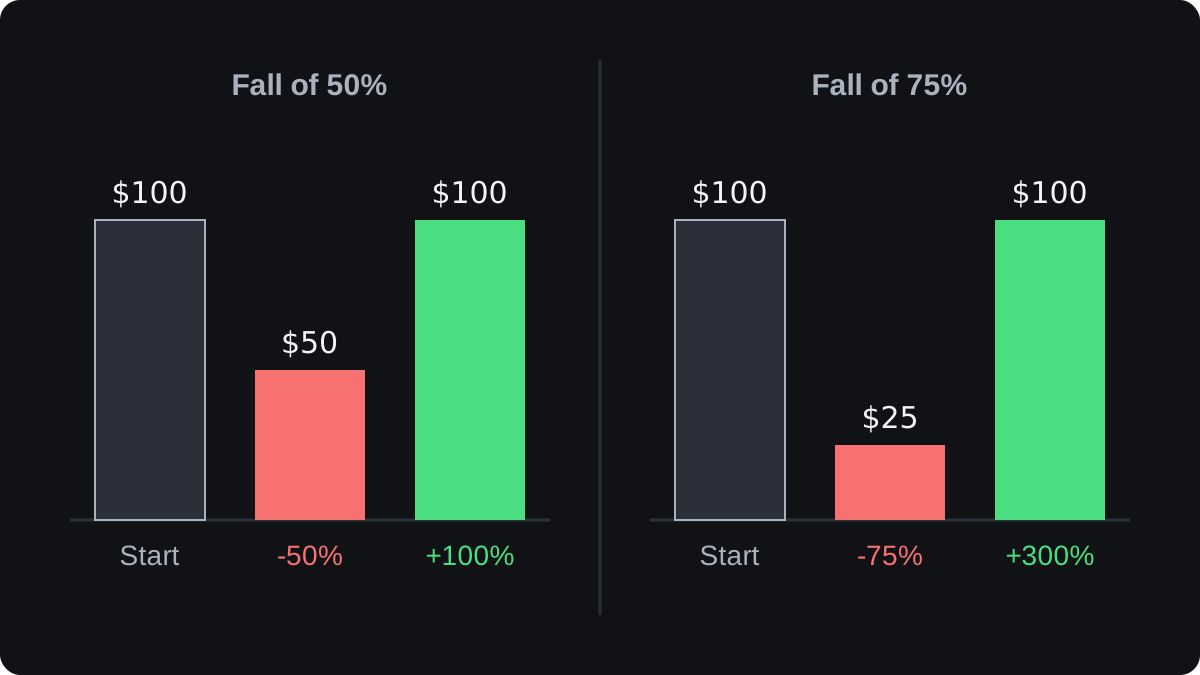
A fall and a rise of the same size do not cancel out. If an asset falls 50%, it needs a 100% gain to get back to where it started. After a 75% fall, it needs a 300% gain.
The maths is the same for every asset, and bitcoin has fallen by more than 70% from a peak more than once. The drawdown lesson works through the recovery formula.
Worked example: a small slice of a portfolio
Because crypto swings so far, the size of the slice decides how much it can hurt. Here is the arithmetic with round illustrative numbers. It shows how sizing works and is not a suggested size.
- You hold a $10,000 portfolio and put 5% of it, $500, into crypto.
- Crypto falls 70%. The $500 becomes $150, a loss of $350, which is 3.5% of the portfolio. The portfolio is now worth $9,650.
- Crypto doubles instead. The $500 becomes $1,000, a gain of $500, which is 5% of the portfolio. The portfolio is now worth $10,500.
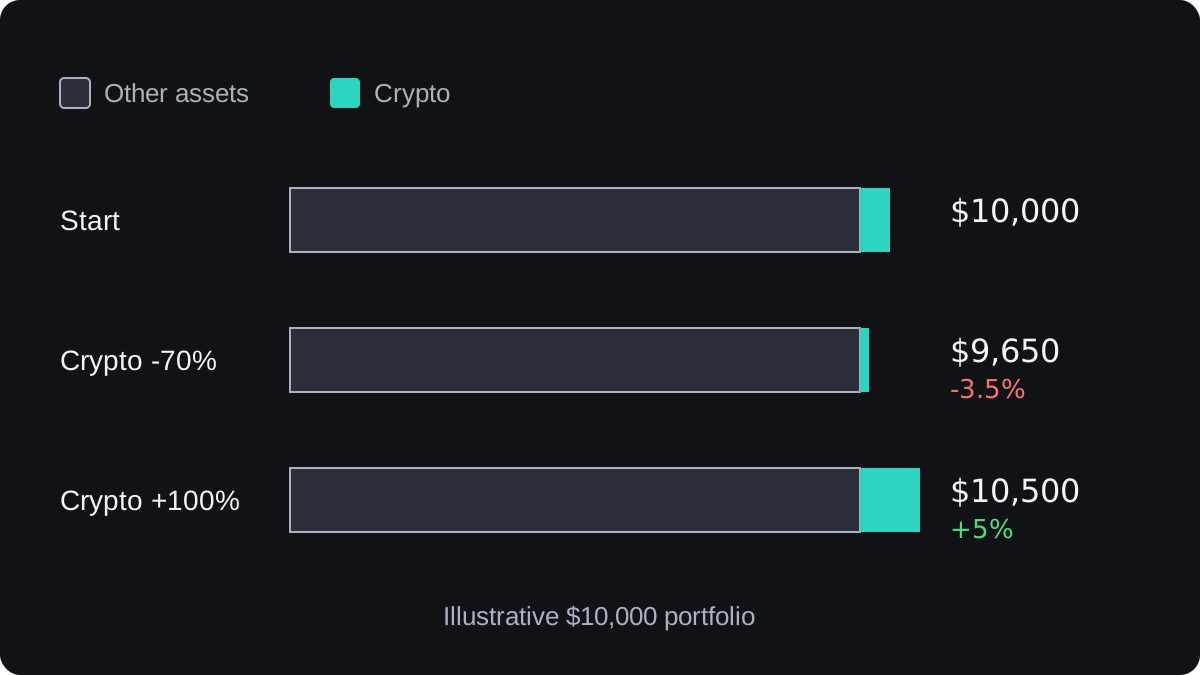
This example keeps the rest of the portfolio flat. If stocks fall at the same time, the total loss is larger. For trading accounts, the same idea is covered in how much to risk per trade.
Which kind of crypto are we talking about?
When people ask whether crypto is an asset class, they usually mean bitcoin. The answer shifts for other coins, because each type earns and behaves differently:
| Type | Closest comparison | What drives the price |
|---|---|---|
| Bitcoin | A scarce commodity, like gold | Demand against a fixed supply |
| Ether and other platform coins | Fuel for a tech platform | Network use, fees, staking rewards |
| Stablecoins | Cash | Should not move; rests on the issuer's reserves |
| Meme coins | A bet on popularity | Attention and mood |
Some platform coins pay staking rewards for helping to secure the network, which look a little like interest. They carry their own risks, covered in what is staking.
Câu hỏi thường gặp
Is Bitcoin a commodity or a currency?
It has features of both, and regulators in different countries classify it differently. Its fixed supply and lack of income make it look more like a commodity such as gold than a currency managed by a central bank.
Does crypto pay dividends or interest?
Bitcoin pays neither. Some platform coins pay staking rewards, and some exchanges and lenders offer interest on deposits, with the risk that the platform fails.
Is crypto a hedge against inflation?
The record is mixed. No one can speed up Bitcoin's supply schedule, yet its price fell sharply in 2022 while inflation was high in many countries, so it has not protected purchasing power reliably.
How much of my portfolio should be in crypto?
That is a personal decision, and this lesson cannot give you a right amount. You can test any size the way the worked example does: work out what a 70% fall would cost you before you buy.
Học tiếp
 Chương 1What is cryptocurrency?Cryptocurrency is digital money recorded on a shared public ledger called a blockchain. A network of computers checks every transfer, and no central bank issues the coins. You control your coins with a secret private key, and the price is whatever buyers and sellers agree to trade at.
 Chương 1How is crypto different from forex?Forex is the trade of national currencies, issued by central banks and traded around the clock on weekdays. Crypto is the trade of digital coins that mostly have no central issuer, and it trades at weekends too. Crypto prices usually swing much further in a day, and you can own the coin or trade a contract on its price.

