What is a crypto exchange?
A crypto exchange is a marketplace where you swap government money for coins, or one coin for another. It lists trading pairs, matches buy and sell orders, and charges a fee on each trade. Most exchanges also hold the coins you deposit, so the exchange is your custodian as well as your market.
Nội dung này hiện chỉ có bản tiếng Anh.
Say you want to turn 500 dollars into bitcoin. The Bitcoin network has no shop window, so you need someone who wants to sell and a place that brings the two of you together.
That place is usually a crypto exchange, a business that lists coins and matches the orders of buyers and sellers. This lesson covers the company-run kind. The next lesson compares it with exchanges that run as code on a blockchain.
Trading pairs: what the price on the screen means
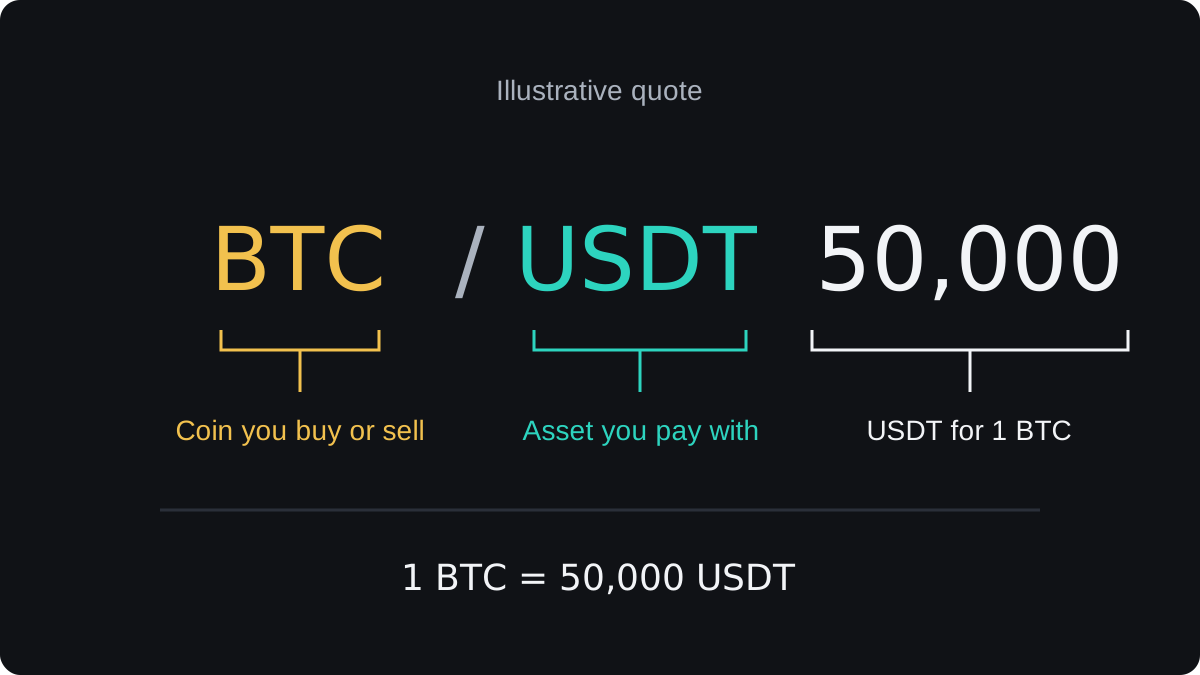
Every market on an exchange is a trading pair, such as BTC/USD or ETH/BTC. The first asset is the one you buy or sell. The second is what you pay with.
The price tells you how many units of the second asset buy one unit of the first. If BTC/USD shows 50,000 (an illustrative price), one bitcoin costs 50,000 US dollars. If ETH/BTC shows 0.05, one ether costs 0.05 bitcoin.
Many pairs are quoted in a stablecoin such as USDT or USDC. A stablecoin is a token built to track a currency, usually the US dollar.
That makes BTC/USDT read almost like BTC/USD. A stablecoin is still a separate asset, though, and its peg can slip.
How your order gets filled
Most exchanges keep an order book, a live list of open offers to buy (bids) and to sell (asks), sorted by price. The gap between the highest bid and the lowest ask is the spread.
A market order fills at once against the best offers on the other side. A limit order waits in the book at your price until someone trades with it or you cancel it.
Say the book offers 0.5 BTC at 50,000 and another 0.5 BTC at 50,100, with bids at 49,950 and 49,900. These are illustrative prices. You place a market buy for 1 BTC.
- The first 0.5 BTC fills at 50,000: 0.5 × 50,000 = 25,000.
- The next 0.5 BTC fills at 50,100: 0.5 × 50,100 = 25,050.
- You pay 25,000 + 25,050 = 50,050, an average of 50,050 per bitcoin.
- A 0.1% trading fee adds 50,050 × 0.001 = 50.05, so the trade costs 50,100.05 in total.
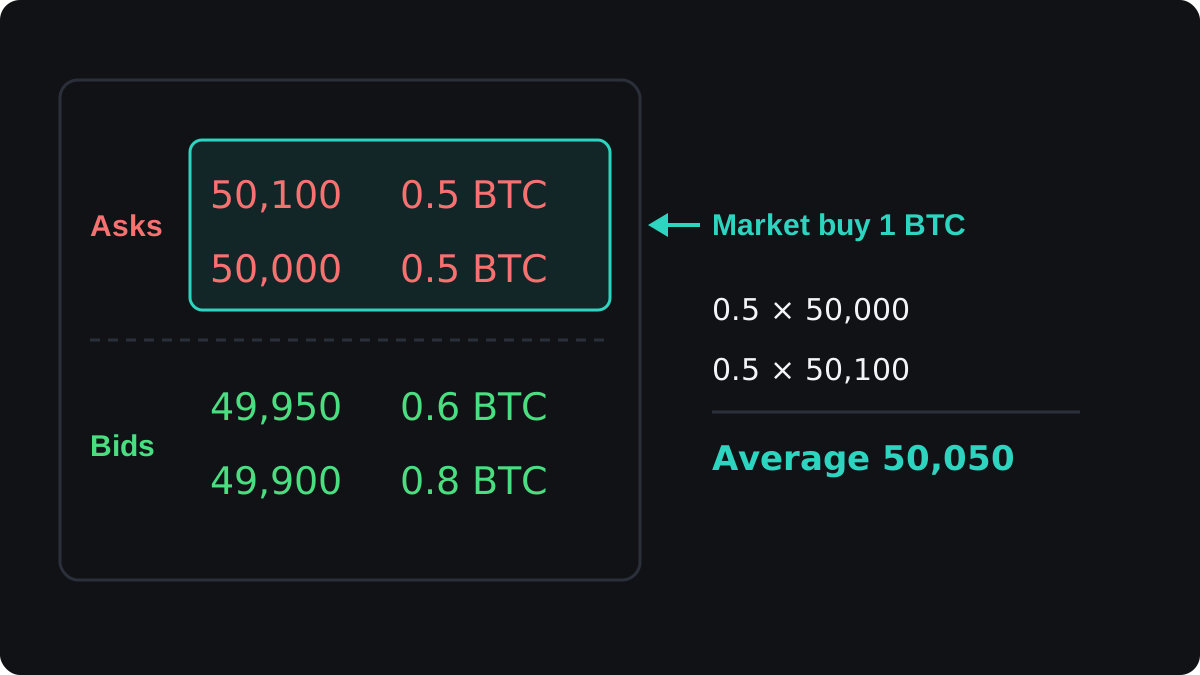
The extra 50 per bitcoin above the best ask is price impact. On a busy pair the book is deeper and that gap is small.
On a thinly traded coin it can be large, which is why the order book lesson teaches you to check depth before you trade.
Where your coins actually are
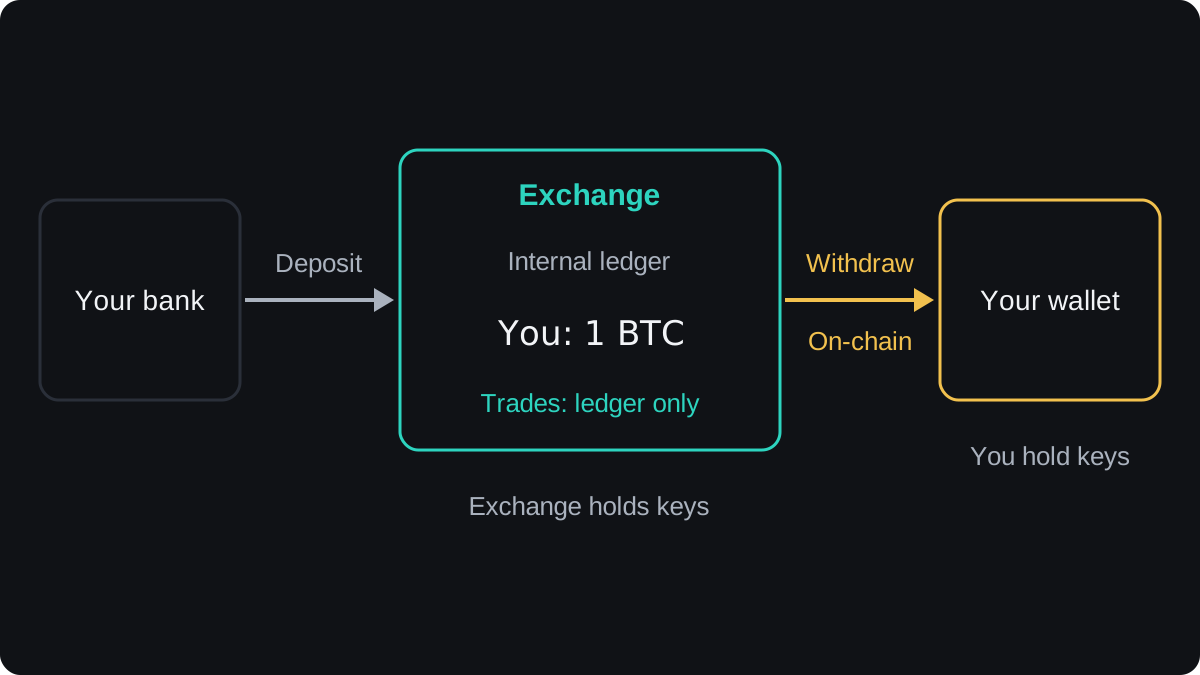
When you deposit, coins go into wallets the exchange controls and money goes into its bank accounts. Your account then shows a balance, and that balance is an entry in the exchange's own records.
Trades inside the exchange only change those records. If you buy bitcoin and sell it an hour later, nothing appears on the Bitcoin blockchain. The chain is only touched when coins move in or out.
This arrangement is custody: the exchange holds the private keys, so it controls the coins and owes you their value. Withdrawing to a wallet you control puts them under your own keys.
Custody is convenient, and it means the exchange's problems become yours. If it is hacked, goes bust or freezes withdrawals, customers can be locked out for years while courts decide who gets what.
Two large exchanges went this way. Mt. Gox halted withdrawals and filed for bankruptcy in 2014, and FTX did the same in 2022. Both cases have run for years in the courts.
How exchanges make money
An exchange earns from several fees, and the cheapest-looking screen is not always the cheapest way to buy.
- Trading fees, a percentage of each trade. Many exchanges charge less for orders that rest in the book than for orders that fill at once, as the maker and taker fees lesson explains.
- A markup on simple buy or convert screens, where your price sits above the order book price.
- Withdrawal fees, usually a fixed amount of the coin, which cover the network fee and sometimes more.
- Deposit fees on some payment methods, such as cards.
The markup is easy to miss because no fee line appears. Say a convert screen offers 1 BTC for 50,500 while the best ask in the order book is 50,000 (illustrative).
The extra 500 is a 1% markup, since 500 ÷ 50,000 = 0.01. On a 1,000 dollar purchase, that markup costs about 10 dollars.
The same purchase on the order book with a 0.1% fee costs about 1 dollar, plus the spread.
Exchange, wallet or broker?
These three services get mixed up, and each one gives you something different.
| Service | What you hold | Can you send coins elsewhere? |
|---|---|---|
| Crypto exchange | A balance the exchange holds for you | Yes, by withdrawing |
| Self-custody wallet | Your own keys and coins | Yes, at any time |
| Broker offering crypto CFDs | A contract on the price | No, there are no coins |
A crypto CFD lets you trade the price of bitcoin with a broker without owning any bitcoin. The choice between coins and CFDs comes later in this course.
Câu hỏi thường gặp
Is a crypto exchange the same as a crypto wallet?
No. An exchange is a market that usually holds coins for you, and a wallet holds keys you control. The "wallet" page inside an exchange app shows your balance in the exchange's records.
Do I own the coins I buy on an exchange?
You have a claim on them while they sit on the exchange, because the exchange holds the keys. You control them directly once you withdraw them to a wallet whose seed phrase only you hold.
Are trades on an exchange recorded on the blockchain?
Trades between customers of the same exchange stay in its internal ledger. Only deposits and withdrawals of coins create blockchain transactions.
Why did I pay more than the price on the screen?
The screen usually shows the last trade or a mid price. Your fill also includes the spread, any price impact, a trading fee and, on simple buy screens, a markup.
Học tiếp
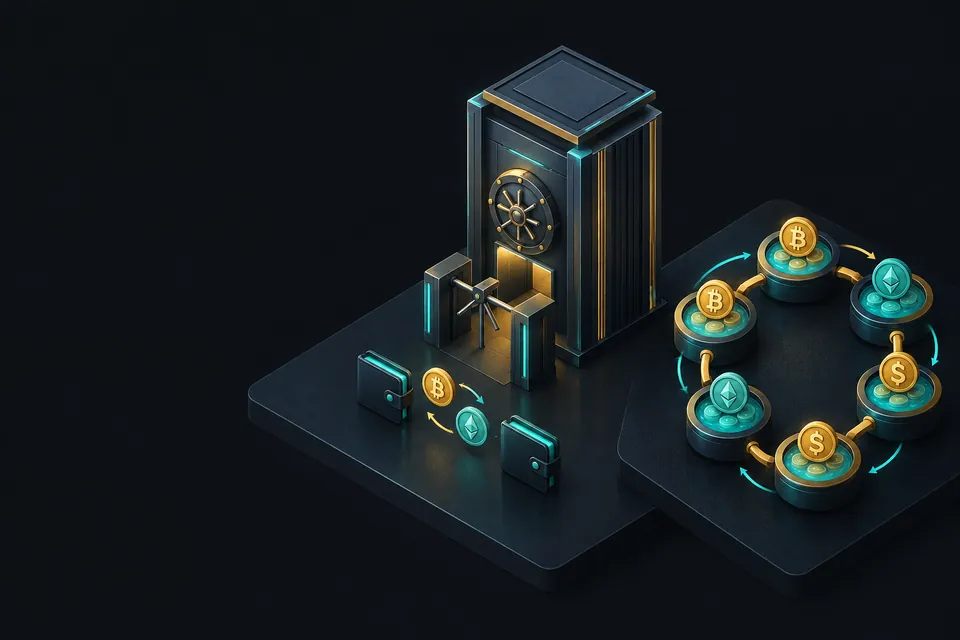 Chương 1Centralized vs decentralized crypto exchanges.A centralized exchange (CEX) is a company that holds your deposits, checks your identity and matches orders on its own servers. A decentralized exchange (DEX) is a set of smart contracts that swaps tokens straight from your own wallet. With a CEX you trust a company; with a DEX you rely on the code and on your own care.
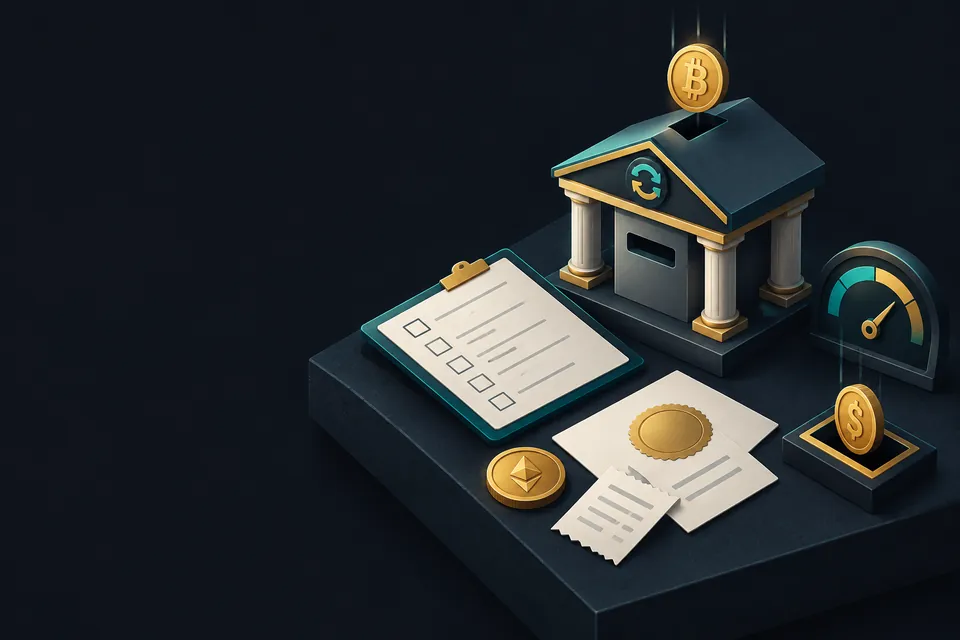 Chương 1How to choose a crypto exchange.Check five things in order: that the exchange is allowed to serve people where you live, how it holds customer funds, the full cost of buying and withdrawing under your own plan, whether its order books are deep enough for your trade size, and how a small test deposit and withdrawal go before you move larger sums.
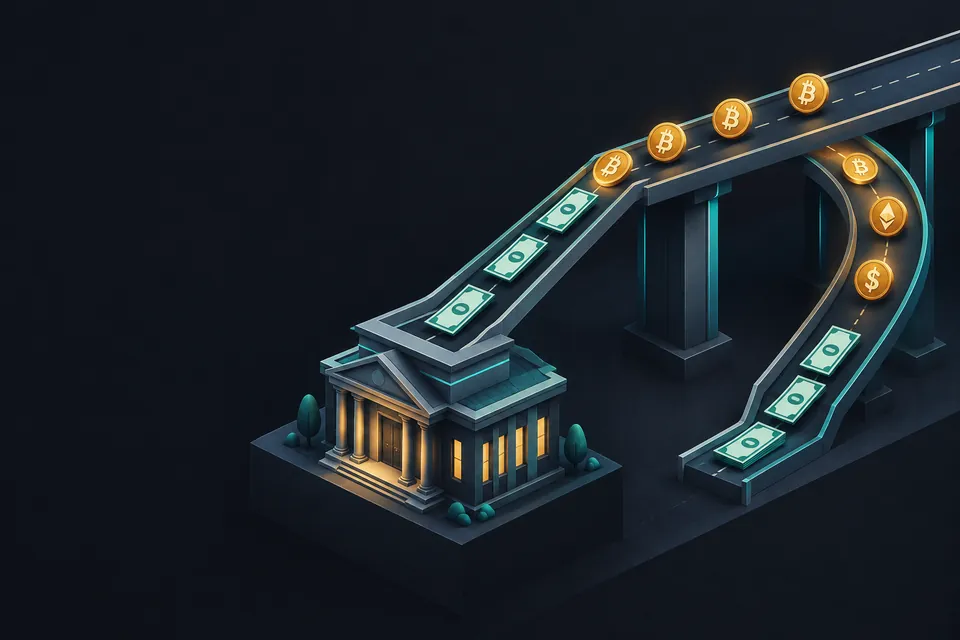 Chương 1What are fiat on-ramps and off-ramps?A fiat on-ramp is any service that turns government money, such as dollars or euros, into crypto. An off-ramp does the reverse and pays the money back to your bank account. Exchanges, card payment providers and peer-to-peer markets all do this job, and each one charges its fees in different places.
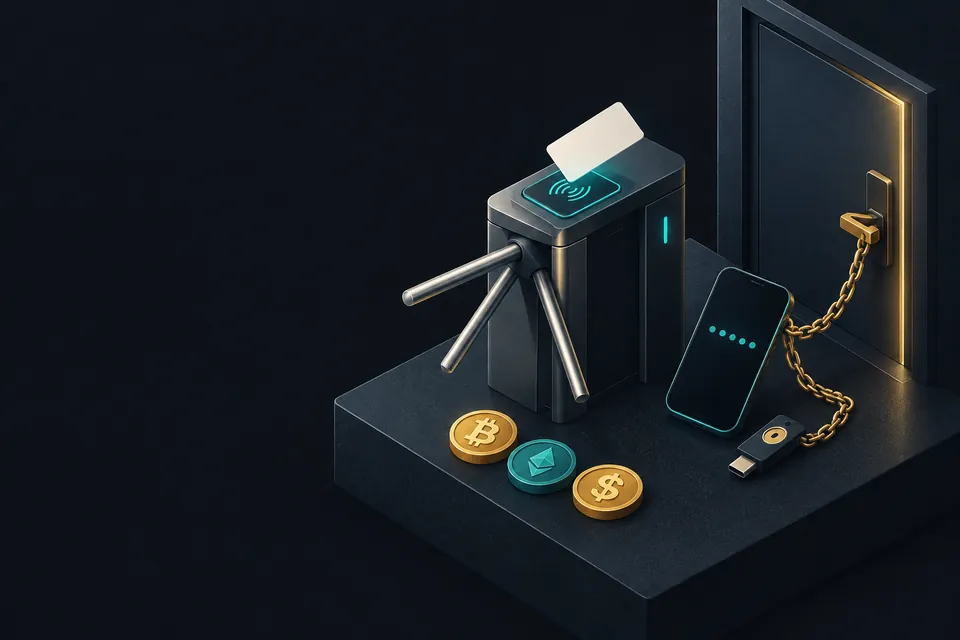 Chương 1KYC and 2FA on crypto exchanges.KYC, short for know your customer, is the identity check an exchange runs before you can deposit, trade or withdraw, usually with an ID document and a selfie. 2FA, two-factor authentication, asks for a second proof at login and withdrawal, such as an app code or a hardware security key. KYC protects the financial system; 2FA protects your account.

