How to choose a crypto exchange.
Check five things in order: that the exchange is allowed to serve people where you live, how it holds customer funds, the full cost of buying and withdrawing under your own plan, whether its order books are deep enough for your trade size, and how a small test deposit and withdrawal go before you move larger sums.
Nội dung này hiện chỉ có bản tiếng Anh.
Exchanges that list the same coin at nearly the same price can still treat you very differently. One may hide a markup in its buy price while another charges heavily to withdraw. A few have frozen customer withdrawals for months.
This lesson gives you a method to judge any exchange yourself. It names no best exchange, because the answer depends on your country and on what you plan to do.
Start with what you need
Write down your plan before you compare anything. Buying a small amount each month to hold in your own wallet needs different things from trading several times a day.
Answer these first:
- Which currency will you pay in, and by which method?
- Which coins do you want, and on which networks will you withdraw them?
- Will you mostly buy and withdraw, or trade actively?
- Roughly how large will each trade be?
The answers decide which costs matter. An active trader cares most about trading fees and liquidity. A monthly buyer who withdraws to a wallet cares more about the buy price and withdrawal fees.
Check that it may serve you
Many countries require crypto exchanges to hold a licence or registration before serving local residents. The rules differ by country and change often, so check the current position yourself.
- Find the legal entity that serves your country. The terms of service name it, often in the first lines.
- Search the national regulator's public register for that exact name.
- Confirm that the register covers the services you plan to use.
This is the same method as the broker licence check in the forex course. If an exchange's terms exclude your country but its app lets you sign up anyway, you may have no local protection when something goes wrong.
A licence does not make an exchange safe on its own, and bank deposit insurance generally does not cover crypto. Read what the terms promise, and check how your country protects customers of crypto firms.
Look at how it holds your money
An exchange usually holds your coins for you, so its safety is your safety. Look for these signs in its terms and public reports:
- Customer assets kept separate from company money, and not lent out without your consent.
- Most coins held in cold storage, offline and out of reach of online attackers.
- Proof of reserves checked by an independent firm, covering what the exchange owes as well as what it holds.
- Account protection such as app-based 2FA and withdrawal allowlists.
- How it treated customers after any past hack or outage.
Proof of reserves compares the coins in an exchange's wallets with the balances it owes customers. Say customers hold 10,000 BTC in total (illustrative). Wallets holding 10,200 BTC give a ratio of 10,200 ÷ 10,000 = 102%.
If the wallets held 9,000 BTC, the ratio would be 9,000 ÷ 10,000 = 90%. Customers as a group could not all withdraw at once.
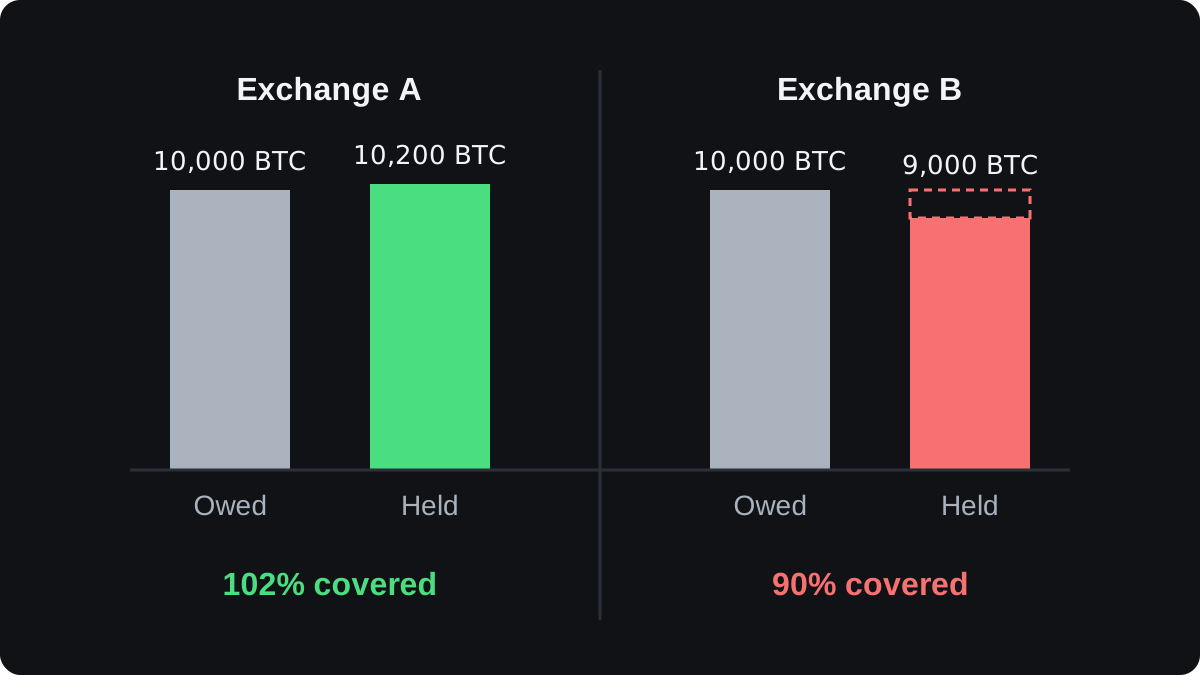
The check has limits. It is a snapshot of one moment, and coins can be borrowed for that moment. It also says nothing about debts the company owes elsewhere, so treat it as one piece of evidence among several.
Add up the full cost
Fees sit in several places: the trading fee, the spread, any markup on simple buy screens, card deposit fees and withdrawal fees. Compare the total for your own plan, since a headline fee alone can mislead.
Take a plan of buying $500 of bitcoin each month for a year, $6,000 in all, and withdrawing to your own wallet every three months. Both exchanges below are hypothetical and the fees illustrative.
- Exchange A advertises zero fees on its instant buy screen, with a 1% markup in the price: $6,000 × 1% = $60. Four withdrawals at $5 each add $20, for a total of $80.
- Exchange B charges a 0.3% trading fee on its order book: $6,000 × 0.3% = $18. The spread costs about 0.1%, or $6, and four withdrawals at $8 each add $32, for a total of $56.
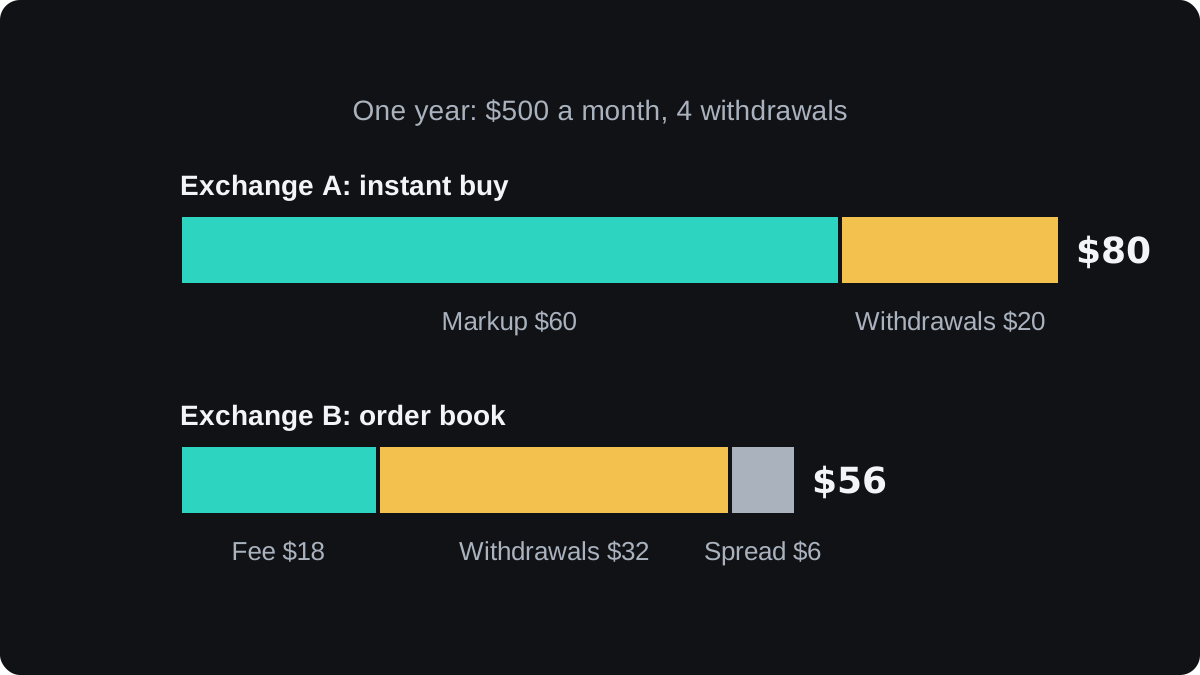
Exchange B is cheaper here even with a higher withdrawal fee. For someone who never withdraws, the gap is wider: $24 against $60. The maker and taker fees lesson shows how your order type changes the trading fee.
Check withdrawal fees for the exact coin and network you plan to use. The same coin can cost very different amounts to withdraw on different networks, and sending crypto on a network the receiver does not support can lose it.
Check liquidity and listings
Deep order books give better fills. Open the book for the pairs you plan to trade and check the spread and how much is offered near the price. A thin book means price impact on every larger order.
Reported trading volume can be inflated with fake trades between accounts the same party controls. The visible depth of the book is better evidence, and the order book lesson shows how to read it.
A long list of tiny tokens is no sign of quality. It can mean low listing standards, and small tokens are easier to push around with pump-and-dump schemes and can be delisted at short notice.
Test it small before you commit
- Open the site from an address you typed yourself, or the app from the official app store listing. Fake exchange sites are a common scam.
- Finish identity checks and turn on 2FA before you deposit.
- Deposit a small amount, buy, and withdraw to your own wallet.
- Note how long each step took and what each fee came to.
- Send support a question and see how and when they answer.
Coins you leave on an exchange carry its risk. Keeping there only what you trade, and the rest in a wallet you control, limits what one failure can cost you.
Câu hỏi thường gặp
What is the safest crypto exchange?
No exchange is free of risk, and its safety can change after any review. Judge it on its licence where you live, how it holds customer assets, its proof of reserves, account security and past problems.
Are zero-fee crypto exchanges really free?
The cost usually moves somewhere else, such as a markup in the buy price, a wider spread or higher withdrawal fees. Compare the total for your own plan, including withdrawals.
How do I check if a crypto exchange is licensed?
Find the legal entity that serves your country in the terms of service, then search that exact name in your national regulator's public register. A logo or a claim on the exchange's own website is not proof.
Is it a good idea to use more than one exchange?
Spreading balances limits the damage if one exchange fails or freezes withdrawals. Each extra account is also another login to secure and another set of fees to track.
Học tiếp
 Chương 1What is a crypto exchange?A crypto exchange is a marketplace where you swap government money for coins, or one coin for another. It lists trading pairs, matches buy and sell orders, and charges a fee on each trade. Most exchanges also hold the coins you deposit, so the exchange is your custodian as well as your market.
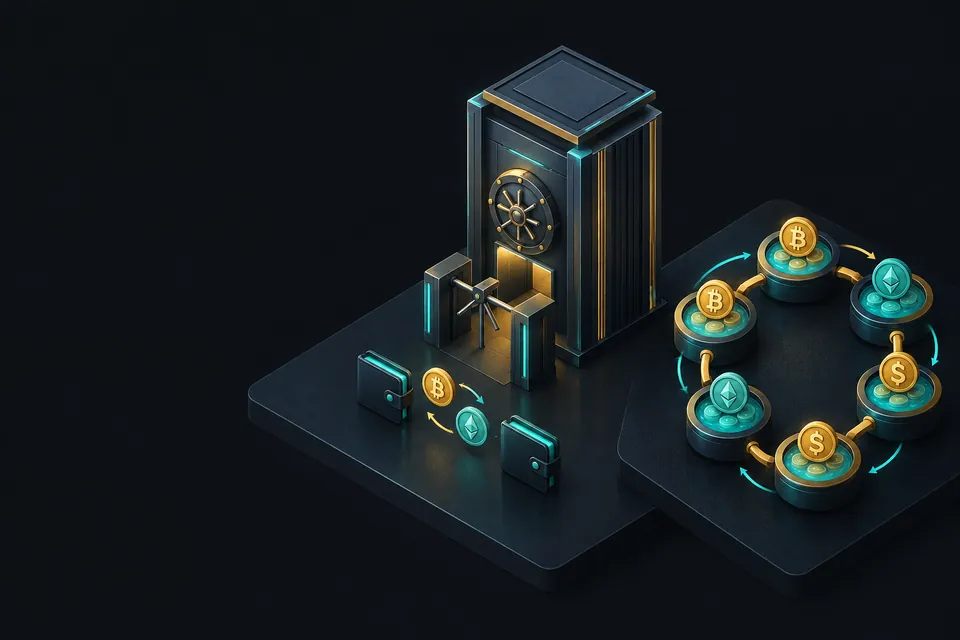 Chương 1Centralized vs decentralized crypto exchanges.A centralized exchange (CEX) is a company that holds your deposits, checks your identity and matches orders on its own servers. A decentralized exchange (DEX) is a set of smart contracts that swaps tokens straight from your own wallet. With a CEX you trust a company; with a DEX you rely on the code and on your own care.
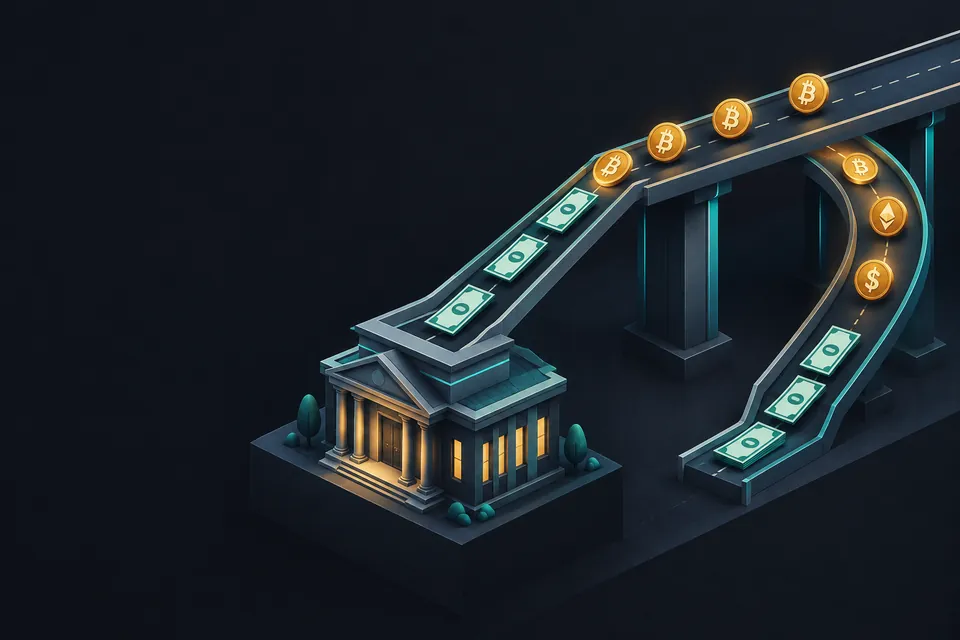 Chương 1What are fiat on-ramps and off-ramps?A fiat on-ramp is any service that turns government money, such as dollars or euros, into crypto. An off-ramp does the reverse and pays the money back to your bank account. Exchanges, card payment providers and peer-to-peer markets all do this job, and each one charges its fees in different places.
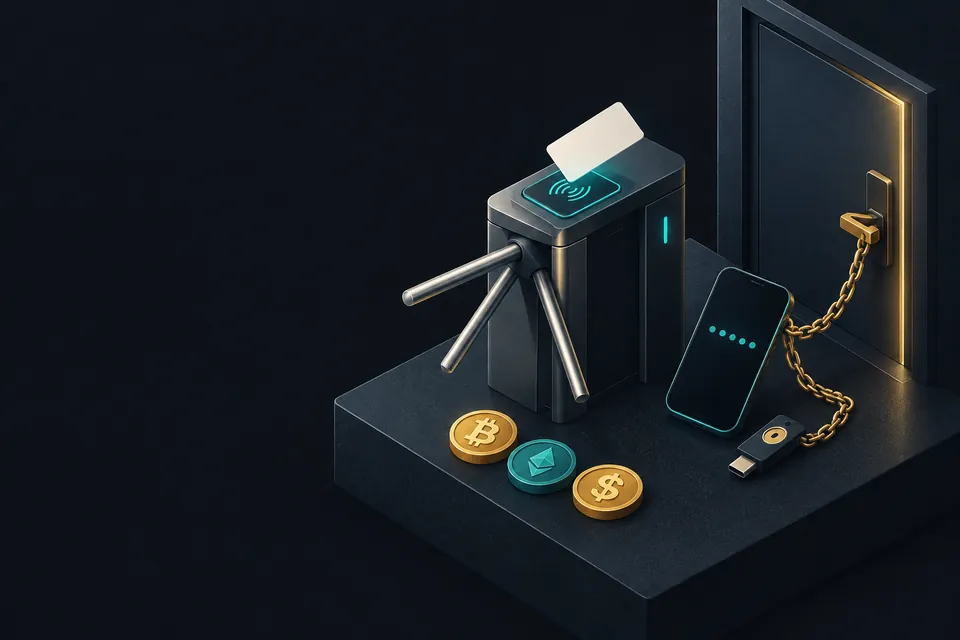 Chương 1KYC and 2FA on crypto exchanges.KYC, short for know your customer, is the identity check an exchange runs before you can deposit, trade or withdraw, usually with an ID document and a selfie. 2FA, two-factor authentication, asks for a second proof at login and withdrawal, such as an app code or a hardware security key. KYC protects the financial system; 2FA protects your account.

