How to spot a crypto scam.
To spot a crypto scam, check four things. The offer: a guaranteed or high fixed return. The person: a stranger who contacted you first and wants speed or secrecy. The platform: an unknown app that wants a fee before you can withdraw. The payment: a request for your seed phrase, a wallet approval or a transfer to a personal address.
Crypto scams change their story often, but the moves underneath repeat. You can check any offer in four places: the offer itself, the person, the platform and the payment.
Red flags in the offer
- The return is guaranteed, or high and fixed with "no risk". Crypto prices move both ways, so no honest platform can promise profit without risk.
- The return is quoted per day or per week, which makes a huge number sound small.
- Your profit depends on bringing in friends.
- A deadline pushes you to decide today.
One quick test exposes a fixed-return offer: compound the promise for a year.
Take an offer of 1% a day, which sounds modest. With illustrative numbers, $1,000 growing at 1% a day for 365 days becomes $1,000 × 1.01 to the power of 365, or about $37,800.
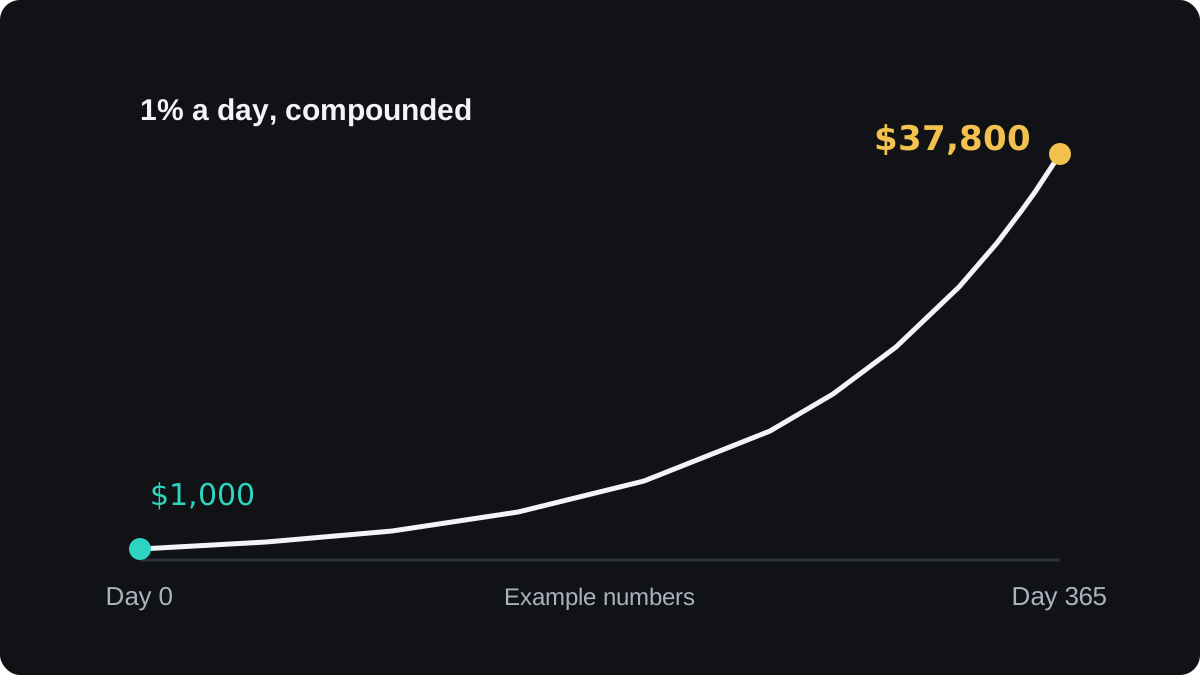
Keep going for three years at the same rate and the $1,000 becomes about $54 million. Anyone who could really do that would have no reason to ask for your money.
Red flags in the person
- They contacted you first, through a "wrong number" message, a dating app or a reply to your post.
- They move the chat to a private messaging app soon after.
- They claim inside tips, a contact at an exchange or a secret trading method.
- They tell you to keep it from your family or your bank.
- They ask you to share your screen or install remote access software.
A message from a friend's account can come from whoever hacked it. If a friend suddenly pitches an investment, call them before you act.
A video call no longer proves much either. Faces and voices can be faked with AI tools, so judge the request itself: a stranger with an investment idea is the warning sign, however real they look.
Red flags in the platform
- You are told to install the app from a link or a test (beta) profile instead of the official app store.
- The web address differs from a known brand by a letter or an extra word.
- Support exists only in a chat window, and nobody can point you to the firm's entry on a regulator's register.
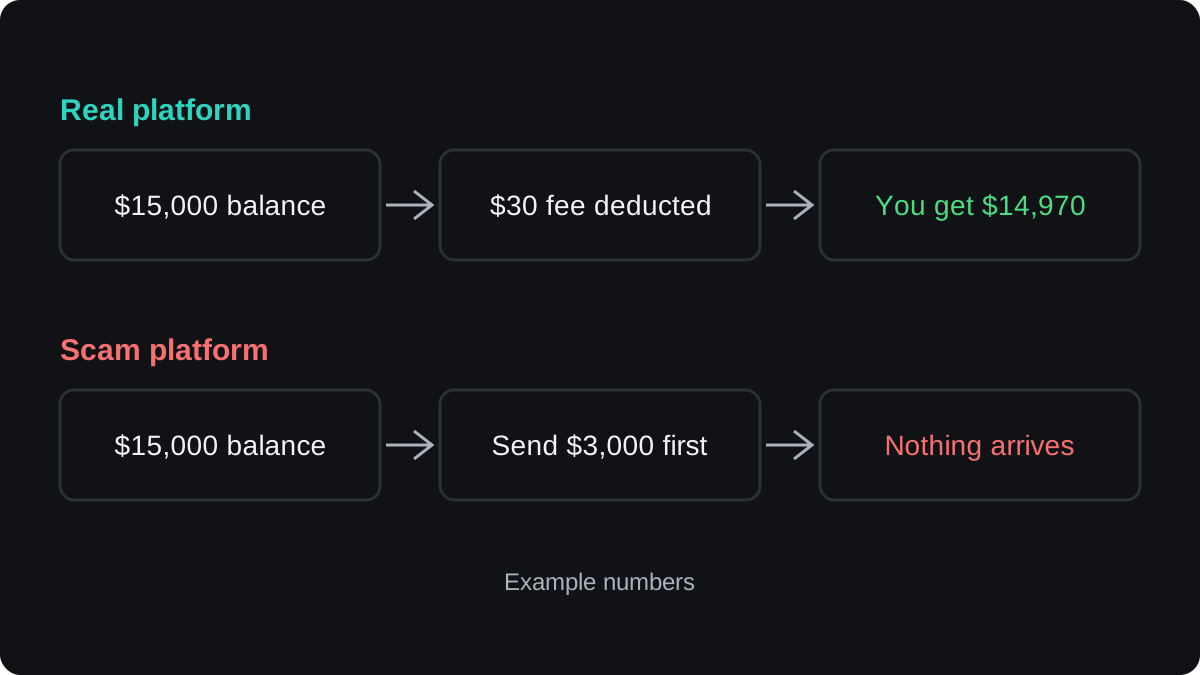
- A withdrawal needs a fee, tax or "release deposit" paid with new money.
The last sign is the most telling. Here it is with illustrative numbers. A real platform takes its fee out of your balance: withdraw $15,000, pay a $30 fee, receive $14,970.
A scam asks you to send $3,000 of new money before it releases anything. After you pay, nothing arrives, or a new fee appears.
To check a firm's licence, search the regulator's own register, as the forex lesson on checking a broker's licence shows.
Red flags in the payment request
- Anyone asks for your seed phrase or private key. No real exchange, wallet maker or support team needs it.
- Someone sends you a wallet address in a chat to pay into, instead of you using a deposit address shown inside an account in your own name.
- A site asks you to connect your wallet and sign something you do not understand, especially an approval with no spending limit.
- Someone wants payment in gift cards, or guides you on the phone while you buy crypto at an ATM.
Tests to run before you send anything
- Find the platform yourself. Type the address of the exchange or wallet you know, or use a bookmark. Do not follow a link from a message or a search ad.
- Search the platform's name together with words like "scam" or "withdrawal".
- Ask someone you trust. Scammers push secrecy because an outside opinion tends to end the scam.
- Do not treat a small withdrawal as proof. Fake platforms pay out small sums on purpose, to win a larger deposit.
How a genuine service compares
Put the four checks side by side and the gap is easy to see:
| Check | Genuine exchange or wallet | Scam platform |
|---|---|---|
| Returns | None promised; prices go up and down | Fixed, high and always positive |
| First contact | You found it and signed up yourself | Someone found you and brought you in |
| Withdrawal fee | Small, taken from your balance | Large, paid with new money first |
| Seed phrase | Never asked for | Asked for to "verify" or "sync" |
One mismatch is enough reason to stop. Scams rarely fail only one of these checks.
The lesson on common crypto scams walks through how each scheme plays out. For brokers, the forex lesson on spotting a forex scam covers the same signs.
Questions
What is the clearest sign of a crypto scam?
A guaranteed return, especially a high fixed one paid daily or weekly. Crypto prices move both ways, so a promise of steady profit means someone is hiding the risk or paying you with other people's money.
Can a scam website look professional?
Yes. Exchange-style dashboards, live charts and chat widgets are cheap to copy, so a polished design tells you nothing about who controls the money.
Is a platform safe if I have withdrawn money from it before?
Not necessarily. Fake platforms often allow a small first withdrawal to build trust before they ask for larger deposits.
Will a real exchange ever ask for my seed phrase?
No. An exchange account uses a password and two-factor authentication, and a wallet's seed phrase never needs to leave your hands. Anyone asking for it wants your coins.
Keep learning
 Chapter 4What are the most common crypto scams?The most common crypto scams are fake investment platforms that show profits you can never withdraw, schemes that promise fixed returns, impersonators running fake giveaways or support chats, phishing sites and wallet drainers that steal access, and rug pulls. They all rely on one fact: a confirmed crypto transfer cannot be reversed.
 Chapter 4How to protect yourself from crypto scams.To protect yourself from crypto scams, keep your seed phrase offline and never share it, use an authenticator app for 2FA, and keep only small sums in a hot wallet. Send a small test before any transfer to a new address, read what you sign, and treat strangers who contact you about money as scammers until you check them.

