How to read a crypto order book.
An order book is the live list of limit orders waiting on an exchange. Sell orders, the asks, sit above the price and buy orders, the bids, sit below it. Each row shows a price and an amount. The gap in the middle is the spread, and the running totals show how far a large order would move the price.

Most exchange trading screens show a column of numbers next to the chart, red on top and green below, changing several times a second.
That column is the order book: every buy and sell order waiting to trade, sorted by price. Once you can read it, you can see what a trade will cost before you place it.
What the order book lists
Each row in the book holds one or more limit orders: instructions to buy or sell an amount at a set price or better. Orders at the same price are added together into one row.
The book has two sides. The asks are sell orders, usually shown in red, and they sit above the price. The bids are buy orders, usually shown in green, and they sit below it.
Both sides are sorted so that the best prices meet in the middle. The lowest ask sits just above the highest bid.
Each row shows a price and the amount waiting there. Exchanges often add more columns, such as the money value of that row or a running total from the middle outward. Check the column names on yours.
Here is a small book with round illustrative numbers, for a coin priced in dollars:
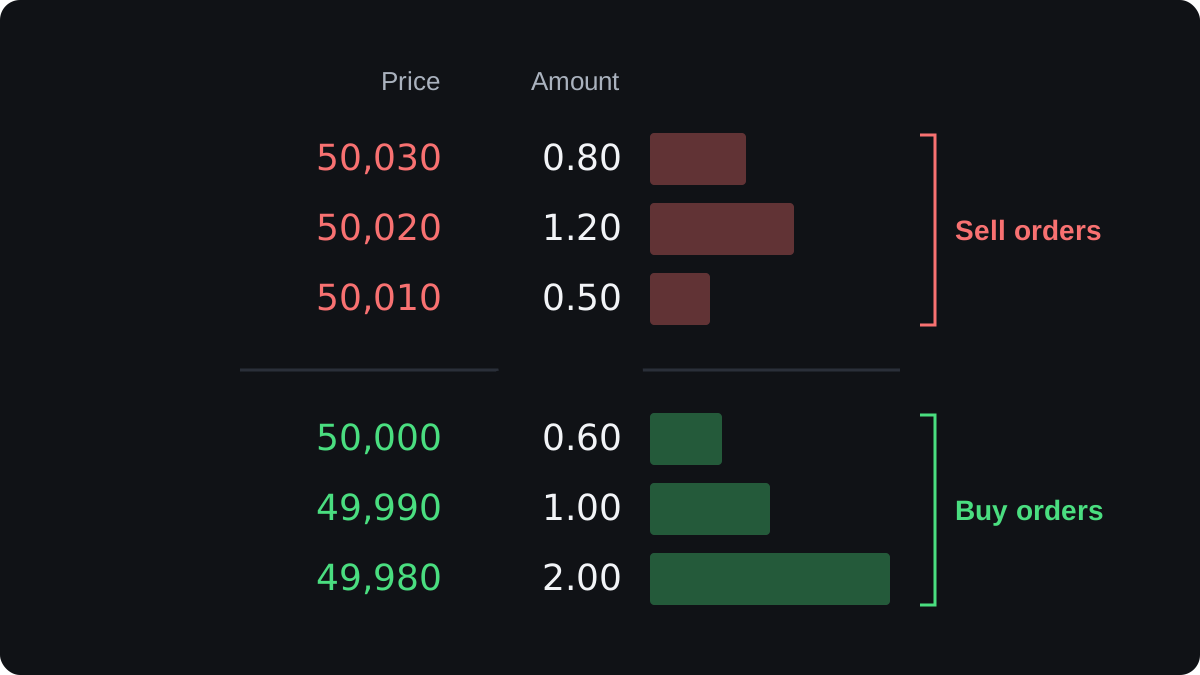
Finding the spread and the best prices
The lowest ask is the best price you can buy at right now, 50,010 in the example. The highest bid is the best price you can sell at, 50,000.
The gap between them is the spread: 50,010 minus 50,000 = 10, about 0.02% of the mid price of 50,005. The lesson on bid, ask and spread in crypto shows the percentage method.
Many exchanges print the last traded price between the two sides. It tells you where the most recent trade happened, while your own fill depends on what is in the book now.
Worked example: a market buy walks up the book
A market order takes whatever is on the other side of the book, starting from the best price. Say you place a market buy for 2.0 coins in the example book.
- The best ask holds 0.50 at 50,010. You take all of it: 0.50 × 50,010 = $25,005.
- The next level holds 1.20 at 50,020. You take all of it: 1.20 × 50,020 = $60,024.
- You still need 0.30. The third level has 0.80 at 50,030, so you take 0.30 of it: 0.30 × 50,030 = $15,009.
- In total you pay 25,005 + 60,024 + 15,009 = $100,038 for 2.0 coins, an average of $50,019 each.
The best ask was 50,010, so you paid 9 more per coin on average, $18 in total. That extra is price impact, and the liquidity lesson explains why it grows in thin books.
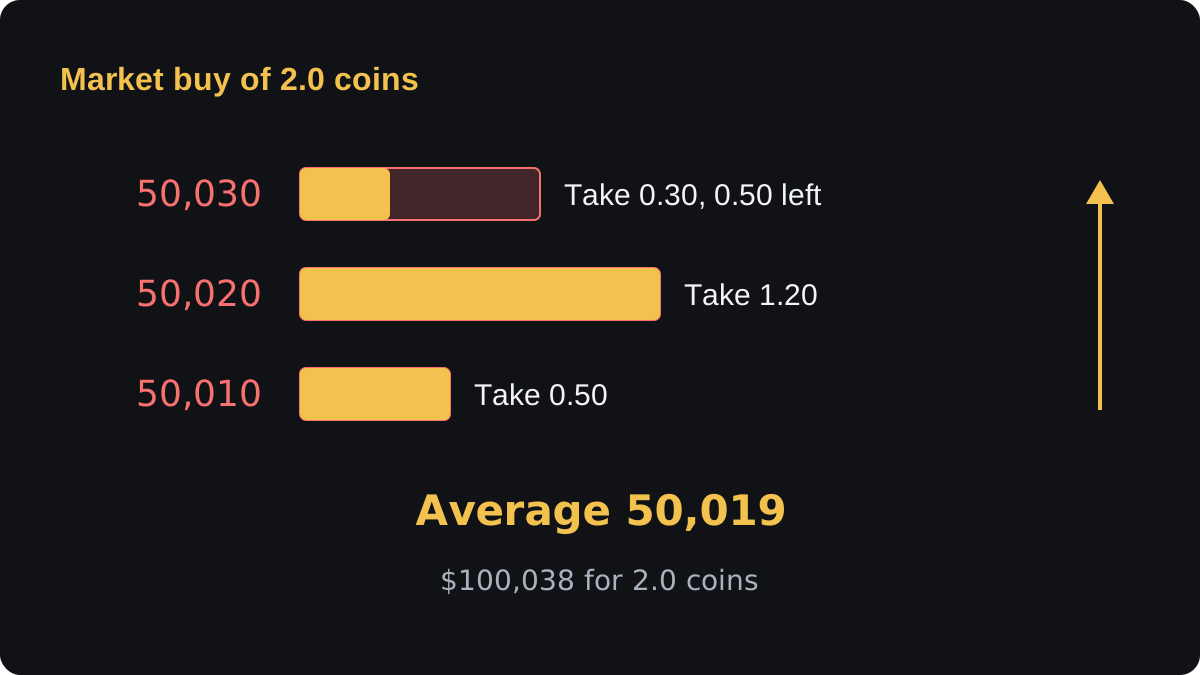
A running total tells you this before you trade. Counted from the best ask, it reaches 1.70 at 50,020 and 2.50 at 50,030, so a 2.0 coin order has to reach the third level.
After the fill, 0.50 is left at 50,030, and that is the new best ask. The spread has widened from 10 to 30 until new sellers post orders.
A limit order behaves differently. A limit buy for 2.0 at 50,020 fills 1.70 at once and leaves the other 0.30 in the book as a new bid at 50,020.
That resting part is a maker order, which usually pays a lower fee, as maker and taker fees explains.
Reading a depth chart
A depth chart draws the same book as two staircases. Price runs along the bottom. The height of each line is the running total of orders from the middle out to that price.
The bid side is green and climbs to the left as you add up buy orders at lower prices. The ask side is red and climbs to the right. The flat gap between them at the bottom is the spread.
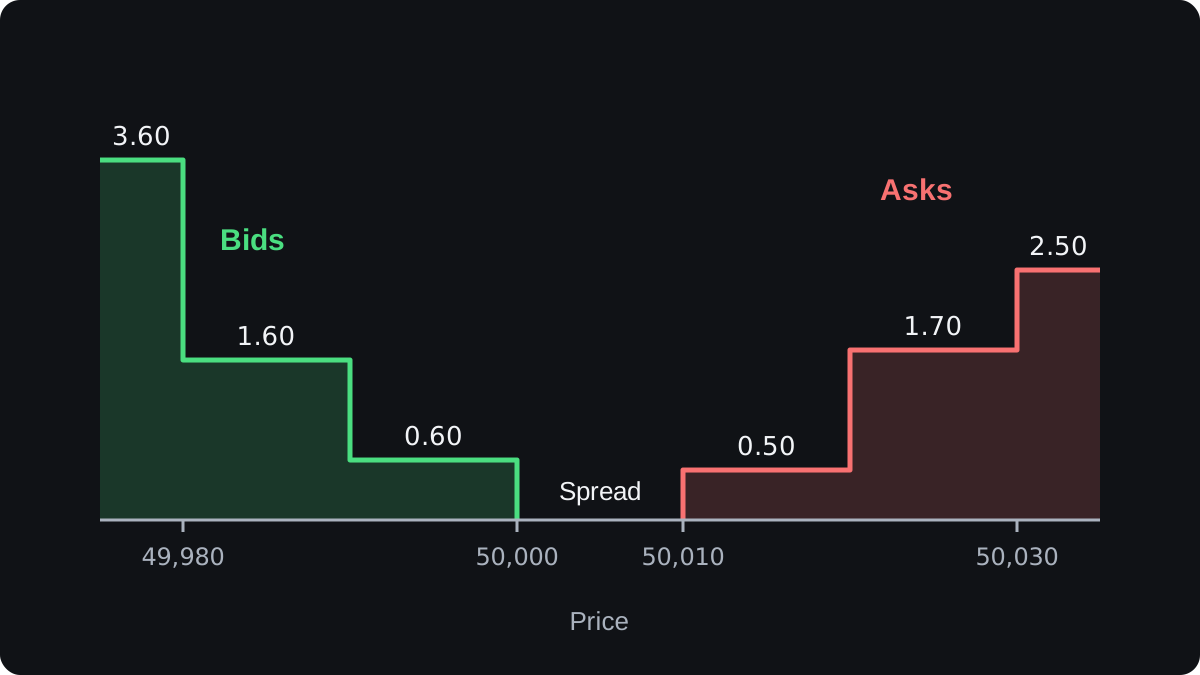
A tall step means a large amount waits at one price. Traders call a very large step a wall: a buy wall below the price or a sell wall above it.
A gentle slope means little is waiting, so a market order of the same size travels further from the price before it fills.
What the order book does not show
The book is a snapshot of intentions, and it has gaps:
- Orders can be cancelled at any moment. A large wall can vanish in a split second as price comes near it.
- Placing large orders you do not mean to fill, to push other traders around, is called spoofing. Treat a wall as what someone wants right now, which can change.
- Some exchanges let traders hide part of an order, so the book can show less than is really waiting.
- Each book covers one trading pair on one exchange. The same coin has a separate book on every other exchange and against every other currency.
A decentralized exchange built on an automated market maker has no order book at all. You trade against a pool, and a formula sets the price.
At a broker, a crypto CFD is priced by the broker, which quotes a bid and an ask and is the other side of your contract. You read its spread and contract specification instead of an exchange book.
Questions
What do the red and green numbers in an order book mean?
Red rows are asks, sell orders waiting above the price. Green rows are bids, buy orders waiting below it. Some exchanges let you swap the colors in the settings.
What is the difference between the order book and the trade history?
The order book shows orders still waiting to trade. The trade history, often called recent trades, lists orders that have already filled, with their price, size and time.
What is a buy wall?
A buy wall is an unusually large buy order, or cluster of orders, at one price below the market. It can slow a fall while it stands, but its owner can cancel it at any moment.
Does a crypto CFD have an order book?
Not in the exchange sense. MetaTrader 5 has a Depth of Market window, but for a CFD it is built from your broker's own quotes, not from other traders' orders.
Keep learning
 Chapter 1Bid, ask and spread in crypto.The bid is the highest price a buyer will pay for a coin right now, and the ask is the lowest price a seller will accept. You buy at the ask and sell at the bid. The gap is the spread, a cost you pay on every trade. Crypto traders measure it as a percentage of the price.
 Chapter 1What is liquidity in crypto?Liquidity is how easily you can buy or sell a coin without moving its price. A liquid coin has many orders close to the current price, so the spread is narrow and a large order fills near the quoted price. In a thin market, the same order eats through the book and fills at worse prices.
 Chapter 1What are maker and taker fees?A maker fee applies when your order waits in the order book and someone else fills it later. A taker fee applies when your order fills straight away against an order that was already waiting. Exchanges usually charge takers more, because makers supply the orders that keep spreads narrow.
 Chapter 1When does the crypto market trade?Crypto coins trade 24 hours a day, seven days a week, on exchanges around the world, with no official open or close. A crypto CFD at a broker follows the broker's own schedule, including any daily break and its weekend rules. You find those hours in the symbol's contract specification.

