What is cryptocurrency?
Cryptocurrency is digital money recorded on a shared public ledger called a blockchain. A network of computers checks every transfer, and no central bank issues the coins. You control your coins with a secret private key, and the price is whatever buyers and sellers agree to trade at.
Nội dung này hiện chỉ có bản tiếng Anh.
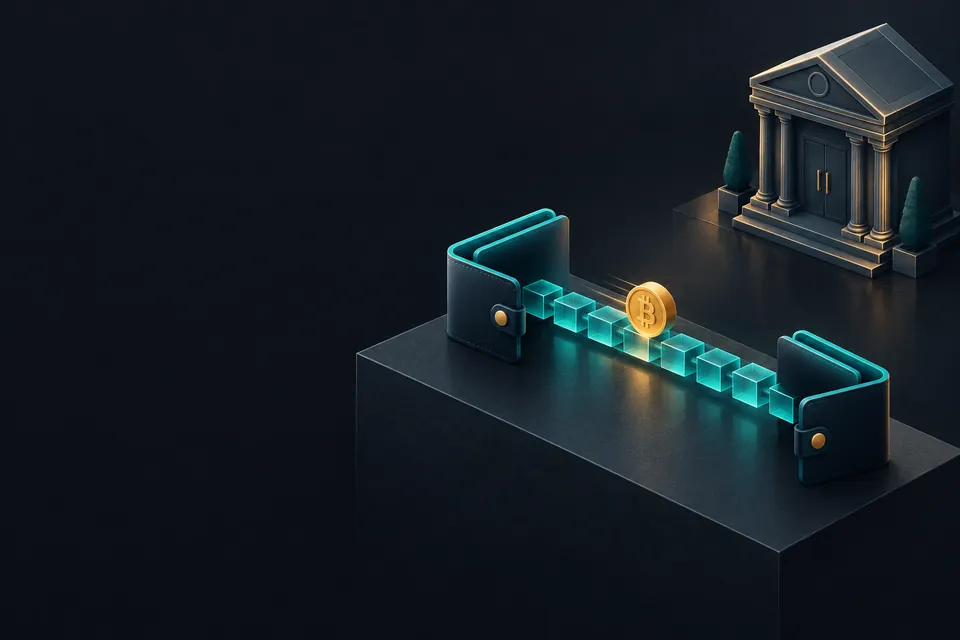
Say you want to send money to a friend in another country at 11 pm on a Sunday. A bank transfer waits for Monday, and it may pass through two or three banks on the way.
A cryptocurrency transfer leaves your phone straight away, and the network usually records it within the hour, though a low fee can mean a longer wait. The bigger difference is who keeps the record of who owns what.
A transfer with no bank in the middle
Take two people, Ana and Ben. Ana holds 1.20 coins of a cryptocurrency and wants to pay Ben 0.50.
With a bank, the bank's own database is the record. Ana's bank lowers her balance, Ben's bank raises his, and both of them trust the banks to keep the numbers right.
Crypto has no central database. On a large network such as Bitcoin, thousands of computers, called nodes, each keep a copy of the same ledger.
Ana's wallet signs the payment and sends it to the network. Nodes check her signature and that her address really holds the coins. The payment then joins the next batch of records, and every copy updates.
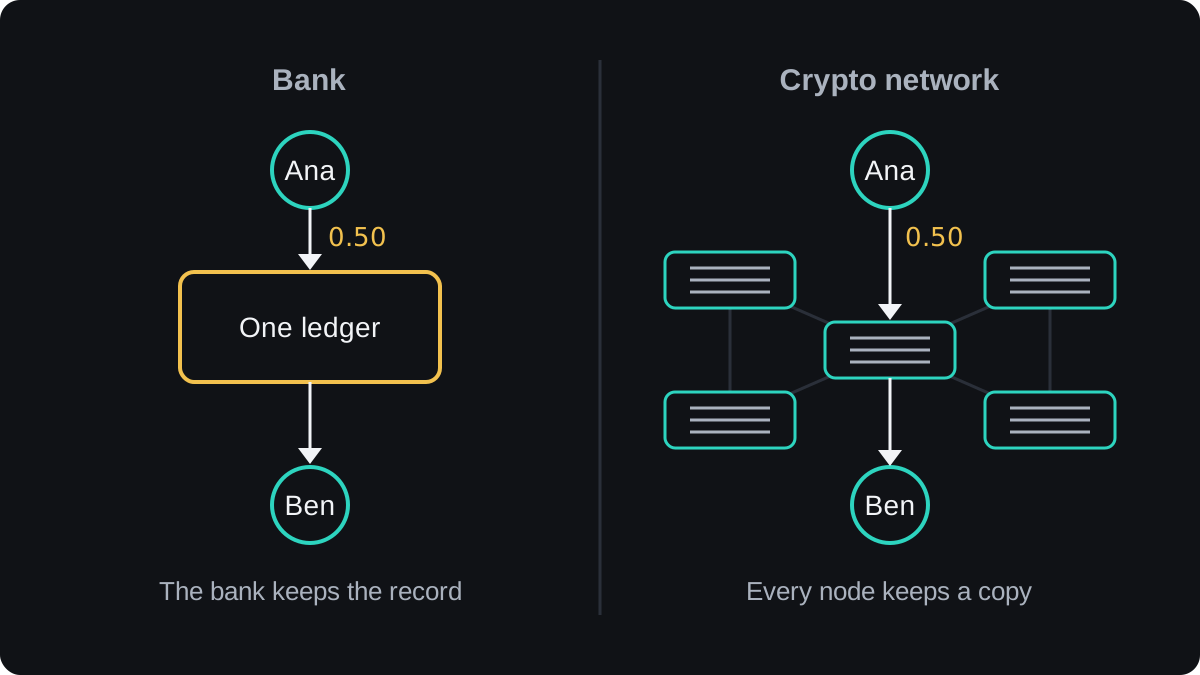
The batches are called blocks, and the ledger they form is a blockchain. Each block points back to the one before it, so changing an old entry would break every later link. The blockchain lesson shows how that works.
What makes something a cryptocurrency?
A cryptocurrency is a digital asset recorded on a blockchain and moved by its owner with a cryptographic key. The network's software enforces the rules, and no bank has to approve a transfer.
The "crypto" in the name comes from cryptography, the maths behind digital signatures. A signature proves that a payment came from the owner of an address, and it is practically impossible to forge.
Every cryptocurrency combines four parts:
- Every node shares one ledger, which holds the full history of transfers.
- Each owner has a secret private key that signs payments, and a public address, like an account number, that others pay into.
- Nodes check every transfer against the rules, and miners or validators add the new blocks.
- The rules are written in code, including how new coins are created.
The public and private keys lesson explains how anyone can check a signature that only the private key could have made.
Coins, tokens and the main families
A coin is the native unit of its own blockchain, such as bitcoin (BTC) on the Bitcoin network or ether (ETH) on Ethereum. A token is issued on top of another blockchain. Many stablecoins, for example, are tokens on Ethereum.
You will meet these groups most often:
- Bitcoin was the first cryptocurrency, launched in 2009 as digital money with a fixed supply.
- Platforms such as Ethereum run programs on their blockchain, and their coin pays the network fees.
- Stablecoins try to hold a fixed price, often one US dollar, usually backed by reserves that an issuer holds.
- Meme coins and other small tokens trade mostly on attention and mood.
Every coin other than bitcoin is often called an altcoin. The groups behave very differently, so the word "crypto" on its own tells you little about the risk of a given coin.
Where does the price come from?
No government guarantees a cryptocurrency, and bitcoin pays no interest or share of profits. Its price is the last price at which a buyer and a seller agreed to trade.
Buyers have different reasons. Some want an asset whose supply no one can raise, or need the coin to pay fees on a network they use. Others are betting that the price will rise.
Most coins have nothing behind the price except demand, so it can move fast in both directions. Falls of more than half from a peak have happened many times in crypto. The volatility lesson shows how large those swings get.
Worked example: buying part of a coin
You do not need to buy a whole coin. Coins divide into tiny units, so you can buy whatever amount your money covers.
Here is the arithmetic with round illustrative prices:
- A coin trades at $20,000.
- You spend $100 and get 100 ÷ 20,000 = 0.005 coins.
- If the price falls 30% to $14,000, your coins are worth 0.005 × 14,000 = $70.
- If it rises 30% to $26,000, they are worth 0.005 × 26,000 = $130.
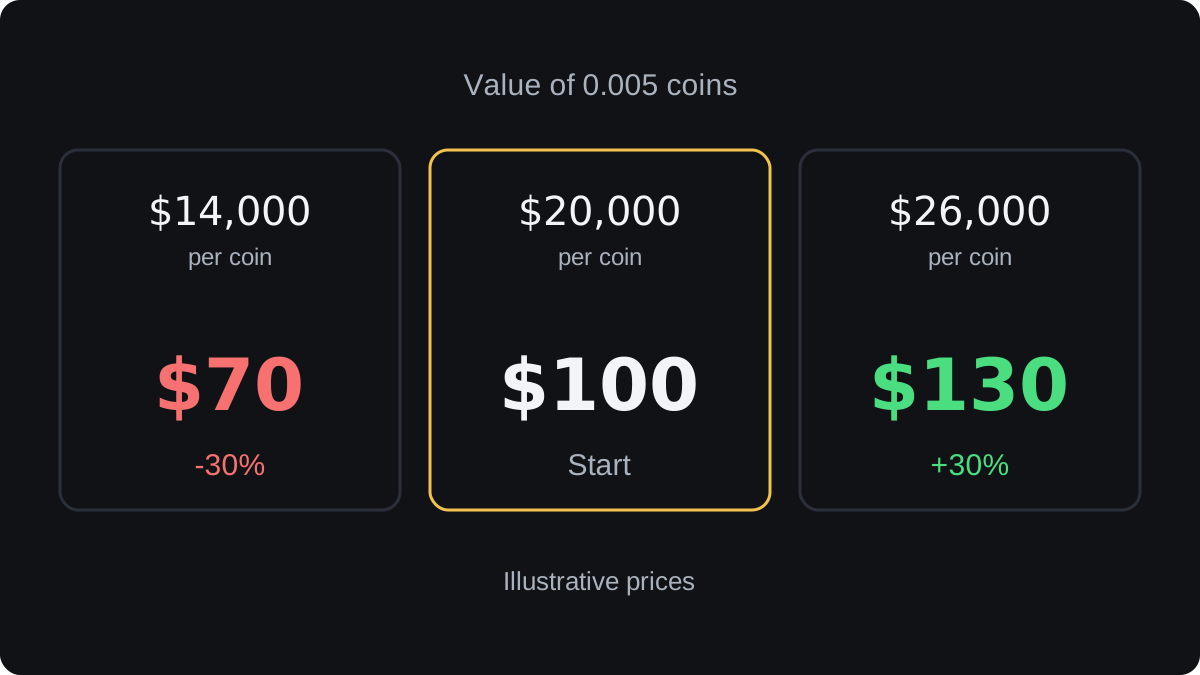
The value of your holding moves by the same percentage as the price. A real purchase also costs a trading fee, which the crypto exchange lesson covers.
Keeping crypto: keys, wallets and exchanges
Your coins never sit inside your phone. They are entries on the ledger, tied to your address, and whoever holds the private key can move them.
A crypto wallet is the app or device that stores your keys and signs payments. On an exchange, the company usually holds the keys for you. That is convenient, and it also means your coins depend on that company.
The ledger itself shows only addresses and amounts. Ben's address held 0.30 coins before. Here is how the ledger changes when Ana pays him 0.50, plus a fee of 0.01 that goes to the miner:
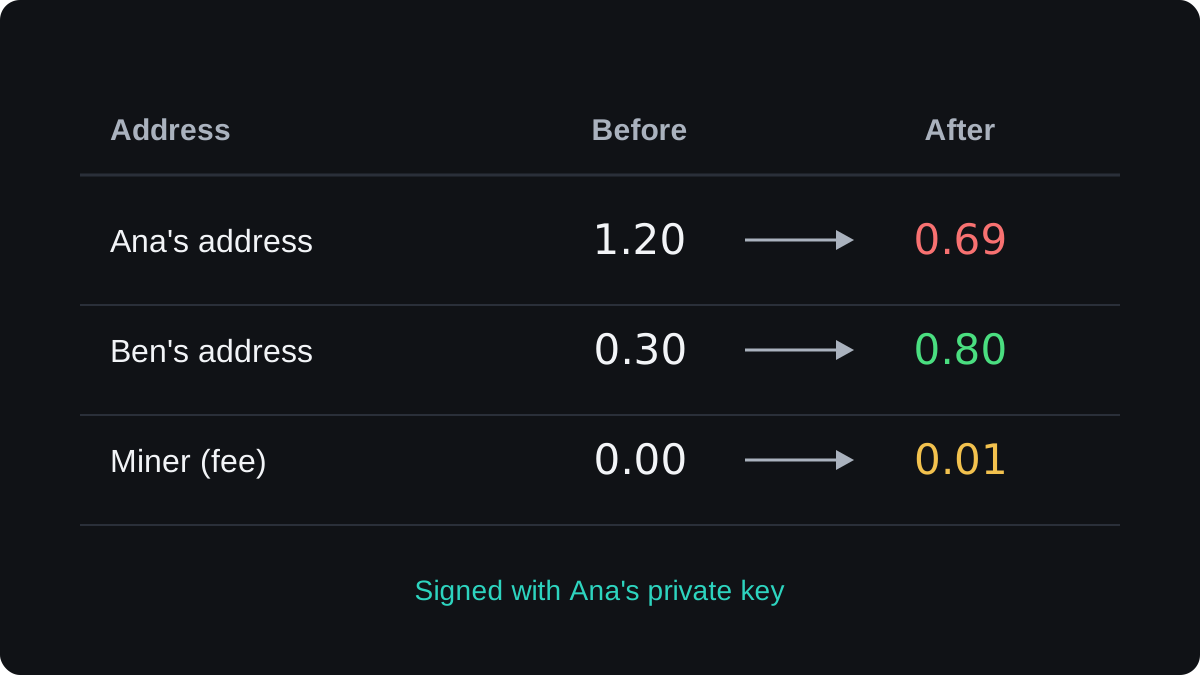
No one can reset a lost key. If you lose the private key and its backup, the coins stay on the ledger, out of reach for good. If a scammer gets the key, every transfer they make is final.
Câu hỏi thường gặp
Is cryptocurrency real money?
Some people and businesses accept it as payment. Most people hold it as an asset with a moving price, and each country decides how to treat it in law and for tax.
Who controls cryptocurrency?
For Bitcoin, no single person or company does: changes to the rules need wide agreement among the people who run the software. Many newer coins have a foundation or company with much more say over their rules and supply.
Can crypto transactions be traced?
On most blockchains, yes. Every transfer is public, and while addresses carry no names, exchanges collect identity documents and can link addresses to people.
Can you buy less than one coin?
Yes. One bitcoin divides into 100 million units called satoshis, so you can buy a few dollars' worth.
Học tiếp
 Chương 1Is crypto an asset class of its own?Crypto has its own markets and its own price drivers, two marks of an asset class. It differs from stocks and bonds in one basic way: most coins pay no income, so their price rests on demand alone. Some funds and investors now give it a separate slot, and whether that lasts is still debated.
 Chương 1How is crypto different from forex?Forex is the trade of national currencies, issued by central banks and traded around the clock on weekdays. Crypto is the trade of digital coins that mostly have no central issuer, and it trades at weekends too. Crypto prices usually swing much further in a day, and you can own the coin or trade a contract on its price.

