What are the most common crypto scams?
The most common crypto scams are fake investment platforms that show profits you can never withdraw, schemes that promise fixed returns, impersonators running fake giveaways or support chats, phishing sites and wallet drainers that steal access, and rug pulls. They all rely on one fact: a confirmed crypto transfer cannot be reversed.
Nội dung này hiện chỉ có bản tiếng Anh.

A bank can sometimes stop a card payment or reverse a transfer sent by mistake. A confirmed crypto transfer is final. Whoever controls the receiving address controls the coins, and scammers build everything around that.
Why scams cluster around crypto
- Transfers are final. No central party can undo a confirmed payment, and there is no chargeback.
- Addresses carry no names, so the receiver can be anyone, anywhere.
- New buyers arrive in waves when prices rise, and many have never used a wallet or an exchange before.
- Large price swings make wild promises sound believable.
Each scam below uses one or more of these gaps. The lesson on sending and receiving crypto shows how a normal transfer should look.
Fake platforms and slow relationship scams
One of the most damaging scams is also one of the slowest. A stranger reaches out through a "wrong number" text, a dating app or a social network. Over weeks they become a friend.
Then they mention how much they make trading crypto, and offer to show you the platform they use. The platform is a website or app the scammer controls.
Your deposits go straight to the scammer's wallet. The balance on screen is a number they type in.
This scheme is often called pig butchering, a translation of a phrase used by the groups that run it. The target is fattened up with fake profits before the final cut.
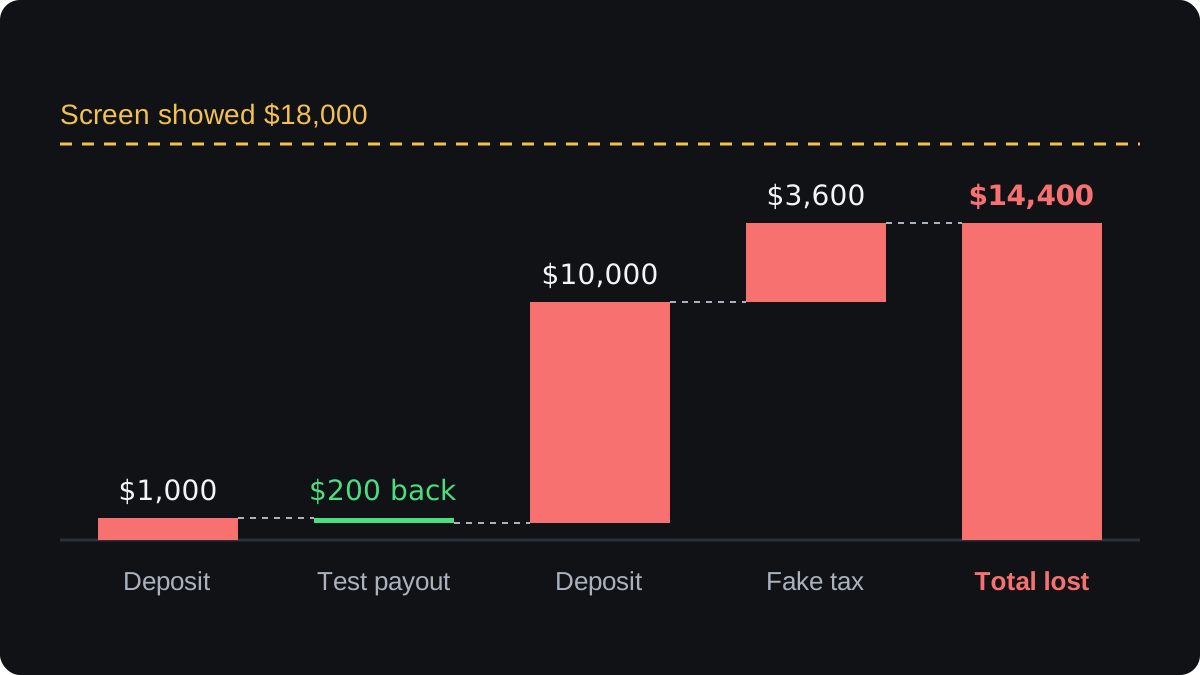
Here is how the money usually moves, with illustrative figures:
- You deposit $1,000. A week later the dashboard shows $1,400.
- You withdraw $200 as a test, and it arrives. Your trust grows.
- You deposit $10,000 more. The dashboard soon shows $18,000.
- You ask to withdraw. The platform says you must first pay a 20% "tax" on the balance, which is $3,600.
- You pay it. A new fee appears, or the account is frozen.
You paid in $1,000 + $10,000 + $3,600 = $14,600 and got $200 back, so you lost $14,400. The $18,000 on screen never existed.
Promised returns: Ponzi schemes and fake yield
A Ponzi scheme pays early investors with money from later ones. In crypto it often appears as a staking, mining or trading program that pays a fixed daily return.
A pyramid scheme adds recruitment. You earn by bringing in new members, and they earn by bringing in theirs.
The numbers give these away. A fixed 2% a day, paid out and never compounded, is 2% × 365 = 730% a year.
No real lending or trading business can pay that for long. When new deposits slow, payouts stop and withdrawals freeze.
Real staking does exist. It pays a variable reward set by the network, and the reward can fall. Forex has the same schemes, as the lesson on common forex scams shows.
Impersonators, fake giveaways and fake support
- Giveaway scams promise to double any coins you send. They often run as fake livestreams that reuse video of a well-known founder, sometimes altered with AI. A real giveaway never asks you to send coins first.
- Fake support agents answer public questions about stuck transfers, then message you privately with a link to "verify" your wallet. The form asks for your seed phrase.
- Callers posing as exchange staff warn you about a "suspicious login" and walk you through moving funds to a "safe" address. The safe address is theirs.
Phishing, wallet drainers and poisoned addresses
- Phishing sites copy a real exchange or wallet page, often at a web address one letter away from the real one. Some pay for search ads so they appear above the genuine site.
- Fake wallet apps copy real ones and send any seed phrase you type to the scammer.
- A wallet drainer is a website that asks you to connect your wallet and sign a request. The signature gives it permission to move your tokens, and it uses that to empty the wallet.
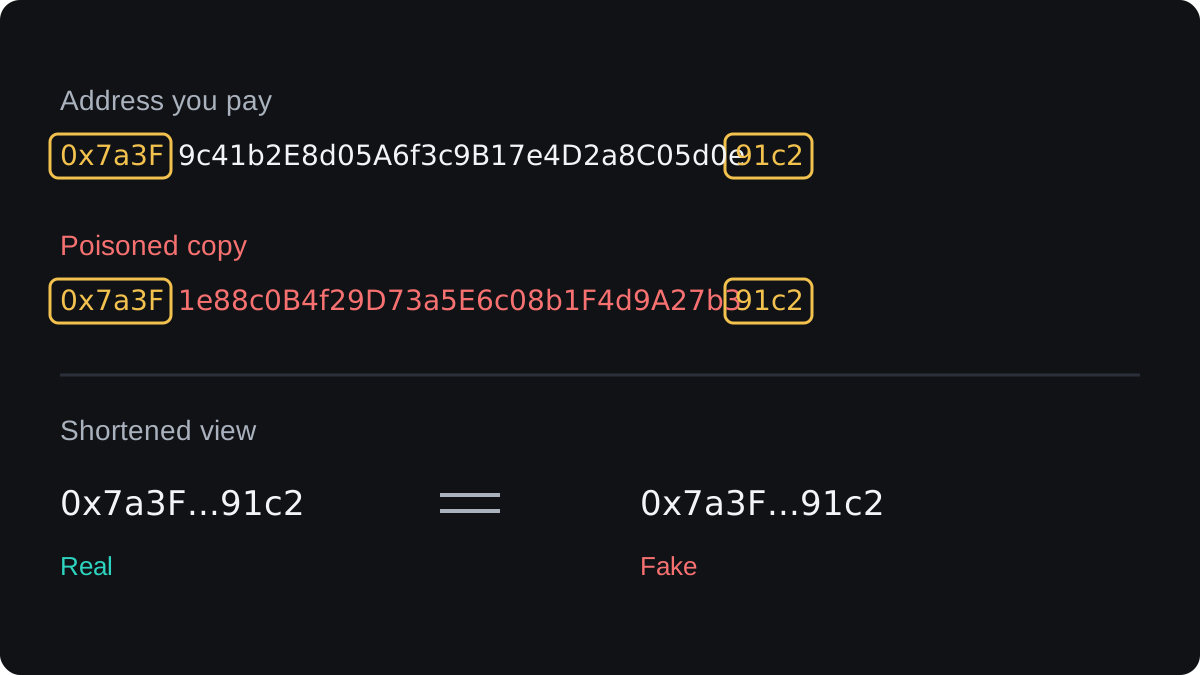
- In address poisoning, a scammer sends you a tiny transfer from an address that starts and ends like one you often pay. If you later copy the address from your history, you pay the scammer.
Rug pulls, pump and dumps, and recovery scams
- In a rug pull, the team behind a token takes the money and vanishes, often by draining its trading pool or selling a hidden supply. New meme coins are a common vehicle.
- In a pump and dump, a group buys a thinly traded coin, hypes it in chats, and sells to the buyers it pulls in.
- A recovery scam targets people who have already lost money. Someone offers to trace and return the coins for an upfront fee, sometimes posing as police or a lawyer.
The next lesson shows how to spot a crypto scam before you send anything.
Câu hỏi thường gặp
Is crypto itself a scam?
No. Bitcoin and other large networks run open-source software that anyone can inspect. The scams are built around them and take advantage of transfers that cannot be reversed.
Can you get scammed just by receiving crypto?
Receiving coins cannot take anything from you. Unknown tokens or tiny transfers that appear in your wallet can be bait, though, because they lead to drainer sites or poison your address history.
Why do fake platforms let you withdraw at first?
A small payout builds trust. It costs the scammer a little and often brings in a much larger deposit.
Can money lost to a crypto scam be recovered?
Sometimes, if an exchange or a stablecoin issuer freezes the coins after a police report. Anyone asking an upfront fee to recover them is running a second scam, as what to do if you have been scammed explains.
Học tiếp
 Chương 4How to spot a crypto scam.To spot a crypto scam, check four things. The offer: a guaranteed or high fixed return. The person: a stranger who contacted you first and wants speed or secrecy. The platform: an unknown app that wants a fee before you can withdraw. The payment: a request for your seed phrase, a wallet approval or a transfer to a personal address.
 Chương 4How to protect yourself from crypto scams.To protect yourself from crypto scams, keep your seed phrase offline and never share it, use an authenticator app for 2FA, and keep only small sums in a hot wallet. Send a small test before any transfer to a new address, read what you sign, and treat strangers who contact you about money as scammers until you check them.

