What is DeFi?
DeFi, short for decentralized finance, is trading and lending run by smart contracts on a public blockchain instead of by a company. You use it straight from your own wallet, with no account to open, at any hour. The same code that makes it open to anyone also makes its mistakes and losses final.
Nội dung này hiện chỉ có bản tiếng Anh.

Say you want to swap 1,000 USDC for ether. On an exchange, you first open an account, usually pass identity checks, and deposit the coins. The company then holds them while you trade.
In DeFi, you open a website, connect your wallet and send one transaction to a contract that does the swap. No company holds your coins at any point.
DeFi, short for decentralized finance, is the name for financial services built this way: as smart contracts on a public blockchain, used straight from a wallet.
How DeFi differs from a bank or an exchange
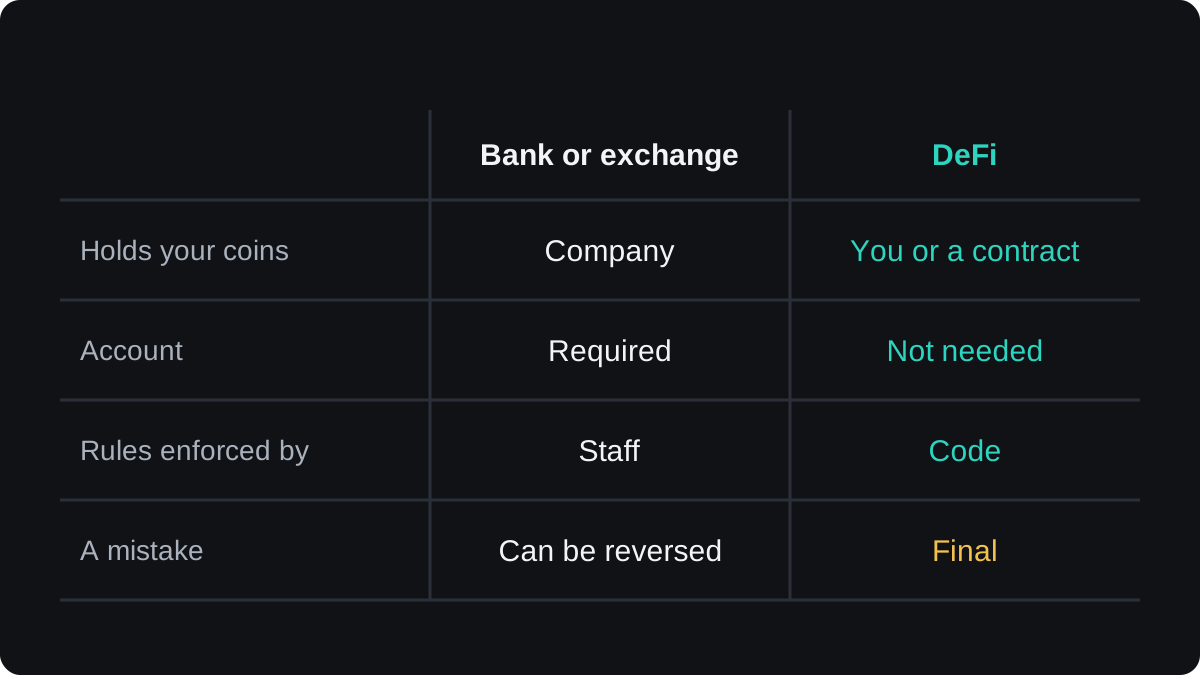
At a bank or a centralized exchange, a company holds your money and keeps the records. It decides what you may do. It can freeze an account or reverse a mistake.
In DeFi, your coins stay in your wallet until you send them to a contract, and the contract's code decides what happens next. Anyone with a wallet can use it, and the code is usually public for anyone to read.
The trade-off is that nobody sits on the other end. A payment to the wrong address or a bug in the contract has no help desk and no reversal.
What you can do in DeFi
A decentralized exchange lets you swap one token for another against a pool of tokens, with no person on the other side. The lesson on automated market makers shows how those pools set a price.
You can also lend and borrow: deposit coins for others to borrow and earn interest, or lock coins as collateral and borrow against them. The lending and yield lesson covers both sides.
Many DeFi services use stablecoins, tokens that track a currency such as the US dollar. Some are issued by companies holding cash, and some by DeFi contracts holding crypto as collateral.
Bridges move tokens between networks. Many lock your tokens on one chain and issue a matching token on another. Others destroy tokens on one side and create them on the other.
The locked pile can grow very large, which makes bridges a favourite target for attackers.
Who runs it
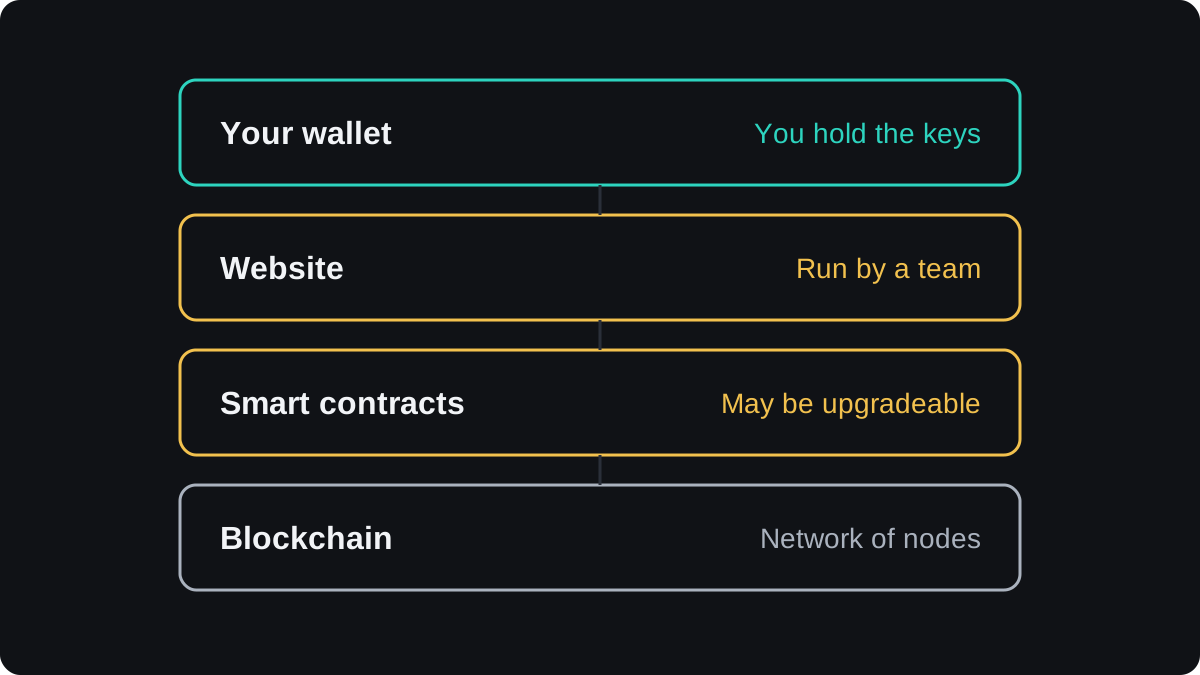
Decentralized comes in degrees. The blockchain underneath may be run by thousands of independent computers, while the pieces on top are run by much smaller groups.
A development team writes the contracts. Some can be changed after launch by an admin key, or by a vote of holders of the project's governance token. Others can never be changed.
That power can fix a bug, and it can also be misused.
The website you click through is ordinary web hosting run by a team. It can block some countries, go offline, or be hijacked to show a fake page. The contracts keep running underneath, whatever happens to the site.
Worked example: what a DeFi swap costs
The numbers below are illustrative. Fees vary by network, pool and time of day.
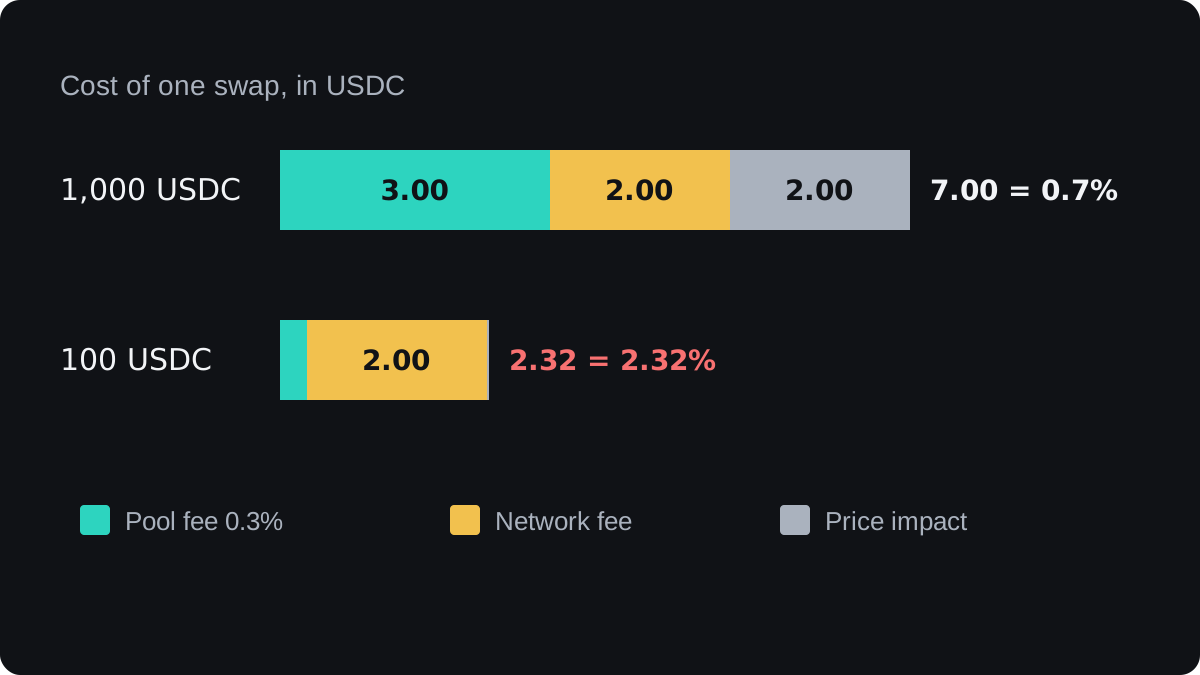
You swap 1,000 USDC for ether on a decentralized exchange:
- The pool charges a 0.3% fee: 1,000 × 0.003 = 3.00 USDC.
- The network fee for your transaction is 2.00 USDC.
- Your trade moves the pool's price slightly against you. Say this price impact costs 0.2%, another 2.00 USDC.
- In total you pay 3.00 + 2.00 + 2.00 = 7.00 USDC, or 0.7% of the trade.
Now swap 100 USDC in the same pool:
- The pool fee is 0.3% of 100 = 0.30 USDC.
- The network fee is still 2.00 USDC, because it is charged per transaction, whatever the size.
- Price impact shrinks with size, to about 0.02%, or 0.02 USDC.
- In total you pay 0.30 + 2.00 + 0.02 = 2.32 USDC, or 2.32% of the trade.
You also set a slippage tolerance, such as 0.5%: the most the price may move against you before your transaction lands.
If it moves further, the swap fails, and on most networks you still pay the network fee. The forex lesson on slippage covers the general idea.
Where DeFi breaks
Code that holds money is a target. A single bug in a contract can let an attacker drain it, and audits by security firms lower that risk without removing it.
Contracts that need outside prices, such as a lender valuing collateral, read them from a price feed called an oracle. If the feed is wrong or manipulated, the contract acts on the wrong number.
On your side, the risk is approvals. Using a contract often means signing an approval that lets it move a token from your wallet.
A malicious contract holding that approval can take the tokens later. Approve only what you need, and revoke approvals you no longer use.
Rules also differ between countries and keep changing. A website may stop serving your region even though the contracts underneath still work.
Câu hỏi thường gặp
Is DeFi safe?
No company holds your coins, but bugs, admin keys, faulty price feeds and your own mistakes can all lose them. Losses from bugs or bad signatures are usually permanent.
Do I need to give my name to use DeFi?
The contracts do not ask for identity; they only see your address. The exchange where you first buy coins usually does, through its KYC checks.
What is the difference between DeFi and a crypto exchange?
A centralized exchange is a company that holds your coins and matches orders in its own systems. A DeFi exchange is a contract you trade with straight from your wallet, and your coins stay under your control until the swap.
Can I lose money in DeFi without trading?
Yes. A contract you deposited into can be exploited, a stablecoin can lose its peg, and an approval you signed can let a thief move your tokens.
Học tiếp
 Chương 3What is an automated market maker?An automated market maker, or AMM, is a smart contract that holds a pool of two tokens and quotes prices from a formula instead of matching buyers with sellers. You swap against the pool, and every trade moves its price. The people who supply the tokens earn fees and carry a risk called impermanent loss.
 Chương 3DeFi lending and yield: where the risk sits.In DeFi lending you lock more crypto than you borrow, and a contract sells part of your collateral if its value falls too far. Lenders earn the interest borrowers pay, minus a cut for the protocol. The risk sits in the collateral price, the code, the price feeds it trusts, and yields paid in new tokens.

