What is the Bitcoin halving?
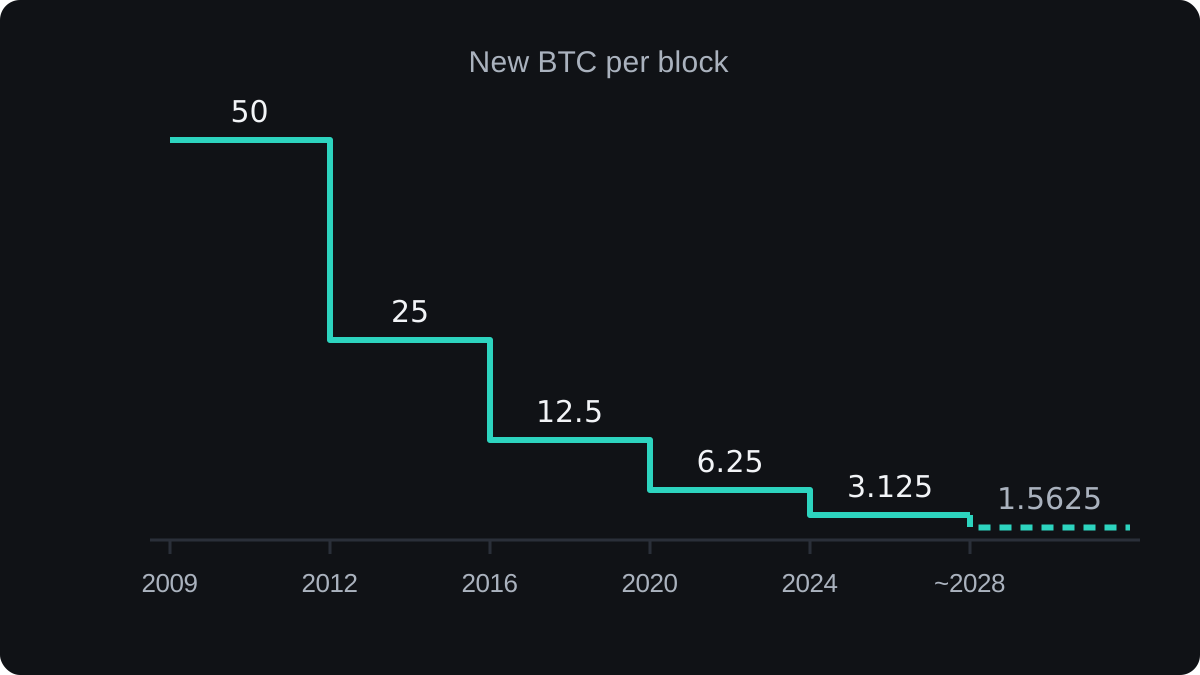
The Bitcoin halving is the moment the new bitcoin paid to miners for each block is cut in half. It happens every 210,000 blocks, roughly every four years, and is written into Bitcoin's rules. The payment started at 50 BTC per block in 2009 and fell to 3.125 BTC after the 2024 halving.
Nội dung này hiện chỉ có bản tiếng Anh.
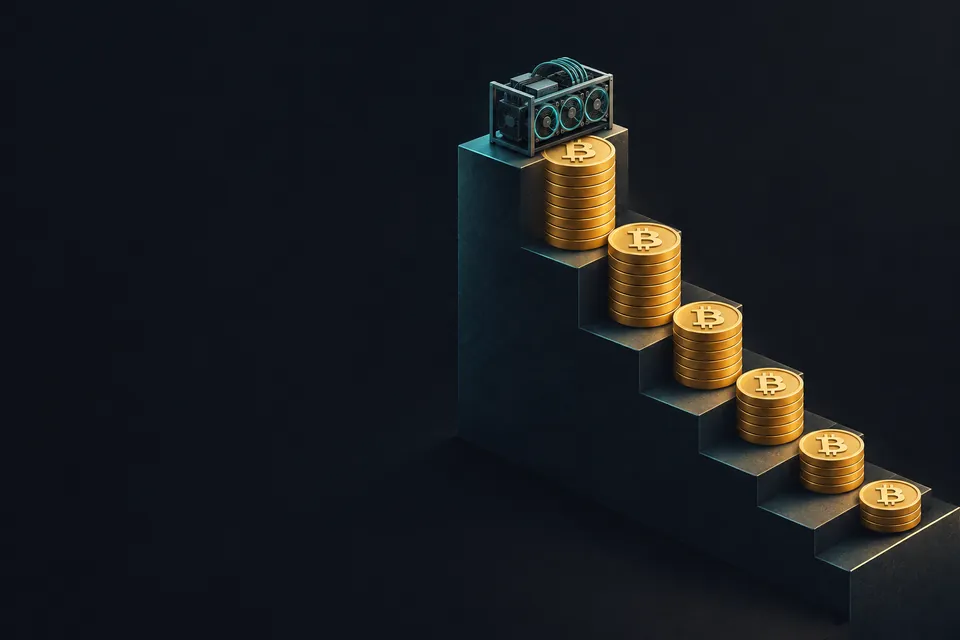
In 2009, each new block on the Bitcoin network paid its miner 50 new bitcoins. After the 2024 halving, the same work paid 3.125 BTC. No one voted for those cuts, because the software has scheduled them from the start.
What the halving is
Every block a miner adds to the chain includes a payment to that miner. Part of it is brand new bitcoin, called the block subsidy. The rest is the fees paid by the transactions inside the block.
The halving is the point where the subsidy drops to half. Bitcoin's rules set it once every 210,000 blocks, and these cuts make up Bitcoin's money supply schedule. If you are new to the coin, start with how Bitcoin works.
Blocks arrive about every ten minutes, so the network adds about 144 a day. At that pace, 210,000 blocks take close to four years, which is why people call the halving a four-yearly event.
The trigger is a block number, so the calendar date drifts a little between halvings as blocks arrive faster or slower than ten minutes. The lesson on Bitcoin mining explains how the network holds that pace.
The halving schedule so far
Here is each halving so far, plus the next one. The block numbers are fixed by the rules. The years are when each of those blocks arrived, and the last one is an estimate.
| Event | Block | New BTC per block | Year |
|---|---|---|---|
| Launch | 0 | 50 | 2009 |
| 1st halving | 210,000 | 25 | 2012 |
| 2nd halving | 420,000 | 12.5 | 2016 |
| 3rd halving | 630,000 | 6.25 | 2020 |
| 4th halving | 840,000 | 3.125 | 2024 |
| 5th halving | 1,050,000 | 1.5625 | about 2028 |
Why the halving caps supply near 21 million
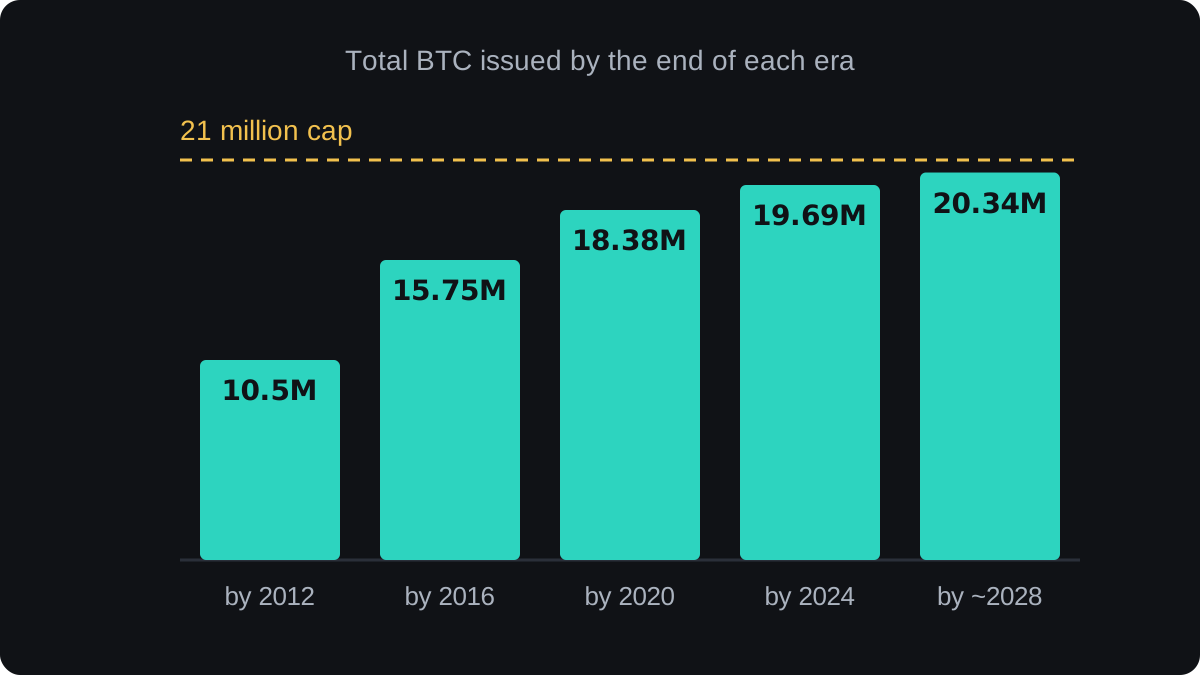
The halving is what gives Bitcoin a fixed maximum supply. You can check it with one multiplication per era: 210,000 blocks times the subsidy in that era.
- First era: 210,000 × 50 = 10,500,000 BTC.
- Second era: 210,000 × 25 = 5,250,000 BTC, for a total of 15,750,000.
- Third era: 210,000 × 12.5 = 2,625,000 BTC, total 18,375,000.
- Fourth era: 210,000 × 6.25 = 1,312,500 BTC, total 19,687,500.
- Fifth era: 210,000 × 3.125 = 656,250 BTC, total 20,343,750.
Each era issues half as much as the one before, so each one closes half of the remaining gap to 21,000,000. The total creeps toward that line and never passes it.
Bitcoin counts amounts in satoshis: one bitcoin is 100,000,000 of them. After enough halvings the subsidy rounds down to zero, around the year 2140. That rounding leaves the final total a little under 21 million.
What a halving does to miners
Miners pay for machines and electricity in ordinary money. A halving cuts their income in bitcoin overnight, while their bills stay the same.
Take a large mining firm that wins 2 blocks a day on average, with fees of 0.25 BTC per block. The block count and fees are round numbers for illustration.
- Before the 2024 halving, it earned 2 × (6.25 + 0.25) = 13 BTC a day.
- After it, the firm earns 2 × (3.125 + 0.25) = 6.75 BTC a day.
- Income in bitcoin falls by 6.25 BTC out of 13, a drop of about 48%.
Unless the bitcoin price or fees rise enough to make up the gap, the least efficient miners start losing money and switch their machines off.
The network reviews its mining difficulty every 2,016 blocks. When miners leave, it lowers the difficulty, so the remaining machines keep blocks coming about every ten minutes.
Over the long run the subsidy keeps shrinking, so fees will have to pay for more of the network's security. Whether fees will be enough is an open question.
Why traders watch the halving
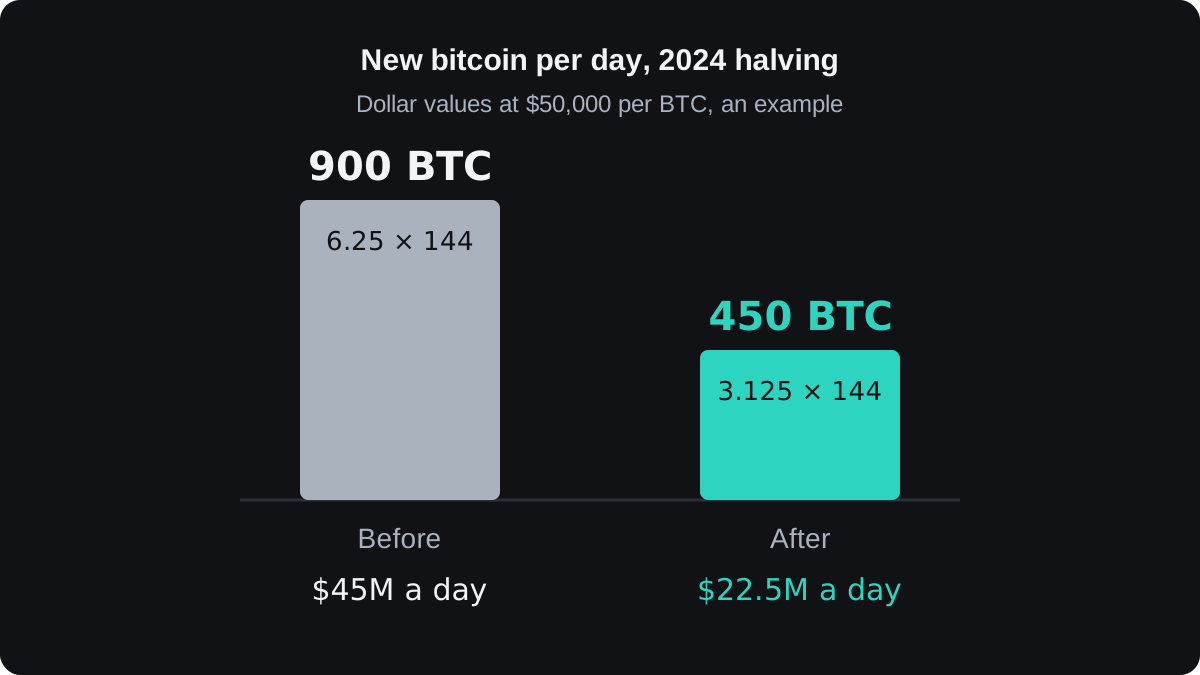
The halving also changes how many new coins reach the market. Before the 2024 halving, new supply was about 6.25 × 144 = 900 BTC a day. After it, the figure was 3.125 × 144 = 450 BTC.
At an example price of $50,000, that is a drop from $45 million to $22.5 million of new coins a day. Miners often sell part of their coins to pay costs, so the halving cuts a steady stream of selling.
If demand stays the same while new supply halves, buyers compete for fewer fresh coins, and the price has to rise to bring out sellers. That argument is the basis of the four-year market cycle story.
Where the halving story is weak
The halving is known years in advance, down to the block. Anyone who expects it to lift the price can buy early, which pulls any effect forward or spreads it out.
The cuts have also shrunk. The first halving reduced new supply by 3,600 BTC a day; the 2024 halving reduced it by 450. Each cut is smaller next to the coins already in circulation.
Daily new supply is small next to daily trading, too. One large holder selling can outweigh weeks of mined coins, because the price is set by every buyer and seller, and miners are a small part of that crowd.
There have been only four halvings. The years after each also brought other forces, such as changes in interest rates and in global liquidity.
Four data points cannot separate the halving from those forces. The lesson on crypto and the economy looks at the outside influences in more detail.
Câu hỏi thường gặp
When is the next Bitcoin halving?
It is due at block 1,050,000, which at about ten minutes per block falls around 2028. The exact day depends on how fast blocks arrive, so estimates move as the date gets closer.
What happens when all 21 million bitcoin are mined?
Miners will then earn transaction fees only. The subsidy shrinks toward zero over many halvings, and the last tiny amount is expected to be issued around 2140.
Does the halving make the Bitcoin price go up?
The halving does not raise the price on its own. It cuts the flow of new coins, which only matters if demand holds or grows, and four halvings are too few to prove a reliable effect.
Do other cryptocurrencies have halvings?
Some coins copied Bitcoin's design and cut their issuance on a fixed schedule, Litecoin among them. Ether has no halving: its supply follows staking rewards and a fee burn.
Học tiếp
 Chương 3How crypto market cycles work.A crypto market cycle is a full round of rising and falling prices: a quiet base, a strong rally, a peak and then a deep fall. Between 2012 and 2024, Bitcoin's cycles each lasted about four years and lined up with its halvings. That is only three cycles, so the pattern is weak evidence and may not repeat.
 Chương 3What is Bitcoin dominance?Bitcoin dominance is Bitcoin's market value as a share of the value of all cryptocurrencies combined. If Bitcoin is worth $1,000 billion and the whole market $2,000 billion, dominance is 50%. Traders use it to see whether money is moving toward Bitcoin or toward other coins, though stablecoins and data choices can distort it.

