How markets react to news.
When a major economic figure is released, price can jump many pips in seconds. Liquidity providers quote less and wider, so the spread widens, and orders can fill at a worse price than requested, which is slippage. A stop loss closes the trade but cannot guarantee its price when the market gaps.
Nội dung này hiện chỉ có bản tiếng Anh.

At a scheduled minute, a government agency or central bank publishes a number. Within a second, EUR/USD can move further than it did all morning, and your platform may show a spread several times wider than usual.
Those same few minutes explain why a stop loss can close your trade somewhere other than where you set it.
What happens in the minutes around a big release?
Major releases are scheduled in advance. An economic calendar lists the time, the previous figure and a forecast, often called the consensus. Prices before the release largely reflect that forecast.
In the minutes before, trading often thins out. Banks and other liquidity providers quote smaller amounts or step back, because nobody wants to hold a position at the wrong price when the number lands.
At the release time, the figure appears and price jumps to a new level. The size of the jump depends mostly on how far the figure lands from the forecast, which the expectations versus actual lesson covers in detail.
After the first jump, price often swings back and forth while traders read the details. A jobs report carries several figures, and a strong headline with weak wage growth can push price one way and then the other.
Over the following minutes, liquidity returns and the spread narrows. Sometimes the first move holds and extends, and sometimes it reverses completely. No reliable rule tells you in advance which will happen.
Why does the spread widen at the release?
The spread is the gap between the bid and the ask. It is narrow when many providers compete to quote a pair. Around a release fewer of them quote, and those that do quote wider to protect themselves.
Your broker's prices reflect those quotes, so the spread you see widens too.
In the chart, with round illustrative numbers for EUR/USD, a normal spread of 1.0 pip grows to 2.0 a minute before the release, peaks at 6.0 at the release, then falls to 3.0 and 1.2.
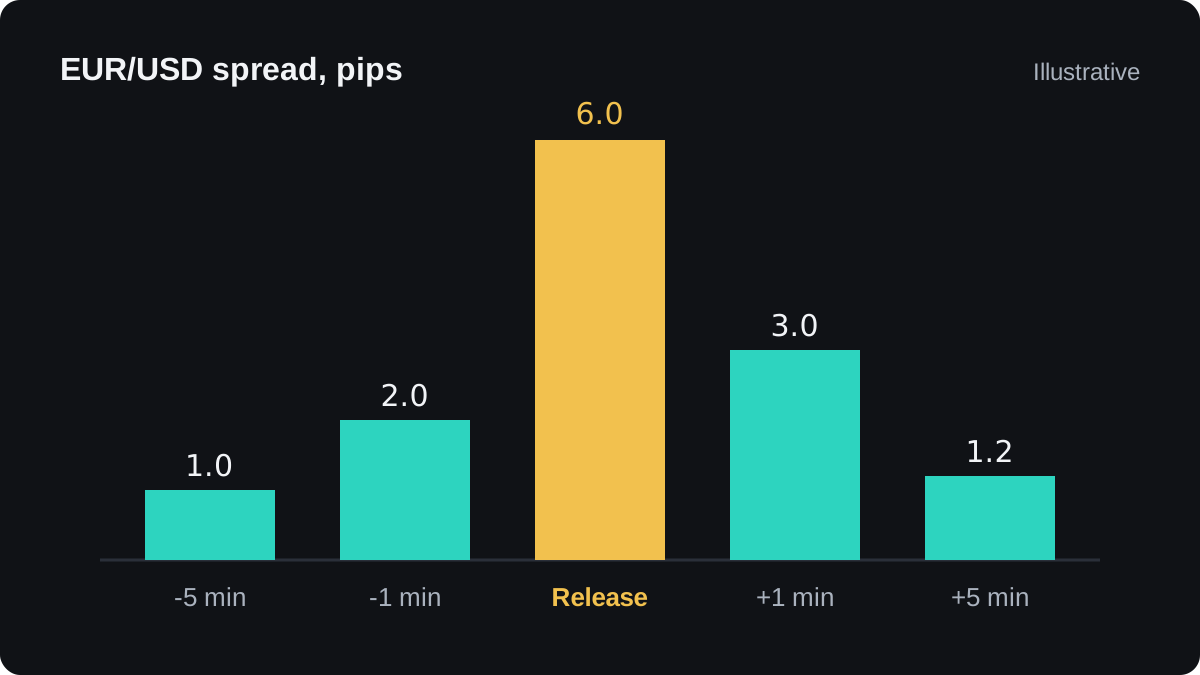
A wider spread costs money even if price does not move. On 0.50 lot of EUR/USD a pip is worth $5, so crossing a 1.0 pip spread costs $5 and crossing a 6.0 pip spread costs $30.
It can also close trades by itself. On most platforms a stop on a long position triggers when the bid reaches it, and a stop on a short position triggers when the ask reaches it.
Say the spread widens from 1.0 to 6.0 pips around an unchanged middle price. The bid drops 2.5 pips and the ask rises 2.5 pips, which can hit a tight stop while the market has barely moved.
Why does your order fill at a different price?
Slippage is the difference between the price you asked for and the price you got.
It happens when price moves between sending an order and filling it, and news releases are when that gap tends to be largest. The slippage lesson covers it across all market conditions.
A stop loss is a resting order to close at a set level. When price reaches that level, the stop becomes a market order and fills at the next available price. In a fast market, that price can be several pips away.
Sometimes price skips levels entirely. If the bid moves from 1.10050 straight to 1.09720 with no quotes in between, a stop anywhere in that range fills at 1.09720 or worse. This jump is called a gap.
Slippage can also go in your favour, when price moves toward you before the fill. Whether your broker passes on that positive slippage as well as the negative kind is set out in its order execution policy.
A limit order behaves differently. It fills only at your price or better, so it cannot slip against you, yet in a fast move it may not fill at all. The order types lesson compares the two.
Worked example: a stop loss during a surprise
Here is a long trade caught by a surprise release, with round illustrative prices.
- You buy 0.50 lot of EUR/USD at the ask of 1.10000. That is 50,000 euros, so one pip is worth 50,000 × 0.0001 = $5.
- You place a stop at 1.09800, which is 20 pips below entry. The planned loss is 20 × $5 = $100.
- Just before a major US release, the bid sits at 1.10050. The figure lands far above the forecast and the dollar strengthens.
- The bid gaps from 1.10050 to 1.09720 with no quotes in between, then falls further to 1.09600.
- Your stop triggers and fills at the first available bid, 1.09720.
- The loss is 1.10000 minus 1.09720 = 0.00280, which is 28 pips. That gives 28 × $5 = $140.
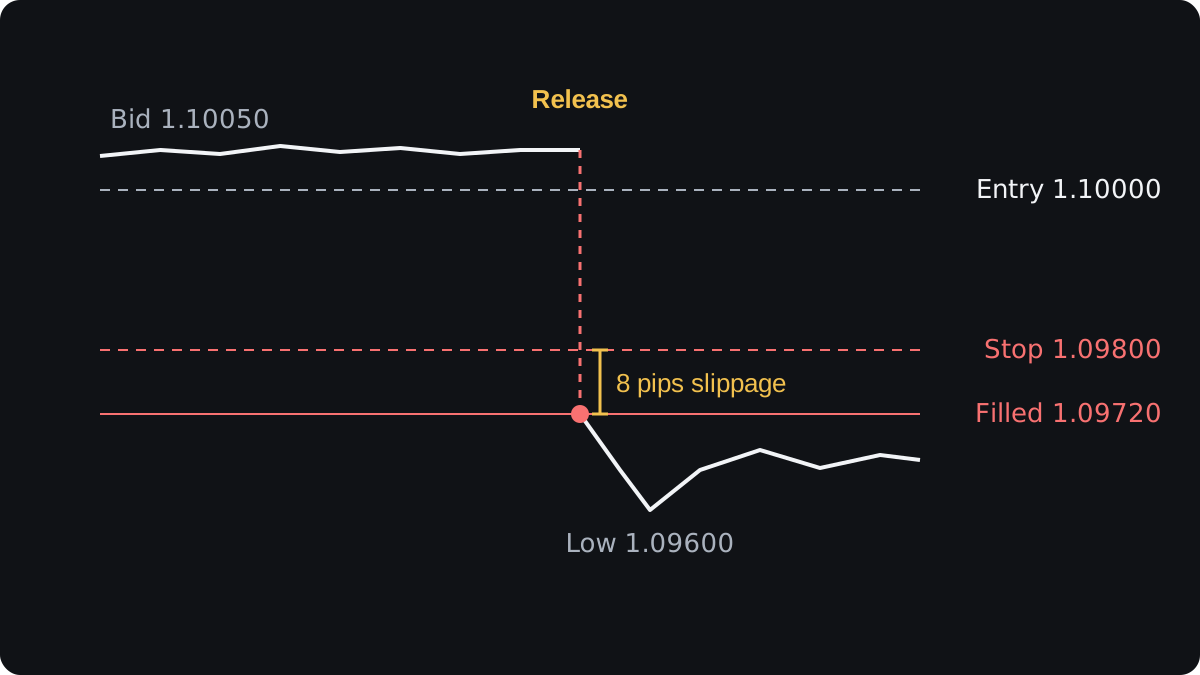
The extra 8 pips, worth 8 × $5 = $40, is slippage. You planned to risk $100 and lost $140, which is 40% more than planned.
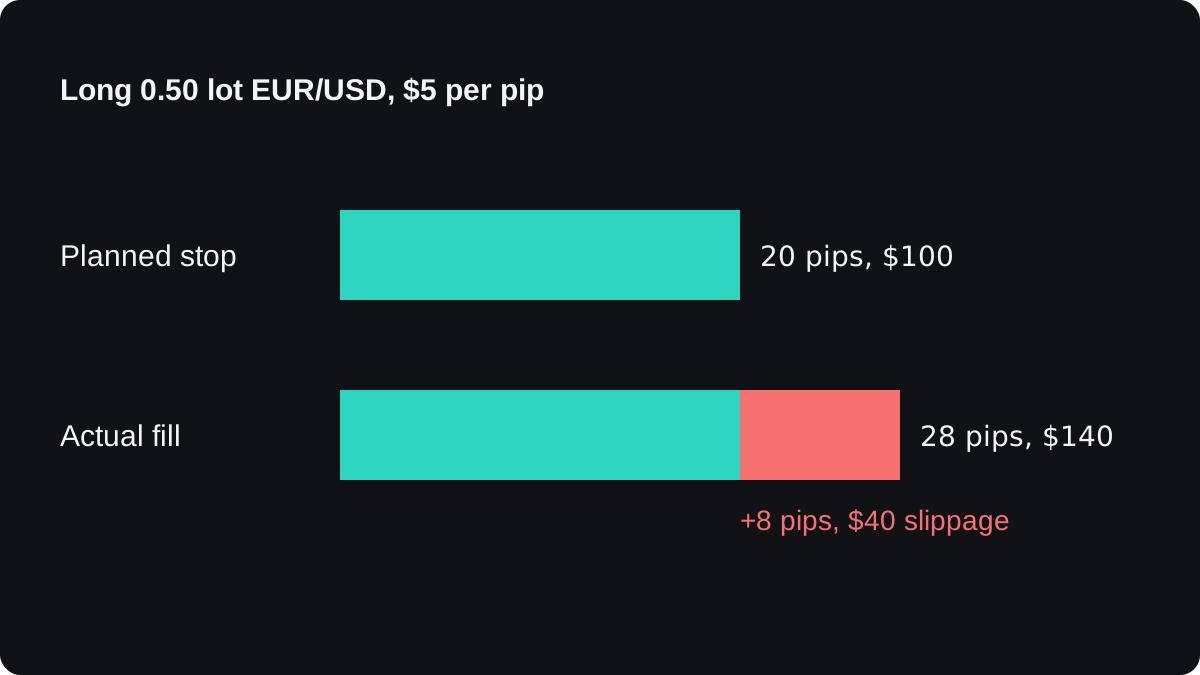
The stop closed the trade as designed, but a stop order cannot fix the price it fills at. When you size a trade with a position size calculation, a news gap is the case where the real loss can exceed the planned one.
The same thing can happen when the market reopens after a weekend, if price opens away from Friday's close.
Why the first move can mislead
The first seconds after a release are fast and messy. Automated systems trade the headline figure almost instantly, and stop orders triggering one after another add to the push.
The headline is rarely the whole story. Revisions to last month's figure, the other numbers in the same report and, for a central bank decision, the statement and press conference can each start a second move.
A figure that matches the forecast often moves price very little, because the market had already priced it. The market-moving economic data lesson lists the releases that usually bring the largest reactions.
What to check before a release
Start with the calendar time converted to your own time zone. Then look at any open trades and ask how a gap of 20 or 30 pips past your stop would change the loss.
You can reduce size, close positions before the release, or wait until the spread returns to normal. Watching a release on a demo account shows you the spread and slippage of your own broker without risking money.
Read your broker's terms as well. Some brokers offer a guaranteed stop, which fills at your exact level, usually at an extra cost, and some change margin requirements around major events.
Trading the release itself is a separate choice, and the directional news trading lesson looks at one way people attempt it and where it goes wrong.
Câu hỏi thường gặp
Why does my spread get so wide during news?
Liquidity providers quote less and wider around a release because the price may jump. Your broker's spread reflects those quotes, so it can be several times its normal size for a few seconds or minutes.
Can a stop loss fail during news?
The stop still triggers, but it fills at the next available price. If the market gaps past your level, the fill can be many pips worse than the stop price.
Is slippage always negative?
No. Price can move toward you before your order fills, which gives a better price. Your broker's execution policy says how it handles both kinds.
Which news moves forex the most?
Central bank interest rate decisions, inflation figures and employment reports tend to bring the largest moves. The size of the reaction depends on how far the result lands from the forecast.
Should beginners trade during news releases?
That is a personal decision, but spreads, slippage and gaps make costs and losses harder to predict at those times. Watching releases on a demo account first shows what to expect.
Học tiếp
 Chương 7Directional news trading.Directional news trading means taking a side, long or short, on what an economic release will do to a currency pair. You can trade before the number and guess the surprise, or after it and trade the move. Both face wide spreads, slippage and sudden reversals, so position size matters more than usual.
 Chương 7Non-directional news trading.Non-directional news trading places a buy stop above the price and a sell stop below it just before a release, so whichever way the market breaks, one order catches the move. The catch is execution: around the release spreads widen and fills slip, and a whipsaw can trigger both orders, so costs can erase the expected gain.

