Pairing a strong currency with a weak one.
A currency pair moves on the gap between its two currencies, so a correct view on one currency can still give a flat trade. Pairing a currency you expect to strengthen with one you expect to weaken lets both forces push the price the same way, though each half of that view is a forecast that can fail.
Nội dung này hiện chỉ có bản tiếng Anh.

Say you have done the work from the previous lesson and you expect the US dollar to strengthen. You still cannot trade that view on its own.
Every forex trade is a pair, so the currency on the other side decides much of the result.
Why is a view on one currency only half a trade?
A currency pair is a ratio. EUR/USD tells you how many dollars one euro buys, so it moves when either currency changes value.
If the dollar strengthens and the euro strengthens by the same amount, EUR/USD stays where it was. Your dollar view was right, and the trade made nothing.
So you choose the second currency as carefully as the first. You want a currency you expect to be strong against one you expect to be weak, so both forces push the pair in the same direction.
How do strength and weakness add up?
Picture each currency measured against the same yardstick, for example a basket of other currencies. The pair's move then comes from the gap between its two currencies.
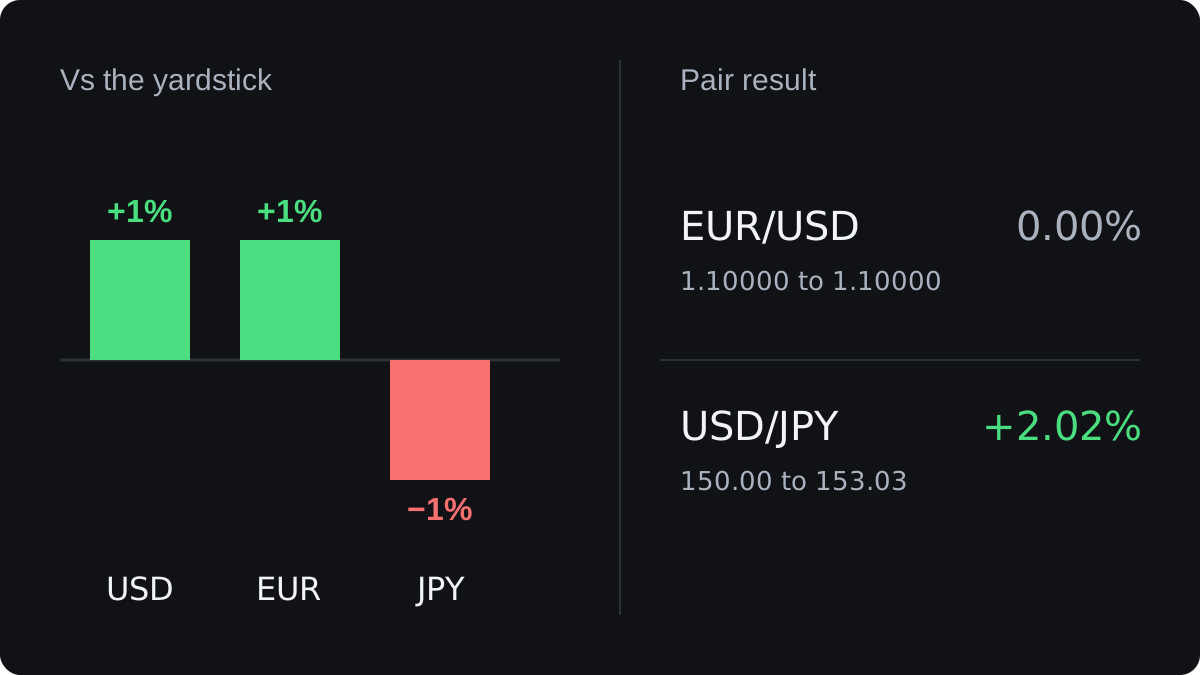
Here is an illustrative month, with round numbers chosen to keep the sums easy:
| Currency | Change against the yardstick |
|---|---|
| USD | +1% |
| EUR | +1% |
| JPY | −1% |
EUR/USD compares two currencies that both rose 1%. The ratio is 1.01 ÷ 1.01 = 1.00, so the pair is unchanged. From 1.10000 it stays at 1.10000.
USD/JPY compares a currency that rose 1% with one that fell 1%. The ratio is 1.01 ÷ 0.99 = 1.0202, a rise of about 2.02%, which takes the pair from 150.00 to 153.03.
Now turn that into a trade. You buy 0.10 lot of USD/JPY at the illustrative price of 150.00.
- New price: 150.00 × 1.01 ÷ 0.99 = 153.03.
- Move: 153.03 − 150.00 = 3.03. A yen pip is 0.01, so that is 303 pips.
- On 0.10 lot, which is 10,000 dollars, one pip is 10,000 × 0.01 = ¥100.
- Gain: 303 × ¥100 = ¥30,300.
- In a dollar account at 153.03: ¥30,300 ÷ 153.03 = $198.00.
Selling 0.10 lot of EUR/USD instead, where a pip is worth $1, gives a move of 0 pips. That trade ends with a small loss equal to the spread, although the dollar view behind it was the same.
How do you rank currencies from strong to weak?
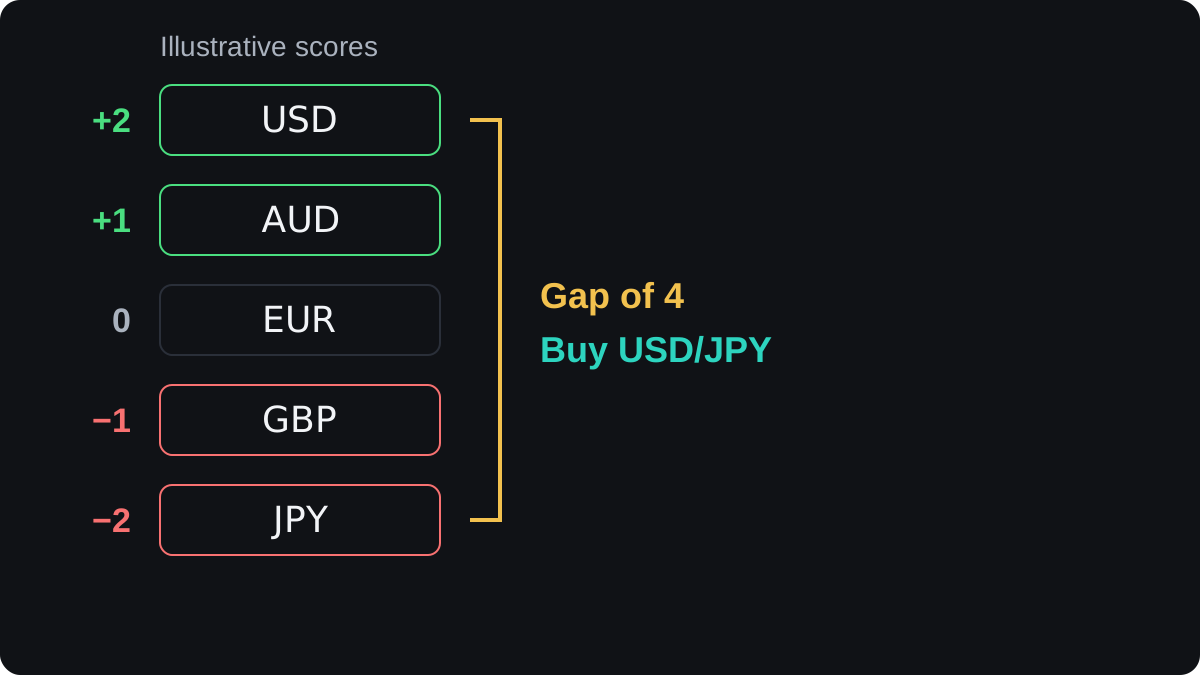
Start from the view you built for each currency. Give each one a score from +2 (clearly strong) to −2 (clearly weak), based on what you expect from its interest rate outlook and its economy.
Then line the scores up. The pairs with the widest gap between their scores are the ones where your view has the most room to show in the price.
In a made-up ranking, USD scores +2, AUD +1, EUR 0, GBP −1 and JPY −2. USD against JPY is a gap of 4, which points to buying USD/JPY. AUD against EUR is a gap of only 1.
Check how the market writes the pair. A strong AUD against a weak GBP is traded by selling GBP/AUD, because the pound is quoted first.
The currency heat map shows how currencies have moved against each other recently. That is measured history, while your ranking is a forecast, and the two can disagree.
Where does the strong-versus-weak idea fail?
Every score in the ranking is a guess, and each guess can go wrong in its own way.
A weak-looking currency may already be priced as weak. If forecasters widely expect its central bank to cut rates, the cut is in the price, and the currency can rise when it happens. Expectations versus actual explains why.
Market mood can override slower fundamentals for weeks. In past risk-off moves, the yen and the Swiss franc have often gained even when their own economic outlook looked poor.
Rankings also go stale. One inflation report can move a currency from strong to neutral, so a pair that suited your view on Monday may not suit it by Friday.
A ranking is a way to choose which pair expresses a view. It is not a tested strategy on its own, so test any rules you build from it on a demo account before using real money.
Why does the pair you pick change your cost and risk?
Two pairs can carry the same view at different costs. Pairs between two non-dollar currencies, covered in what currency crosses are, usually have wider spreads than the majors.
The interest gap between the two currencies sets your overnight swap. Buying the higher-rate currency can earn a credit, but the broker's markup can turn a small credit into a charge.
Pairs also move by different amounts in a typical day. A 50 pip stop can be wide on one pair and tight on another, so size each position from its own stop distance and pip value.
Then watch for doubling up. Buying USD/JPY and selling EUR/USD at the same time are two trades, but both are long the dollar. Currency correlation shows how to measure that overlap.
Suppose you hold 0.10 lot of each, and the dollar then falls 1% against the yardstick while the euro and yen hold still. EUR/USD rises from 1.10000 to 1.10000 ÷ 0.99 = 1.11111.
The EUR/USD short loses 111.1 pips, or $111.10. USD/JPY falls from 150.00 to 148.50, a loss of 150 pips or ¥15,000, which is ¥15,000 ÷ 148.50 = $101.01.
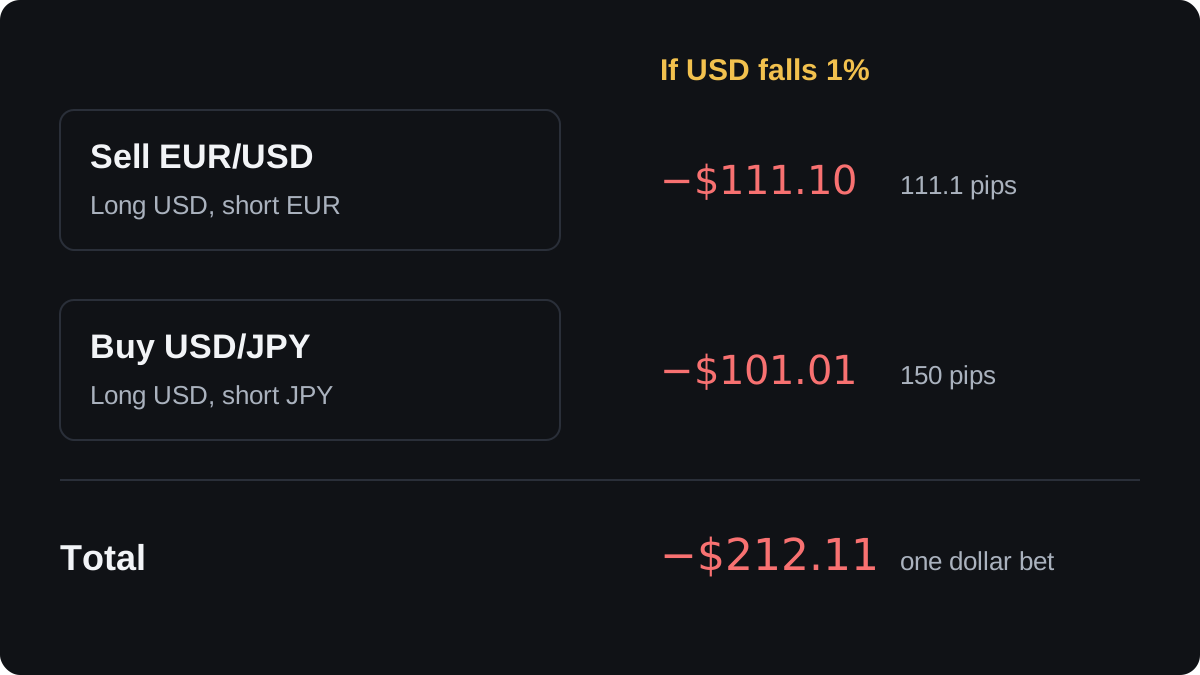
Together that is $111.10 + $101.01 = $212.11 lost on what was really a single bet on the dollar.
A short check before you choose a pair
Run through these questions each time a view turns into a possible trade:
- Can you name one currency you expect to strengthen and one you expect to weaken?
- Is the gap in your ranking wide, or only one step?
- How does the market quote the pair, and does your view mean buying or selling it?
- How do the spread and swap on this pair compare with other pairs that carry the same view?
- Do your open trades already hold the same currency on the same side?
- What position size does your stop distance and this pair's pip value allow?
Choosing the pair settles what you trade. The next lesson, combining fundamentals with technical analysis, deals with when to enter.
Câu hỏi thường gặp
What is the strongest currency to trade?
No currency stays the strongest for long. Strength is relative and shifts with interest rate expectations, economic data and market mood, so any ranking needs regular updates.
How do I measure currency strength?
For the past, compare each currency's performance against several others over the same period, which a heat map does. For the future, you rely on your fundamental view, which is a forecast.
Why did my pair not move when my view was right?
The other currency in the pair probably moved the same way. When both sides strengthen or weaken together, the pair changes little.
Can I pair any strong currency with any weak one?
Only if your broker lists a pair that joins them. Less common combinations can be missing, or carry wider spreads, so check the contract specifications first.
Is pairing strong and weak currencies a proven strategy?
Not on its own. It is a way to pick which pair expresses a view, and each half of that view is a forecast that can fail, so any rules built on it need testing.
Học tiếp
 Chương 4Building a fundamental view of a currency.A fundamental view is a written judgement of whether an economy's data favour its currency. A simple method scores three pillars, growth, inflation and central bank policy, from -2 to +2 each, based on direction and surprises. Comparing two totals shows which currency the data lean toward, though prices often move for other reasons.
 Chương 4Combining fundamentals with technical analysis.Combining the two means using fundamental analysis to decide which direction you favour for a currency pair, then using the chart to choose when to enter, where to place the stop and where to take profit. You act only on chart signals that agree with that direction, which cuts trades but does not guarantee better results.

