Your trading personality.
Your trading personality is how you behave while a trade is open: how long you can wait, how big a loss you can watch, and whether you keep your own rules. These habits decide which strategies you can follow through. Test them on a demo or small account and fit your plan to the results.
本頁目前僅提供英文版。

Two traders can copy the same strategy and still get very different results. One holds each trade until the stop or the target is hit. The other closes early, moves the stop, or skips the next signal after two losses.
The rules were identical. What differed was what each person could stand to do while money was moving. Three traits often sit behind that gap: patience, appetite for risk and discipline.
Which parts of your personality show up in your trades?
Here, personality means your habits under pressure: what you do when a trade is open and the result is uncertain. How calm you are in daily life may tell you little about how you act with a losing trade on screen.
Patience is how long you can wait, both for a setup to appear and for an open trade to finish. It decides which holding times you can live with.
Your risk appetite is the size of loss you can watch without changing your plan. It decides how much of your account each trade should put at stake.
Discipline is following your own rules when they feel wrong in the moment. It decides whether the plan you tested is the plan you actually trade.
No quiz can tell you whether you will be profitable, and online trading personality tests have little evidence behind them. Your own record is a better guide, and the last section shows how to collect it.
How patient are you with an open trade?
Holding time is what separates trading styles. A scalper may close a trade within minutes, while a swing trader may hold for days, as the trading styles lesson compares.
Impatience shows up in two ways. Some people find hours with no trade boring and start forcing entries. Others find a trade that moves every second stressful and close it on the first wobble.
Longer holds usually need wider stops, because price tends to swing further over days than over minutes. A wider stop does not have to mean a bigger loss, because you can shrink the position to match.
Here are two trades on EUR/USD in a US dollar account, where one pip on one standard lot is worth $10. The numbers are illustrative.
- Short hold: a 25 pip stop on 0.20 lot. The pip value is 0.20 × $10 = $2, so the risk is 25 × $2 = $50.
- Longer hold: a 100 pip stop on 0.05 lot. The pip value is 0.05 × $10 = $0.50, so the risk is 100 × $0.50 = $50.
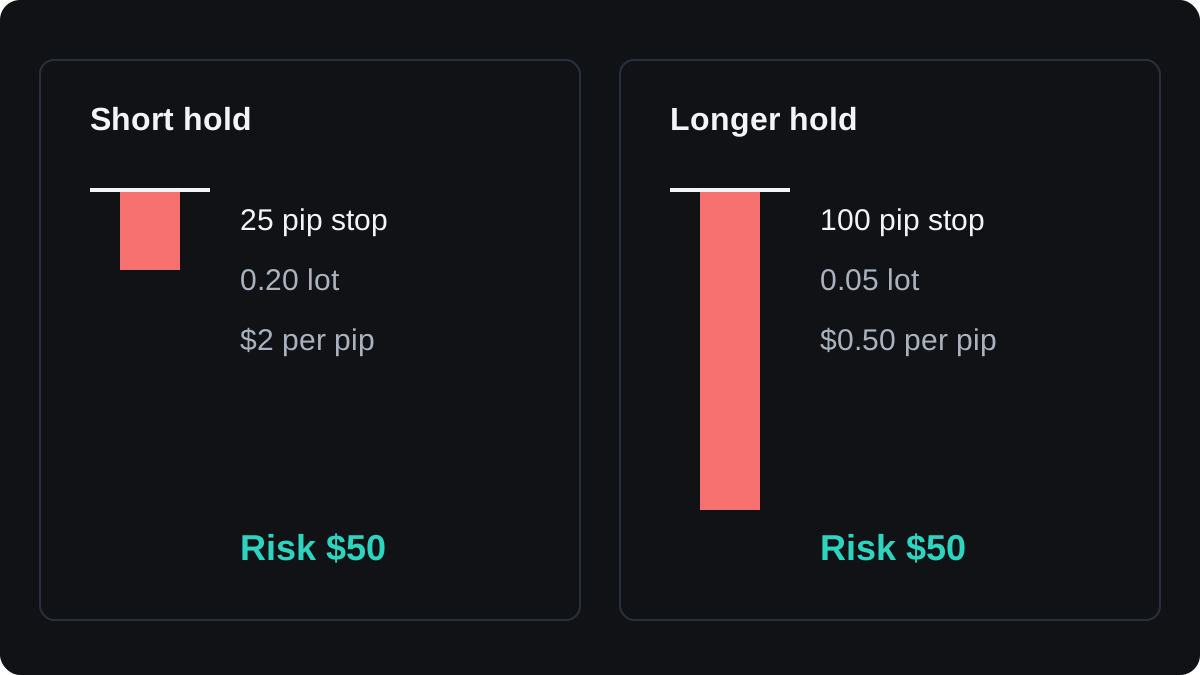
Both trades risk the same $50. The difference is how long you watch the trade and how far price can move against you first, so choose the holding time you can sit through without interfering.
How much loss can you sit through?
A drawdown is the fall in your balance from its highest point. Your risk appetite is really a question about drawdowns, because the hard moments usually come from several losses in a row.
Such runs are normal. With an illustrative 50% win rate and trades that do not affect each other, the chance that five given trades all lose is 0.5 multiplied by itself five times, or 1 in 32.
Over a few hundred trades, a streak like that is very likely to appear somewhere. Plan for it before it happens.
Take a $5,000 account, a 25 pip stop on EUR/USD, and a fixed risk of 3% of the starting balance on each trade:
- Risk per trade: 3% × $5,000 = $150.
- Position size: $150 ÷ 25 pips = $6 per pip, which is 0.60 lot at $10 per pip for one lot.
- Five losses: 5 × $150 = $750, leaving $4,250.
- Drawdown: $750 ÷ $5,000 = 15%.
- Recovery: to get back to $5,000 you need $750 on $4,250, a gain of 17.6%.
The same sums at three risk levels look like this:
| Risk per trade | Lot size (25 pip stop) | Loss per trade | Balance after 5 losses | Drawdown | Gain to recover |
|---|---|---|---|---|---|
| 1% | 0.20 | $50 | $4,750 | 5% | 5.3% |
| 3% | 0.60 | $150 | $4,250 | 15% | 17.6% |
| 5% | 1.00 | $250 | $3,750 | 25% | 33.3% |
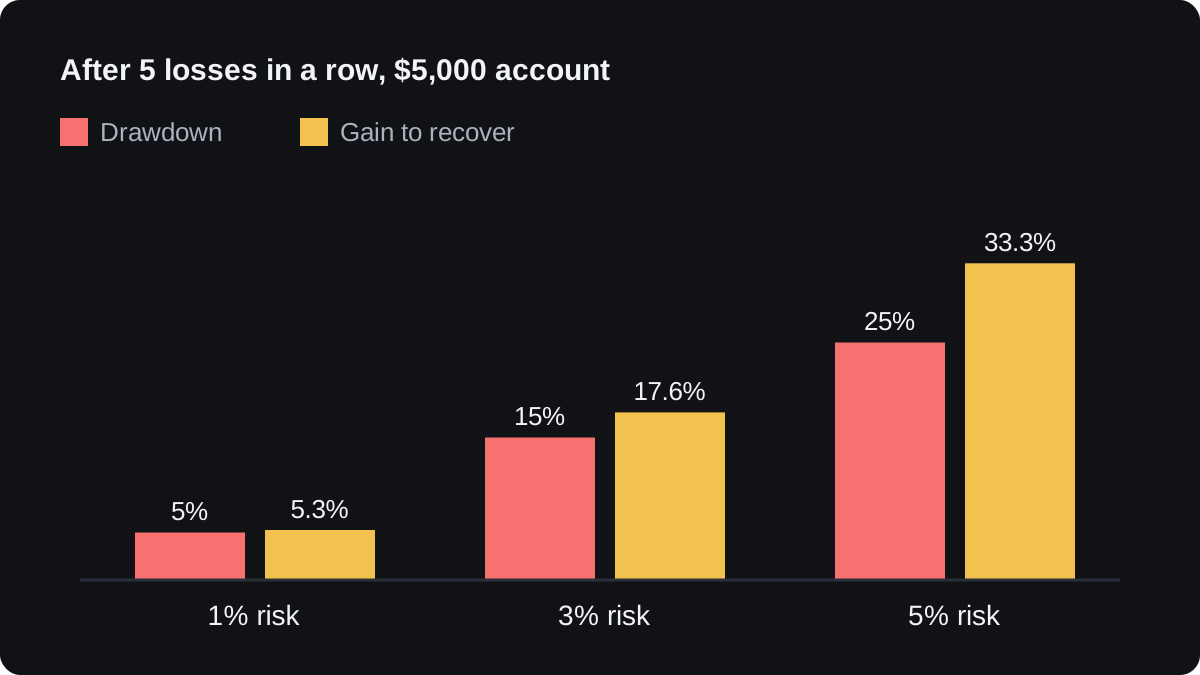
The recovery gets harder faster than the risk grows. At 5% risk the drawdown is five times the 1% row, yet the gain needed to recover is more than six times as large, 33.3% against 5.3%.
The drawdown and recovery lesson explains why the gap widens. For this lesson, ask which row you could watch without breaking your rules.
If the 15% row would make you double the next trade to win it back, your risk appetite is lower than your risk setting. The fix is a smaller number, which the risk per trade lesson helps you choose.
The position size lesson then turns that number into a lot size for any pair.
Why does discipline decide whether a plan works?
Say you buy 0.20 lot of EUR/USD at 1.08500 with a stop at 1.08250. That is 25 pips, and at $2 per pip the planned loss is $50.
Price falls toward the stop, and you move it down to 1.07900 to give the trade more room. The gap is now 1.08500 minus 1.07900 = 0.00600, which is 60 pips.
If price reaches the new stop, the loss is 60 × $2 = $120. That is 2.4 times the loss you planned, on the same trade and the same position size.
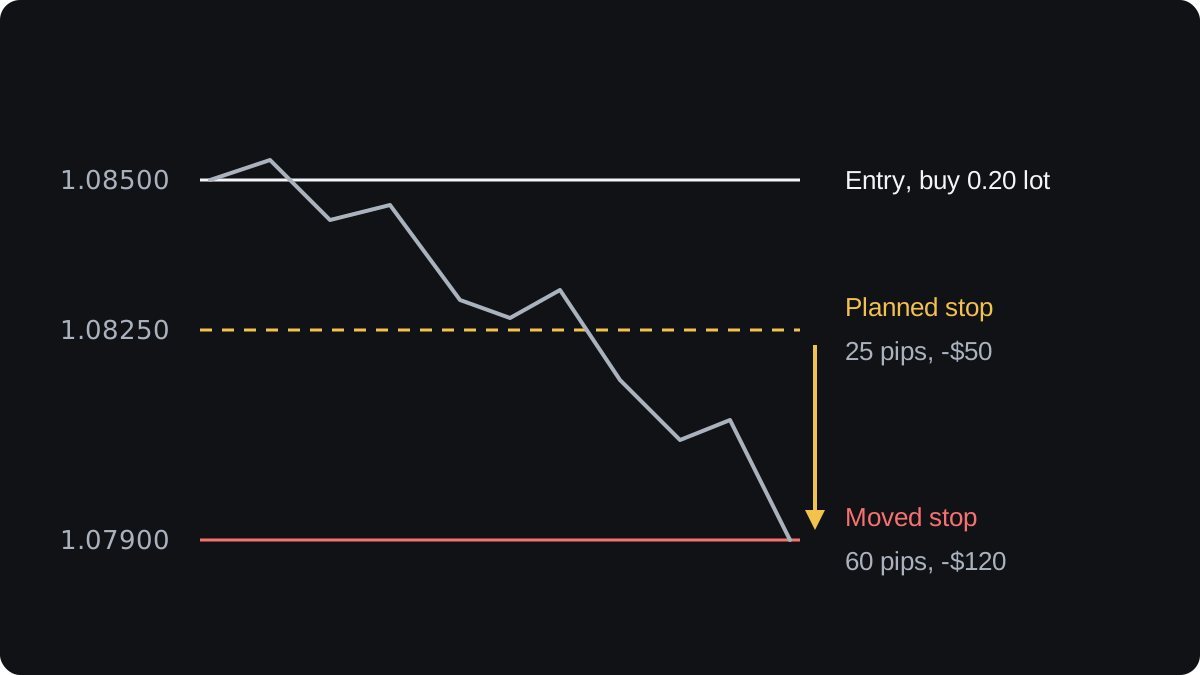
Moving a stop is one common slip. Others include closing winners early while letting losers run, trading bigger after a loss to win it back, and taking trades outside the plan when the market is quiet.
Each slip changes the numbers your plan was built on. A strategy tested with 25 pip stops tells you nothing about how it behaves with stops you move by feel.
Rules that remove choices in the moment help. Place the stop as an order when you enter, and write down the reason for each trade before you click.
How can you find out what kind of trader you are?
Watching yourself trade gives better answers than guessing. A demo account shows how you handle the rules, though losing pretend money is easier than losing your own.
A very small live account adds real feelings at a low cost. Keep the risk per trade tiny while you are learning about yourself.
Keep a trading journal and record more than prices. Note how you felt, whether you followed the plan, and anything you changed during the trade and why.
After 20 to 30 trades, read the journal and answer these questions:
- How often did you close before the stop or the target was hit?
- Did you ever move a stop further from your entry?
- Did your trade size change after a win or a loss?
- Which holding time felt calm, and which had you checking the screen constantly?
If a pattern appears, change the plan to fit it, for example a longer timeframe or a smaller risk per trade. Then test the new version the same way.
The next lesson turns these choices into a trading system: written rules for entries, exits and position size that match the trader you are.
常見問題
Is there a best personality for trading?
No single personality type has been shown to win. Choosing rules you can actually follow, with a holding time and a risk level that suit you, matters more.
Can you change your trading personality?
Habits can change with practice, written rules and regular review, though the pace differs from person to person. Adjusting the plan to fit your habits is often the quicker fix.
How do I know my risk tolerance?
Work out what five losses in a row would cost at your planned risk, as in the table above, and ask whether you could keep following your rules after it. Then check on a demo or small account whether your behaviour matches your answer.
Why do I close winning trades too early?
A small gain feels good to lock in, and the fear of watching it turn into a loss is strong. Setting a take-profit order at entry, with a rule against closing by hand before it, is one common way to handle this.
Are trading personality quizzes reliable?
They can start a useful conversation with yourself, but there is little evidence that they predict trading results. A journal of your own trades is better evidence.
繼續學習
 第 2 章Scalping, day, swing and position trading.Scalping holds trades for seconds to minutes, day trading closes everything the same day, swing trading holds for days and position trading for weeks to months. Shorter styles pay the spread more often and need more screen time. Longer styles pay a smaller share of each target in spread but carry swap, weekend gaps and wider stops.
 第 2 章Choosing a style that fits your life.Pick a trading style by checking three things: the hours you can watch the market, the size of your account and the kind of pressure you handle. Scalping and day trading need long blocks of screen time and lose more of each target to costs. Swing and position trading fit around a job but need wider stops.

