Scalping, day, swing and position trading.
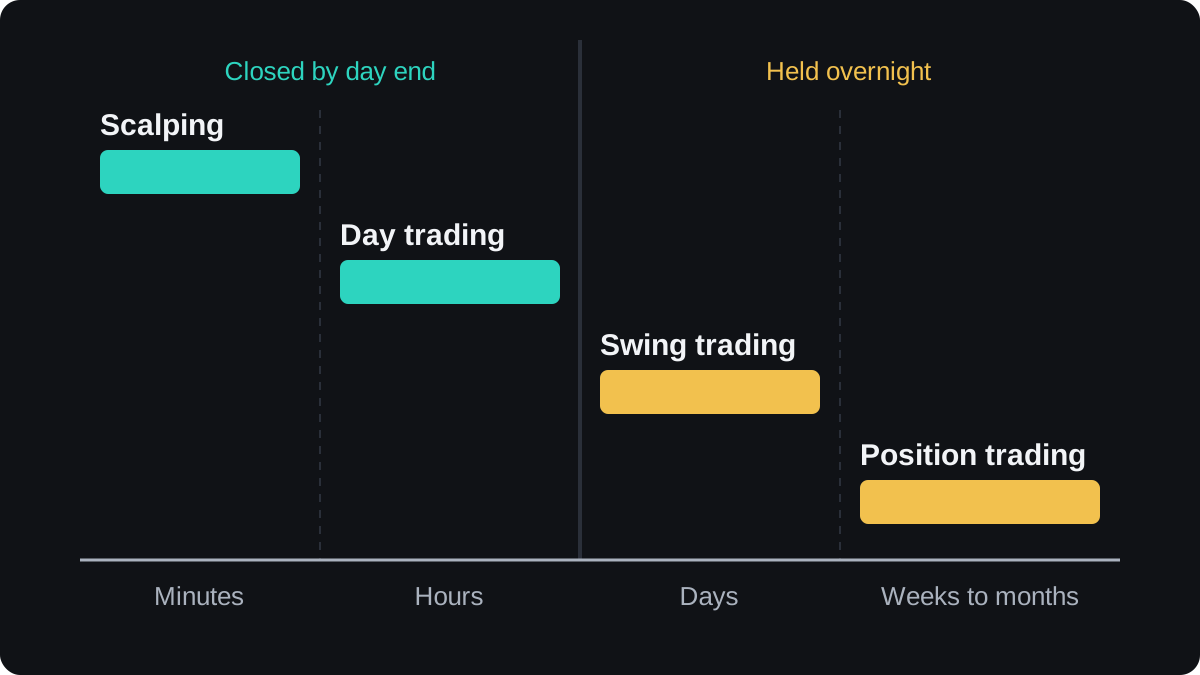
Scalping holds trades for seconds to minutes, day trading closes everything the same day, swing trading holds for days and position trading for weeks to months. Shorter styles pay the spread more often and need more screen time. Longer styles pay a smaller share of each target in spread but carry swap, weekend gaps and wider stops.

Two traders can buy EUR/USD on the same morning and run very different businesses. One closes four minutes later for 5 pips. The other holds for two months, aiming at 600 pips.
Holding time separates them. It changes what each trader pays and how long each one has to watch the screen.
How long does each style hold a trade?
Scalping means opening and closing trades within seconds or minutes, aiming for a few pips each time. A scalper may trade many times in one session.
Day trading holds trades for minutes to hours and closes everything before the trading day ends. Nothing stays open overnight.
Swing trading holds a trade for a few days to a couple of weeks. It tries to catch one leg of a move, from a swing low to a swing high or the reverse.
Position trading holds for weeks, months or longer. It often rests on a fundamental view, such as where a central bank is taking interest rates.
These ranges are custom, and the edges blur. A day trade you keep past the close has become a swing trade, with the overnight costs that come with it.
What does each style pay per trade?
Every round trip pays the spread once. Any trade still open at the daily rollover, around 17:00 New York time, also pays or earns swap.
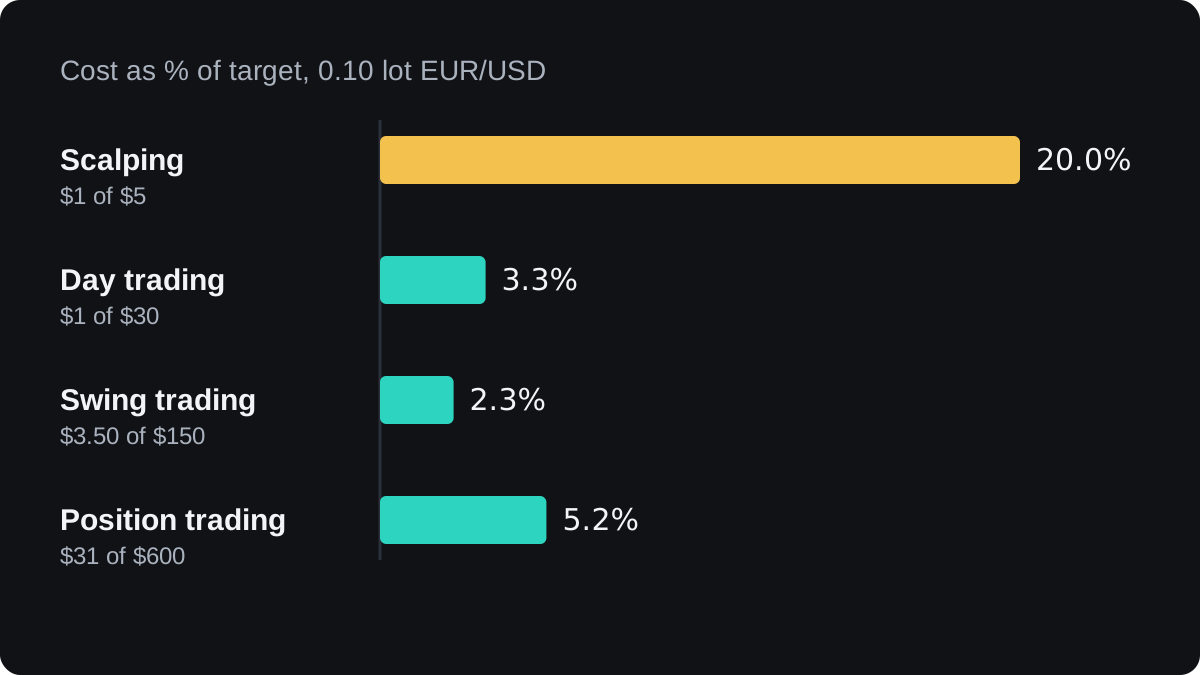
The size of those costs only means something next to the profit you are aiming for. The example uses round illustrative numbers, and every trade is 0.10 lot of EUR/USD, where one pip is worth $1.
The spread is 1.0 pip, so each round trip costs $1. Swap is an illustrative charge of $0.50 per night on 0.10 lot, and there is no commission.
- Scalp: the target is 5 pips, or $5. The cost is the $1 spread, and $1 ÷ $5 = 20% of the target.
- Day trade: the target is 30 pips, or $30. The cost is $1, and $1 ÷ $30 = 3.3%.
- Swing trade: the target is 150 pips, or $150. Swap is charged 5 times, so 5 × $0.50 = $2.50, and with the $1 spread the total is $3.50. Then $3.50 ÷ $150 = 2.3%.
- Position trade: the target is 600 pips, or $600. Swap is charged 60 times, so 60 × $0.50 = $30, and with the $1 spread the total is $31. Then $31 ÷ $600 = 5.2%.
| Style | Target | Spread | Swap | Total cost | Share of target |
|---|---|---|---|---|---|
| Scalping | 5 pips, $5 | $1.00 | $0.00 | $1.00 | 20.0% |
| Day trading | 30 pips, $30 | $1.00 | $0.00 | $1.00 | 3.3% |
| Swing trading | 150 pips, $150 | $1.00 | $2.50 | $3.50 | 2.3% |
| Position trading | 600 pips, $600 | $1.00 | $30.00 | $31.00 | 5.2% |
Swap can also be a credit, depending on the pair, the direction and the broker's rates. With a credit, the position trade's swap would reduce its cost instead of adding to it.
Brokers commonly charge three nights of swap on one weekday to cover the weekend, so the number of charges roughly matches calendar nights. Sixty charges is about two months.
Short trades also feel execution most. Half a pip of slippage, the gap between the price you expected and the price you got, is 10% of a 5 pip target and about 0.3% of a 150 pip one.
How do costs add up over a month?
Short styles pay a larger share of each target, and they also trade more often. Take 20 trading days, the same 0.10 lot and the costs above:
- A scalper making 10 trades a day makes 200 trades, so 200 × $1 = $200.
- A day trader making 2 trades a day makes 40 trades, so 40 × $1 = $40.
- A swing trader making 4 trades a month pays 4 × $3.50 = $14.
- A position trader opening one trade every two months pays $31 ÷ 2 = $15.50 a month.
The trade counts are chosen to illustrate the sums. Your own counts will differ.
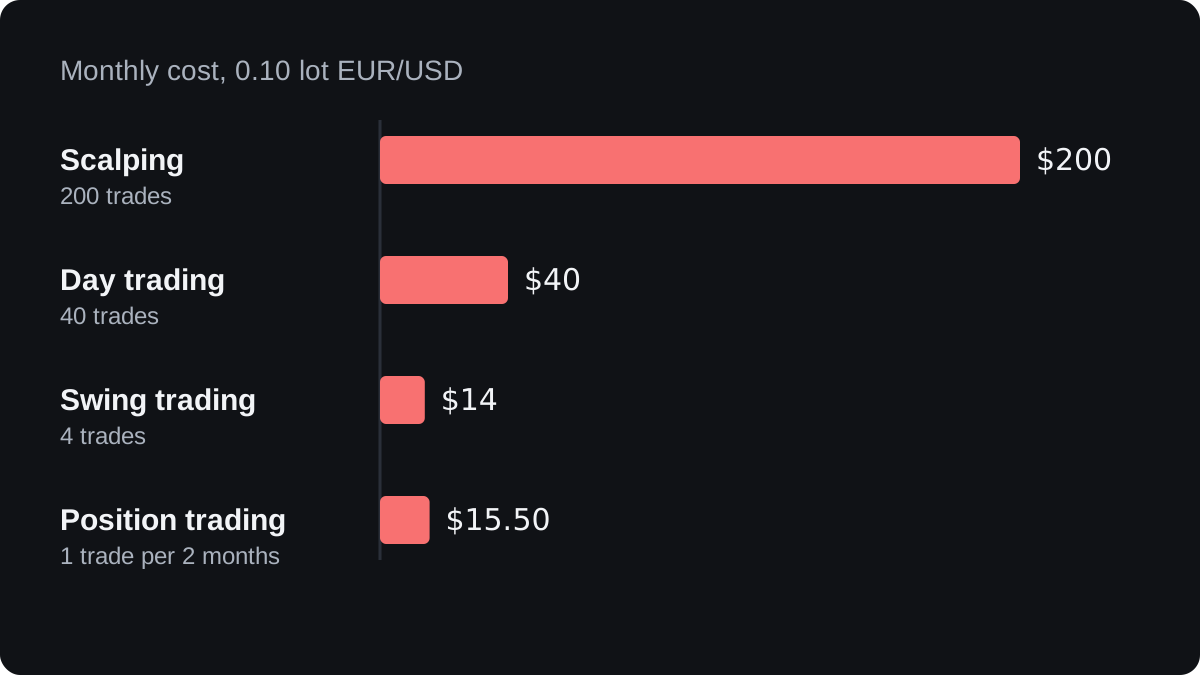
Because the scalper makes so many trades, a small change in the spread moves the monthly total a lot.
Cutting 0.2 pip from the spread saves 200 × $0.20 = $40 a month for the scalper and 4 × $0.20 = $0.80 for the swing trader.
That is why active traders compare Standard and Raw spread accounts, where a tighter spread plus a commission can change the cost per trade.
A rebate pays back a set amount for each lot traded, so it adds up fastest for busy styles; the Exness broker page shows how it works.
How much screen time does each style need?
Scalping needs unbroken attention for a block of hours, because trades open and close within minutes. It suits the busiest hours, such as the overlap of the London and New York trading sessions, when spreads are often at their tightest.
Day trading needs a few focused hours that line up with an active session, plus time to close everything. Once you are flat, with no open position, you can step away.
Swing trading needs a check once or twice a day. Pending orders, a stop loss and a take profit do the waiting for you.
That freedom comes with overnight exposure. A market can gap over a weekend and fill your stop at a worse price than the one you set.
Position trading needs a regular weekly review and a lot of patience. You may sit through pullbacks of a hundred pips or more, while swap is charged or credited every night.
Why do longer trades need smaller positions?
A longer trade needs room, so its stop sits further from the entry. If you risk the same money on every trade, a wider stop forces a smaller position. The position size lesson covers the full method.
Take a $2,000 account that risks 1% per trade, which is $20. On EUR/USD one standard lot is worth $10 per pip, so lot size = $20 ÷ stop in pips ÷ $10.
| Style | Stop (illustrative) | Value per pip | Lot size |
|---|---|---|---|
| Scalping | 5 pips | $4.00 | 0.40 |
| Day trading | 20 pips | $1.00 | 0.10 |
| Swing trading | 100 pips | $0.20 | 0.02 |
| Position trading | 300 pips | $0.067 | 0.0067 |
Many accounts have a minimum trade size of 0.01 lot. At 0.01 lot, a 300 pip stop risks 300 × $0.10 = $30, which is 1.5% of the account.
So a small account may not be able to position trade at its planned risk. It has to accept a larger risk, a tighter stop or a different style.
Is one style more profitable than the others?
There is no reliable public evidence that one style earns more for retail traders. Results depend on the method, its costs and how consistently it is followed.
The mechanics, on the other hand, can be compared. Shorter styles pay more cost against each target and depend on fast, clean fills. Longer styles pay little per pip of target but carry swap, weekend gaps and stops wide enough to strain a small account.
Each style also fails in its own way. A scalping method fails when costs and slippage eat its small edge per trade. A position trade fails when the fundamental view is wrong and you hold it for weeks.
The next lesson, choosing a style that fits your life, matches these demands to your hours and your account.
Questions
Do day traders pay swap?
Not if every position is closed before the daily rollover, around 17:00 New York time. A trade still open at that moment is charged or credited swap like any other.
Which trading style is best for beginners?
No style is proven best. Slower styles give you more time to think and pay less spread per pip of target, while shorter styles give faster feedback at a higher cost per trade.
Can you scalp with any broker?
Terms differ between brokers. Some set conditions on very short trades, so read the client agreement and the account terms before you start.
Can you combine two trading styles?
You can, as long as each style has its own written rules. Record them separately in your journal so you can see the results of each one.
How long does a swing trade last?
Usually a few days to a couple of weeks. The exact range is a convention, and what matters is that the trade stays open overnight and pays or earns swap.
Keep learning
 Chapter 2Choosing a style that fits your life.Pick a trading style by checking three things: the hours you can watch the market, the size of your account and the kind of pressure you handle. Scalping and day trading need long blocks of screen time and lose more of each target to costs. Swing and position trading fit around a job but need wider stops.
 Chapter 2Your trading personality.Your trading personality is how you behave while a trade is open: how long you can wait, how big a loss you can watch, and whether you keep your own rules. These habits decide which strategies you can follow through. Test them on a demo or small account and fit your plan to the results.

