Keeping a margin buffer.
A margin buffer is how much equity you can lose before your broker's stop out begins, measured in money and in pips. You keep it wide by sizing trades so that even a rough day against you leaves the margin level far above stop out, and your own stop loss closes the trade first.
هذا المحتوى متاح حاليًا باللغة الإنجليزية فقط.
Picture a $1,000 account with a 0.50 lot buy on EUR/USD. If price falls 145 pips, the broker closes the trade itself and about $725 is gone.
With a smaller trade, the same account could survive a fall many times that size. The difference is the margin buffer.
A margin buffer is the distance between your equity now and the equity at which your broker's stop out begins, counted in money and in pips. A wide buffer means ordinary price swings cannot force your positions closed.
How do you measure the buffer in pips?
Your broker tracks your margin level: equity divided by used margin, times 100. Equity is your balance plus or minus the profit or loss on open trades.
When the margin level falls to the stop out level, the broker starts closing positions.
That trigger is a fixed number, so you can find it before you trade. Equity at stop out is used margin times the stop out level, written as a decimal (50% is 0.50).
The buffer is your equity now minus that figure. Divide it by the pip value and you have it in pips:
Pips to stop out = (equity − used margin × stop out level) ÷ pip value
In this worked example, the 1:100 leverage, the 100% margin call and the 50% stop out are illustrative, since brokers and account types differ.
- Your balance is $1,000 and nothing else is open. You buy 0.50 lot of EUR/USD at 1.10000.
- That is 50,000 euros, worth 50,000 × 1.10000 = $55,000.
- Used margin at 1:100 is 55,000 ÷ 100 = $550.
- Pip value is 50,000 × 0.0001 = $5 per pip.
- Margin call comes at equity of $550, which is (1,000 − 550) ÷ 5 = 90 pips away, near 1.09100.
- Stop out comes at equity of 550 × 0.50 = $275, which is (1,000 − 275) ÷ 5 = 145 pips away, near 1.08550.
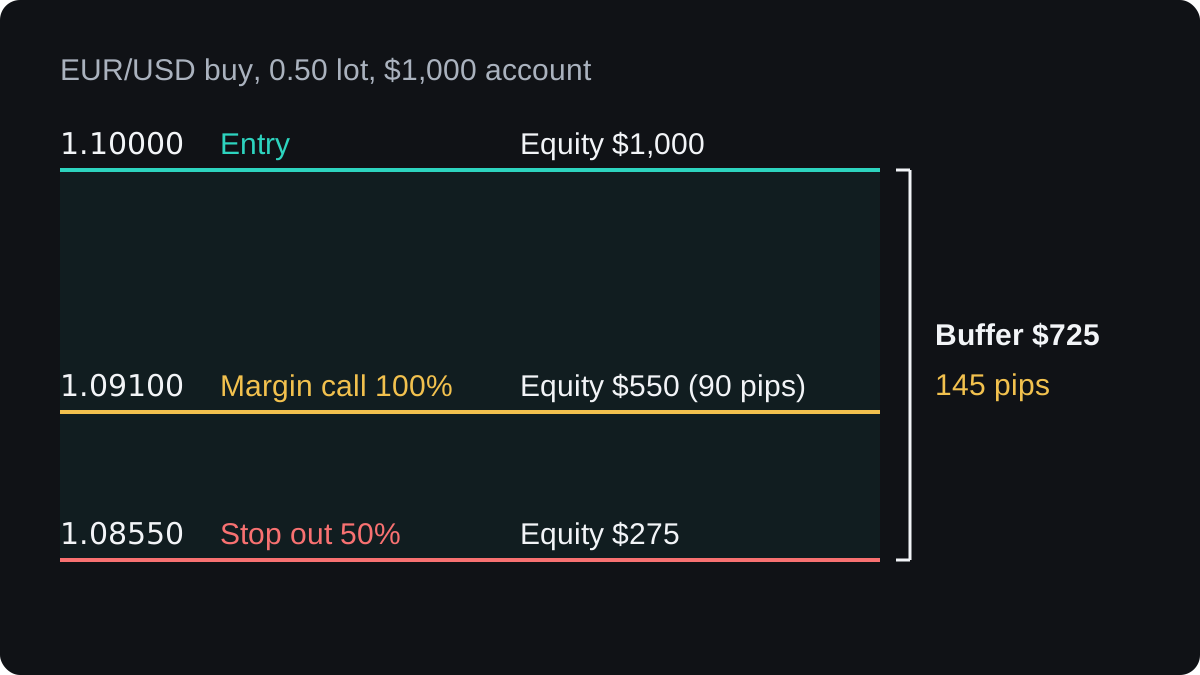
These sums ignore the spread and treat used margin as fixed. Some platforms recalculate it as the price moves, so read the price levels as close estimates.
For other pairs and account sizes, the margin calculator gives the used margin to plug into the formula.
Why does a bigger trade shrink the buffer so fast?
Keep the same $1,000 account and change only the size. Effective leverage is the position's value divided by your equity, as the effective leverage lesson explained.
| Lot size | Effective leverage | Used margin | Pip value | Pips to margin call | Pips to stop out |
|---|---|---|---|---|---|
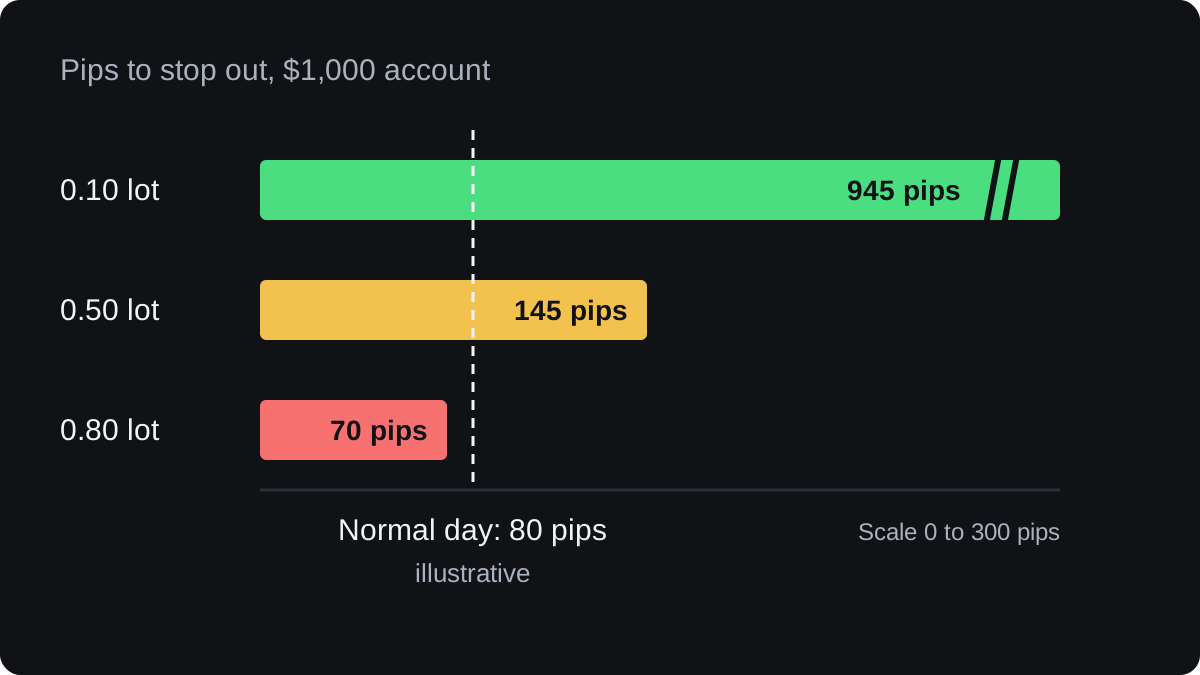
| 0.10 | 11:1 | $110 | $1 | 890 | 945 |
| 0.50 | 55:1 | $550 | $5 | 90 | 145 |
| 0.80 | 88:1 | $880 | $8 | 15 | 70 |
Moving from 0.50 to 0.80 lot makes the trade 60% bigger, yet the room to stop out falls by more than half, from 145 pips to 70.
A bigger trade loses more per pip and also raises the equity line where stop out begins. The buffer is squeezed from both sides at once.
The 0.80 lot trade is still allowed, because its $880 margin fits inside $1,000. It opens at a margin level of about 114%, only 15 pips from a margin call.
What counts as a normal move against you?
A normal move is the distance a pair often travels in the time you plan to hold the trade. The average true range (ATR), covered in measuring volatility, is one common way to read it from your own chart.
Suppose EUR/USD has recently covered about 80 pips on an ordinary day. That figure is illustrative, and the real one changes as markets get calmer or wilder.
On those numbers, one ordinary day against you can stop out the 0.80 lot trade. The 0.50 lot trade survives one such day, but two days, 160 pips, would take it past 145.
Moves bigger than normal happen too. Major news and weekend gaps can carry price well past a typical day's range.
Spreads can also widen around news and the daily rollover. A buy is valued at the bid, so a wider spread lowers your equity even when the middle price barely moves.
You can run the formula backwards. Decide how many pips you want the account to survive, then try sizes until the pips to stop out clear that target.
In this account, a 300 pip target allows about 0.28 lot. That size uses $308 of margin, puts stop out at equity of $154 and leaves (1,000 − 154) ÷ 2.80 = about 302 pips.
Why should your stop loss close the trade first?
A stop out is a forced close at market, at whatever price is available when your margin runs short. Your broker decides which positions to close and in what order, by its own rules.
A stop loss closes the trade at a level you picked for a reason. If you size each trade from that stop, the buffer usually takes care of itself.
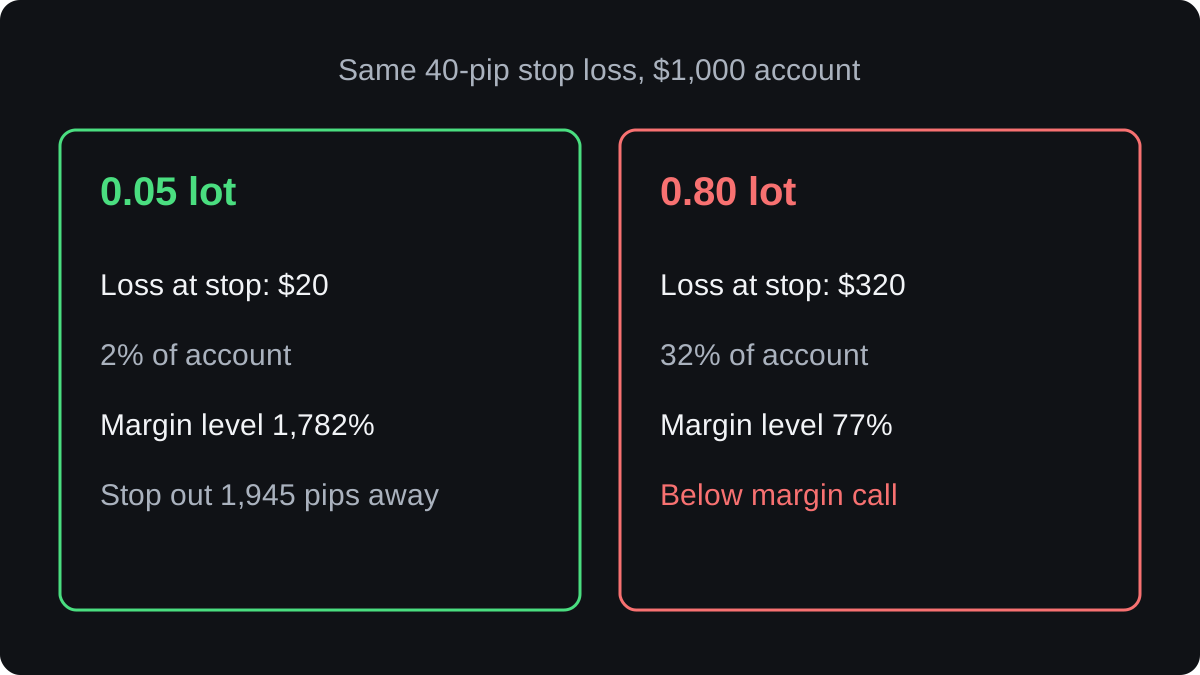
Say you risk an illustrative 2% of $1,000, which is $20, with a stop 40 pips from entry.
- Pip value allowed: $20 ÷ 40 = $0.50 per pip, which is 0.05 lot.
- Used margin at 1:100: 5,000 × 1.10000 ÷ 100 = $55.
- If the stop is hit, equity is $980 and the margin level is 980 ÷ 55 × 100, about 1,782%.
- Stop out would need (1,000 − 27.50) ÷ 0.50 = about 1,945 pips.
Now put 0.80 lot behind the same 40 pip stop. The loss at the stop is 40 × $8 = $320, or 32% of the account.
Equity falls to $680 and the margin level to 680 ÷ 880 × 100, about 77%. The trade never reached stop out, yet it passed through margin call on the way to the stop.
A stop loss is still an order, and in a fast market or across a weekend gap it can fill beyond its price. A wide buffer keeps that kind of slippage from reaching your stop out level.
The position size lesson turns this sizing method into a routine you can use on any pair.
What quietly eats into the buffer?
The buffer belongs to the whole account. Every open position adds its used margin to the total.
Positions that tend to move together also lose together. Long EUR/USD and long GBP/USD both lose if the dollar strengthens, as the lesson on correlation and portfolio risk shows.
Withdrawals lower equity at once, and so do swap charges on positions held overnight. Neither moves the price, but both bring the stop out line closer in pips.
Some brokers raise margin requirements for large positions or ahead of weekends, holidays and major news. That raises the used margin on trades you already hold.
Your broker's margin terms say whether and when this applies. Stop out levels themselves also differ between brokers and between account types.
أسئلة شائعة
What margin level should I keep?
There is no single safe number, so measure the buffer in pips instead. It should sit well beyond your stop loss and beyond a rough day on the pair.
In this lesson's account, 0.10 lot opened at a margin level of about 909% and left 945 pips.
Does higher leverage give me a bigger buffer?
Only if the trade size stays the same. At 1:500, the 0.50 lot trade uses $110 of margin, so stop out moves from 145 to 189 pips away.
Each pip still costs $5, and a bigger trade opened with the freed margin takes that room back.
Is a stop loss enough to protect my account?
When the size is based on the stop, it usually closes the trade long before stop out. Gaps and fast markets can fill it at a worse price, which is why the buffer should be much wider than the stop distance.
Where do I find my broker's stop out level?
Look in the account type or margin terms on the broker's website, and often in the platform's account details. It can differ between account types at the same broker.
What happens to my other trades at stop out?
The broker closes positions until the margin level is back above the stop out level. It uses its own order of closing, so check its terms to see which positions go first.