How to trade breakouts.
You can trade a breakout in three ways. Enter on the break with a stop order, wait for a candle to close beyond the level, or wait for price to retest it. Earlier entries catch more moves and more false starts; later entries filter some failures but cost price or missed trades.
هذا المحتوى متاح حاليًا باللغة الإنجليزية فقط.

A breakout tells you that price has left its range. It does not tell you when to get in.
You can enter the moment price crosses the level, wait for a candle to close beyond it, or wait for price to come back and test it.
Each choice changes your entry price and your stop distance. It also changes how often you end up in a trade at all.
What you decide before price breaks
Start with the level. The previous lesson described a breakout as price leaving a range or crossing a level it had respected before.
A level that price has turned at several times is more likely to be one other traders watch too.
It is rarely one exact price, so treat it as a narrow zone and place orders a few pips beyond it, where small pokes do not trigger them.
Then write down the entry, the stop and the target before the break. That way you are not choosing them while price moves fast.
A common way to set a target is the measured move: take the height of the range and add it to the breakout level. A 50 pip range that breaks upward gives a target 50 pips above resistance.
The measured move is a convention only. Price can stop short of it or run well past it.
The stop usually goes back inside the range, on the far side of the broken level. If price returns deep into the range, the breakout idea has failed and there is little reason to stay in.
Entering on the break
The fastest entry is a buy stop order placed a little above resistance, or a sell stop a little below support. It is a pending order that waits and fills automatically when price trades through it.
The order types lesson covers how pending orders work. Their benefit here is that you never miss a move that runs straight away. Some strong breakouts never come back to the level, and a trader waiting for a better price watches them leave.
The cost is that you also catch every false start. Price can poke through, trigger your order and fall back into the range within minutes. That problem has its own lesson, false breakouts.
A stop order fills at the next available price. In a fast move or around news you may get slippage, a fill worse than your order price, and the spread can widen at the same moment.
Waiting for a candle to close beyond the level
Confirmation here means a candle closes beyond the level on the timeframe you trade. A wick through resistance shows that price visited higher prices. A close shows it was still there when the candle ended.
On one-hour candles, a candle that reaches 1.08560 but closes at 1.08460 has failed to hold above 1.08500. A candle that closes at 1.08600 has confirmed the break on that timeframe.
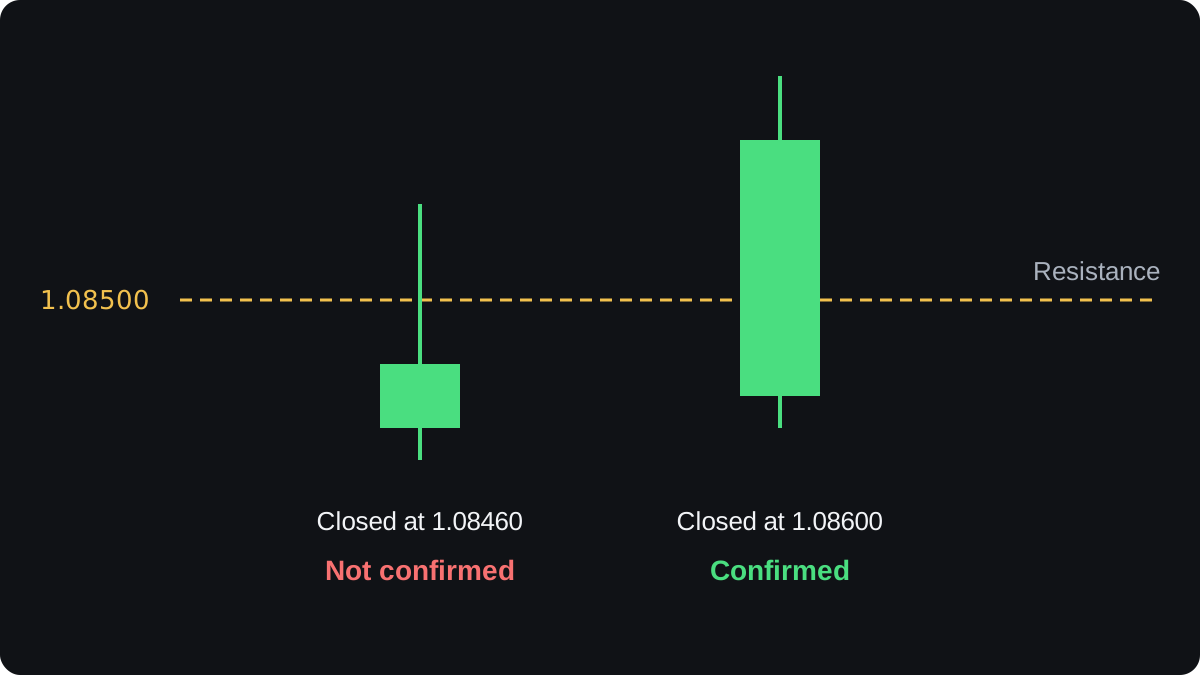
The trade-off is price. By the time the candle closes, price may already be well past the level, so your stop sits further away and less of the target is left.
A close also confirms less than it seems. Price can close above resistance and fall back on the very next candle. You can demand two closes, or a close a set number of pips beyond the level, but each extra filter costs more price.
Entering on the retest
After a break, price sometimes pulls back to the level it just crossed. Old resistance may then hold as support, an idea covered in role reversal. Entering on that pullback is called trading the retest.
You place a buy limit order just above the old resistance, with a stop below the retest. This gives the best entry price of the three methods and usually the tightest stop.
The cost is missed trades. When price breaks and keeps going, the limit order never fills and you sit out the whole move.
A retest can also keep falling straight through the level, which turns it into a failed breakout. A tight stop is also easier for ordinary price noise around the level to reach.
One breakout, three entries: a worked example
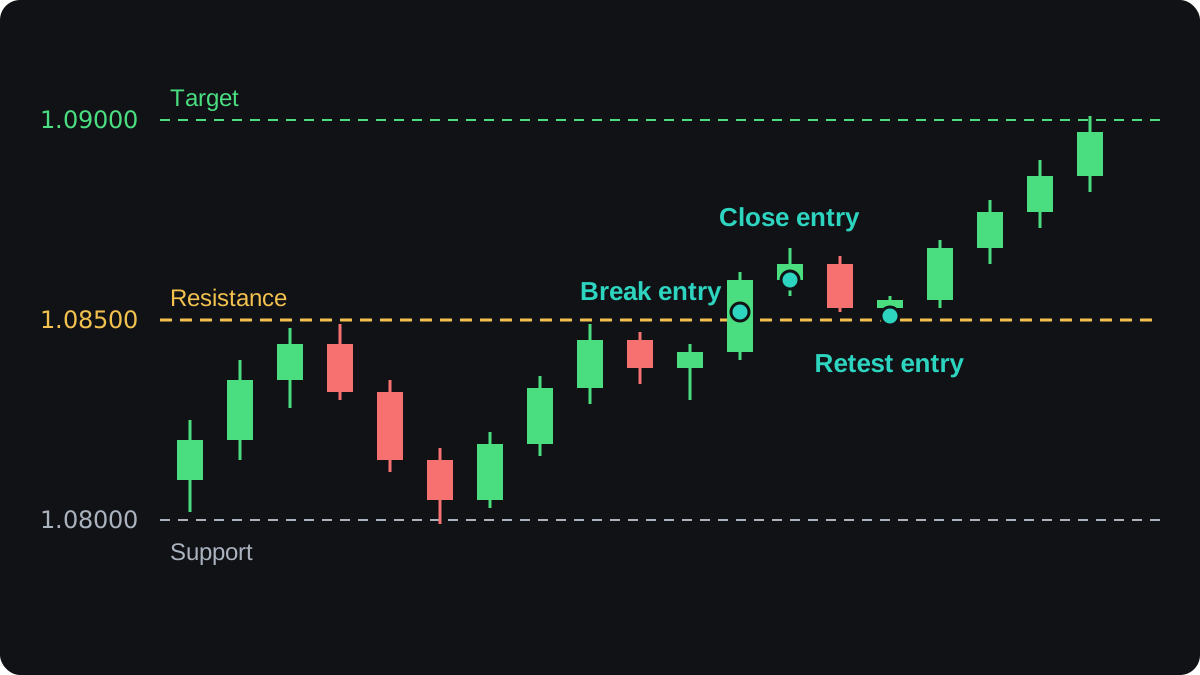
Here is one illustrative EUR/USD setup on one-hour candles. Resistance sits at 1.08500 and support at 1.08000, so the range is 50 pips tall. A pip on EUR/USD is 0.0001.
- Target by measured move: 1.08500 plus 0.00500 = 1.09000.
- Break entry: a buy stop at 1.08520, with the stop loss at 1.08300. Risk is 1.08520 minus 1.08300 = 0.00220, or 22 pips. Reward is 1.09000 minus 1.08520 = 0.00480, or 48 pips.
- Close entry: the breakout candle closes at 1.08600 and you buy at the next open, also 1.08600. With the same stop, risk is 0.00300, or 30 pips, and reward is 0.00400, or 40 pips.
- Retest entry: three candles after the breakout candle, price dips to 1.08490 and fills a buy limit at 1.08510. The stop goes at 1.08400, below the retest low. Risk is 0.00110, or 11 pips, and reward is 0.00490, or 49 pips.
These sums ignore the spread and treat each order price as the fill price.
The chart shows where each entry happens: the break inside the breakout candle, the close entry at the next open, and the retest three candles after the breakout.
The same pips give different lot sizes once you fix the money at risk. Say you risk $100 per trade, and one standard lot of EUR/USD is worth $10 per pip.
Then lot size = $100 ÷ (stop pips × $10), rounded down to two decimals. The position size lesson explains the formula.
| Entry | Entry price | Stop pips | Target pips | Lot size | Risk | Reward at target |
|---|---|---|---|---|---|---|
| On the break | 1.08520 | 22 | 48 | 0.45 | $99 | $216 |
| After the close | 1.08600 | 30 | 40 | 0.33 | $99 | $132 |
| On the retest | 1.08510 | 11 | 49 | 0.90 | $99 | $441 |
Check one row yourself. 0.45 lot × $10 = $4.50 per pip, so 22 pips risk $99 and 48 pips earn $216.
Measured in pips, the retest offers the most target for the smallest stop. The close entry offers the least target for the widest stop.
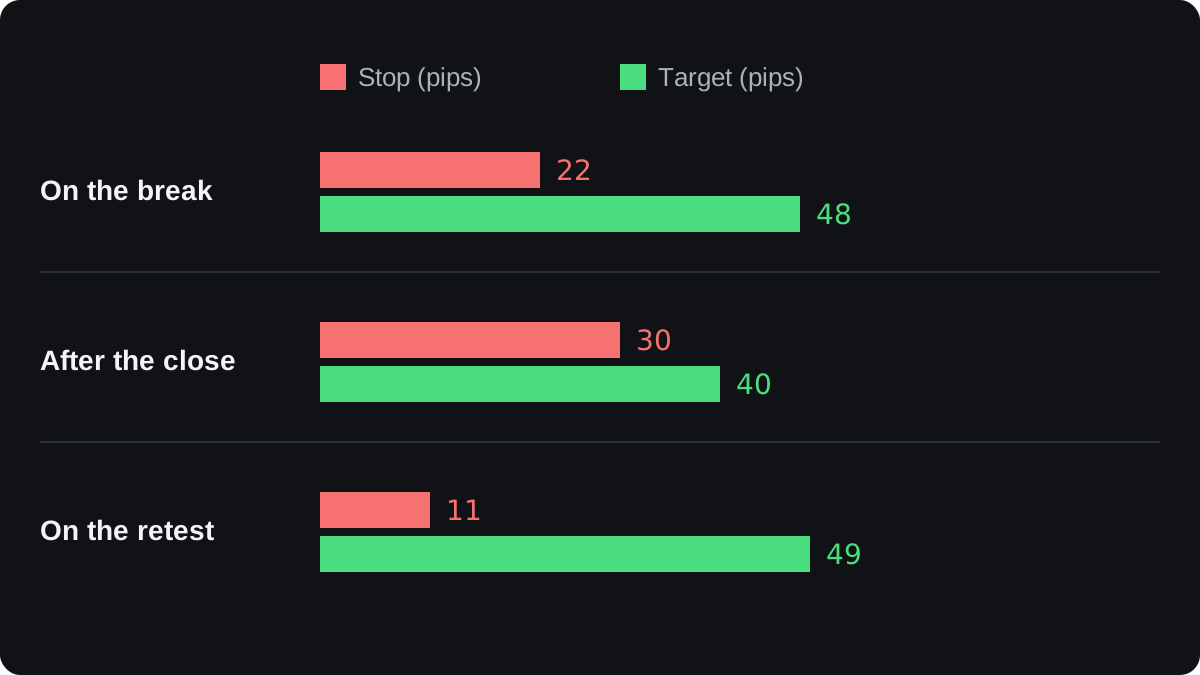
The table shows only what happens when each trade reaches its target. It cannot show the breakouts where the retest never came, or the ones where the close entry filled and then reversed into the stop.
How to choose between the three
Each entry swaps one risk for another. A break entry puts you in every move, false starts included. Waiting for a close filters some false starts at a worse price, and waiting for a retest gets the best price but misses moves that never return.
Your daily routine matters too. A resting stop order suits someone who cannot watch the screen at the moment of the break. A retest entry needs patience, and a rule for when to cancel the limit order if price runs away.
There is no general evidence that one entry beats the others on every pair and timeframe. Results depend on the market, the period and your exact rules.
So write one rule down and test it on past charts, then on a demo account, before using real money.
Whichever method you pick, keep the money risked per trade the same. A run of false breakouts then costs an amount you knew in advance.
أسئلة شائعة
What is the safest way to trade a breakout?
No entry is safe. Waiting for a close or a retest filters some false breakouts but costs price or missed trades, so the stop loss and a fixed risk per trade are what limit the damage.
Should I use a buy stop or a buy limit for a breakout?
A buy stop above resistance enters on the break itself. A buy limit just above old resistance enters on a retest, and it only fills if price comes back down to it.
Which timeframe should confirm a breakout?
Use the timeframe you trade on. A close on a 5-minute chart says much less than a close on a daily chart, so pick one and apply it the same way every time.
Where do I put the stop loss on a breakout trade?
Usually back inside the range, beyond the level that broke. Price returning there means the breakout has failed, and the stop distance then sets your lot size.
How do I set a target for a breakout trade?
A common method is the measured move: add the height of the range to the breakout level. Price can stop short or run past it, so use it as a planning number with no promise attached.
تابع التعلّم
 الفصل 2What is a breakout?A breakout is a move that takes price out of a range or chart pattern, through a support or resistance level that had held it before. Traders usually wait for a candle to close beyond the level. A break tends to hold better when the move is strong and agrees with the larger trend, though neither condition guarantees it.
 الفصل 2False breakouts and how to trade them.A false breakout is a move through support or resistance that fails and returns inside the old range, often leaving a long wick. A common way to trade one is to wait for a close back inside, sell or buy back toward the range, and set a stop just beyond the failed break's extreme. It loses when the break proves real.

