Forward testing on a demo account.
Forward testing means running a trading system on live prices as they arrive, usually on a demo account, before you risk real money. It checks whether backtest results survive real spreads, slippage, missed signals and your own discipline. Use the same rules, account size and lot sizing you plan to use live, and record every trade.

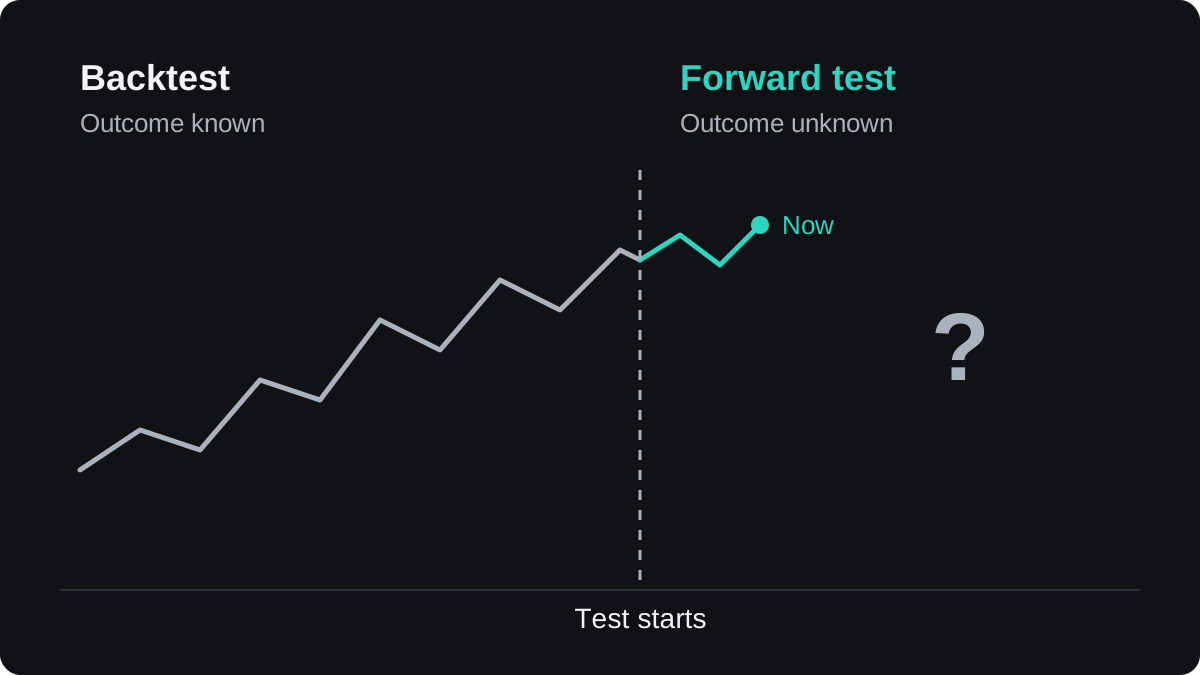
A backtest tells you how your rules would have done on prices that already happened. A forward test runs the same rules on prices as they arrive, when you cannot see the next candle.
Doing it on a demo account gives you real market prices with play money. It is the step between a promising backtest and your first live trade.
Why is a good backtest not enough?
In a backtest you can see the whole chart. Even with care, hindsight leaks in: you know how the move ended, so a doubtful signal can look clearer than it did at the time.
Backtests also tend to assume tidy conditions. The fill is the exact price, the spread never changes, and you were awake for every signal.
Then there is overfitting: adjusting your rules until they fit past prices closely. Part of that fit may be luck that will not repeat.
A forward test checks these problems together. Price arrives one bar at a time, and you must decide before the outcome exists. Every trade pays the spread the market charged at that minute.
How do you set up a fair test?
Write your rules down before the first trade, in the form you built in building your entry and exit rules. If a rule needs judgement, write down how you will judge it.
Open a demo account with the same broker and account type you expect to use live. Spreads and commissions differ between account types, so testing on a different one measures a different cost.
Set the demo balance to the amount you plan to deposit. A $100,000 demo balance makes a $40 loss feel like nothing, and it hides how small your live positions will be.
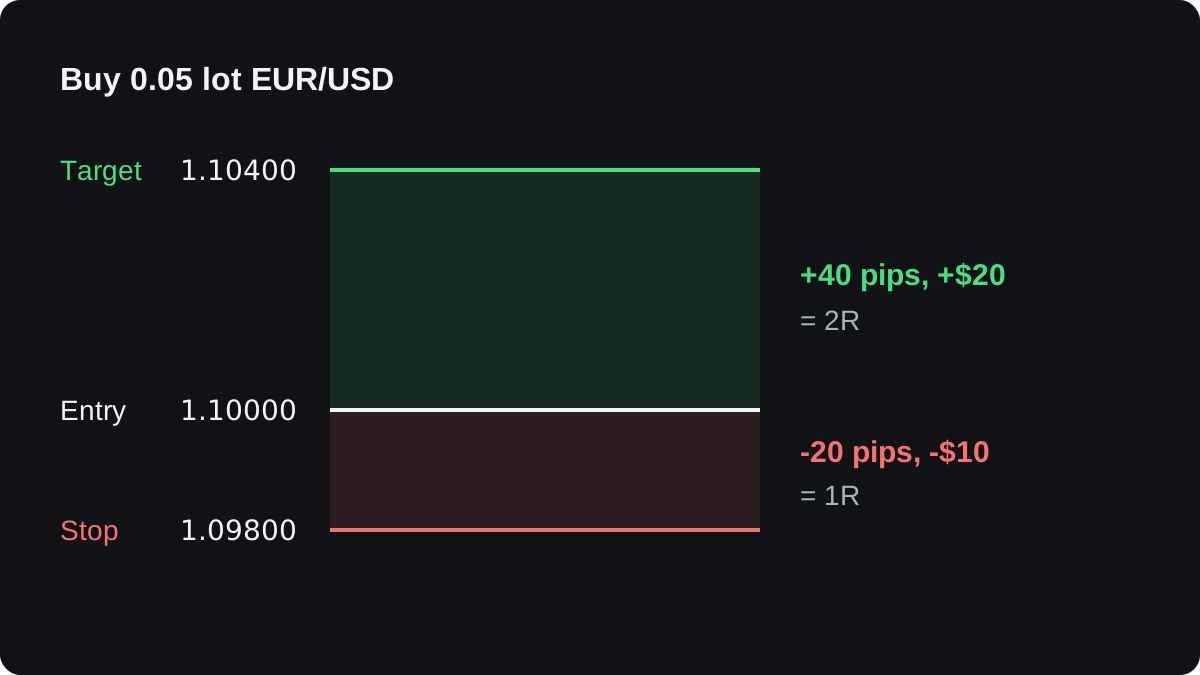
Size every position exactly as you will live. In this lesson's example the plan is a $1,000 account risking 1% per trade, so each loss at the stop should cost $10. That amount is called 1R, one unit of risk.
The example system trades EUR/USD with a 20 pip stop and a 40 pip target. On 0.05 lot, which is 5,000 euros, one pip is worth 5,000 × 0.0001 = $0.50.
So 20 pips cost 20 × $0.50 = $10, and 40 pips earn 40 × $0.50 = $20. The position size lesson shows how to get the lot size from your stop for any pair.
Decide the length of the test in advance, as a number of trades. Small samples are noisy, so dozens of trades tell you more than a handful, and a system that trades rarely needs more calendar time to get there.
What should you record for every trade?
Record each trade the moment it closes, while the details are fresh. A useful log has these fields:
- Date, time and pair.
- The signal, and the rule that triggered it.
- Planned entry, stop and target, and the prices you actually got.
- The spread at entry and any slippage at exit.
- The result in pips, in dollars and in R.
- Whether you followed every rule.
Also log the signals you missed or skipped, with the reason. If the system fires at 3 a.m. your time and you sleep through it, the backtest counted a trade you could never have taken.
The trading journal lesson comes next and turns this log into a lasting habit.
Worked example: demo results against the backtest
Suppose the backtest covered 200 trades. It won 45% of them, the average win was 2.0R and every loss was 1.0R. These numbers are illustrative.
Expectancy is the average result per trade: win rate × average win, minus loss rate × average loss. For the backtest that is 0.45 × 2.0 − 0.55 × 1.0 = 0.90 − 0.55 = +0.35R.
The demo test then ran for 40 trades with the same $1,000 sizing, where 1R is $10:
- Wins: 16 of 40, a win rate of 16 ÷ 40 = 40%.
- Average win: 36 pips, which is 36 × $0.50 = $18, or 1.8R.
- Losses: 24, averaging 22 pips, which is 22 × $0.50 = $11, or 1.1R.
- Total: 16 × 1.8R − 24 × 1.1R = 28.8R − 26.4R = +2.4R, which is +$24.
- Expectancy: 2.4R ÷ 40 = +0.06R per trade.
You can check step 5 with the formula: 0.40 × 1.8 − 0.60 × 1.1 = 0.72 − 0.66 = +0.06R. The risk-reward lesson explains how win rate and trade size trade off.
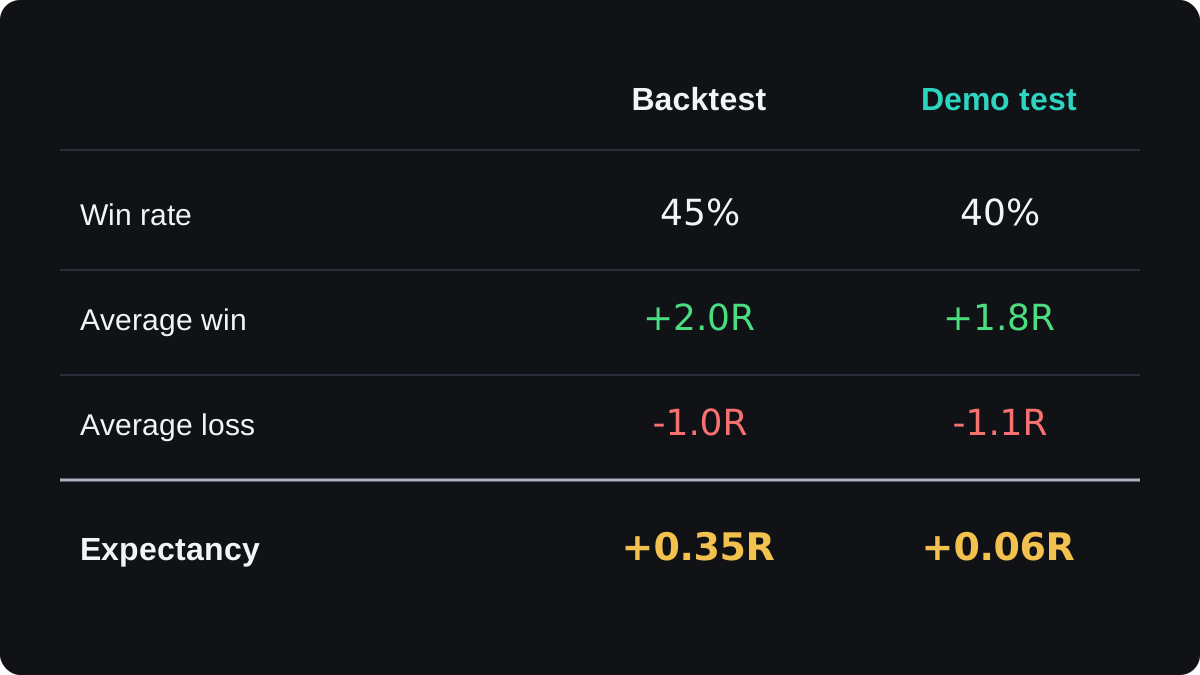
The system is still slightly positive, yet most of its edge has gone. With only 40 trades, +0.06R is too close to zero to call it profitable.
Separating chance from cost
The win rate fell from 45% to 40%. At 45%, you would expect 18 wins in 40 trades, so the test produced two fewer. A gap that small is the kind chance alone produces often in 40 trades.
The trade sizes are more telling. Wins averaged 36 pips against a 40 pip target, and losses averaged 22 pips against a 20 pip stop.
That pattern points to costs the backtest left out, such as the spread and slippage on stops during fast moves, or to winners closed early.
In this test the smaller sizes cost 5.6R in total: 16 × 0.2R on the wins plus 24 × 0.1R on the losses, or $56. A run of bad luck can reverse, while a cost like that returns on every trade.
Demo money and your own discipline
Demo money is easy to treat lightly. You may take a trade the rules do not allow, or skip one after two losses, and neither choice costs you anything.
Mark every rule break in your log and calculate the results twice: once for all trades, and once for the trades that followed the rules. A large gap means the problem is how you execute, and more testing of the rules will not fix it.
A demo can also fill orders more smoothly than a live account, depending on the broker. Treat demo slippage as a best case and expect live fills to be no better.
What happens when the test ends?
Set pass and fail rules before you start, so the result cannot talk you into anything. One possible rule: after 40 trades, continue only if expectancy is above zero and there were no more than two rule breaks.
If you change any rule during the test, the count restarts at zero. Results from two versions of a system mixed together describe neither of them.
The example result is too close to zero to go live. One reasonable path is to check whether trading at hours with tighter spreads lowers the cost, then run a fresh test with that single change written into the rules.
Passing a demo test does not prove a system will make money. When you do go live, start at the smallest size your broker allows, such as 0.01 lot, and compare live fills with demo fills before you size up.
On EUR/USD, 0.01 lot is 1,000 euros, so a pip is worth 1,000 × 0.0001 = $0.10 and a 20 pip stop risks $2.
Questions
How long should I forward test a strategy?
Long enough to collect a number of trades you fixed before starting. Dozens of trades give a more reliable picture than a handful, so a system that trades rarely may need months.
Is forward testing the same as paper trading?
They overlap. Paper trading means placing pretend trades, and forward testing is paper trading with fixed rules, a planned sample size and results you compare with a backtest.
Can I forward test on a live account with tiny lots?
Yes, and it tests real fills and how you react to losing real money. At 0.01 lot of EUR/USD a pip is worth $0.10, so the cost is small, though it is still real money.
Why are my demo results worse than my backtest?
Live prices bring costs and limits a backtest often ignores, such as changing spreads, slippage and signals you missed. A short test can also be unlucky, so compare average trade sizes in pips as well as the win rate.
Do demo results predict live results?
Only partly. A demo tests your rules on live prices, but its fills can be smoother and play money does not test how you handle real losses.
Keep learning
 Chapter 3What is a trading system?A trading system is a written set of rules that decides which market you trade, when you enter, when you exit and how much you risk on each trade. Following the same rules every time makes your decisions consistent and lets you measure results, though no system wins every trade or guarantees a profit.
 Chapter 3Building your entry and exit rules.Entry and exit rules are precise when two people reading them would take the same trade at the same price. Each rule names a timeframe, a price type, a number and an order type. A complete set covers the filter, trigger, entry, stop, target, position size and a time limit, plus what to do in awkward cases.
 Chapter 3How to backtest a strategy.Backtesting means applying fixed entry and exit rules to past price data, one candle at a time, and recording every trade the rules would have taken, including costs. The result shows how the rules behaved in the past, with their win rate and worst drawdown. It cannot prove future profits, and errors like look-ahead bias inflate it.

