How carry shows up in your swap.
The swap is the daily interest you earn or pay for holding a currency position overnight. In theory it equals the interest rate gap between the two currencies, which is the carry. In practice your broker subtracts a markup from both sides, so a positive swap shrinks and a negative one grows.
Konten ini baru tersedia dalam bahasa Inggris.

A carry trade, from the previous lesson, holds a high-interest currency against a low-interest one. On a trading platform that interest never appears under its own name. It shows up as swap, a small credit or charge each night your position stays open.
The swap is the carry minus your broker's markup. With a few lines of arithmetic you can work out each part from the figures your platform shows.
Why an open position earns or pays interest each night
A spot currency deal normally settles two business days after the trade. Your retail position has no settlement date, so the broker rolls it forward one day at a time for as long as you hold it.
Holding a pair overnight is like borrowing one currency to hold the other. Long AUD/USD means you hold Australian dollars paid for with borrowed US dollars. Each night you earn interest on the first and pay interest on the second.
Between banks, the daily roll is a tom-next swap: two linked deals that close the position for tomorrow and reopen it for the day after. Their small price difference reflects the interest gap.
Your broker passes its version of that cost to you as swap. The roll happens once a day, usually around 17:00 New York time. A position opened and closed before then pays or earns no swap.
The rates behind it are short-term market rates. They track central bank rates closely without matching them exactly, which is one reason swaps move even when no central bank has acted.
The lesson on interest rates and currencies explains why those rates differ between countries.
Working out the carry on one lot
All rates and prices in this example are round illustrative numbers. Suppose the short-term rate is 4.00% a year for the Australian dollar and 1.00% for the US dollar, and AUD/USD trades at 0.65000.
You buy one standard lot, which is 100,000 Australian dollars.
- The position is worth 100,000 × 0.65000 = $65,000.
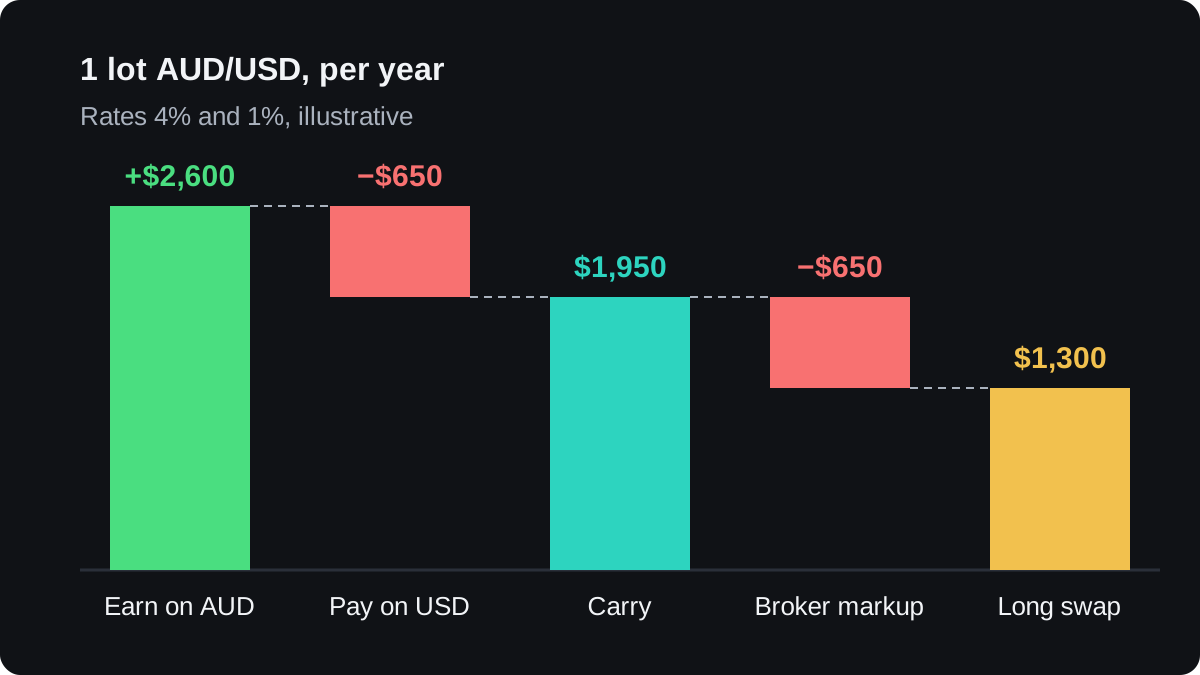
- Interest earned on the Australian dollars is 100,000 × 4.00% = A$4,000 a year, which converts to 4,000 × 0.65000 = $2,600.
- Interest paid on the borrowed US dollars is 65,000 × 1.00% = $650 a year.
- The carry is 2,600 − 650 = $1,950 a year. The shortcut gives the same answer: 65,000 × 3.00% = $1,950.
- Per night, a simple version divides by 365: 1,950 ÷ 365 = $5.34.
Some currencies count interest over a 360-day year, so real figures differ slightly. The method stays the same: the interest gap times the value of your position.
That $1,950 is what the rate gap alone would pay. Brokers keep a markup before crediting anything. With an illustrative markup of 1.00% a year, the broker keeps 65,000 × 1.00% = $650.
What reaches your account is 1,950 − 650 = $1,300 a year, or 1,300 ÷ 365 = $3.56 a night. That figure is your long swap.
What the markup does to the buy side and the sell side
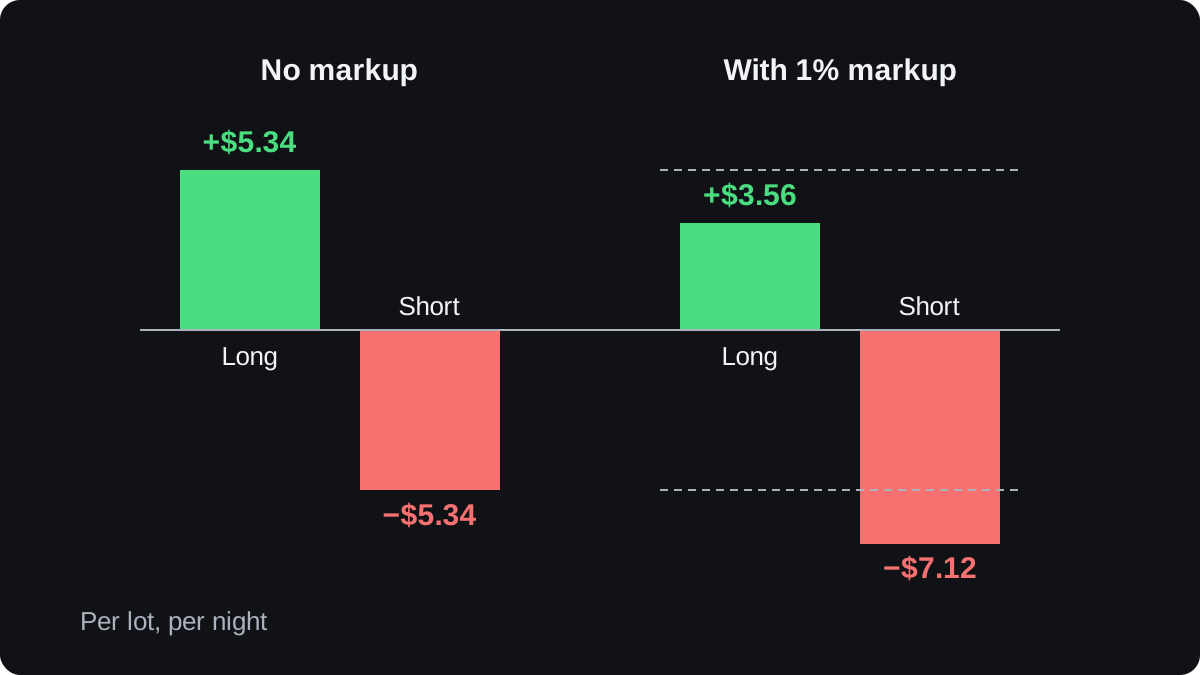
With no markup, the seller would simply pay what the buyer earns. A short AUD/USD position holds US dollars against borrowed Australian dollars, so it pays the 3.00% gap, $5.34 a night.
Brokers apply the markup against you on both sides. The long side's +3.00% becomes 3.00 − 1.00 = +2.00%.
The short side's −3.00% becomes −3.00 − 1.00 = −4.00%. That is 65,000 × 4.00% = $2,600 a year, or 2,600 ÷ 365 = $7.12 a night.
| Position, 1 lot | Rate gap | After 1.00% markup | Per year | Per night |
|---|---|---|---|---|
| Long AUD/USD | +3.00% | +2.00% | +$1,300 | +$3.56 |
| Short AUD/USD | −3.00% | −4.00% | −$2,600 | −$7.12 |
Per night, the markup is 650 ÷ 365 = $1.78 on each side. The buyer gets 5.34 − 1.78 = $3.56 and the seller pays 5.34 + 1.78 = $7.12.
When the interest gap is smaller than the markup, both sides pay. With a 0.50% gap and the same 1.00% markup, the long swap is 0.50 − 1.00 = −0.50% and the short swap is −0.50 − 1.00 = −1.50%.
That is why pairs whose two currencies have similar rates often show a negative number in both swap columns. Brokers also build the markup in different ways and do not always publish the method, so compare the swap figures themselves.
Reading swap figures in MetaTrader
Your platform shows only the final swap numbers. In MetaTrader, right-click a symbol in Market Watch and open Specification to find swap long, swap short, their unit and the day that counts three nights.
The unit varies by broker, for example points, an amount of money, or a yearly percentage. On a five-decimal pair a point is 0.00001, so on one lot of AUD/USD it is worth 100,000 × 0.00001 = $1.
A swap long of 3.56 points therefore means $3.56 per lot per night in a USD account. For pairs quoted in another currency, the swap calculator converts the figure for you.
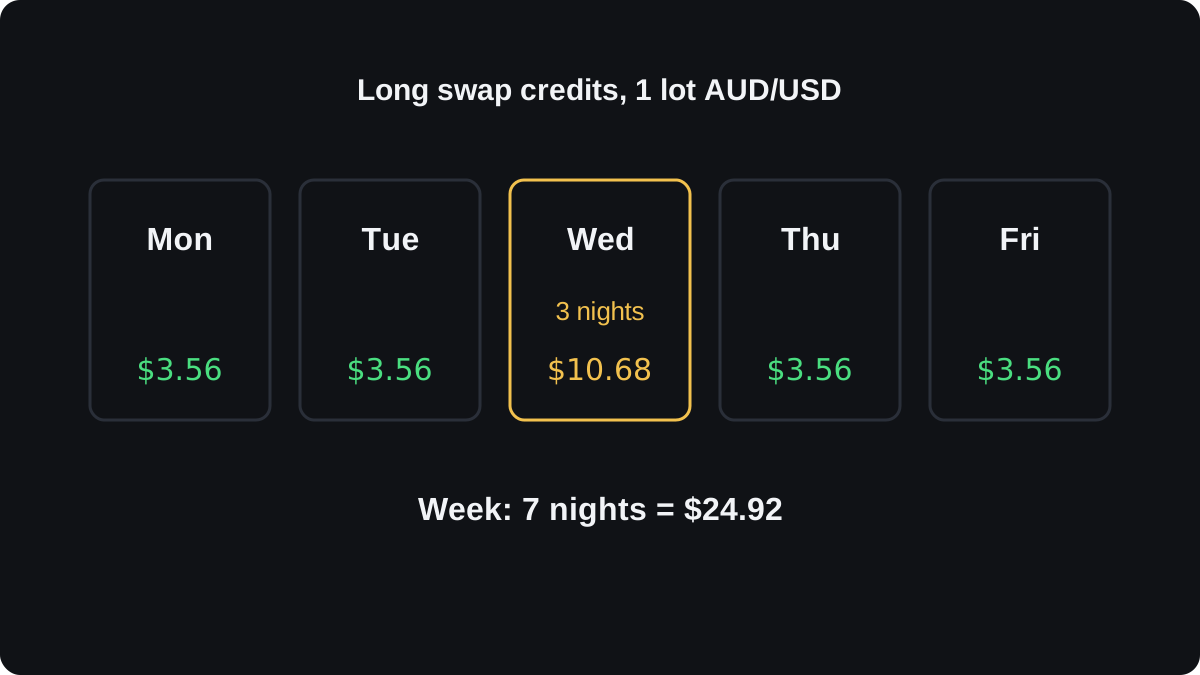
Each weekday rollover counts one night, except one that counts three. Spot deals settle two business days later, so the Wednesday roll pushes settlement from Friday to Monday and covers the weekend.
Many brokers apply that triple night on Wednesday for currency pairs, and some instruments use another day, so check the specification. The swap fees lesson covers rollover timing in more detail.
Open the long position on Monday before the rollover, close it the next Monday before the rollover, and you collect seven nights. Wednesday pays 3 × $3.56 = $10.68, and the week totals 4 × $3.56 + $10.68 = $24.92.
Why a positive swap is not free income
A swap credit is small next to the price risk that comes with it. On one lot of AUD/USD a pip is worth $10.
A fall from 0.65000 to 0.64350 is 65 pips, or 1% of the price. It costs 65 × $10 = $650, which is half a year of long swap in this example.
Swap is worked out on the full size of the position, which can be many times your margin. The yearly credit then looks large next to your deposit, but price losses are measured on that same full size.
Swap rates also move. A central bank decision, a shift in market rates or a change in the broker's markup can shrink a positive swap or turn it negative.
The next lesson, when the carry trade unwinds, looks at what happens when many carry positions close at the same time.
Pertanyaan
Why is my swap negative on both buy and sell?
The broker's markup is larger than the interest gap between the two currencies. Both sides then pay, even though one side would earn in theory.
What time is swap charged?
Swap is applied at the daily rollover, usually around 17:00 New York time. Your broker's specification or website states the exact server time.
Why did my swap change when interest rates did not?
Swaps follow short-term market rates and the broker's own funding costs, which move between central bank meetings. Brokers can also change their markup, so check the specification from time to time.
Does swap scale with lot size?
Yes, in a straight line. In this lesson's example, 0.10 lot earns a tenth of $3.56, about $0.36 a night.
What is a swap-free account?
Some brokers offer accounts with no overnight swap, often for traders who cannot pay or receive interest for religious reasons. Some replace swap with a fee or another charge, so read the terms before you open one.
Lanjut belajar
 Bab 6What is a carry trade?A carry trade buys a currency with a higher interest rate against one with a lower rate and holds the position to collect the difference. In retail forex the carry arrives as a daily swap credit, minus the broker's markup. The risk is the exchange rate: a modest price move can erase months of interest.
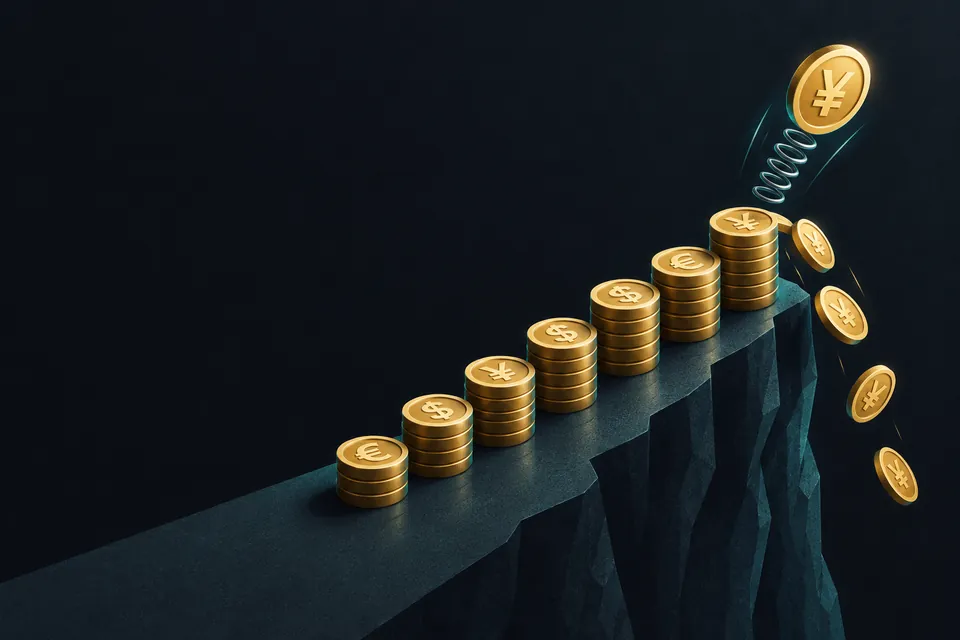 Bab 6When the carry trade unwinds.A carry trade unwinds when many holders close it at once, usually after a risk-off shock or a change in interest rate expectations. The low-yield funding currency, such as the yen, jumps, and the carry pair can fall in days by more than the trade earned in months or years of swap.

