Non-directional news trading.
Non-directional news trading places a buy stop above the price and a sell stop below it just before a release, so whichever way the market breaks, one order catches the move. The catch is execution: around the release spreads widen and fills slip, and a whipsaw can trigger both orders, so costs can erase the expected gain.
Konten ini baru tersedia dalam bahasa Inggris.

In the directional news trading lesson you picked a side before the release. Here you skip that step. You wait for the number and let the market choose the direction.
The method is simple to set up. Its weak point is execution, because it needs good fills in the seconds when news moves markets hardest and fills are at their worst.
What is a news straddle?
EUR/USD sits at 1.08500 a few minutes before a major release on the economic calendar. You expect a big move but have no view on which way. All prices in this lesson are illustrative.
You place a buy stop at 1.08650, 15 pips above the price, and a sell stop at 1.08350, 15 pips below.
A buy stop buys only if the price rises to its level, and a sell stop sells only if the price falls to its level.
That pair of orders is a news straddle. One order waits on each side of the price, so the result depends on how far the market moves, and the market picks the direction.
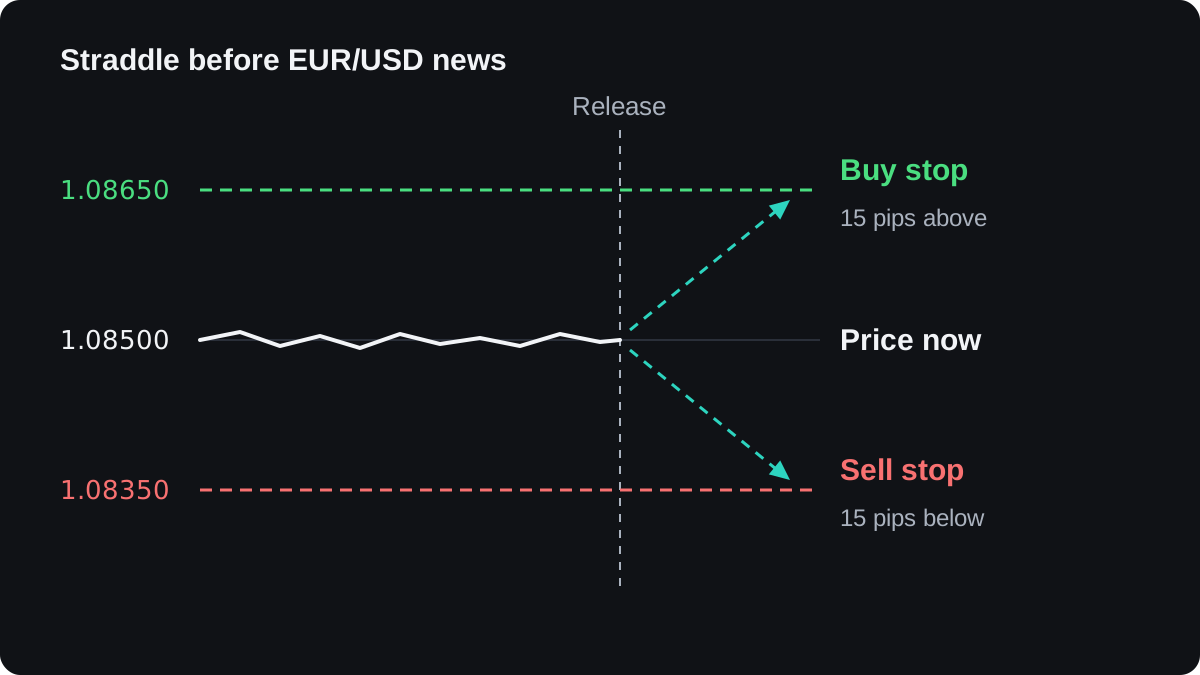
Both are pending orders, covered in the order types lesson. Nothing happens until the price reaches one of them, and then that order becomes a market order.
The whole method rests on one assumption: the surprise in the data pushes the price far and fast enough to carry one order well into profit. On some releases it does. On others the first move stalls or reverses.
How do you set up the two orders?
A typical setup, shown as an example and not as a recommendation, has five steps:
- Mark the high and low of the quiet minutes before the release.
- Place the buy stop a few pips above that high and the sell stop a few pips below that low, so normal noise does not trigger either one. In this lesson's example, that puts them 15 pips either side of 1.08500.
- Give each order a stop loss and a take profit. This lesson uses a 20 pip stop and a 40 pip target, both measured from the trigger price.
- Link the orders as OCO, one cancels the other, so the second order is deleted once the first fills. Some platforms offer this directly; on others you need a script or a manual cancel.
- Choose the size. In a US dollar account, one pip on 0.10 lot of EUR/USD is worth $1, so a 20 pip stop plans a $20 loss.
Distance is a trade-off. Close orders catch more moves but also get triggered by noise. Far orders avoid the noise but enter later, after part of the move has already gone.
The spread matters here too. A buy stop triggers when the ask reaches it, and a sell stop when the bid does.
If the spread widens from 1 pip to 8 pips, the ask rises and the bid falls even though the middle price has not moved. Orders placed close to the price can fill on that alone.
A worked example: the clean breakout
You trade 0.10 lot, so one pip is worth $1. Here is the good outcome, step by step:
- The number comes out and the price jumps. The ask passes 1.08650, and your buy stop becomes a market order.
- In the rush it fills at 1.08680, 3 pips worse than the trigger. That gap is slippage.
- The OCO link cancels the sell stop.
- Your take profit sits 40 pips above the trigger, at 1.09050. The bid reaches it and the trade closes there.
- The gain is 1.09050 minus 1.08680 = 0.00370, which is 37 pips, or 37 × $1 = $37.
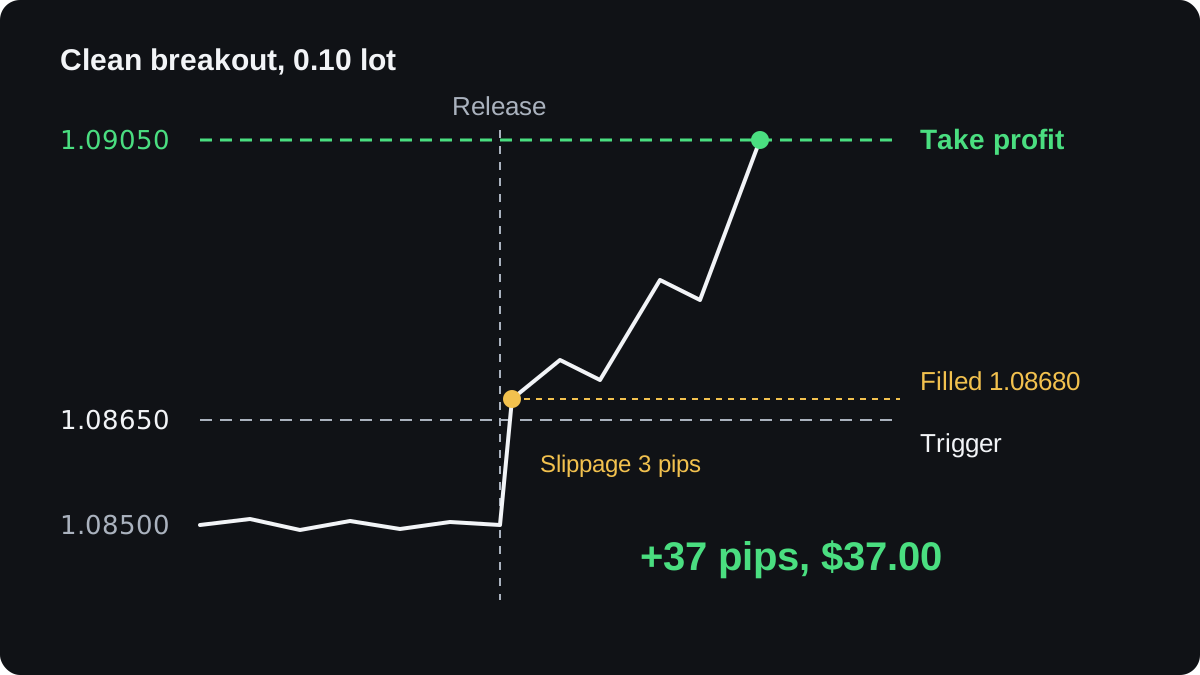
You planned a 40 pip win and got 37 pips. The exit filled at its level in this example, so the entry alone cost 3 of your 40 pips.
The fill prices already use the ask on entry and the bid on exit, so the spread at the moment of entry is inside that $37. It needs no separate deduction.
What happens when the price whipsaws?
Now take the same setup on a worse day. The price spikes up, fills your buy at 1.08680, then turns within a minute and falls through your stop loss.
The stop sat at 1.08450, 20 pips below the trigger, and in the fast fall it fills at 1.08430. The loss is 1.08680 minus 1.08430 = 0.00250, which is 25 pips or $25, against a planned $20.
A sharp move one way followed by a sharp move back is a whipsaw. With an OCO link, the damage stops at that one trade. Without one, the price can keep falling and trigger your sell stop as well.
Say the sell fills at 1.08330, 2 pips below its 1.08350 trigger, and then the price swings back up. Its stop at 1.08550 fills at 1.08570, a loss of 1.08570 minus 1.08330 = 0.00240, which is 24 pips or $24.
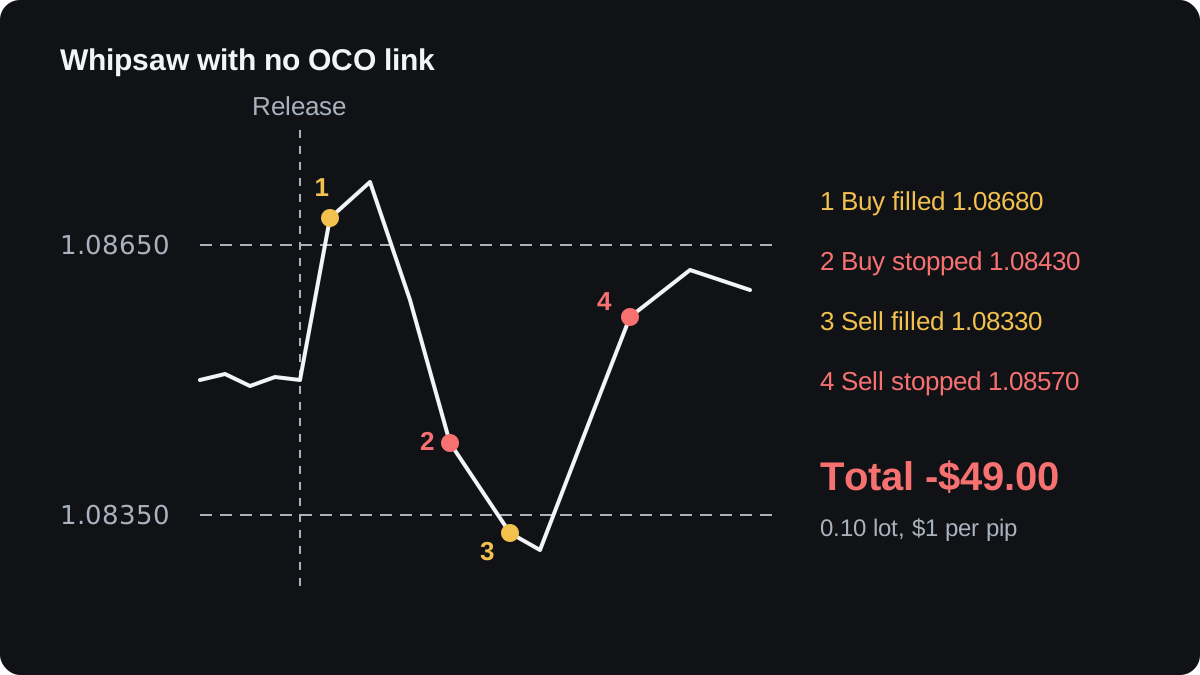
Two losses on one release add up to $25 + $24 = $49, close to two and a half times the $20 you meant to risk on one trade.
Leaving both orders live on purpose can catch the real move after a false start. It also doubles the number of entries made in news conditions, and each one can slip.
How do execution costs eat the edge?
Every extra cost in these examples came from execution, the way your orders were filled. Around a major release, several things tend to get worse together:
- Spreads widen, sometimes to many times their usual size, for seconds or minutes.
- Slippage grows, because each triggered stop is a market order that fills at the next available price.
- Prices can gap, jumping past your level with no trades in between, so a stop loss limits the loss only approximately.
- Liquidity providers often pull or thin their quotes just before the number, which leaves less volume at each price.
A straddle meets all of this head on. It always enters with a stop order in the fastest part of the move, and a losing trade usually exits the same way.
Some brokers also widen the minimum distance for pending orders, or limit changes to them, close to major releases. Your broker's terms say whether it does.
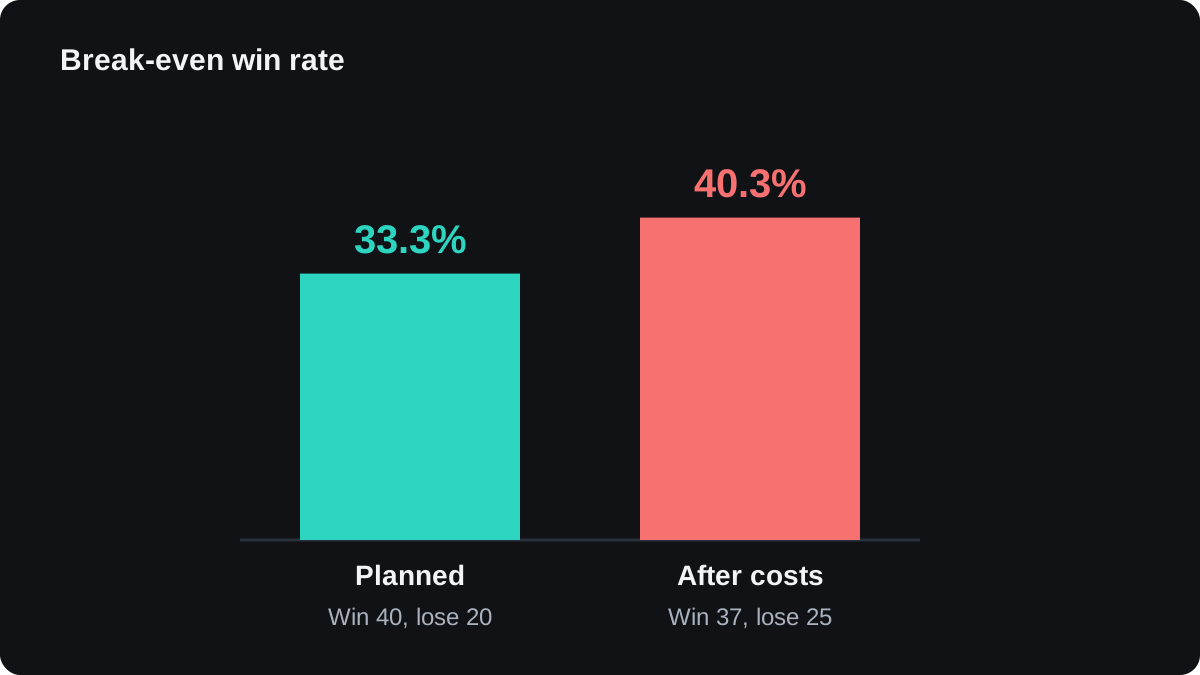
The win rate you need to break even shows the damage. If a win is W pips and a loss is L pips, the break-even win rate is L ÷ (W + L), as the risk-reward lesson explains.
| Case | Win | Loss | Break-even win rate |
|---|---|---|---|
| Planned | 40 pips | 20 pips | 20 ÷ 60 = 33.3% |
| After costs | 37 pips | 25 pips | 25 ÷ 62 = 40.3% |
Three pips of slippage on the entry and two on the stop raised the bar from 33.3% to 40.3%, a rise of 7 percentage points. Each double whipsaw pushes it higher still.
Published evidence that news straddles beat these costs for retail traders is thin. Your costs differ by broker, account type and release, so measure your own fills before trusting any backtest.
A demo account may fill news orders more kindly than a live one. If you test the method, record the actual fill price on every release and judge it on those numbers.
Are there other ways to trade a move without picking a side?
Options offer a version of the same bet with a fixed worst case. Buying a call and a put with the same strike and expiry is an options straddle. At expiry it gains if the price has moved further than the total premium paid.
The most you can lose is that premium. Option sellers also know the release is coming, so premiums tend to be higher before it and often fall once the number is out.
Waiting is another choice. You can skip the first minutes, let spreads settle and trade the move afterwards, accepting a later entry in exchange for a cleaner fill.
Pertanyaan
What is a straddle in forex news trading?
It is a pair of pending orders placed just before a release: a buy stop above the price and a sell stop below it. Whichever way the market breaks, one order enters the trade.
Why did both my buy stop and sell stop trigger?
The price moved through one order, reversed and moved through the other.
Linking the orders as OCO, one cancels the other, removes the second order once the first fills, though a link run by a script on your computer can be too slow for a very fast spike.
Does a stop loss protect me during news?
Only roughly. A stop loss becomes a market order when it triggers, so in a fast or gapping market it can fill several pips beyond its level.
Is non-directional news trading profitable?
Nothing guarantees it. Spreads, slippage and whipsaws raise the win rate you need, and results depend on fills you cannot know in advance, so test with real fill prices first.
Which news releases do traders straddle?
Usually scheduled releases that often move prices sharply, such as central bank rate decisions and major employment or inflation data. An economic calendar shows the time of each one.
Lanjut belajar
 Bab 7How markets react to news.When a major economic figure is released, price can jump many pips in seconds. Liquidity providers quote less and wider, so the spread widens, and orders can fill at a worse price than requested, which is slippage. A stop loss closes the trade but cannot guarantee its price when the market gaps.
 Bab 7Directional news trading.Directional news trading means taking a side, long or short, on what an economic release will do to a currency pair. You can trade before the number and guess the surprise, or after it and trade the move. Both face wide spreads, slippage and sudden reversals, so position size matters more than usual.

