What types of orders can you place in forex?
A market order buys or sells straight away at the current price. A pending order waits for a price you choose: a limit order waits for a better price, and a stop order joins a move once price breaks a level. Stop loss and take profit orders close an open trade at prices you set in advance.
Konten ini baru tersedia dalam bahasa Inggris.
An order is an instruction to your broker to buy or sell a pair at a size you choose. The order type decides when the trade happens and which prices you will accept.
Every order uses the two prices from the bid and ask lesson. Buy orders fill at the ask and sell orders fill at the bid. The examples here use EUR/USD with an illustrative bid of 1.10000 and ask of 1.10010.
What does a market order do?
A market order buys or sells straight away at the best price available. Click buy on EUR/USD and you get the ask, about 1.10010 in this example. Click sell and you get the bid, about 1.10000.
You choose the size and the direction. The price is whatever the market offers when your order arrives, and in a calm market that is usually at or very close to the price on your screen.
In a fast market the price can change between your click and the fill. The difference is slippage, and it can go for you or against you.
On some account types the platform may instead show you a new price to accept or refuse, which is called a requote.
Closing a trade by hand is a market order too, in the opposite direction. You close a buy by selling at the bid, and a sell by buying at the ask.
How do pending orders wait for your price?
A pending order waits on the broker's server until price reaches a level you set, and then it opens a trade. There are two families, limit and stop, and each has a buy and a sell version.
Limit orders wait for a better price
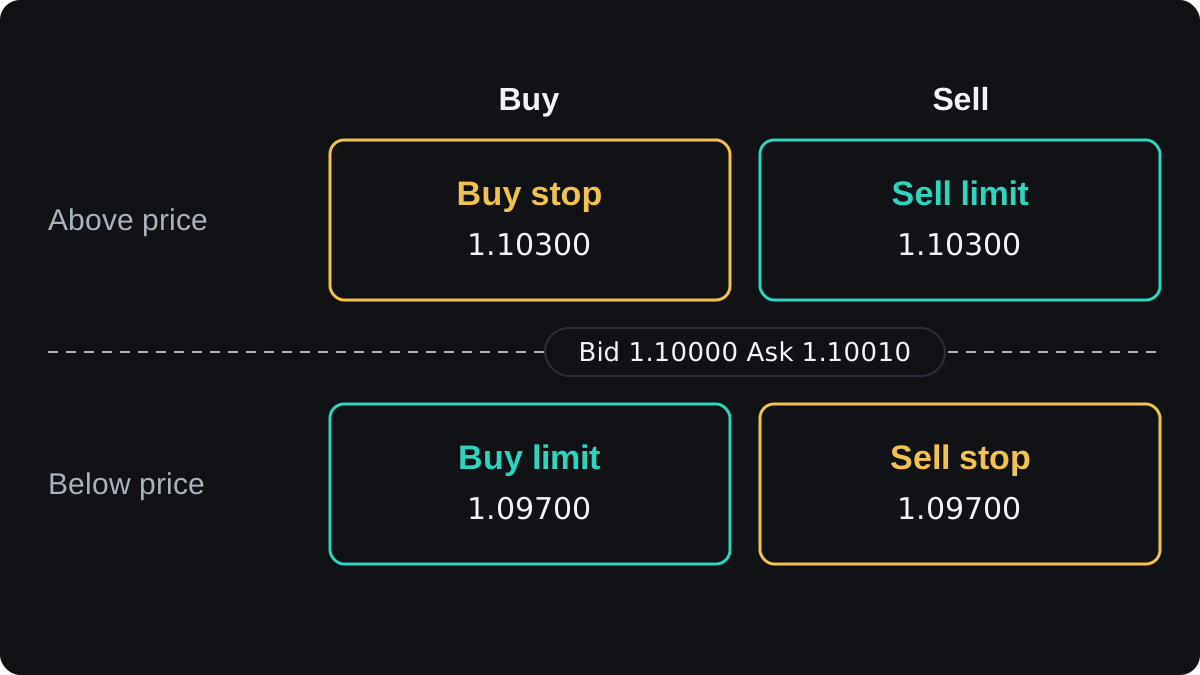
A limit order asks for a better price than the current one. A buy limit sits below the market, since buying cheaper is better. A sell limit sits above the market, since selling higher is better.
Say you like EUR/USD but think 1.10010 is too expensive. A buy limit at 1.09700 opens your trade only if the ask falls to 1.09700, and if price never gets there, the order simply waits.
Stop orders join a move
A stop order works the other way round. A buy stop sits above the market and a sell stop sits below it. You use one when you want to trade only if price shows it is moving in that direction.
Suppose you want to buy only if EUR/USD breaks above 1.10300. A buy stop at 1.10300 stays idle until the ask reaches that level. Then it becomes a market order and fills at the next available price.
A sell stop at 1.09700 does the same for a fall: it sells once the bid drops to 1.09700.
Which price triggers the order?
On MetaTrader and most similar platforms, buy orders watch the ask and sell orders watch the bid. A buy limit at 1.09700 triggers when the ask touches 1.09700, and at that moment the bid reads about 1.09690.
Charts usually draw the bid, so a buy limit can look as if price touched it and did not fill. Price had to fall by one more spread before the ask arrived.
A triggered limit order fills at your price or better. A triggered stop order becomes a market order, so it can fill at a worse price than the one you set.
Brokers can also set a minimum distance between the current price and a new pending order, often called the stops level. You will find it in the contract specification for each instrument, and on some accounts it is zero.
How do stop loss and take profit close a trade?
Pending orders open trades, and two more order types close them.
A stop loss closes your trade if price moves against you to a level you choose. A take profit closes it once price reaches your target. You can attach both to a market or pending order and move them later.
Both are exit orders, so they watch the price you would close at. On a buy trade they are sells and watch the bid.
On a sell trade they are buys and watch the ask. The lesson on why to use a stop loss covers where to put one.
Here is the buy limit from earlier as a full plan, with illustrative prices. A pip on EUR/USD is 0.0001.
- With the bid at 1.10000 and the ask at 1.10010, you place a buy limit for 0.10 lot at 1.09700.
- On 0.10 lot, which is 10,000 euros, one pip is worth 10,000 × 0.0001 = $1.
- You attach a stop loss at 1.09400 and a take profit at 1.10300.
- The ask falls to 1.09700 and your trade opens there.
- If the bid later falls to 1.09400, the stop loss sells. The loss is 1.09700 minus 1.09400 = 0.00300, which is 30 pips, or $30.
- If the bid rises to 1.10300 first, the take profit sells. The gain is 1.10300 minus 1.09700 = 0.00600, which is 60 pips, or $60.
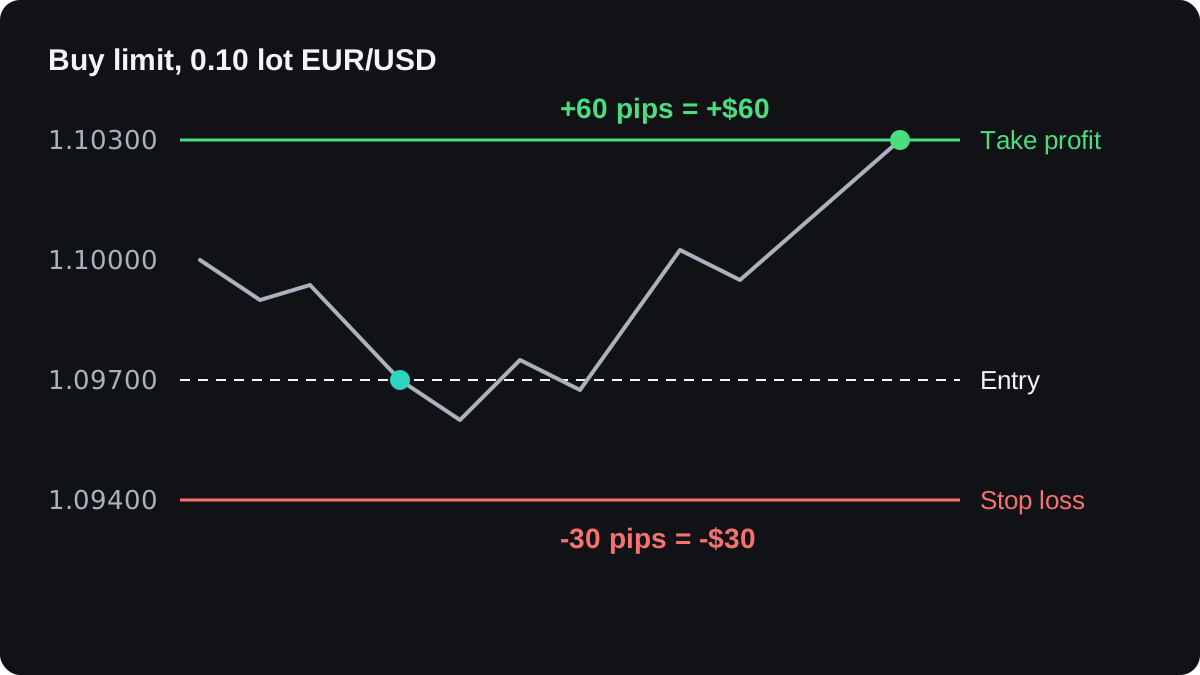
The spread is already inside both numbers, because you entered at the ask and leave at the bid. The profit and loss calculator repeats these sums for other pairs and sizes.
Why can a stop loss fill at a worse price?
A stop loss is a stop order, so once it triggers it becomes a market order. It fills at the first price available, which is usually close to your level but carries no promise.
The biggest misses come from gaps. The market closes for the weekend, and news before it reopens can put the first new price far from the last old one.
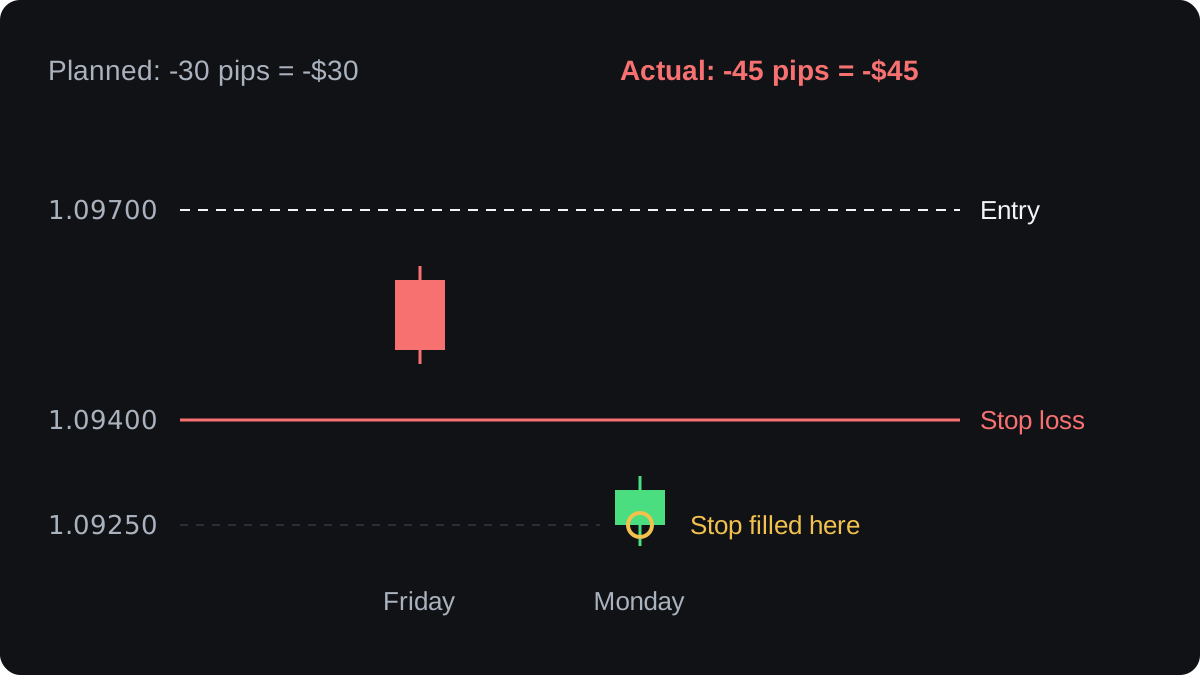
Take the same trade, with Friday ending at a bid of 1.09500, above your stop. Monday opens with the bid at 1.09250. No price between those two ever traded, so the stop at 1.09400 fills at 1.09250.
The loss is now 1.09700 minus 1.09250 = 0.00450, which is 45 pips, or $45 on 0.10 lot. You had planned to risk $30.
Limit orders usually fare better in a gap. A take profit is a limit order, so if price gaps past it in your favour, it normally fills at your level or better.
Some brokers offer a guaranteed stop loss for an extra fee, which closes at your exact price even through a gap. Availability and cost vary, so read your broker's terms.
Which other order settings will you meet?
Expiry
A pending order stays active until it fills or you cancel it, unless you give it an end time, such as the close of the day. A forgotten order can open a trade weeks later, so check your list of pending orders often.
Trailing stop
A trailing stop is a stop loss that follows price at a fixed distance when the trade moves your way. With a 30 pip trail on the buy above, a bid of 1.10100 lifts the stop to 1.09800, and it never moves back down.
In MetaTrader the trailing stop runs inside your platform, so it stops following price while the platform is closed. The stop level it has already reached stays on the broker's server. The trailing stops lesson covers how to choose the distance.
Stop limit
MetaTrader 5 adds buy stop limit and sell stop limit orders. A buy stop limit waits for the ask to reach a stop price, then places a buy limit at a lower price you chose.
For example, a stop at 1.10300 with a limit at 1.10250 places a buy limit at 1.10250 once the ask hits 1.10300. You never pay more than 1.10250, and the trade opens only if price pulls back to that level.
The order types cheat sheet puts every order in this lesson on one page.
Pertanyaan
What is the difference between a limit order and a stop order?
A limit order waits for a better price than now: below the market to buy, above it to sell. A stop order waits for price to break a level: above the market to buy, below it to sell.
Does a stop loss guarantee my exit price?
No. A normal stop loss becomes a market order when triggered, so a fast move or a weekend gap can fill it beyond your level. Only a guaranteed stop, where a broker offers one, fixes the price.
Why did my buy limit not fill when price touched it?
Charts usually show the bid, but a buy limit triggers on the ask, which sits one spread higher. Price has to fall by about one more spread before your order fills.
Can I practise placing orders without real money?
Yes. A demo account uses the same platform and order tickets with virtual money, so you can try every order type before trading live.
Lanjut belajar
 Bab 2How does a forex trade make or lose money?A forex trade makes money when the pair moves in your direction by more than the trade costs, and loses when it moves against you. A buy gains as the price rises and a sell gains as it falls. Profit is the price change times trade size, less commission and swap.
 Bab 2When do you buy or sell a currency pair?You buy a currency pair when you expect the first currency, the base, to strengthen against the second, and you sell when you expect it to weaken. If your view is about one currency, find which side of the pair it sits on: a weaker quote currency pushes the pair up, so you buy.
 Bab 2Apa itu pip dalam forex?Pip adalah satuan standar yang dipakai trader untuk mengukur pergerakan harga. Pada sebagian besar pasangan mata uang, pip adalah 0.0001, yaitu desimal keempat, dan pada pair dengan kuotasi yen Jepang besarnya 0.01. Pipette adalah sepersepuluh pip. Pada satu lot standar EUR/USD, setiap pip bernilai $10.
 Bab 2Apa itu lot dalam forex?Lot adalah satuan untuk menentukan ukuran transaksi forex. Satu lot standar sama dengan 100,000 unit mata uang dasar, lot mini 10,000, dan lot mikro 1,000. Pada EUR/USD, itu membuat setiap pip bernilai $10, $1, dan $0.10. Instrumen lain, seperti emas, memakai ukuran kontraknya sendiri.
 Bab 2Apa itu spread dalam forex?Spread adalah selisih antara harga bid, yaitu harga jual Anda, dan harga ask, yaitu harga beli Anda. Anda membayarnya di setiap transaksi, tepat saat posisi dibuka. Di EUR/USD, spread sering hanya satu atau dua pip atau kurang, dan melebar di sekitar rollover harian, pembukaan pasar mingguan, dan berita besar.
 Bab 2Apa itu harga bid dan ask dalam forex?Setiap kuotasi forex punya dua harga. Bid adalah harga tempat Anda bisa menjual, dan ask adalah harga yang lebih tinggi tempat Anda bisa membeli. Selisih keduanya disebut spread. Anda membeli di ask dan menutup di bid, sehingga setiap transaksi baru langsung tertinggal sedikit, sebesar spread.
 Bab 2Forex terms you will hear every day.The everyday words of forex describe what a trade is doing and what it costs. Long means you bought, short means you sold. A pip is the standard price step, a lot is the trade size, the spread is the gap between bid and ask, and margin is the deposit your broker holds while a trade is open.
 Bab 2Forex order types cheat sheet.A market order fills now at the current price. A limit order waits for a better price: a buy limit below the market, a sell limit above it. A stop order waits for a worse price: a buy stop above, a sell stop below. Buy orders trigger on the ask, sell orders on the bid.
 Bab 2What is a forex demo account, and how should you use it?A forex demo account is a practice account funded with virtual money. You trade on the broker's platform with live or near-live prices, so you can learn orders, stops and margin without risking your own cash. Set it up with the balance and leverage you would really use, and expect live fills and feelings to differ.
 Bab 2Can you get rich trading forex?A few people make large sums trading forex, but the loss figures that EU and UK brokers must publish show that most retail CFD accounts at those brokers lose money. Getting rich would need a large starting balance and years of steady returns. Small accounts chasing big targets usually take risks large enough to wipe them out.
 Bab 2Ringkasan dasar forex: pair, pip, lot, leverage, dan margin.Ringkasan ini merangkum bab dasar forex dalam satu halaman. Setiap konsep mendapat penjelasan singkat, rumusnya, dan link ke pelajaran lengkapnya. Tabel referensi cepat membantu Anda mengecek ukuran pip, nilai pip, ukuran kontrak, dan margin sebelum membuka transaksi, dan satu contoh transaksi menyatukan semuanya.

