Choosing a style that fits your life.
Pick a trading style by checking three things: the hours you can watch the market, the size of your account and the kind of pressure you handle. Scalping and day trading need long blocks of screen time and lose more of each target to costs. Swing and position trading fit around a job but need wider stops.
ខ្លឹមសារនេះមានតែជាភាសាអង់គ្លេសសិន។
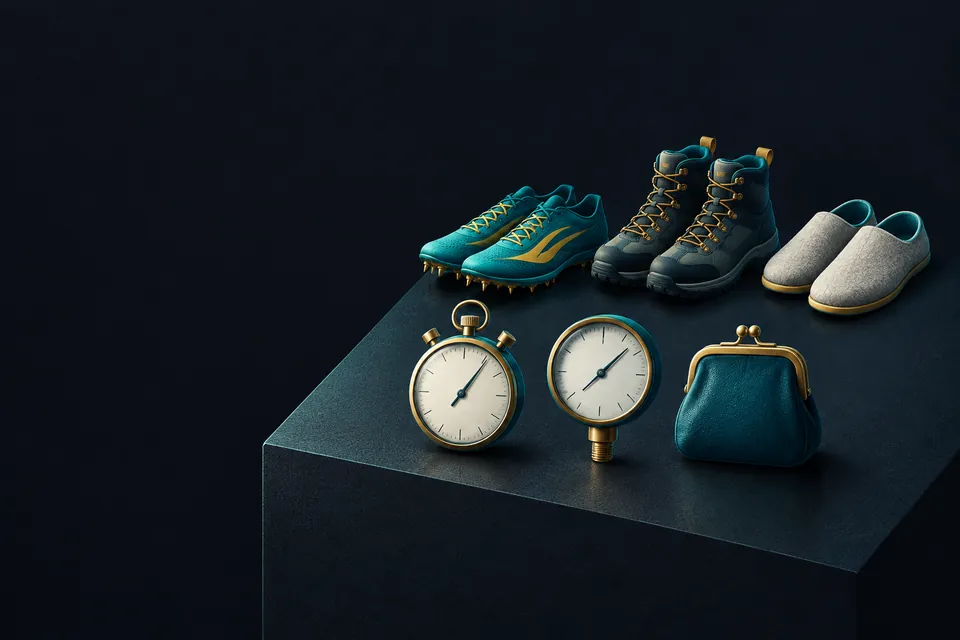
Two people can finish the same course and trade in very different ways. A nurse on rotating shifts cannot watch a chart at 3 pm daily, while a retiree with free mornings may find a three-week trade dull.
The previous lesson described scalping, day trading, swing trading and position trading. This one helps you pick between them by checking each against your schedule, your account size and how you handle pressure.
Start with the hours you can really give
Write down a normal week before you look at any chart. Mark the hours you work, sleep, travel and spend with family, then see what is left and when it falls.
Each style asks for a different kind of time. What matters is the gap between decisions and whether you must be at the screen when they come.
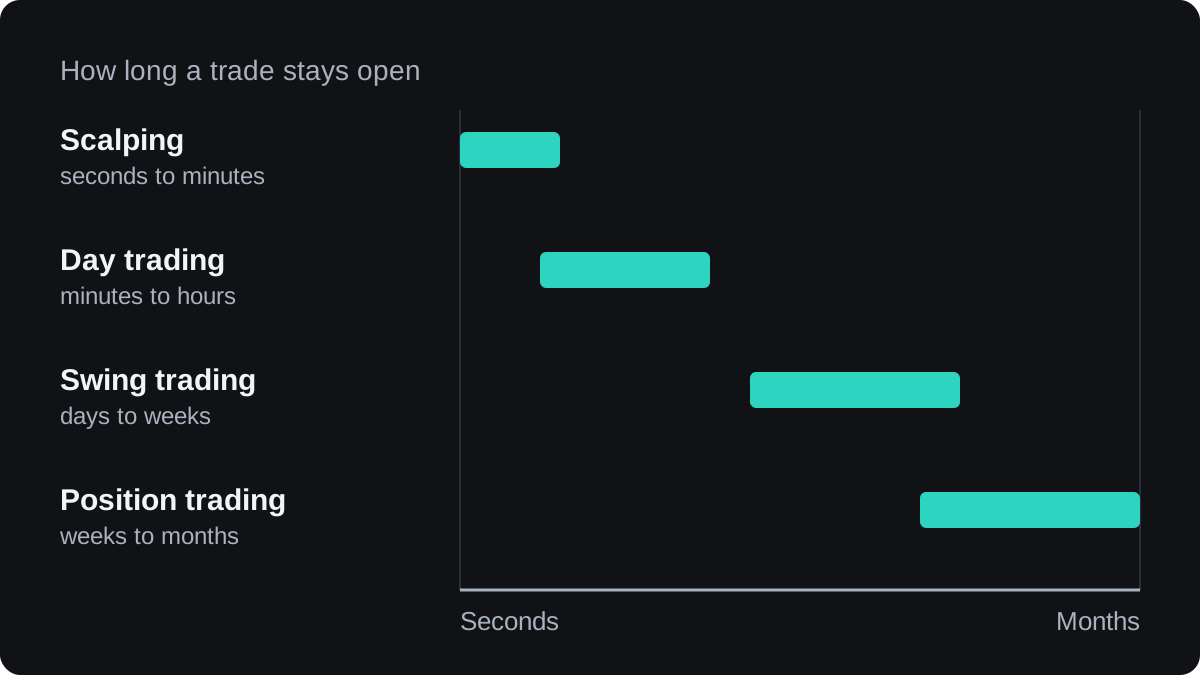
- Scalping holds trades for seconds to a few minutes and needs unbroken attention for the whole period you trade.
- Day trading holds trades for minutes to hours and closes everything before the day ends, so you need a block of several free hours.
- Swing trading holds trades for days to a few weeks. Checking charts once or twice a day is usually enough.
- Position trading holds trades for weeks to months, and a review every few days can work.
Your free hours also need to line up with when the market moves. A day trader in Sydney with free evenings sees a different market from one in London with free afternoons.
The market hours tool shows which trading sessions are open in your local time, so you can see what your free block overlaps.
If your free time comes in short, unpredictable pieces, the faster styles are hard to run well.
Swing and position trading fit around a job more easily. On common platforms such as MetaTrader, a stop loss and a take profit wait on the broker's server while you are away.
Why costs weigh more on short trades
Every trade pays the spread, and many accounts add a commission. The spread in pips is the same whatever style you use, while the move you are trying to catch changes a lot.
Take EUR/USD with a 1.0 pip spread, a round illustrative number. You pay it once per round trip, because you buy at the ask and sell at the bid.
Here is that pip as a share of the move each style aims for, using round illustrative targets:
- Scalping, aiming for 5 pips: 1 ÷ 5 = 20% of the target.
- Day trading, aiming for 20 pips: 1 ÷ 20 = 5%.
- Swing trading, aiming for 100 pips: 1 ÷ 100 = 1%.
- Position trading, aiming for 300 pips: 1 ÷ 300 = about 0.33%.
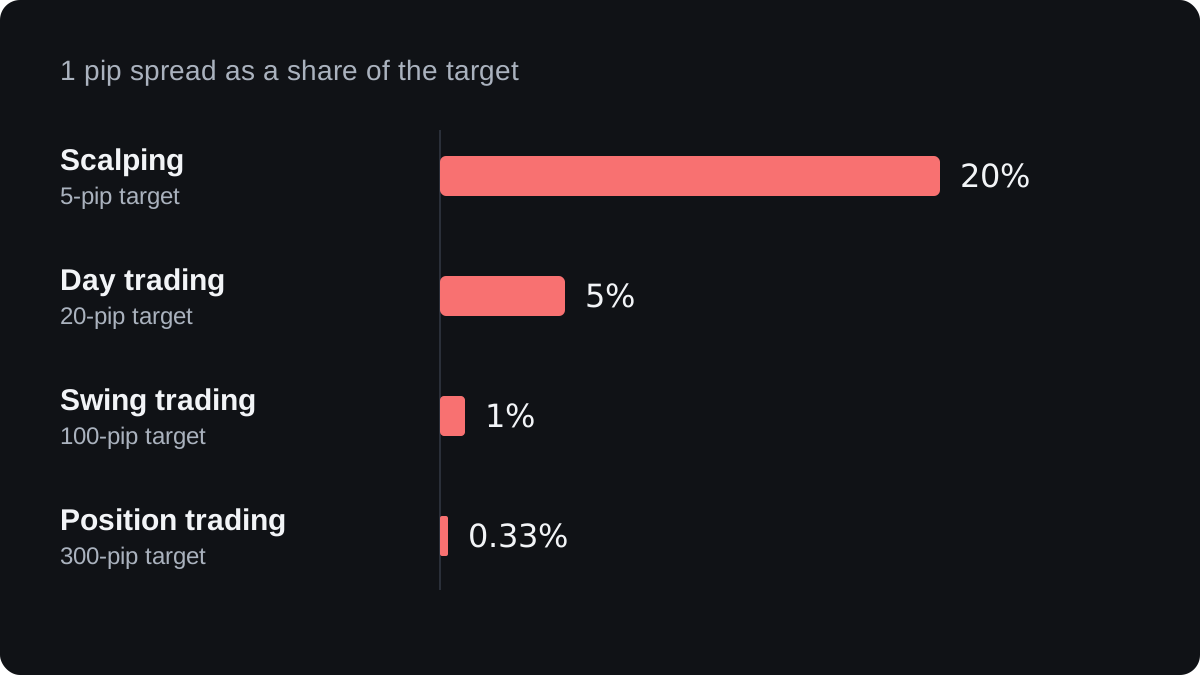
A scalper gives up a fifth of each target before the price has done anything. Scalping is still possible, but a small rise in spread or one poor fill can turn a thin edge into a loss.
Trade count adds up too. Ten scalps a day on 0.20 lot, where a pip is worth $2, cost 10 × $2 = $20 in spread per day. On a $1,000 account that is 2% of the balance each trading day.
Longer holds bring a different cost. Positions kept past the daily rollover pay or earn swap, and over weeks or months that can grow larger than the spread.
How your account size limits the choice
Capital decides which styles you can trade at a sensible risk. A common approach is to risk a fixed share of the account on each trade, such as 1%, as the risk per trade lesson explains.
Say you have $1,000 and risk 1%, which is $10 a trade. On EUR/USD in a USD account, one pip on 0.01 lot is worth $0.10.
For illustration, give each style a stop the same size as its target above:
- Scalping, 5-pip stop: $10 ÷ 5 = $2.00 per pip, which is 0.20 lot.
- Day trading, 20-pip stop: $10 ÷ 20 = $0.50 per pip, which is 0.05 lot.
- Swing trading, 100-pip stop: $10 ÷ 100 = $0.10 per pip, which is 0.01 lot.
- Position trading, 300-pip stop: $10 ÷ 300 = about $0.033 per pip, which is about 0.0033 lot.
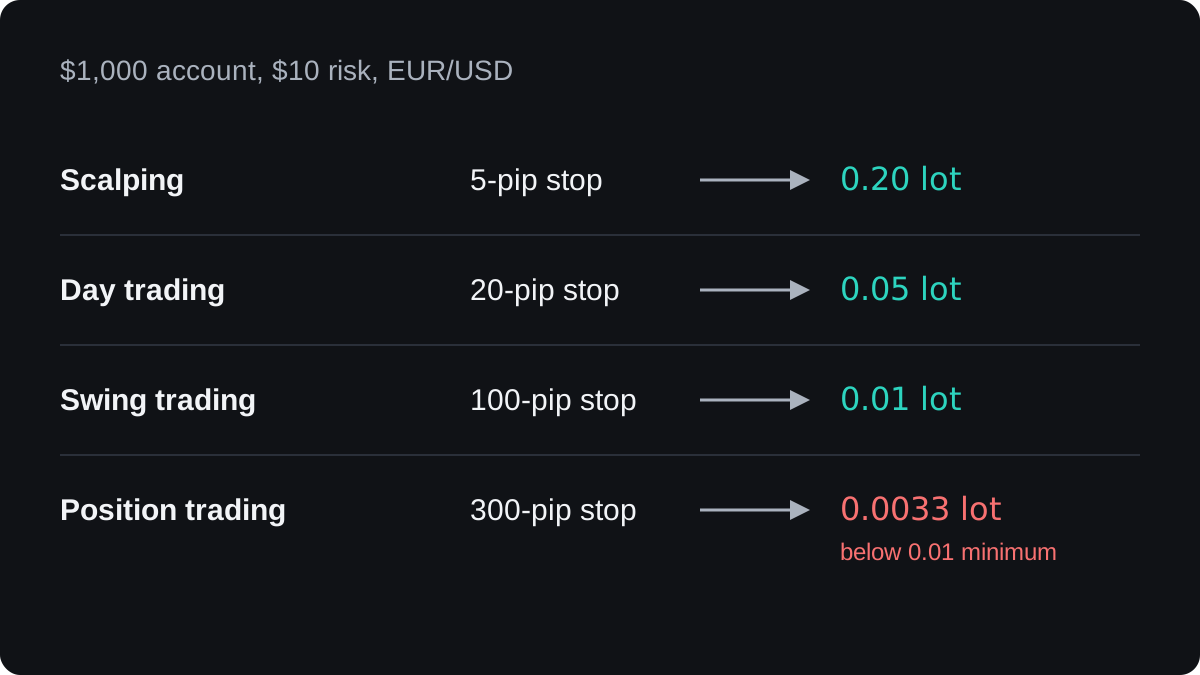
That last size cannot be placed on many accounts, where the smallest trade is 0.01 lot. At 0.01 lot the 300-pip stop risks 300 × $0.10 = $30, which is 3% of the account.
Wide stops therefore need a larger account, more risk per trade, or an account type that allows smaller sizes. Your broker's contract specification shows the minimum.
Short stops are easy to size on a small account, but they bring the cost problem from the previous section.
They also mean larger positions: 0.20 lot of EUR/USD is 20,000 euros, more than 20 times a $1,000 account, so check the margin it ties up.
The lesson on how to calculate position size works through the same sum for other pairs and account currencies.
Which kind of pressure you handle better
Each style is stressful in its own way, and the useful question is which version you can live with.
Scalping and day trading pack many decisions into a short time. You have seconds to act and losses arrive quickly. Some people find this focusing, while others start chasing the money back after a few losses in a row.
Swing and position trading spread the pressure out. You make fewer decisions, but you sleep with open trades and watch floating losses for days.
Prices can also jump between Friday's close and the next open. A stop loss inside that gap is filled at the first available price, which can be worse than the level you set.
A simple test is to picture a trade showing a loss equal to your full planned risk. Would you rather that loss arrive in four minutes, or sit open on your screen for four days?
Your honest answer points to one end of the scale. The next lesson on trading personality looks at this side of the choice in more detail.
Testing a style before you commit to it
Once one or two styles pass the schedule, cost and capital checks, write simple rules for them and try them where mistakes are free. A forward test on a demo account over several weeks shows how a style fits your real days.
Record more than profit. Note how often you missed a planned trade or broke a rule, and how you felt after a losing day.
If you keep missing trades on ordinary working days, the style does not fit your life, even when its results look good on paper.
Demo fills and emotions differ from live trading, so treat a good demo period as a first check only. Your schedule and account will change over time, and your style can change with them.
សំណួរ
Which trading style is best for beginners?
No style is best for everyone. Slower styles give more time to think and lose less of each target to the spread, but their wider stops are harder to size on a small account.
Can I trade forex with a full-time job?
Yes, if your style fits around it. Swing and position trading rely on orders that wait on the broker's server, so you can check charts before or after work.
Is scalping profitable?
Scalping can make or lose money like any style, and the outcome depends on your rules and your costs. It leaves the thinnest margin for error, because the spread takes a large share of each small target.
How much money do I need for swing trading?
It depends on your stop and your risk per trade. With a 100-pip stop on EUR/USD, 1% risk and a 0.01 lot minimum, $1,000 is the smallest account that keeps the risk at 1%.
Can I switch trading styles later?
Yes. Test the new style on demo first, because its costs, stop sizes and pressure differ from the style you are leaving.
បន្តរៀន
 ជំពូក 2Scalping, day, swing and position trading.Scalping holds trades for seconds to minutes, day trading closes everything the same day, swing trading holds for days and position trading for weeks to months. Shorter styles pay the spread more often and need more screen time. Longer styles pay a smaller share of each target in spread but carry swap, weekend gaps and wider stops.
 ជំពូក 2Your trading personality.Your trading personality is how you behave while a trade is open: how long you can wait, how big a loss you can watch, and whether you keep your own rules. These habits decide which strategies you can follow through. Test them on a demo or small account and fit your plan to the results.

