The Australian, Canadian and New Zealand dollars.
The Australian, Canadian and New Zealand dollars are called commodity currencies because their countries export large amounts of raw materials. The Aussie tends to follow metals and Chinese demand, the loonie oil and the US economy, and the kiwi dairy prices. Interest rates and global risk appetite also move all three, and can outweigh commodities.
ខ្លឹមសារនេះមានតែជាភាសាអង់គ្លេសសិន។

When iron ore gets more expensive, Australia earns more from every shipload it sends abroad. When oil climbs, Canadian producers are paid more for every barrel. Those flows of money can show up in the exchange rate.
Traders group the Australian, Canadian and New Zealand dollars together for that reason. Each country sells large amounts of raw materials to the rest of the world, and each currency tends to react to what those materials fetch.
Why are they called commodity currencies?
A commodity currency is the currency of a country whose exports lean heavily on raw materials such as metals, energy or food. The label is market slang, and no official body keeps a list.
The idea behind it is the terms of trade: the price of what a country exports compared with the price of what it imports.
When export prices rise faster than import prices, more foreign money flows in, and demand for the local currency tends to grow.
| Australian dollar | Canadian dollar | New Zealand dollar | |
|---|---|---|---|
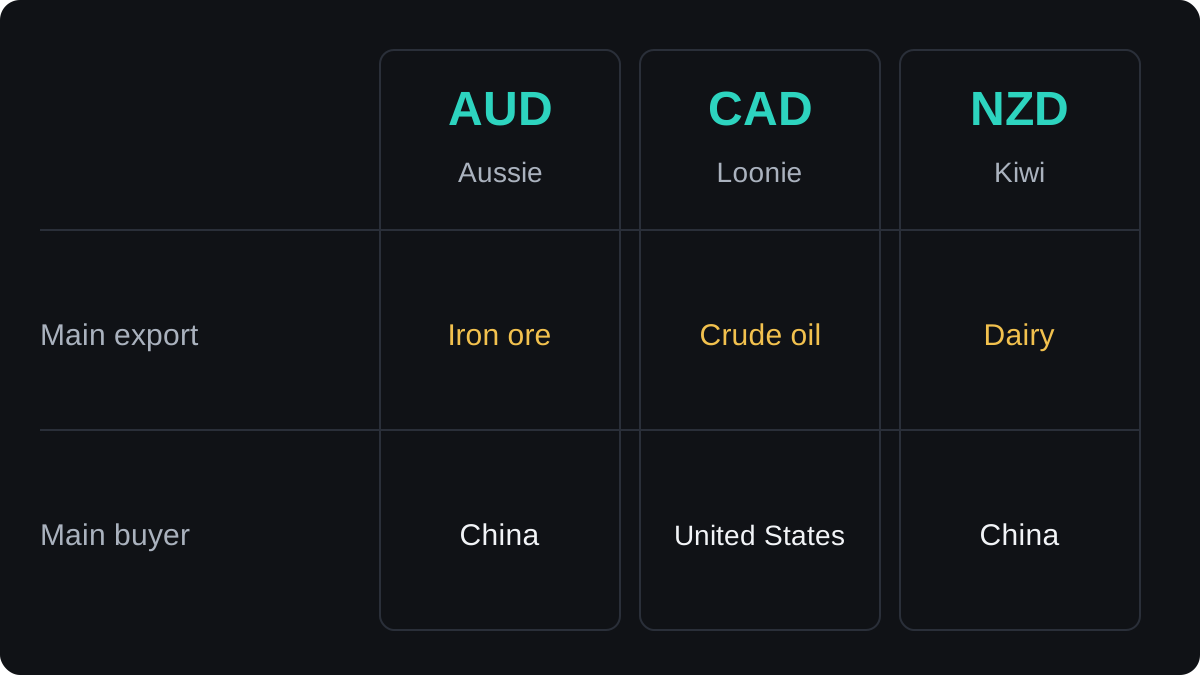
| Code and nickname | AUD, Aussie | CAD, loonie | NZD, kiwi |
| Central bank | Reserve Bank of Australia | Bank of Canada | Reserve Bank of New Zealand |
| Large exports | Iron ore, coal, natural gas, gold | Crude oil, natural gas, vehicles | Dairy, meat, wood |
| Largest customer | China | United States | China |
| Main US dollar pair | AUD/USD | USD/CAD | NZD/USD |
The wider link between raw material prices and exchange rates, including gold and oil, has its own lesson on commodity currencies.
The Australian dollar: metals, China and risk appetite
Australia is one of the world's largest exporters of iron ore, the main ingredient in steel. Much of that ore goes to China, so news about Chinese construction and factory output often moves AUD/USD.
Coal, liquefied natural gas and gold are also large exports. Higher prices for them tend to support the Australian dollar, although the link is loose from one week to the next.
The Aussie also follows global mood. It tends to rise when investors feel confident and buy shares, and to fall when fear takes over, so traders treat it as a risk-on currency.
Rates set by the Reserve Bank of Australia move the currency through the gap between Australian rates and rates abroad.
When Australian rates sat well above Japanese ones, AUD/JPY was a popular carry trade. It fell hard when those positions were closed in a panic.
The Canadian dollar: oil and the United States
Canada is a large oil producer, and most of the crude it exports goes to the United States. The two economies share a long border and deep trade links, so US economic news moves the loonie as well.
The pair is written USD/CAD, with the US dollar first. When the Canadian dollar strengthens, USD/CAD falls, because one US dollar now buys fewer Canadian dollars.
The usual explanation is a flow of money. Oil is sold in US dollars, so a higher oil price means Canadian producers earn more of them. They sell many of those dollars to pay wages and costs at home.
That extra demand for Canadian dollars tends to push USD/CAD down, for example from 1.4000 to 1.3860.
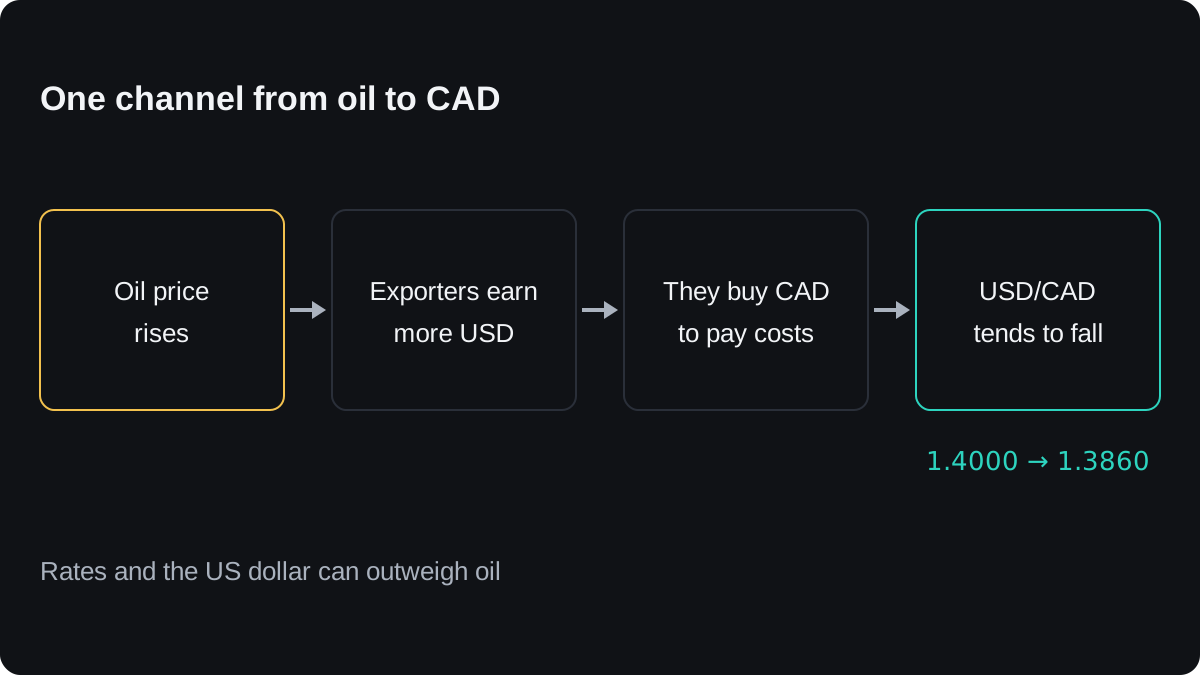
The chain describes a tendency. Oil and the loonie have drifted apart for long stretches, and decisions by the Bank of Canada or the US Federal Reserve can outweigh oil on any given day.
A weak US economy can also hurt the Canadian dollar while oil holds steady, because the US buys so much of what Canada sells.
The New Zealand dollar: dairy and a small open economy
New Zealand is a small economy that sells a large share of what it makes abroad. Dairy products, especially milk powder, are its largest goods export, followed by meat and wood.
Global Dairy Trade is an online auction where large dairy sellers offer their products, and it publishes the prices it achieves. Traders who follow the kiwi often watch those results along with decisions from the Reserve Bank of New Zealand.
The kiwi and the Aussie often move in the same direction. Both economies sell heavily to China and sit in the same region, so NZD/USD and AUD/USD tend to be positively correlated.
The strength of that link changes over time. A rate decision in one country can pull the two pairs apart for days or weeks.
AUD and NZD are most active during Asian trading hours, when Sydney, Wellington and Tokyo are open. CAD is busiest during North American hours.
Which way is stronger in each pair?
AUD/USD and NZD/USD put the commodity currency first, and USD/CAD puts it second. The same strengthening therefore looks like a rise in one pair and a fall in the other. Here is a worked example with round illustrative prices:
- AUD/USD rises from 0.6500 to 0.6565. The gap is 0.0065, and a pip on this pair is 0.0001, so the move is 65 pips.
- Since 0.6500 × 1.01 = 0.6565, the Australian dollar has gained 1% against the US dollar.
- On 0.10 lot the position is 10,000 Australian dollars, so one pip is worth 10,000 × 0.0001 = $1. A buyer gains 65 × $1 = $65.
- USD/CAD falls from 1.4000 to 1.3860. The gap is 0.0140, a move of 140 pips.
- Since 1.4000 × 0.99 = 1.3860, the US dollar has lost 1% against the Canadian dollar, which means the Canadian dollar has gained about 1%.
- On 0.10 lot of USD/CAD the position is 10,000 US dollars, so one pip is worth 10,000 × 0.0001 = C$1. A seller gains 140 × C$1 = C$140.
- In a US dollar account the broker converts at the current rate: C$140 ÷ 1.3860 = $101.01.
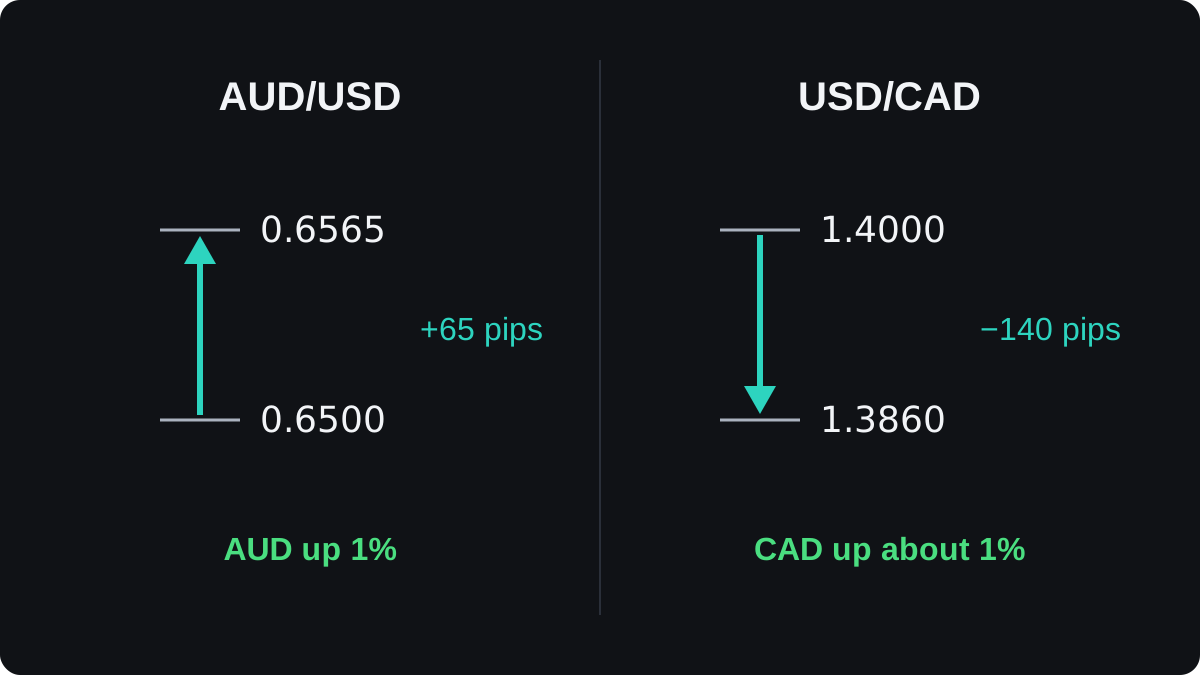
Both currencies gained about the same percentage, yet the pip counts differ because the pairs start at different price levels. The pip value calculator does the conversion for other sizes and account currencies.
Where the commodity link breaks down
The label suggests a simple rule: commodity up, currency up. Real markets are messier, and the link is weaker and less stable than the nickname implies.
Interest rates are often a bigger force. If one central bank is expected to raise rates while another cuts, money tends to follow the higher return whatever iron ore or oil is doing. The interest rates lesson explains why.
The cause can also run the other way. Oil and metals are priced in US dollars, so a broad dollar move can shift commodity prices and commodity currencies at the same time.
In that case both are reacting to the dollar, and neither is leading the other.
Domestic data matter too. Jobs, inflation and housing figures from each country can move its currency sharply on release day, so check the economic calendar before holding a position through one.
A view built only on a commodity chart rests on a single cause. The commodity is one input among several, and there will be periods when the currency ignores it completely.
សំណួរ
Why is the Canadian dollar called the loonie?
Canada's one-dollar coin shows a loon, a water bird, and the coin's nickname spread to the currency. Traders use it for CAD in general.
Does the Australian dollar go up when gold goes up?
Sometimes. Gold is one of Australia's large exports, but iron ore, interest rates and global risk appetite also pull on the currency, so gold alone is a weak guide.
Why does USD/CAD fall when oil rises?
Higher oil prices tend to bring more money into Canada, which supports the Canadian dollar. The US dollar is the base of USD/CAD, so a stronger loonie shows up as a lower price, though the relationship often weakens or breaks.
Do AUD/USD and NZD/USD move together?
They often do, because both economies sell heavily to China and react to the same regional news. The correlation changes over time and can break around local events such as a central bank decision.
បន្តរៀន
 ជំពូក 4The US dollar.The US dollar is on one side of most forex trades because it is the main reserve, trade and funding currency. Its value moves largely on what traders expect from the Federal Reserve, and those expectations shift with US jobs, inflation and growth data. In a global panic it often rises.
 ជំពូក 4The euro.The euro is the shared currency of 21 European Union countries, managed by the European Central Bank in Frankfurt. The ECB sets one interest rate for economies that can need different ones, aiming for 2% inflation across the whole area. EUR/USD, the euro against the US dollar, is the world's most traded currency pair.
 ជំពូក 4The Japanese yen.The Japanese yen is shaped by decades of very low interest rates set by the Bank of Japan, which made it a popular funding currency for carry trades. It often rises when markets panic, though not always. Japan's Ministry of Finance sometimes intervenes, and on yen pairs a pip is 0.01.
 ជំពូក 4The British pound.The British pound, or sterling (GBP), moves mainly on Bank of England interest rate expectations and on data from a services-heavy UK economy. GBP/USD, nicknamed cable, is one of the most traded pairs. The pound has often swung further in a day than the euro, so a trade on it may need a wider stop and a smaller position.
 ជំពូក 4The Swiss franc.The Swiss franc (CHF) is the currency of Switzerland, a small economy with a currency that investors often buy in times of stress. That safe-haven demand can push the franc too high, so the Swiss National Bank has fought it with negative rates and currency intervention, including a 1.20 floor on EUR/CHF that it dropped without warning in 2015.

