The Japanese yen.
The Japanese yen is shaped by decades of very low interest rates set by the Bank of Japan, which made it a popular funding currency for carry trades. It often rises when markets panic, though not always. Japan's Ministry of Finance sometimes intervenes, and on yen pairs a pip is 0.01.
ខ្លឹមសារនេះមានតែជាភាសាអង់គ្លេសសិន។

The yen is Japan's currency and one of the most traded currencies in the world. USD/JPY, the US dollar against the yen, is among the busiest pairs on any trading platform.
Most of the yen's behaviour comes from two long-running facts. Japan has kept interest rates very low for decades, and Japanese investors own a large pile of assets abroad.
Why are yen prices such large numbers?
One yen is a small unit of money, so it takes many yen to buy one dollar. With a round illustrative price, USD/JPY might sit at 150.00, which means one dollar costs 150 yen.
Because of that scale, a pip, the standard step of price movement, is 0.01 on any pair quoted in yen. On most other pairs it is 0.0001.
The yen is the quote currency in all the common yen pairs: USD/JPY, EUR/JPY, GBP/JPY and AUD/JPY. Profit and loss on them arrive in yen, and your broker converts them into your account currency.
On one standard lot of 100,000 units, a pip is 0.01 × 100,000 = 1,000 yen. At 150.00 that converts to 1,000 ÷ 150.00 = $6.67.
How did Japan end up with near-zero interest rates?
Japan's stock and property bubble burst in the early 1990s. Growth stayed weak for years, and from the late 1990s consumer prices often fell or barely rose.
The Bank of Japan (BoJ), the country's central bank, cut its short-term rate to around zero. It was also one of the first central banks to buy government bonds on a large scale to push longer-term rates down.
From 2016 to 2024 its main short-term rate was slightly below zero. For several years it also capped the yield on 10-year government bonds.
Rates have moved up since then, so check the BoJ's own website for the current level.
For a currency trader, the gap between Japanese rates and rates abroad matters more than the level alone. Money tends to move toward currencies that pay more, as the interest rates lesson explains.
How does the rate gap make the yen a funding currency?
When yen rates are low, borrowing yen is cheap. A carry trade borrows a low-yielding currency and holds a higher-yielding one to earn the difference.
The yen has long been a popular funding currency, the cheap side of a carry trade.
On a retail platform you do not arrange a loan yourself. You buy USD/JPY, and the broker credits or charges a daily swap based on the two interest rates.
Here is the carry on one lot, with illustrative rates:
- The US rate is 4.5% and the Japanese rate is 0.5%, a gap of 4.0 percentage points.
- One lot of USD/JPY is $100,000, and 4.0% of that is $4,000 a year.
- Per day that is $4,000 ÷ 365 = $10.96.
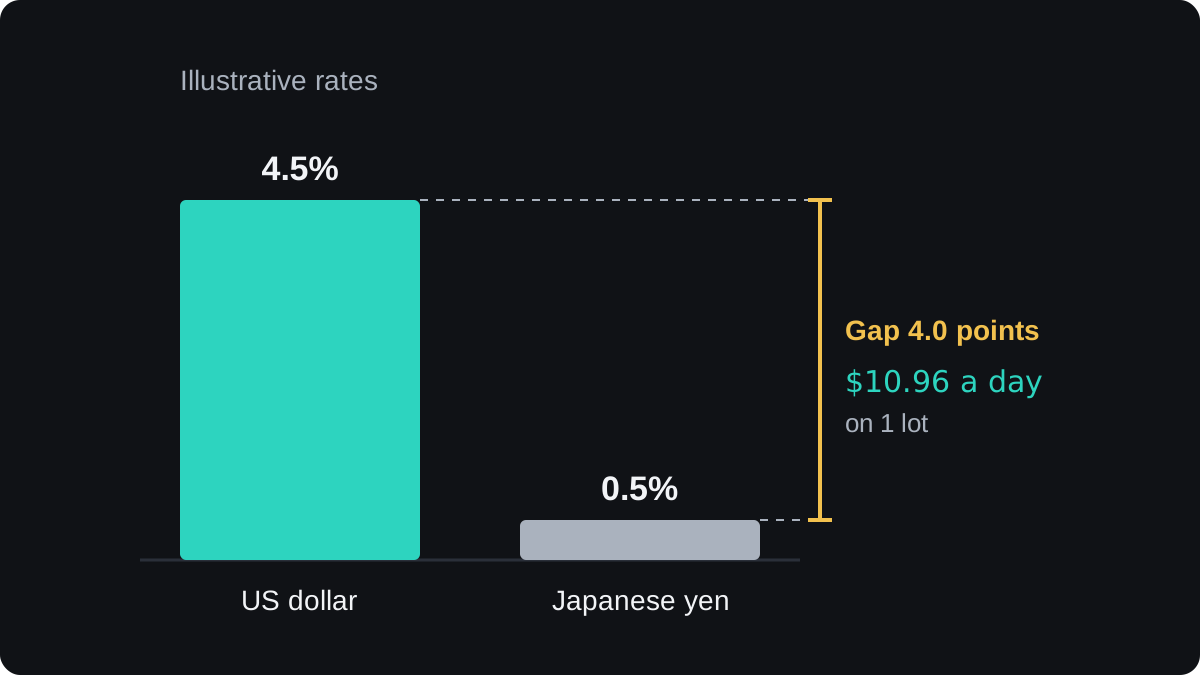
Your real swap is usually smaller, because the broker adds its own charge, and it changes whenever either rate changes. Your platform's contract specification shows the swap for each pair, and the swap calculator turns it into money.
The carry income is small next to price moves. Suppose USD/JPY falls from 150.00 to 147.00 while you hold that lot:
- The move is 150.00 minus 147.00 = 3.00 yen, which is 300 pips.
- The loss is 300 × 1,000 yen = ¥300,000.
- Converted at 147.00, that is 300,000 ÷ 147.00 = $2,040.82.
- At $10.96 a day, the loss equals about 186 days of carry, since 2,040.82 ÷ 10.96 is about 186.
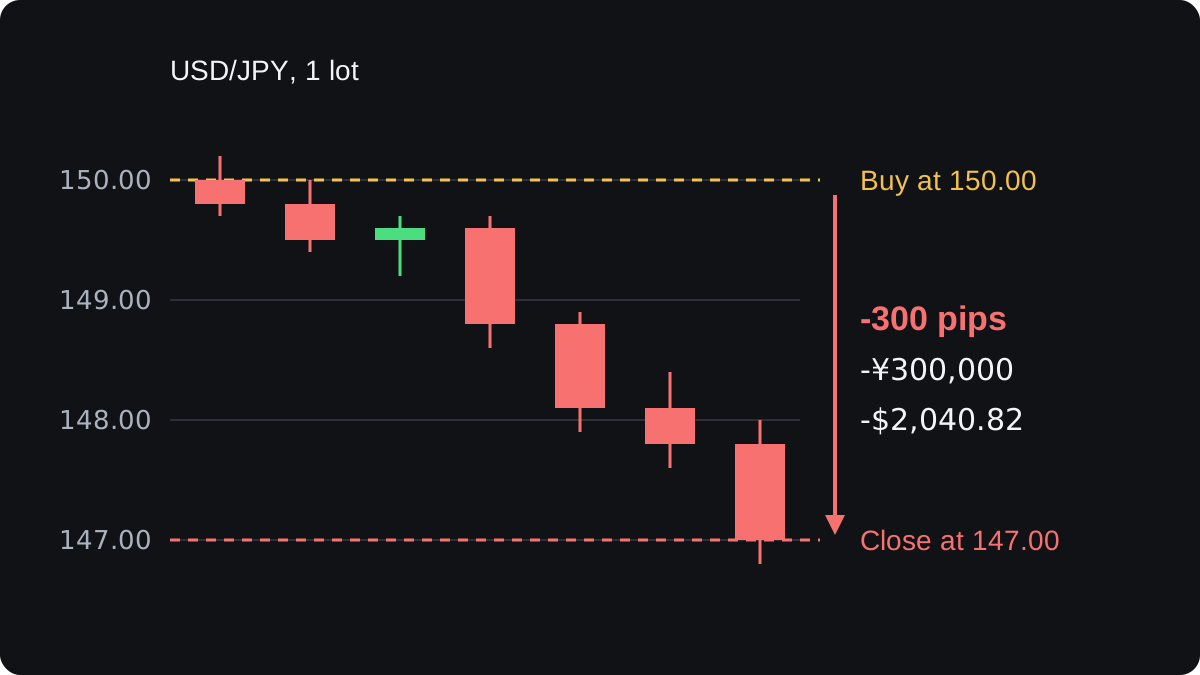
When many traders hold the same position, a fall like this can feed itself. Closing a long USD/JPY trade means buying yen, which pushes the yen higher still. The carry trade risks lesson covers these unwinds.
Why does the yen often rise when markets panic?
A safe haven is a currency that tends to gain when investors grow fearful. The yen often behaves this way, like the Swiss franc, and two mechanisms are usually given for it.
Japan is one of the world's largest net creditors: its residents own far more assets abroad than foreigners own in Japan. In a scare, some of that money may come home, which means selling foreign currency and buying yen.
Carry trades add to the effect. When stocks drop and volatility jumps, traders close positions funded in yen, and each close buys yen back. This is part of risk-on and risk-off behaviour.
The haven role is a tendency with clear limits. In 2022 global stocks fell, yet the yen weakened steeply against the dollar, because US rates rose fast while Japanese rates stayed near zero.
In that case a widening rate gap outweighed fear.
Who steps in when the yen moves too fast?
Buying or selling a currency on purpose to move its price is called intervention. In Japan the decision belongs to the Ministry of Finance, and the Bank of Japan places the trades in the market on its behalf.
Action usually starts with words. Officials warn that moves are too fast or one-sided, and traders read the tone of those warnings closely. After any intervention, the Ministry publishes the totals, so you can check what happened.
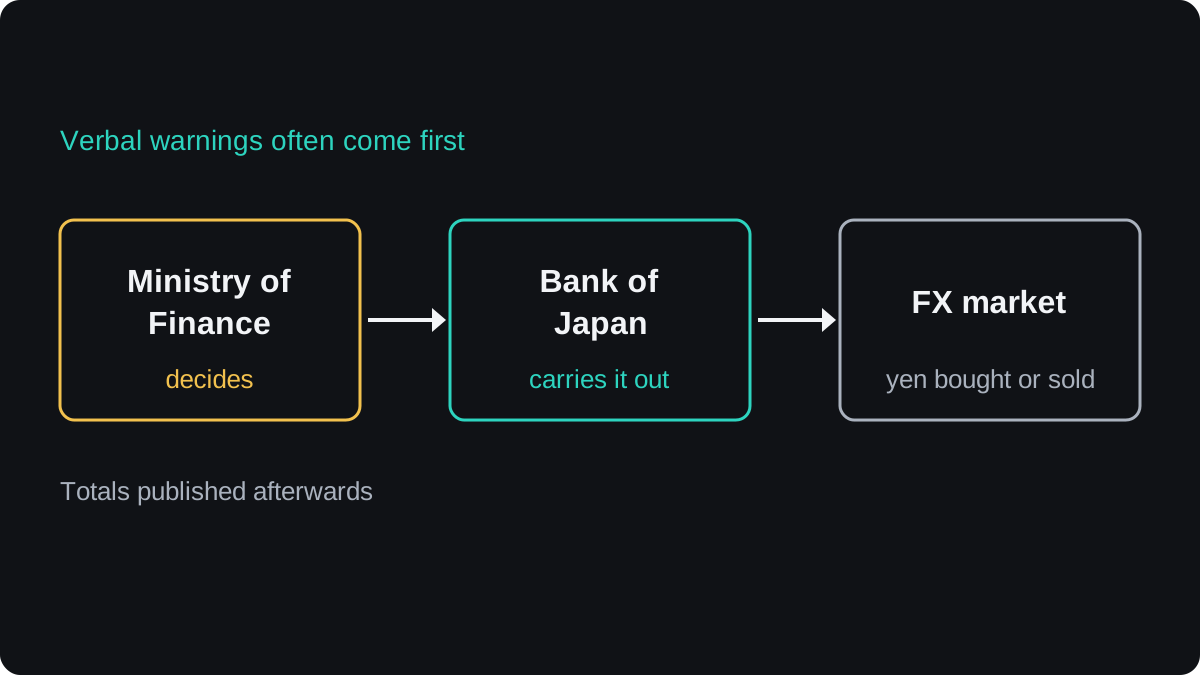
Japan has intervened in both directions. It sold yen to weaken it in earlier decades, and it bought yen to support it in 2022, 2024 and 2026, including a joint operation with the US Treasury in July 2026.
An intervention can move yen pairs sharply within minutes. The effect has sometimes faded when the rate gap behind the slide stayed in place.
That makes intervention a source of sudden risk for any open yen position. The currency intervention lesson covers how other countries do it.
What do yen traders watch on the calendar?
BoJ policy decisions come at scheduled meetings through the year, followed by a press conference from the governor. Hints about future rate changes can move the yen even when the rate itself stays the same.
Inflation data shapes what the BoJ does next. Consumer prices for the Tokyo area are released before the national figures and are read as an early guide.
Spring wage talks between large companies and unions get attention too, because the BoJ has tied lasting inflation to rising wages. Its quarterly Tankan survey of business conditions is another regular release.
For USD/JPY, US bond yields often matter as much as Japanese news. When the gap between US and Japanese yields widens, USD/JPY has often risen, though the link can break for long spells.
Japanese data usually comes out around the start of the Tokyo session, while the US releases that move USD/JPY arrive later in the day.
សំណួរ
Why is the Japanese yen considered a safe haven?
Japanese investors own large foreign assets that may be brought home in a crisis, and carry trades funded in yen are closed when fear rises. Both buy yen. It is a tendency only, and a widening rate gap can override it.
What is a pip on USD/JPY?
A pip on USD/JPY is 0.01. On one standard lot that is 1,000 yen, worth $6.67 when the price is 150.00.
Why does USD/JPY follow US interest rates?
For long periods Japanese rates stayed low and stable, so changes in US rates did most of the work in moving the gap. A wider gap makes holding dollars instead of yen pay more.
Who decides currency intervention in Japan?
The Ministry of Finance decides, and the Bank of Japan carries out the trades. The Ministry publishes the totals afterwards.
Is the yen carry trade safe?
No. In this lesson's illustrative example, a 300 pip fall on one lot of USD/JPY cost $2,040.82, about 186 days of carry income.
បន្តរៀន
 ជំពូក 4The US dollar.The US dollar is on one side of most forex trades because it is the main reserve, trade and funding currency. Its value moves largely on what traders expect from the Federal Reserve, and those expectations shift with US jobs, inflation and growth data. In a global panic it often rises.
 ជំពូក 4The euro.The euro is the shared currency of 21 European Union countries, managed by the European Central Bank in Frankfurt. The ECB sets one interest rate for economies that can need different ones, aiming for 2% inflation across the whole area. EUR/USD, the euro against the US dollar, is the world's most traded currency pair.
 ជំពូក 4The British pound.The British pound, or sterling (GBP), moves mainly on Bank of England interest rate expectations and on data from a services-heavy UK economy. GBP/USD, nicknamed cable, is one of the most traded pairs. The pound has often swung further in a day than the euro, so a trade on it may need a wider stop and a smaller position.
 ជំពូក 4The Australian, Canadian and New Zealand dollars.The Australian, Canadian and New Zealand dollars are called commodity currencies because their countries export large amounts of raw materials. The Aussie tends to follow metals and Chinese demand, the loonie oil and the US economy, and the kiwi dairy prices. Interest rates and global risk appetite also move all three, and can outweigh commodities.
 ជំពូក 4The Swiss franc.The Swiss franc (CHF) is the currency of Switzerland, a small economy with a currency that investors often buy in times of stress. That safe-haven demand can push the franc too high, so the Swiss National Bank has fought it with negative rates and currency intervention, including a 1.20 floor on EUR/CHF that it dropped without warning in 2015.

