The Tokyo session: hours and what moves.
The Tokyo session is the Asian part of the forex day, roughly 00:00 to 09:00 UTC. Japan does not use daylight saving time, so those hours stay fixed all year. Yen pairs and the Australian and New Zealand dollars are most active, and ranges on European pairs are often smaller than in London.

At 9 in the morning in Tokyo, it is midnight in London in winter and 7 in the evening of the day before in New York. That is when Japanese banks and companies start their currency business for the day.
The lesson on forex trading sessions showed the whole 24-hour cycle. This lesson looks more closely at the first of the three main sessions.
What hours does the Tokyo session cover?
Forex has no central exchange, so no bell opens or closes the Tokyo session. The usual convention is 00:00 to 09:00 UTC, which is 09:00 to 18:00 in Tokyo, the working day of Japanese banks.
Japan does not change its clocks for daylight saving time. Tokyo time is UTC+9 all year, so the session sits at the same UTC hours in January and in July.
The wider Asian session starts earlier. Sydney opens a few hours before Tokyo, and Singapore and Hong Kong, both large currency centres on UTC+8, trade through much the same hours as Tokyo.
At the end of the session, London opens at 08:00 UTC in northern winter. For one hour both centres are active, and trading usually picks up as European banks arrive.
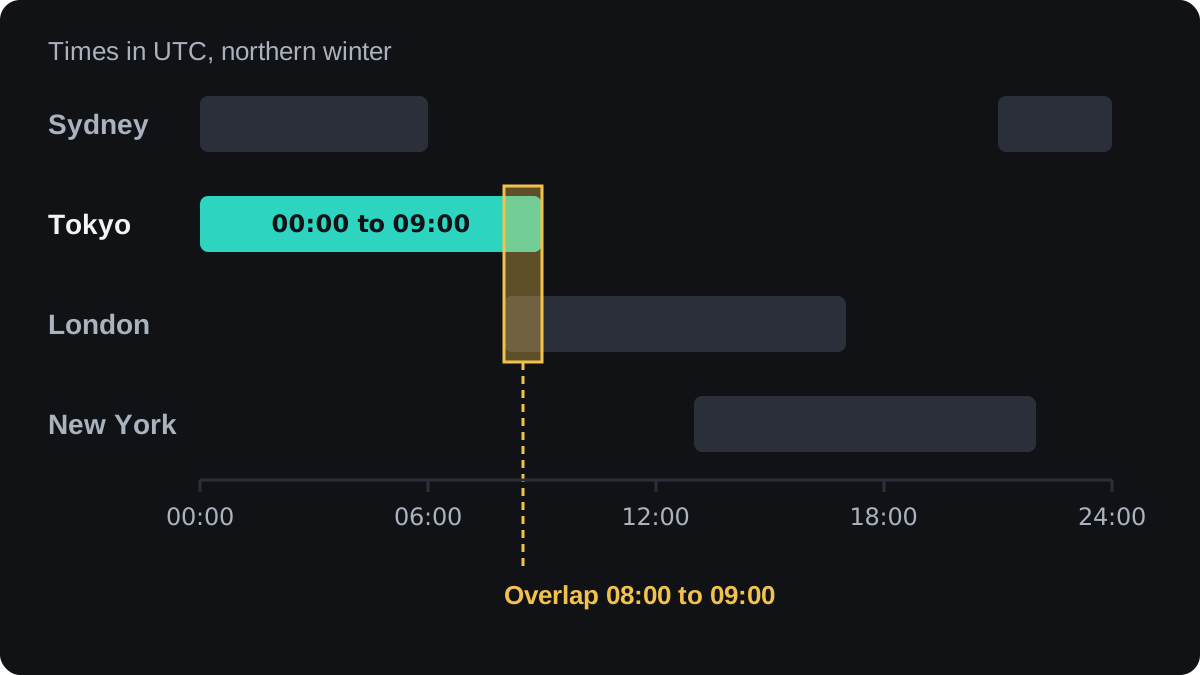
In northern summer the UK moves to UTC+1, so London opens at 07:00 UTC and the overlap grows to two hours. Sydney shifts the other way, because Australian daylight saving runs during the northern winter.
What time is the Tokyo session where you live?
Take 00:00 and 09:00 UTC and apply your own offset. Add the hours if you are east of UTC, and subtract them if you are west.
New York in winter is UTC-5. Subtract 5 hours from 00:00 UTC and you get 19:00 the previous evening, and from 09:00 UTC you get 04:00.
So in winter the Tokyo session runs from 7 pm to 4 am New York time.
| City | Offset | Tokyo session in local time |
|---|---|---|
| Tokyo | UTC+9 | 09:00 to 18:00 |
| Singapore | UTC+8 | 08:00 to 17:00 |
| Sydney, standard time | UTC+10 | 10:00 to 19:00 |
| Sydney, daylight saving | UTC+11 | 11:00 to 20:00 |
| Dubai | UTC+4 | 04:00 to 13:00 |
| London, winter | UTC+0 | 00:00 to 09:00 |
| London, summer | UTC+1 | 01:00 to 10:00 |
| New York, winter | UTC-5 | 19:00 to 04:00, starting the evening before |
| New York, summer | UTC-4 | 20:00 to 05:00, starting the evening before |
Europe, North America and Australia change their clocks on different dates. For a few weeks each spring and autumn the gaps shift, so check the market hours tool against your own clock.
Which currency pairs move most in Tokyo hours?
In Tokyo hours most of the trading comes from Asian banks, companies and investors. Much of their business involves the yen and the Australian and New Zealand dollars.
USD/JPY, EUR/JPY and AUD/JPY tend to be active because Japanese firms buy and sell yen during their working day. AUD/USD and NZD/USD react to local data and to news from China, a large trading partner of both countries.
EUR/USD and GBP/USD often move less until Europe wakes up. Their main news and most of their volume come later, so their Asian ranges are usually smaller than their London or New York ranges.
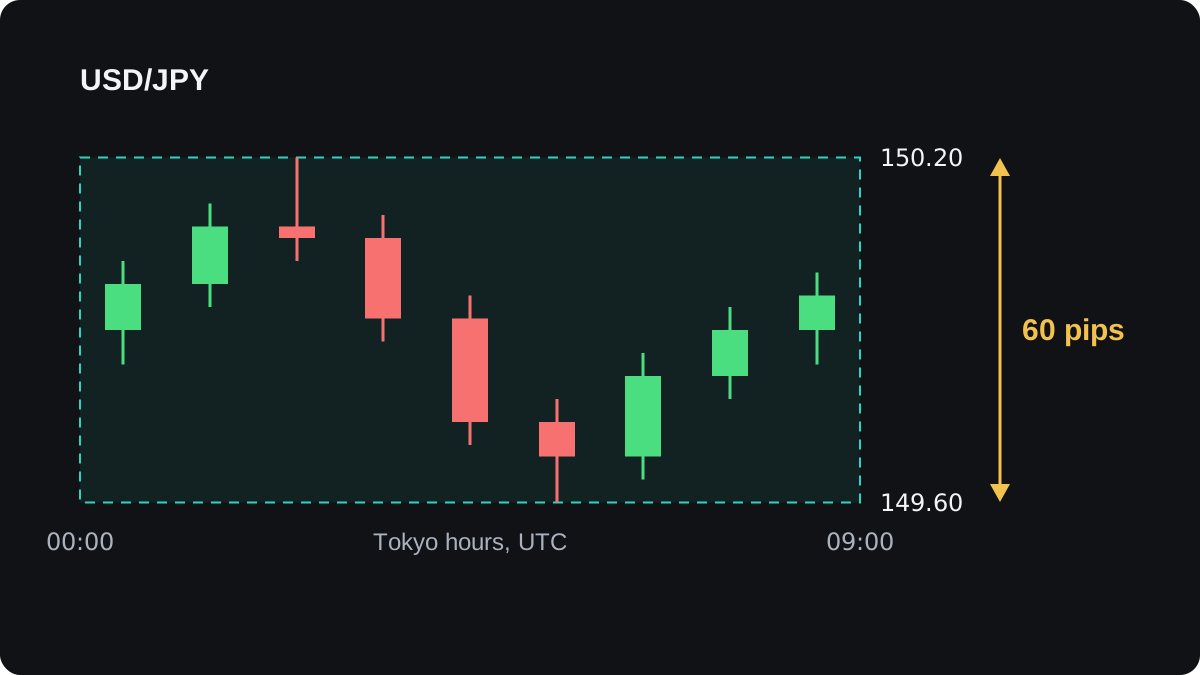
The range is the gap between the session high and the session low, counted in pips. The chart below shows an illustrative USD/JPY Tokyo session with round prices.
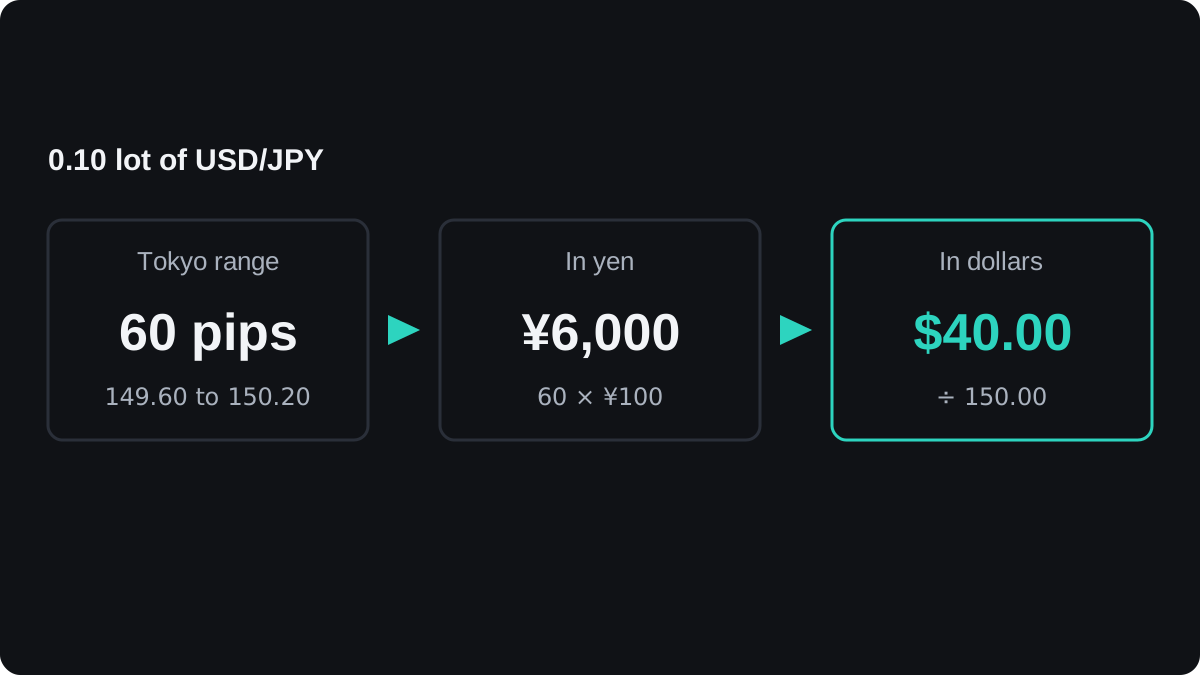
Work out what that range means for a trade of 0.10 lot:
- The session high is 150.20 and the low is 149.60.
- The range is 150.20 minus 149.60 = 0.60. A pip on a JPY pair is 0.01, so that is 60 pips.
- 0.10 lot is 10,000 US dollars, so one pip is worth 10,000 × 0.01 = ¥100.
- A move across the whole range on that size is 60 × ¥100 = ¥6,000.
- In a US dollar account at a rate of 150.00, that is ¥6,000 ÷ 150.00 = $40.00.
No real trade catches the full range, because nobody knows the high and low until the session is over. The range shows how much room the market gave, so you can judge whether a 20 pip target was modest or ambitious that day.
What news comes out during Asian hours?
Much Japanese data is released shortly before Tokyo opens, often at 08:50 Tokyo time, which is 23:50 UTC. The Bank of Japan's quarterly Tankan survey of businesses is one example.
Bank of Japan policy decisions also arrive in Tokyo hours, with no fixed minute. The Reserve Bank of Australia announces its rate decisions in the Sydney afternoon, inside the Asian session.
Chinese economic data also comes out in Asian hours and can move the Australian and New Zealand dollars.
Japanese banks set a daily reference rate for customer deals at 9:55 Tokyo time, 00:55 UTC, known as the Tokyo fix. Company orders around it can push USD/JPY early in the session, though evidence of a dependable pattern is mixed.
Japan's Ministry of Finance can also order intervention, where the Bank of Japan buys or sells yen to steer the rate. It can happen at any hour, and USD/JPY can then move several hundred pips within hours.
Release times change, so check them on an economic calendar set to your time zone. The yen also tends to rise when markets turn fearful, a pattern explained in the lesson on risk-on and risk-off.
How does the Asian range lead into London?
When London opens, volume rises and prices often leave the range set in Asian hours. Some traders mark the Tokyo high and low and plan trades around a break of one of them.
Treat this as an idea to study, with real limits. In the example above, a move through 150.20 at the London open might keep going, or it might fall back inside the range, which is a false breakout.
There is little solid public evidence that the simple version of this rule profits after spreads and commissions. Test any rule like it on past data and on a demo account before you trust it.
The London session lesson explains what changes when Europe opens.
What are the risks of trading in Tokyo hours?
Liquidity, the ease of trading without moving the price, is usually thinner in early Asian hours than in the London and New York overlap. In a thin market, a modest order can move the price further than you expect.
A few hours before Tokyo opens comes the daily rollover at 17:00 New York time. Spreads often widen for a while around it, so a tight stop loss can be hit by the wider spread alone.
The trading week also begins in the Asia-Pacific region, on Sunday evening UTC. If big news broke over the weekend, Monday's first price can open far from Friday's close.
A price gap like that can skip past a stop loss, which then fills at the next available price.
On Japanese public holidays, such as the Golden Week cluster from late April to early May, Tokyo banks are quiet and yen trading thins out. The Japanese yen profile covers what drives the currency in more depth.
Questions
What time does the Tokyo forex session open?
By convention it opens at 00:00 UTC, which is 09:00 in Tokyo, and closes around 09:00 UTC. Japan has no daylight saving time, so these UTC hours stay the same all year.
Is the Asian session the same as the Tokyo session?
Nearly. The Asian session also includes Sydney, which opens a few hours earlier, and Singapore and Hong Kong, which trade alongside Tokyo.
Which pairs move most in the Tokyo session?
Yen pairs and the Australian and New Zealand dollars are usually the most active in these hours. EUR/USD and GBP/USD often move less until London opens.
When do Tokyo and London overlap?
From 08:00 to 09:00 UTC in northern winter, and from 07:00 to 09:00 UTC in northern summer, when the UK is on UTC+1.
Is the Tokyo session good for beginners?
Quieter hours can be easier to watch, but liquidity is thinner and prices can jump on Japanese or Chinese news. A demo account is a sensible place to see how the session behaves first.
Keep learning
 Chapter 3What are the forex trading sessions?The forex day runs in four overlapping sessions named after Sydney, Tokyo, London and New York, each following that city's working hours. Together they cover 24 hours from Monday morning in Asia to Friday evening in New York. The busiest stretch is usually the four hours when London and New York are both open.
 Chapter 3The London session: hours and what moves.The London session is usually the busiest part of the forex day. By common convention it runs from 08:00 to 17:00 London time, which is 08:00 to 17:00 UTC in winter and 07:00 to 16:00 UTC in summer. Euro, pound and Swiss franc pairs tend to move most, and the overlap with New York usually lasts four hours.
 Chapter 3The New York session: hours and what moves.The New York session runs from about 08:00 to 17:00 New York time, which is roughly 13:00 to 22:00 UTC in winter and 12:00 to 21:00 UTC in summer. Its first four hours overlap London, usually the busiest stretch of the day. Much of the major US data comes out at 08:30 New York time.
 Chapter 3What is the best time of day to trade forex?For most major pairs the best conditions come when London and New York are both open, about 12:00 to 16:00 UTC in the northern summer and 13:00 to 17:00 UTC in winter. Liquidity is deepest and spreads are usually tightest then, although big US data releases also land in that window.
 Chapter 3What are the best days of the week to trade forex?Forex opens around 17:00 New York time on Sunday and closes at the same time on Friday. Monday's first hours are often thin and can gap. Tuesday to Thursday are often busier, with many scheduled releases. Friday afternoons thin out before the close. No day is best for everyone, so check your own pairs.

