The New York session: hours and what moves.
The New York session runs from about 08:00 to 17:00 New York time, which is roughly 13:00 to 22:00 UTC in winter and 12:00 to 21:00 UTC in summer. Its first four hours overlap London, usually the busiest stretch of the day. Much of the major US data comes out at 08:30 New York time.

When it is 08:00 in New York, London traders are halfway through their day and Tokyo has gone home. For the next few hours the two largest forex centres trade at the same time, and US economic data starts to land.
New York is the last of the three big sessions in the daily forex trading sessions cycle. Its morning is often the most active part of the day for dollar pairs, and its evening is often the quietest.
When does the New York session open and close?
Forex has no opening bell, so session hours are a convention. A common choice for New York is 08:00 to 17:00 local time, when banks and funds in the city are at their desks.
Some charts start the session an hour earlier, so treat the edges as approximate.
The local hours stay fixed, but their UTC times move with US daylight saving. In winter New York is UTC-5, so the session runs 13:00 to 22:00 UTC.
In summer New York is UTC-4, so the same local hours run 12:00 to 21:00 UTC.
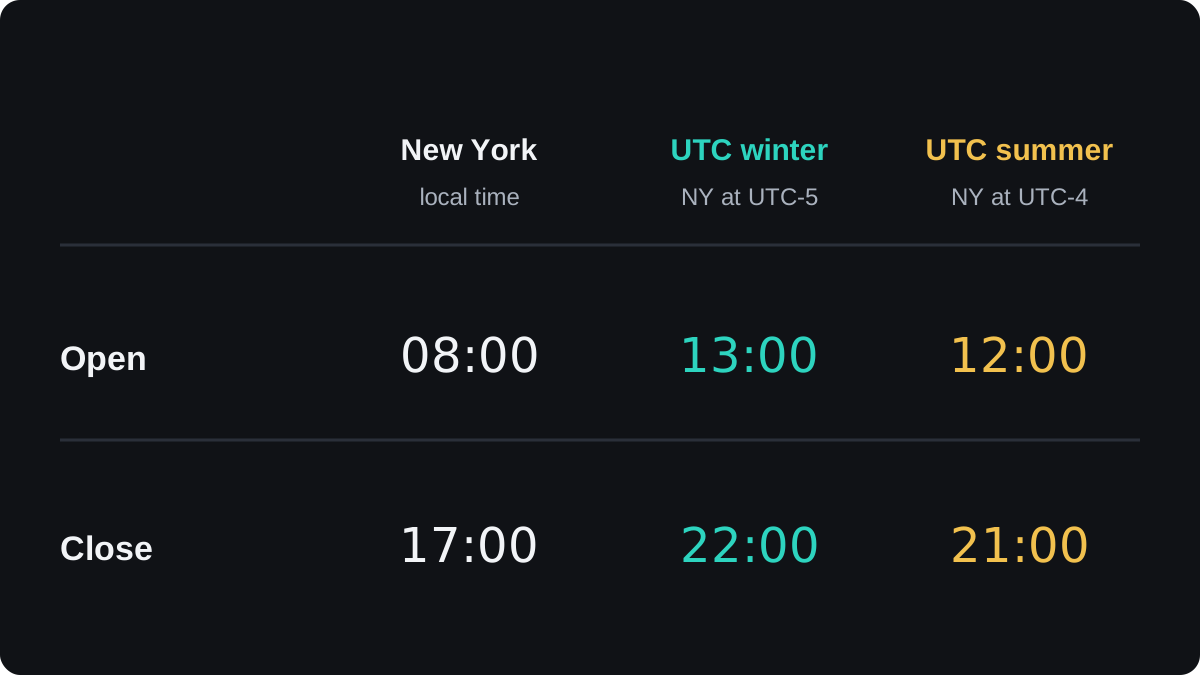
The US and Europe change their clocks on different dates. The US moves to summer time on the second Sunday of March and back on the first Sunday of November.
The UK and the EU change on the last Sunday of March and the last Sunday of October. Between those dates, New York is four hours behind London instead of five.
A session chart that assumes a fixed five hour gap is an hour out in those weeks. A live tool such as the market hours clock handles the change for you.
Why the London overlap is usually the busiest stretch
London trades from about 08:00 to 17:00 London time, as the London session lesson set out. In winter that is 08:00 to 17:00 UTC, so the two cities are open together from 13:00 to 17:00 UTC.
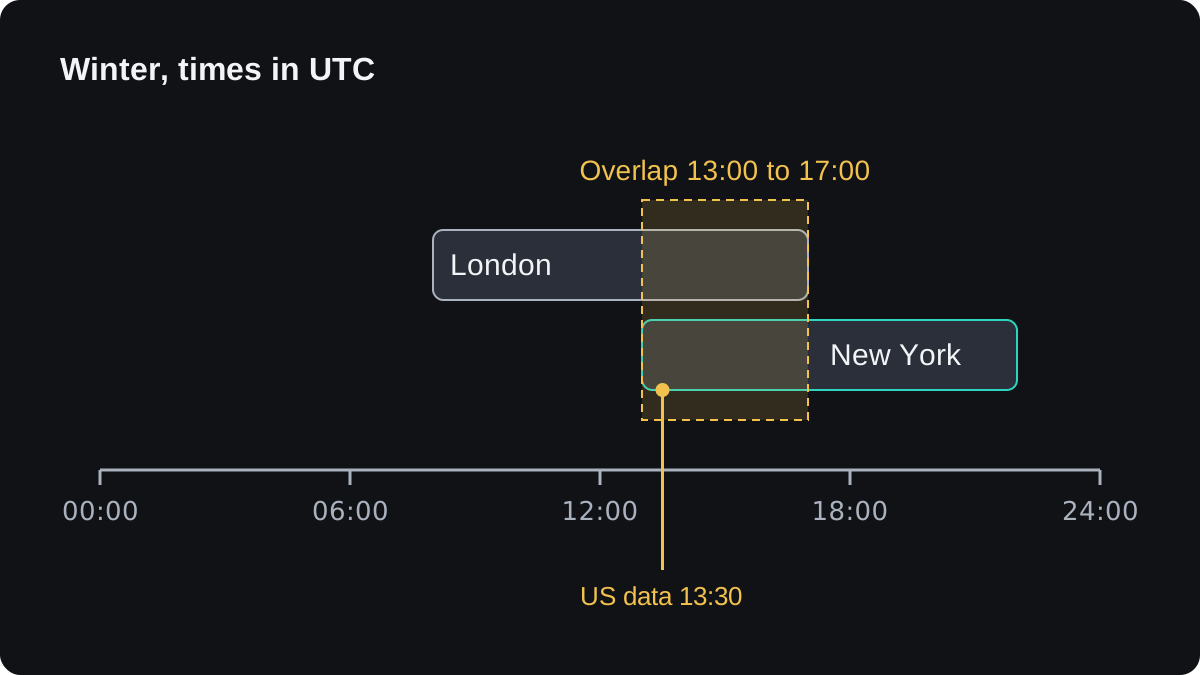
In summer both cities shift by an hour, and the overlap runs 12:00 to 16:00 UTC. In the gap weeks it stretches to about five hours, 12:00 to 17:00 UTC, because New York is on summer time while London is on winter time.
With both centres trading, more banks and funds quote prices at the same moment. That tends to mean a tighter spread and bigger moves on dollar and euro pairs than in Asian hours.
This is a tendency only. A quiet summer Friday afternoon can be duller than a busy Tokyo morning.
One regular event falls inside the overlap: the London 16:00 fix, a benchmark exchange rate that many funds use to value their holdings.
Orders that must trade at the fix can push prices around in the minutes before 16:00 London time, which is usually 11:00 in New York.
Which US data comes out during New York hours?
Many of the US releases that move the dollar come out at 08:30 New York time. They include the monthly jobs report (nonfarm payrolls), the consumer price index (CPI), retail sales and weekly jobless claims.
The Federal Reserve, the US central bank, usually announces its interest rate decision at 14:00 New York time after each of its eight scheduled meetings a year. A press conference follows at 14:30.
The press conference can move prices as much as the decision itself.
These times are fixed in New York, so their UTC times follow US clocks:
| Event | New York time | UTC in winter | UTC in summer |
|---|---|---|---|
| Session opens, roughly | 08:00 | 13:00 | 12:00 |
| Jobs report, CPI, retail sales, jobless claims | 08:30 | 13:30 | 12:30 |
| London desks wind down, roughly | 12:00 | 17:00 | 16:00 |
| Fed rate decision | 14:00 | 19:00 | 18:00 |
| Fed press conference | 14:30 | 19:30 | 18:30 |
| Rollover and session close | 17:00 | 22:00 | 21:00 |
In the gap weeks New York is already on summer time, so use the summer column for every New York event.
Only the London row changes in those weeks. London desks wind down at 17:00 UTC, which is 13:00 New York time.
To convert to your own clock, add your UTC offset to the UTC time (subtract it if your offset is negative). Say your clock is UTC+7 all year:
- A winter jobs report at 13:30 UTC reaches you at 13:30 + 7 hours = 20:30.
- A summer jobs report at 12:30 UTC reaches you at 12:30 + 7 hours = 19:30.
- A winter Fed decision at 19:00 UTC plus 7 hours passes midnight, so it reaches you at 02:00 the next morning.
The economic calendar shows each release in your own time zone, which saves doing this by hand.
What a big release can do to your stop loss
An 08:30 release can move a major pair tens of pips in a few minutes, and the price sometimes jumps past levels without trading at them. Here is an illustrative case on EUR/USD in winter, with round prices.
- Before the jobs report you are long 0.10 lot of EUR/USD, bought at 1.10000, with a stop loss at 1.09900.
- On 0.10 lot, which is 10,000 euros, one pip is 10,000 × 0.0001 = $1. The stop is 10 pips away, so the planned loss is $10.
- At 13:30 UTC the report surprises the market, and within one five minute candle the price drops to 1.09600, a fall of 40 pips.
- The price skips past 1.09900. Your stop becomes a market order and fills at the first available price, 1.09820.
- The loss is 1.10000 minus 1.09820 = 0.00180, which is 18 pips. At $1 a pip that is $18, nearly twice the $10 you planned.
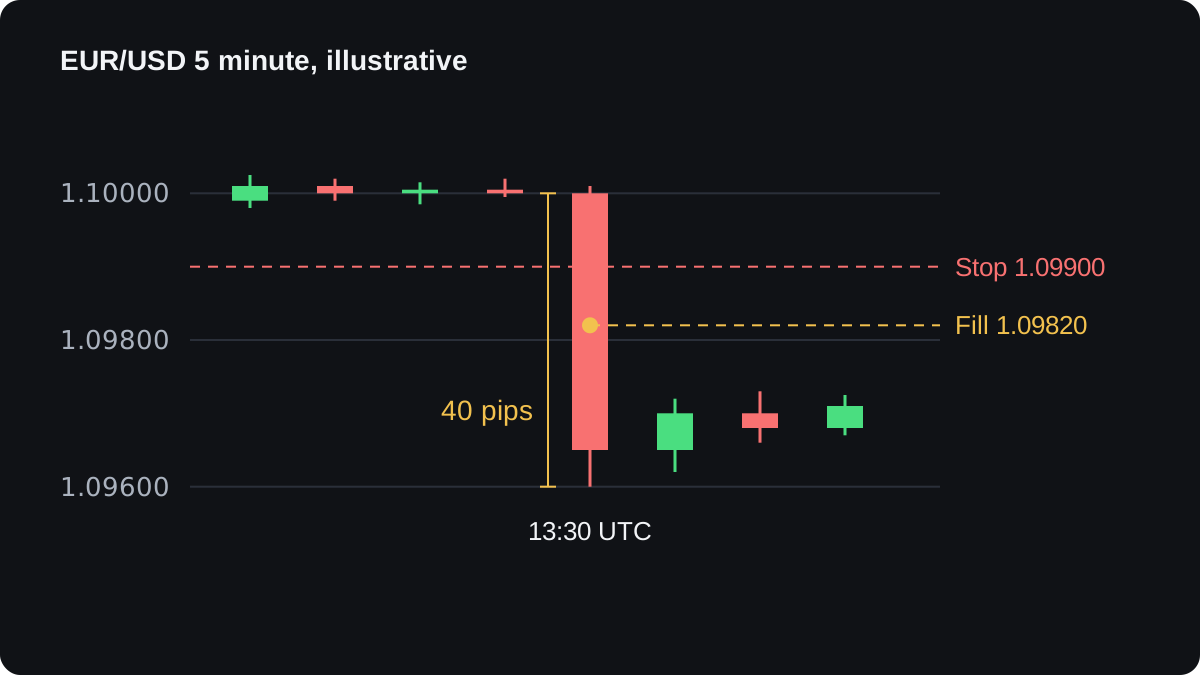
The gap between your stop price and your fill is slippage. Spreads also tend to widen for a short time around a big release, because fewer prices are on offer while dealers wait for the number.
The stop still limited the damage in this example, since an 18 pip loss is smaller than sitting through all 40 pips. A stop is an order to exit, and it does not promise an exact price.
What happens after London closes?
Once London desks wind down, around 12:00 New York time, trading volume usually drops. Afternoon moves tend to be smaller, and spreads can drift wider on euro and pound crosses that depend on European traders.
Fed days are the exception. A decision at 14:00 New York time can make the afternoon the most active part of the day for dollar pairs.
At 17:00 New York time, 22:00 UTC in winter and 21:00 UTC in summer, the trading day rolls over. Open positions are charged or paid swap, and spreads often widen for a few minutes because few banks are quoting.
Many brokers set their platform clock so that a new daily candle starts at this moment, so check yours.
On Friday the same 17:00 ends the trading week. The first price of the new week can open some distance from Friday's close.
Which pairs move most in New York hours?
Any pair with the US dollar can react to US data, which puts EUR/USD, GBP/USD, USD/JPY and USD/CHF at the centre of the session. Gold, quoted in dollars as XAU/USD, also tends to react to US releases.
USD/CAD gets news from both sides. Canada publishes much of its own major data, including its monthly jobs figures, at 08:30 New York time as well, so the two countries sometimes release on the same morning.
The Canadian dollar has often moved with oil prices, which trade actively in US hours, though the link is loose and changes over time. Yen crosses such as EUR/JPY usually go quieter once London has closed.
Which of these hours suit you depends on the pairs you follow and your own day, and the next lesson on the best time to trade forex works through that choice.
Questions
What time does the New York forex session open?
Around 08:00 New York time, which is 13:00 UTC in winter and 12:00 UTC in summer. Some sources start it at 07:00 New York time, because forex has no official opening bell.
When do the London and New York sessions overlap?
From about 13:00 to 17:00 UTC in winter and 12:00 to 16:00 UTC in summer.
For a few weeks in March and about a week around the start of November, when US and European clocks change on different dates, the overlap is about an hour longer.
What time is nonfarm payrolls released?
At 08:30 New York time, usually on the first Friday of the month. That is 13:30 UTC in winter and 12:30 UTC in summer, but check the calendar because the date sometimes moves.
Does the forex market close at 17:00 New York time?
Only on Friday, for the weekend. On other days 17:00 New York time is the rollover from one trading day to the next, and trading carries on into the Asia and Pacific hours.
Why do spreads widen at 17:00 New York time?
It is the daily rollover, when swap is applied and few banks are quoting, so liquidity is thin for a short time. Spreads usually narrow again once more prices return.
Keep learning
 Chapter 3What are the forex trading sessions?The forex day runs in four overlapping sessions named after Sydney, Tokyo, London and New York, each following that city's working hours. Together they cover 24 hours from Monday morning in Asia to Friday evening in New York. The busiest stretch is usually the four hours when London and New York are both open.
 Chapter 3The Tokyo session: hours and what moves.The Tokyo session is the Asian part of the forex day, roughly 00:00 to 09:00 UTC. Japan does not use daylight saving time, so those hours stay fixed all year. Yen pairs and the Australian and New Zealand dollars are most active, and ranges on European pairs are often smaller than in London.
 Chapter 3The London session: hours and what moves.The London session is usually the busiest part of the forex day. By common convention it runs from 08:00 to 17:00 London time, which is 08:00 to 17:00 UTC in winter and 07:00 to 16:00 UTC in summer. Euro, pound and Swiss franc pairs tend to move most, and the overlap with New York usually lasts four hours.
 Chapter 3What is the best time of day to trade forex?For most major pairs the best conditions come when London and New York are both open, about 12:00 to 16:00 UTC in the northern summer and 13:00 to 17:00 UTC in winter. Liquidity is deepest and spreads are usually tightest then, although big US data releases also land in that window.
 Chapter 3What are the best days of the week to trade forex?Forex opens around 17:00 New York time on Sunday and closes at the same time on Friday. Monday's first hours are often thin and can gap. Tuesday to Thursday are often busier, with many scheduled releases. Friday afternoons thin out before the close. No day is best for everyone, so check your own pairs.

