Forex vs stocks: what is the difference?
Stocks are shares in single companies, traded on exchanges with fixed hours. Forex is the trading of one currency against another, over the counter, about 24 hours a day on weekdays. Forex accounts usually offer more leverage and charge or pay overnight swap. Currency prices follow two economies at once, while a share price follows one company.
ខ្លឹមសារនេះមានតែជាភាសាអង់គ្លេសសិន។

Buy a share and you own a small piece of one company. Buy EUR/USD and you hold a position that gains if the euro rises against the US dollar.
Both show up as prices on a screen. The two markets still differ in how they are organised, when they open, what a trade costs and what makes prices move.
What do you own in each trade?
With a regular stock broker, a share is a real part of a company. You may receive dividends, a slice of profits the company pays out, and you can usually hold the share for years without an overnight charge.
A retail forex trade is usually a contract with your broker that tracks an exchange rate. No currency is delivered, and the result is settled in cash. The lesson on what is traded in forex explains this contract.
Every forex price is a pair, so every trade is long one currency and short another. A share has one price in one currency, so you are judging a single company on its own.
Selling short is simpler in forex. Selling a pair is as easy as buying it, while shorting a share means borrowing it first, often for a fee, and regulators have at times restricted short selling in some markets.
Many brokers also offer share CFDs, contracts that track a stock's price without ownership. Their costs and leverage look more like forex than like owning the shares.
When can you trade each market?
Shares trade on exchanges with fixed opening hours. The main session of the New York Stock Exchange runs from 09:30 to 16:00 New York time, six and a half hours. Some exchanges, such as Tokyo's, pause for lunch.
Many stock brokers also offer pre-market and after-hours trading, usually with fewer trades and wider spreads than the main session.
Forex has no single exchange, so trading passes from one financial centre to the next. The week runs roughly from Sunday evening to Friday evening, New York time. The trading sessions lesson shows when each centre is active.
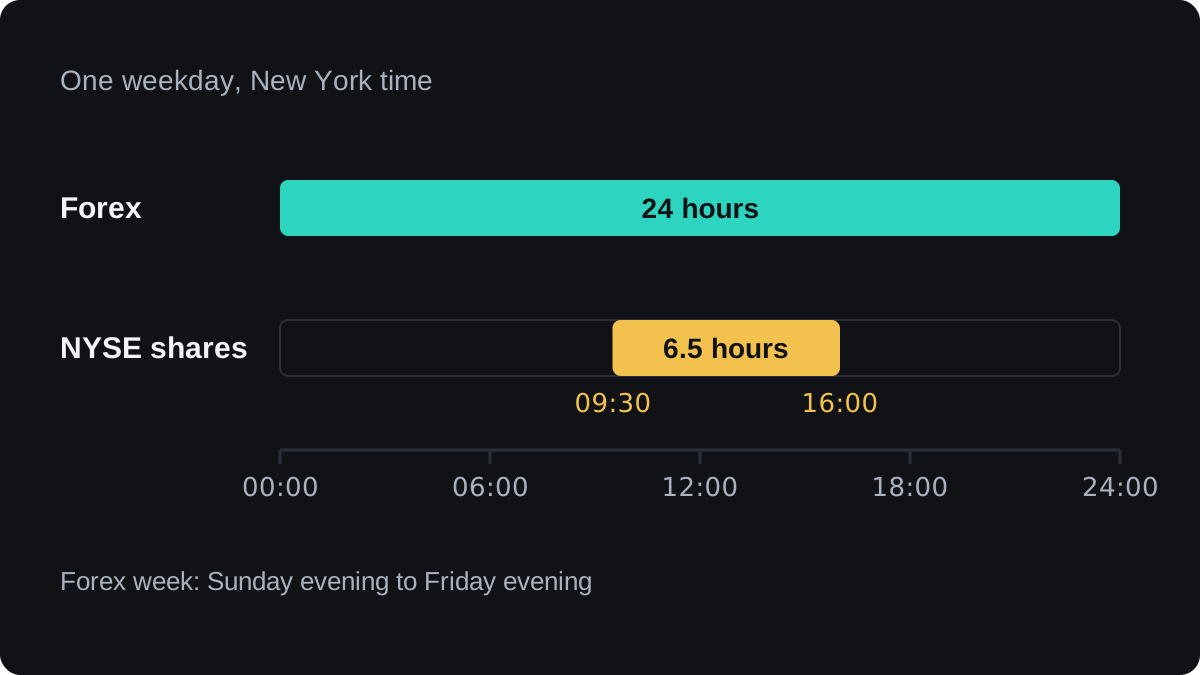
News does not wait for an exchange to open. A company can report results after the close, and its shares may open the next morning far from the last price, a jump called a gap.
Currencies can gap too, mostly over the weekend. A gap on a weekday is less common because trading does not stop. Some hours are still quiet, with wider spreads and smaller moves.
How are the two markets organised?
A share listed on an exchange has a central place where buy and sell orders meet. The exchange publishes trades and an official closing price, so everyone can check the same number.
Spot forex is over the counter: banks, brokers, funds and other dealers deal directly with each other, with no central exchange. Each broker builds its own quotes, so two brokers can show slightly different prices at the same moment.
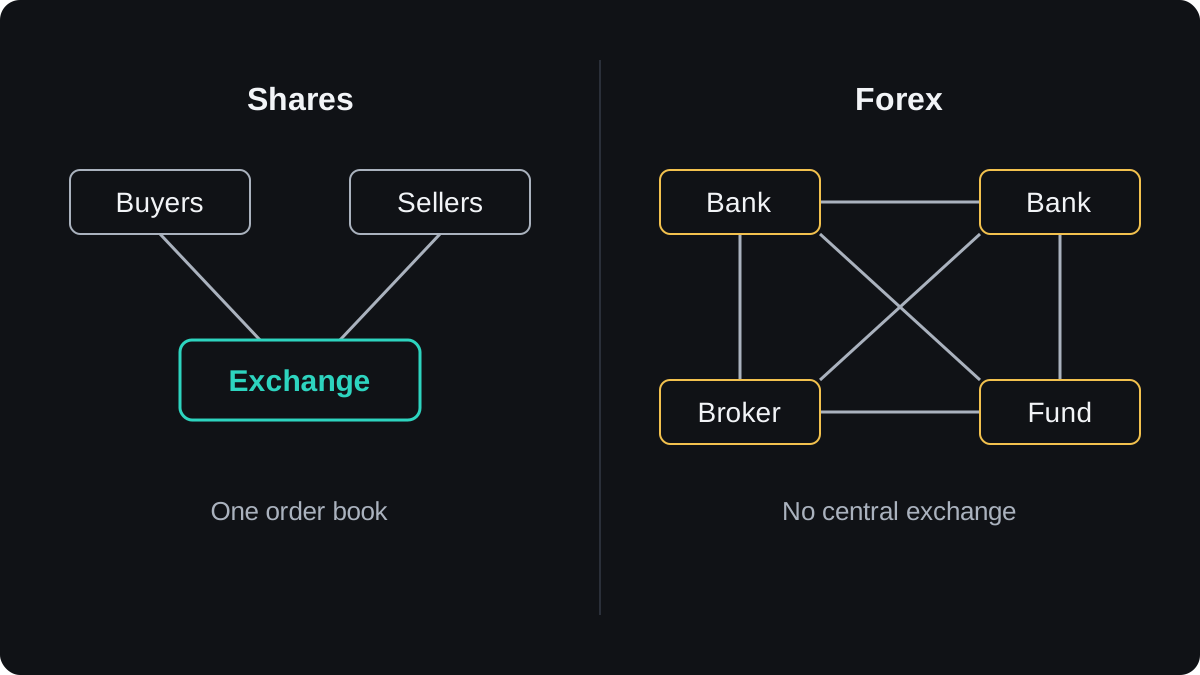
This changes how you check a price. With shares, you compare against the exchange. With forex, you compare your broker against other sources, which the market structure lesson covers in detail.
Currency futures do trade on an exchange, and they are compared in forex vs futures.
The choice of what to trade differs as well. Thousands of companies are listed around the world, while a forex platform usually offers a few dozen pairs, and a few of them carry a large share of the trading.
What does a trade cost in each market?
Both markets charge you to get in and out, though the bill is made up differently.
| Cost | Shares | Spot forex |
|---|---|---|
| Spread | Yes, the gap between bid and ask | Yes, often the main cost |
| Commission | Per trade on many accounts, zero on some | Only on some account types, per lot |
| Overnight charge | None on shares bought with your own cash | Swap on positions held past the daily rollover |
| Other | Some countries tax share purchases; foreign shares may need currency conversion | Usually none beyond the above |
An account advertised as zero commission still earns money somewhere, often through the spread or other fees. Read the broker's full price list in either market.
Swap is the big difference for anyone who holds trades.
A share bought with cash can sit for a year at no holding cost, while a forex position pays or earns swap every night it stays open. The swap lesson shows how it is worked out.
How does leverage change the size of a move?
A stock account that uses your own cash has no leverage: a $2,000 deposit buys $2,000 of shares. Forex accounts normally come with leverage, so a small deposit, the margin, can hold a much larger position.
The maximum leverage depends on your country's rules, the type of client and the broker. The example below uses 1:30 only as an illustration.
Take a $2,000 account in each market and a 1% move against you. All prices here are illustrative.
Shares:
- Buy 40 shares at $50.00: 40 × $50.00 = $2,000.
- The price falls 1% to $49.50, a drop of $0.50 per share.
- The loss is 40 × $0.50 = $20, which is 1% of the account.
Forex:
- Buy 0.20 lot of EUR/USD at 1.10000. That is 20,000 euros, worth 20,000 × 1.10000 = $22,000.
- At 1:30, the margin is $22,000 ÷ 30 = $733.33, so the trade fits in the account.
- The price falls 1%: 1.10000 × 0.01 = 0.01100, which is 110 pips, to 1.08900.
- A pip on 0.20 lot is 20,000 × 0.0001 = $2, so the loss is 110 × $2 = $220.
- That is $220 ÷ $2,000 = 11% of the account.
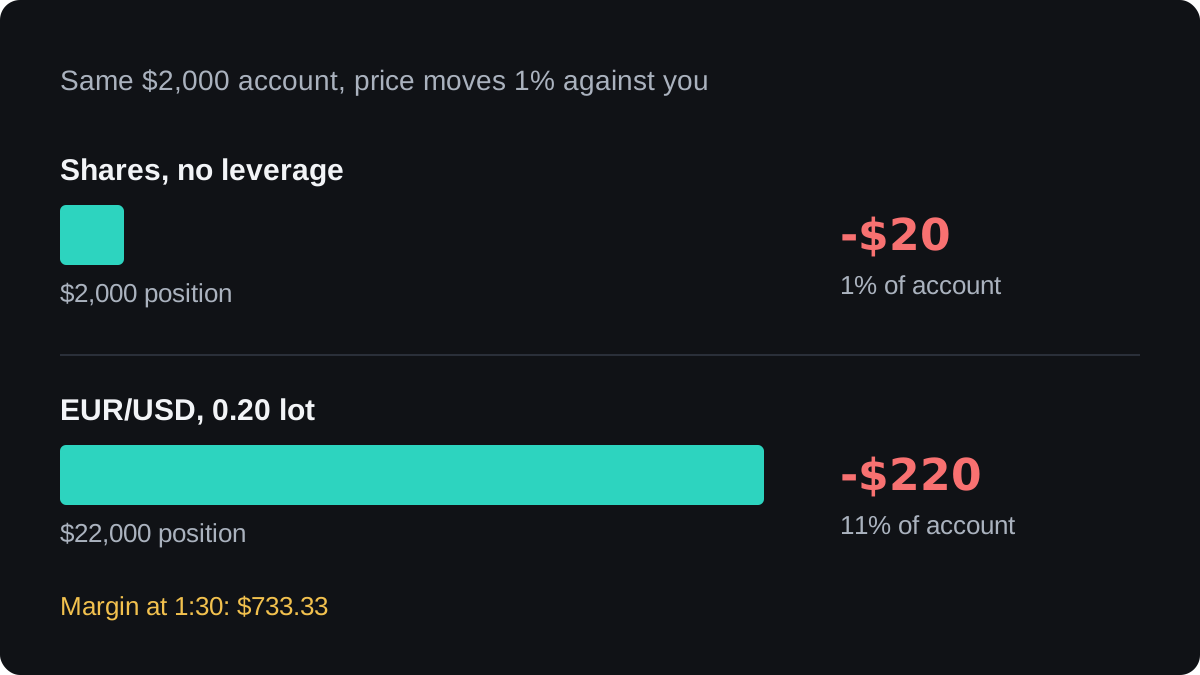
The forex position was 11 times the account ($22,000 ÷ $2,000), so the same 1% move did 11 times the damage. This ratio is called effective leverage, and it decides how hard a move hits you, whatever maximum the broker allows.
Where rules cap leverage by product, the cap on major pairs is often higher than on shares. Major pairs tend to move less in a day than a single share.
Currencies can still jump on news, and a stop loss may then fill beyond its level.
Both sides can be sized down or up. You can trade 0.01 lot of EUR/USD, a $1,100 position at 1.10000, or buy shares on margin. Check any size first with the margin calculator.
What moves prices in each market?
A share price follows one company: its own profits and plans, plus news about its industry and the mood of the wider stock market. The day a company reports its results is often its biggest price event of the quarter.
A currency pair follows two economies at once. Interest rates, inflation, growth and central bank decisions in both places push the rate, and so does global appetite for risk. The lesson on what moves currencies covers these drivers.
Because a pair is relative, good news on one side is not enough. If US data is strong and euro area data is stronger, EUR/USD can rise even though the US economy did well.
The calendar each trader watches differs as a result. Stock traders follow company reporting dates, while forex traders follow scheduled economic releases, such as inflation and jobs figures, and central bank meetings.
សំណួរ
Is forex riskier than stocks?
Neither market is safe by nature. Forex accounts usually carry more leverage, which makes each move larger against your deposit, while a single share can fall sharply on company news. Your risk depends mostly on position size.
Can I trade forex and stocks on the same platform?
Often yes. Many brokers list currency pairs next to share CFDs, though a share CFD gives you no ownership of the company and no voting rights.
Why does forex trade 24 hours but stocks do not?
Shares trade on exchanges with set opening hours. Forex is traded directly between dealers in financial centres around the world, so when one centre closes another is open.
Do forex traders get dividends?
No, dividends go to shareholders. Holding a currency position instead pays or charges swap each night, depending on the interest rates of the two currencies and your broker's terms.
Which is easier for beginners, forex or stocks?
It depends on how you plan to trade. Shares bought with your own cash can lose at most what you paid, while leveraged forex can lose money faster, so a demo account is a sensible place to practise first.
បន្តរៀន
 ជំពូក 5Why do people trade forex?People trade forex because the market runs around the clock from Sunday evening to Friday evening, New York time, major pairs are liquid with usually narrow spreads, and selling a pair you expect to fall is as simple as buying one you expect to rise. Small trade sizes and leverage add access, and leverage also makes losses larger.
 ជំពូក 5Forex vs futures: what is the difference?Spot forex and forex CFDs trade over the counter through a broker, in flexible sizes often down to 1,000 units, with no expiry and a nightly swap. Currency futures trade on an exchange in fixed contract sizes, expire on set dates, settle gains and losses every day and build the interest difference into their price.

