Correlation and portfolio risk.
When two currency pairs tend to move together, trades on both add up to one larger bet. Buying EUR/USD and GBP/USD with 1% risk each puts up to 2% at risk on one view of the US dollar. Direction matters too: buying one pair and selling a pair that moves opposite doubles the bet as well.
เนื้อหานี้ยังมีเฉพาะภาษาอังกฤษ

Say you buy EUR/USD and GBP/USD on the same morning and risk 1% of your account on each. The two trades look separate on your screen.
Both win if the US dollar weakens, and both lose if it strengthens. When pairs move together like this, their risks add up, and your account feels the total.
Why can two trades be one bet?
Correlation measures how closely two prices move together, on a scale from −1 to +1. At +1 they always move the same way, at −1 they always move opposite ways, and near 0 there is no steady link.
EUR/USD and GBP/USD share the US dollar as their quote currency. News that moves the dollar, such as a US jobs report, pushes both pairs at once. Over long stretches the two have often shown a strong positive correlation.
A shared currency is the most common link. Shared drivers add to it: the Australian and New Zealand dollars both tend to follow commodity prices, which is one reason AUD/USD and NZD/USD often rise and fall together.
How much are you really risking?
Take the trades from the opening with round illustrative prices. Your account holds $10,000, and your rule is to risk 1% per trade, which is $100.
- You buy 0.20 lot of EUR/USD at 1.10000 with a stop loss at 1.09500, which is 50 pips away.
- On 0.20 lot, one pip is worth 20,000 × 0.0001 = $2, so the stop risks 50 × $2 = $100.
- You also buy 0.20 lot of GBP/USD at 1.30000 with a stop at 1.29500, again 50 pips away.
- The pip value is again $2, so this stop also risks $100.
- A strong US data release lifts the dollar, and both pairs fall through their stops. The loss is $100 + $100 = $200, or 2% of the account.
Each trade kept to the 1% rule, yet the account lost 2% on one idea: that the dollar would weaken.
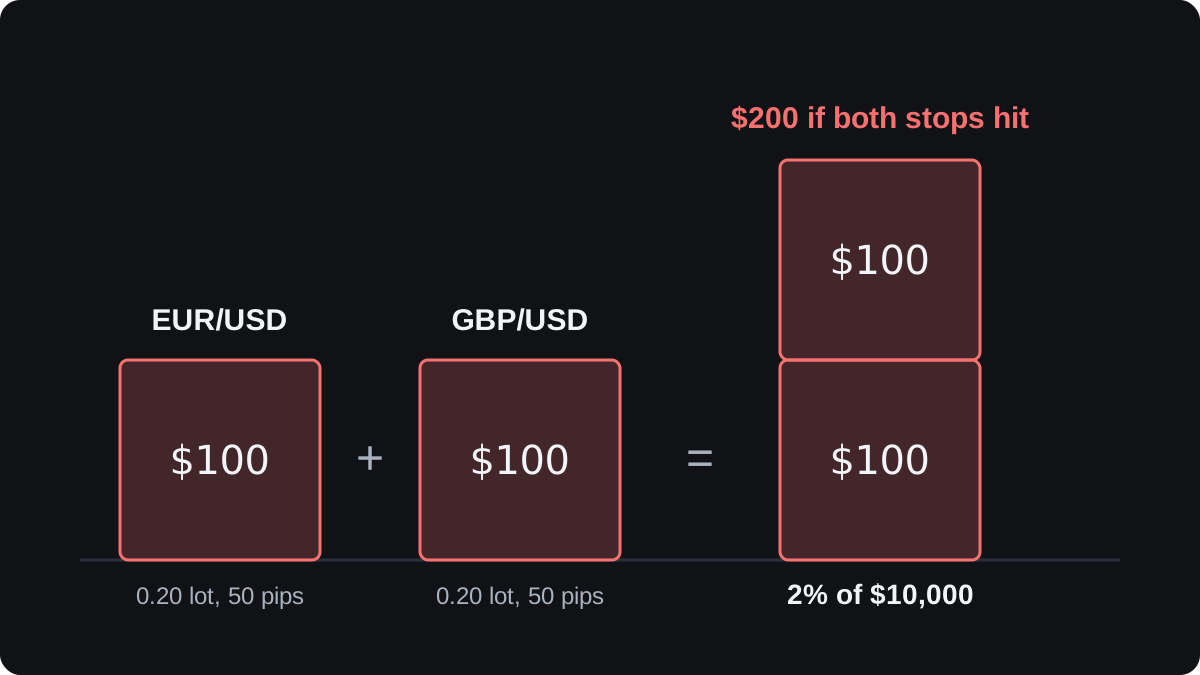
One fix is to size strongly correlated trades as a single position. If your dollar view should cost at most 1%, give each trade 0.10 lot.
Each pip is then worth $1 per trade. Each stop risks 50 × $1 = $50, and the two trades together risk $100.
Does the direction of each trade matter?
Correlation describes how two prices move. Your risk depends on that movement and on which way you trade each pair.
Buying EUR/USD while selling GBP/USD at similar sizes is close to one trade on EUR/GBP, the euro against the pound. A dollar move helps one leg and hurts the other, so the dollar risk largely cancels.
EUR/USD and USD/CHF have often moved in opposite directions, partly because the dollar is the quote currency in one and the base currency in the other.
Buying both of those pairs tends to cancel the dollar exposure. Buying EUR/USD and selling USD/CHF sells the dollar twice.
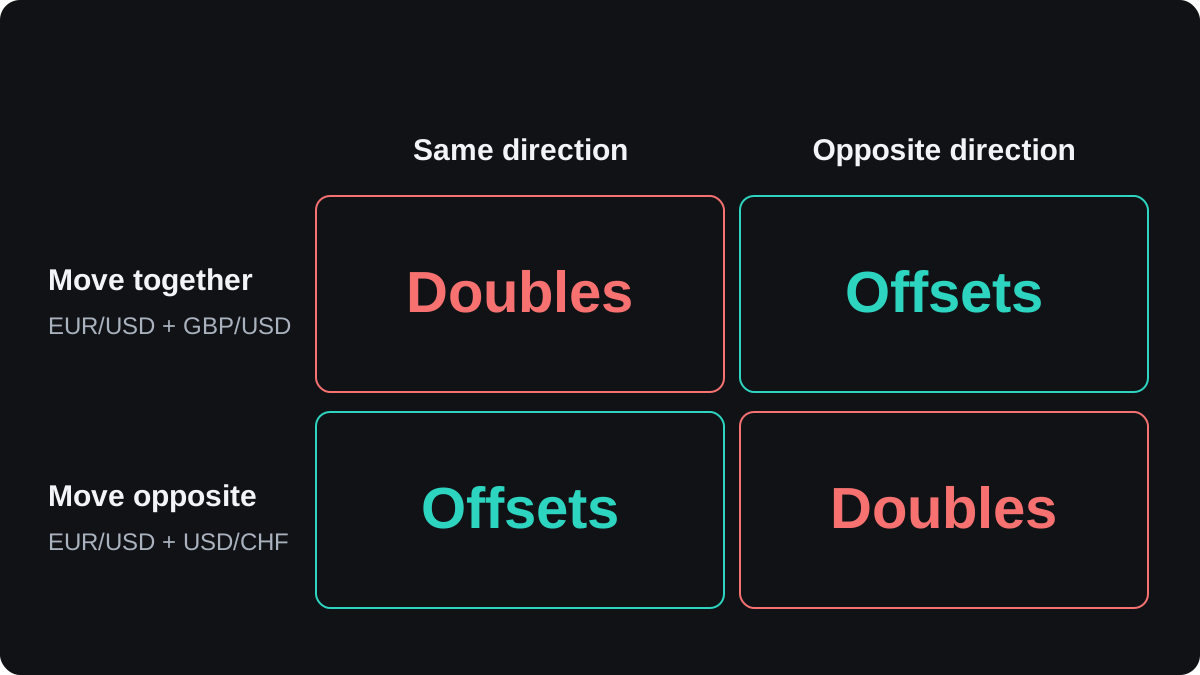
A strongly negative reading can therefore mean doubled risk. The answer depends on whether your two positions face the same way or opposite ways.
How does correlation change the combined swing?
Readings between −1 and +1 fall somewhere between full doubling and full cancelling. Standard portfolio maths shows where.
Suppose each position on its own tends to swing by about $100 in a day, a round illustrative figure. That typical swing is a standard deviation, a measure of how widely results usually spread around their average.
With both trades facing the same way, the combined swing of two positions is:
Combined swing = √(a² + b² + 2 × ρ × a × b)
Here a and b are the single swings, $100 each, and ρ (rho) is the correlation between the two pairs. So a² and b² are 10,000 each, and 2 × a × b is 20,000 before it is multiplied by ρ.
| Correlation (ρ) | Inside the root | Combined swing |
|---|---|---|
| +1.0 | 10,000 + 10,000 + 20,000 = 40,000 | $200 |
| +0.9 | 10,000 + 10,000 + 18,000 = 38,000 | $195 |
| +0.5 | 10,000 + 10,000 + 10,000 = 30,000 | $173 |
| 0 | 10,000 + 10,000 + 0 = 20,000 | $141 |
| −0.9 | 10,000 + 10,000 − 18,000 = 2,000 | $45 |
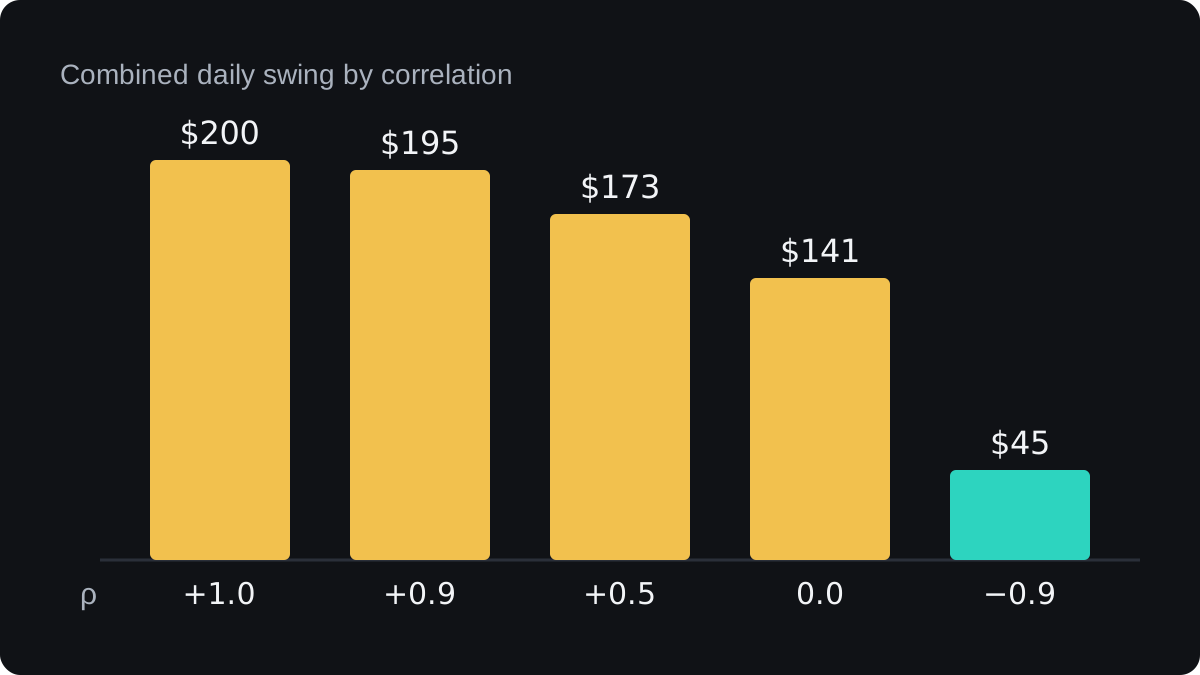
At +0.9 the two trades swing almost as much as one trade of twice the size. At +0.5 they still swing $173, about 87% of the full $200.
Stop losses answer a different question. If both stops are hit, you lose $200 whatever the correlation. A high correlation makes that outcome more likely, and a low one makes it less likely.
How do you count your exposure by currency?
A correlation reading compares pairs two at a time. With several positions open, a quicker check is to add up how much of each currency you are long or short.
Each trade buys the base currency and sells the quote. At 1.10000, 0.20 lot of EUR/USD buys 20,000 euros and sells 20,000 × 1.10000 = 22,000 dollars.
| Position | EUR | GBP | USD |
|---|---|---|---|
| Buy 0.20 lot EUR/USD at 1.10000 | +20,000 | −22,000 | |
| Buy 0.20 lot GBP/USD at 1.30000 | +20,000 | −26,000 | |
| Net | +20,000 | +20,000 | −48,000 |
The net row shows the hidden bet: you are short 48,000 US dollars. Selling 0.20 lot of USD/JPY as well would add 20,000 dollars to that short, taking it to 68,000.
For links that a shared currency does not reveal, the correlation matrix shows how pairs have moved together over recent periods.
Where does correlation let you down?
A correlation figure is measured over a past window, such as the last few weeks or months. It shifts when the reasons behind it change, so last quarter's reading can be wrong today.
Correlations can also jump in stressed markets. In a sharp risk-off move, traders sell risky assets together, and pairs that usually move independently can fall at the same time.
Holding a negatively correlated pair as a hedge has costs. You pay two spreads instead of one, and you may pay swap on both positions each night.
When the correlation weakens, the hedge covers less than you planned, because the offset was a past tendency and nothing guarantees it will continue.
คำถามที่พบบ่อย
Is it wrong to trade two correlated pairs at once?
No. It becomes a problem when you size each trade as if it stood alone, so the combined loss is larger than your plan allows.
How do I work out total risk on correlated trades?
For strongly correlated trades facing the same way, add the stop loss risks together and treat the total as one position. Keep that total inside your risk per trade.
Can USD/CHF hedge a EUR/USD trade?
Buying both has often offset part of the dollar move, because the pairs have tended to move in opposite directions. The offset is never exact, it costs two spreads and possible swap, and it shrinks when the correlation weakens.
What correlation counts as high?
There is no official cut-off. At +0.9, two same-direction trades of equal size swing almost as much as one trade of double size, and at +0.5 they still swing about 87% as much.
How can I use correlation instead of only avoiding it?
Correlation can help you choose between similar trades or check a view across several pairs. The lesson on using correlations in your trading covers those uses and their limits.
เรียนต่อ
 บทที่ 6What is currency correlation?Currency correlation measures how closely two currency pairs move together. It is expressed as a correlation coefficient from -1 to +1. A value near +1 means the pairs tend to move in the same direction, near -1 means they tend to move in opposite directions, and near 0 means there is little linear link.
 บทที่ 6Using correlations in your trading.Correlation helps in three ways. A hedge offsets one position with a correlated pair, such as long EUR/USD and short GBP/USD. Comparing related pairs shows whether a move is about one currency or the dollar. Checking correlation before adding trades stops you stacking the same risk. Each use can fail when the relationship shifts.

