Using correlations in your trading.
Correlation helps in three ways. A hedge offsets one position with a correlated pair, such as long EUR/USD and short GBP/USD. Comparing related pairs shows whether a move is about one currency or the dollar. Checking correlation before adding trades stops you stacking the same risk. Each use can fail when the relationship shifts.
เนื้อหานี้ยังมีเฉพาะภาษาอังกฤษ

Knowing that two pairs tend to move together only matters if it changes a decision. Traders put it to work in three places: softening a position they already hold, working out what is driving a move, and avoiding the same risk taken several times over.
Every coefficient and price in this lesson is illustrative. Real correlations shift with the period you measure, so check them yourself before you act on one.
What a correlation number can and cannot tell you
A correlation coefficient runs from +1 to −1. At +1 the moves of two pairs have lined up perfectly in the same direction, at −1 perfectly in opposite directions, and near 0 there has been no steady link.
The currency correlation lesson explains how the number is measured.
The number describes the past. It summarises a chosen window, such as the last 50 daily closes, and nothing makes the next 50 behave the same way.
It also says nothing about how far each pair moves. Two pairs at +0.90 can rise together while one gains 60 pips and the other 40. That gap matters when you try to hedge.
The correlation matrix shows coefficients across many pairs. Compare a short window with a long one: if they disagree, the relationship is unstable and less useful.
How does a correlation hedge work?
Say you are long 1 lot of EUR/USD at 1.1000. US data is due tonight and you would rather not close the trade.
EUR/USD and GBP/USD have recently shown a correlation of about +0.85, so you sell 1 lot of GBP/USD at 1.3000 as a partial offset. Both pairs are quoted in US dollars, so in a dollar account one pip on one lot is $10 on each.
The data comes out strong and the dollar rises:
- EUR/USD falls to 1.0940. The long loses 1.0940 − 1.1000 = −0.0060, which is 60 pips, or −$600.
- GBP/USD falls to 1.2955. The short gains 1.3000 − 1.2955 = +0.0045, which is 45 pips, or +$450.
- Net result: −$600 + $450 = −$150, against a loss of $600 without the hedge.
The hedge only helps while the pairs keep moving together. Suppose the pound rises on its own news to 1.3020 while EUR/USD still drops to 1.0940.
The short then loses 1.3000 − 1.3020 = −0.0020, which is 20 pips, or −$200. The net loss grows to −$600 − $200 = −$800, worse than having no hedge at all.
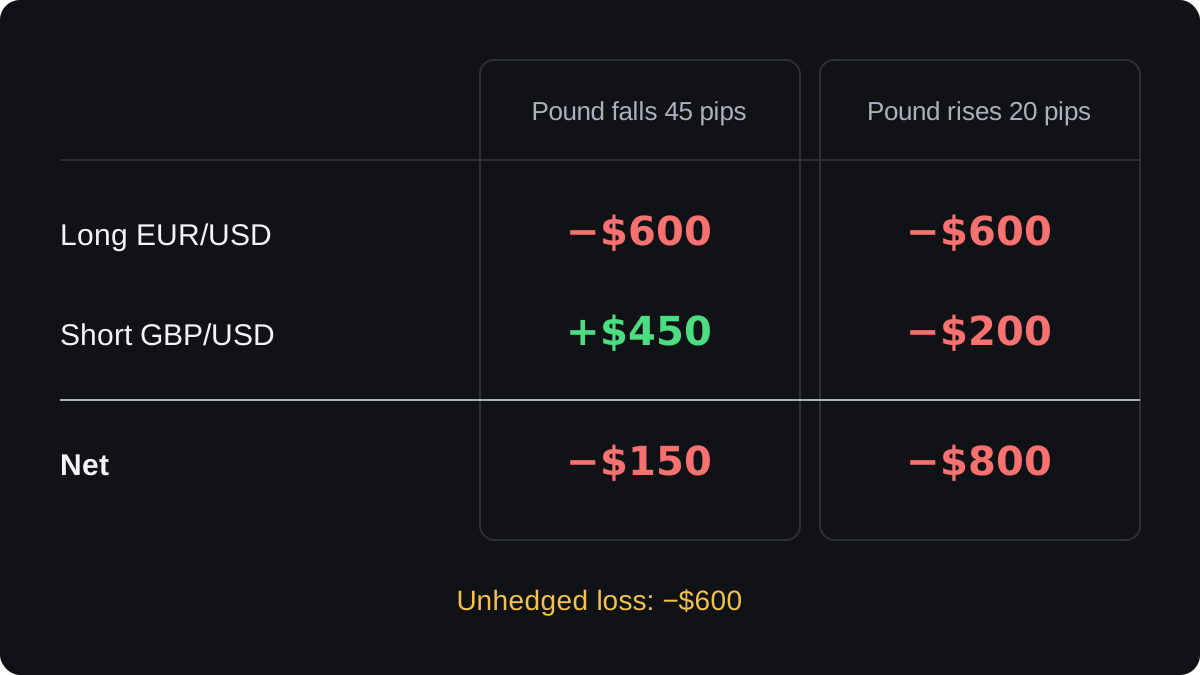
Look at what the two positions hold together. You are long euros and short pounds, and the dollar sides roughly cancel. The hedge has turned a EUR/USD trade into something close to a EUR/GBP trade, with risks of its own.
It also costs more. You pay a spread on both trades and swap on both if you hold them overnight.
You usually need margin on both as well, because brokers generally offset margin only for opposite trades in the same symbol. Your broker's hedging policy sets the details.
A negative correlation works the same way with both trades in the same direction, for example long EUR/USD and long USD/CHF. USD/CHF is quoted in francs, so one pip on one lot is CHF 10.
To match the $10 EUR/USD pip at an illustrative rate of 0.9000, you would trade 0.90 lot of USD/CHF. Its pip is then 0.90 × CHF 10 = CHF 9, and CHF 9 ÷ 0.9000 = $10.00.
The pip value calculator does this conversion for other pairs. Matching pip values is only a start, because the two pairs can still move different distances.
Checking whether a move is about one currency or the dollar
Say EUR/USD climbs 0.45% in an afternoon, about 50 pips from 1.1000. Before you read it as euro strength, look at other pairs that share the US dollar.
If GBP/USD rose 0.40% and AUD/USD 0.50% in the same hours, the move is most likely dollar weakness. If they stayed within about 0.05% of where they started, something specific to the euro is driving it.
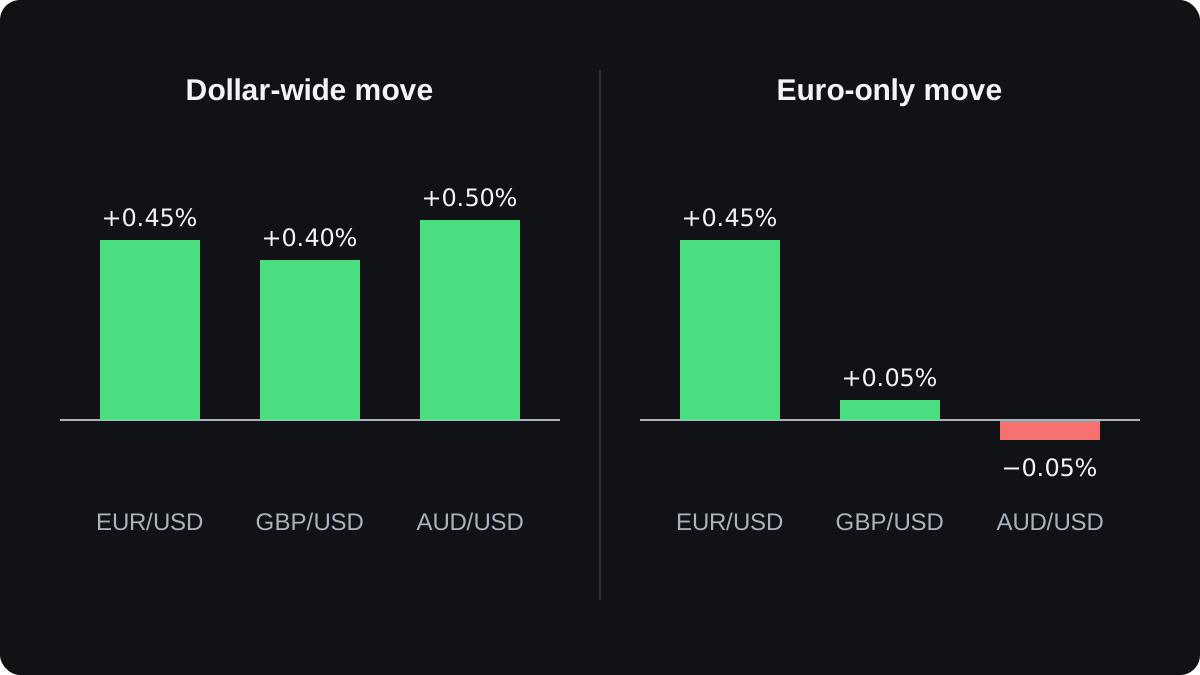
The US dollar index gives a similar answer in one number.
The check tells you which news to watch and which pair expresses your view most directly. If the story is the euro, a cross such as EUR/GBP isolates it better than EUR/USD does.
Be careful about calling it confirmation of a trade. Two pairs at +0.90 are close to the same information seen twice, so their agreement adds little independent evidence.
Public evidence that cross-pair checks improve entry results is thin. Use the check to understand a move; it does not tell you when to enter.
Spreading risk across pairs that move differently
Diversification means holding positions that do not all lose at the same time. Correlation tells you which positions fail that test.
Take a $12,000 account where you risk 1% per trade, which is $120. The risk per trade lesson covers how to choose that figure. You buy EUR/USD, GBP/USD and AUD/USD, each with a stop set to lose $120.
If the dollar rallies across the board, all three stops can be hit in the same session. The loss is 3 × $120 = $360, or 3% of the account, from what was really one idea: a weaker dollar.
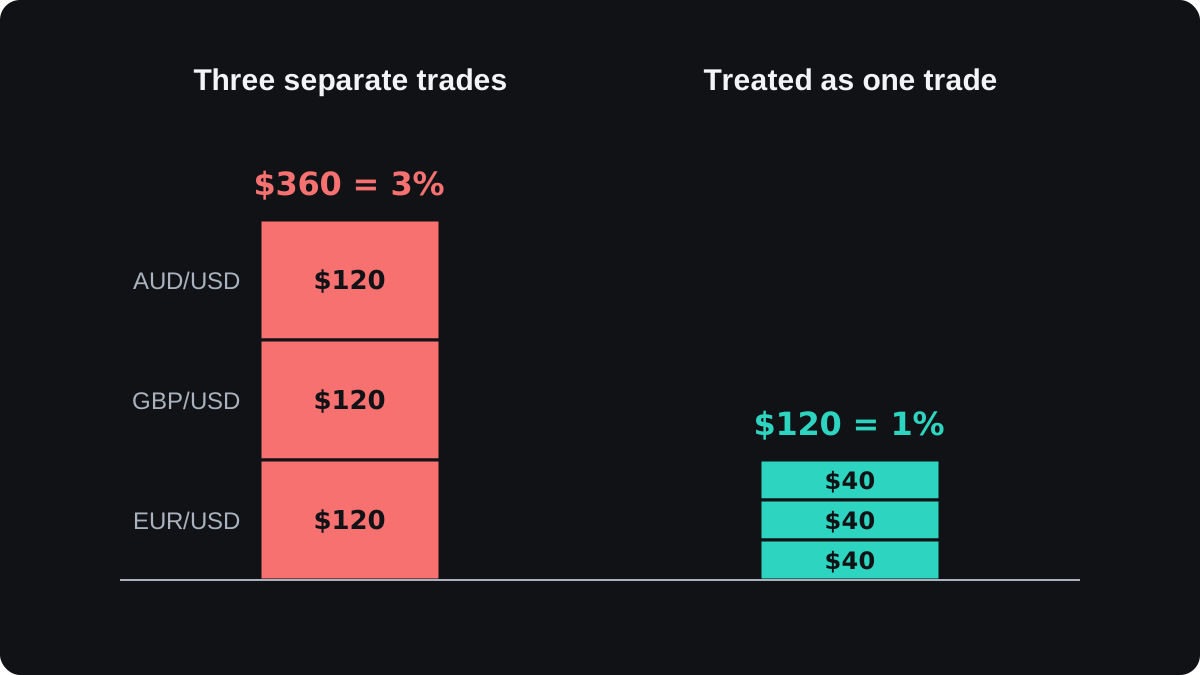
One response is to count highly correlated trades as a single trade and split the risk: $120 ÷ 3 = $40 on each. Another is to choose a second position whose measured correlation with the first is low.
The portfolio risk lesson works through more combinations.
Low correlation in calm markets offers no guarantee. During sudden stress, many currencies tend to move together against the dollar or the yen, and coefficients that sat near 0 can jump.
Where correlation trading goes wrong
Each of these mistakes treats a past relationship as a fixed rule:
- The coefficient drifts. Two pairs that showed +0.80 over a year can sit near 0 over the last month, after a central bank surprise for example.
- The window decides the answer. Hourly data over two weeks and daily data over a year can give opposite readings for the same two pairs.
- Equal lots rarely offset evenly. Correlated pairs move different distances, as the 60 pip and 45 pip moves above showed.
- A shared currency hides overlap. Long EUR/USD and short USD/JPY are both bets against the dollar, even though the pairs look unrelated.
- Divergence bets can widen. Betting that a gap between two normally correlated pairs will close, sometimes called pairs trading, loses when the relationship has really changed.
Measure correlation on the timeframe you trade, and measure it again before each new position.
คำถามที่พบบ่อย
Can I hedge a forex trade with a correlated pair?
Most platforms let you hold positions in two different pairs at once, which is all a cross-pair hedge needs. It only reduces risk while the pairs keep moving together, and you pay spread, swap and usually margin on both.
Which currency pairs are most correlated?
EUR/USD and GBP/USD have often shown strong positive correlation, and EUR/USD and USD/CHF strong negative correlation. The numbers change over time, so check a current correlation matrix.
What correlation counts as strong?
There is no official cut-off. This lesson treats readings above +0.70 or below −0.70 as strong, but whether a reading holds across different windows matters more than the exact figure.
Is it risky to open several trades on correlated pairs?
It repeats the same risk. Trades on pairs that move together can stop out together, so count them as one position when you set your risk.
Does correlation work on shorter timeframes?
Correlation can be measured on any timeframe, but short windows are noisier and change faster. Measure it on the timeframe you actually trade.
เรียนต่อ
 บทที่ 6What is currency correlation?Currency correlation measures how closely two currency pairs move together. It is expressed as a correlation coefficient from -1 to +1. A value near +1 means the pairs tend to move in the same direction, near -1 means they tend to move in opposite directions, and near 0 means there is little linear link.
 บทที่ 6Correlation and portfolio risk.When two currency pairs tend to move together, trades on both add up to one larger bet. Buying EUR/USD and GBP/USD with 1% risk each puts up to 2% at risk on one view of the US dollar. Direction matters too: buying one pair and selling a pair that moves opposite doubles the bet as well.

