What is the US dollar index?
The US dollar index, often called DXY, measures the dollar against a fixed basket of six currencies: the euro, yen, pound, Canadian dollar, Swedish krona and Swiss franc. It started at 100 in March 1973. The euro carries 57.6% of the weight, so the index often moves like EUR/USD turned upside down.

When a news report says the dollar rose today, it rarely names one currency. It usually means the dollar gained on average, and the average most often quoted is the US dollar index, shown on many charts under the ticker DXY.
The index squeezes six exchange rates into one number. One of those six, the euro, carries more than half the weight, and that changes how you should read it.
What does the dollar index measure?
Picture a basket holding fixed shares of six currencies: the euro, yen, British pound, Canadian dollar, Swedish krona and Swiss franc. The index tracks how much of that basket one US dollar buys.
Its starting point is March 1973, around the time the major currencies began to float freely against the dollar. The index was set to 100 at that point.
A reading of 110 means the dollar is about 10% stronger against the basket than in March 1973. A reading of 90 means it is about 10% weaker.
A rising index is therefore a stronger dollar on this measure, and a falling index is a weaker one. The Federal Reserve created the index, and today ICE, the Intercontinental Exchange, calculates it and lists futures on it.
Which currencies are in the basket, and how much does each count?
The euro has a weight of 57.6%. The other five share the remaining 42.4%: yen 13.6%, pound 11.9%, Canadian dollar 9.1%, Swedish krona 4.2% and Swiss franc 3.6%.
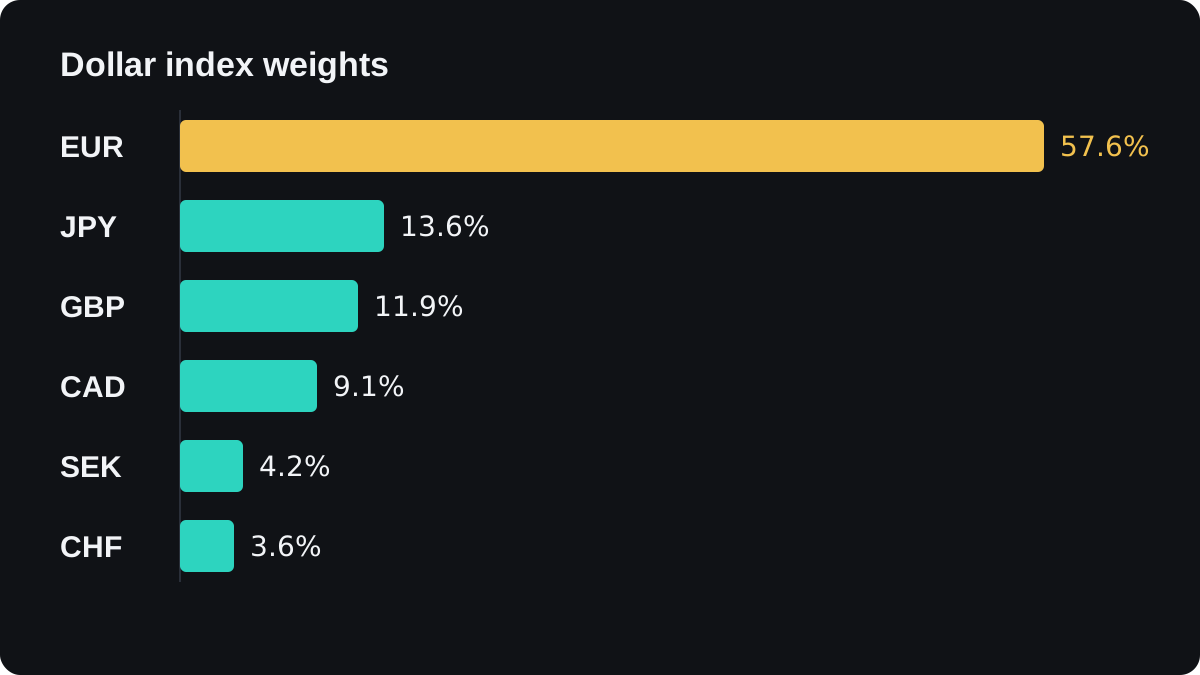
The weights have stayed fixed since 1999. That year the euro replaced five of the ten currencies in the original basket: the German mark, French franc, Italian lira, Dutch guilder and Belgian franc.
Those five had a combined weight of 57.6%, and the euro took it over unchanged. The original weights came from US trade with each country at the time, so the basket still reflects trade patterns from the 1970s.
How is the index calculated?
ICE uses a weighted geometric average of six exchange rates. Your charting platform does the sum for you, but the formula shows which way each pair pushes the index:
``
USDX = 50.14348112 × EURUSD^(−0.576) × USDJPY^(0.136) × GBPUSD^(−0.119) × USDCAD^(0.091) × USDSEK^(0.042) × USDCHF^(0.036)
``
The constant 50.14348112 scales the result so it equalled 100 at the March 1973 rates. Each weight appears as a power, and two of the powers are negative.
The sign depends on where the dollar sits in the pair. In EUR/USD and GBP/USD the dollar is the quote currency, so a falling price means a stronger dollar and a higher index.
In USD/JPY, USD/CAD, USD/SEK and USD/CHF the dollar is the base currency. A rising price there means a stronger dollar, and the index rises with it.
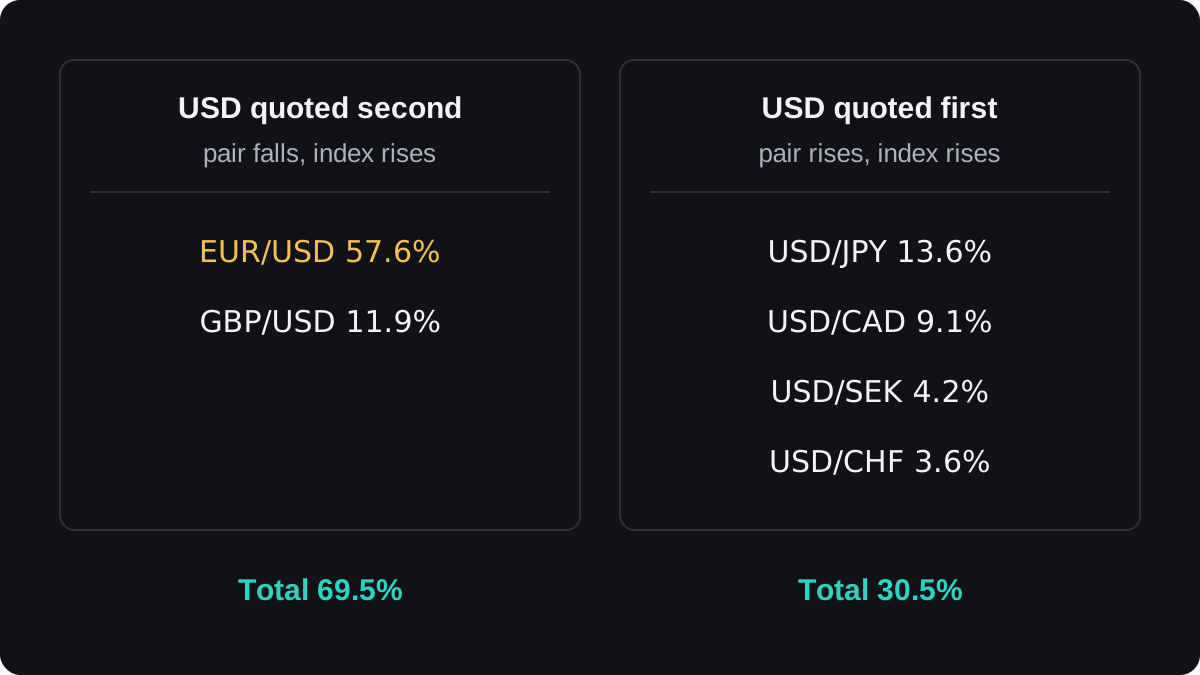
For small moves you can skip the powers. A 1% change in one pair moves the index by roughly that pair's weight times 1%, with the sign from the rule above.
| Pair rises 1% | Approximate index change |
|---|---|
| EUR/USD | −0.576% |
| USD/JPY | +0.136% |
| GBP/USD | −0.119% |
| USD/CAD | +0.091% |
| USD/SEK | +0.042% |
| USD/CHF | +0.036% |
The shortcut drifts a little as moves grow. A full 1% rise in EUR/USD, worked through the formula, lowers the index by about 0.57% rather than 0.576%.
Why does the euro dominate the index?
Each example below starts with the index at 100.00 and uses round, illustrative moves.
- EUR/USD falls 1% and the other five pairs do not move. The index rises about 0.576%, to roughly 100.58.
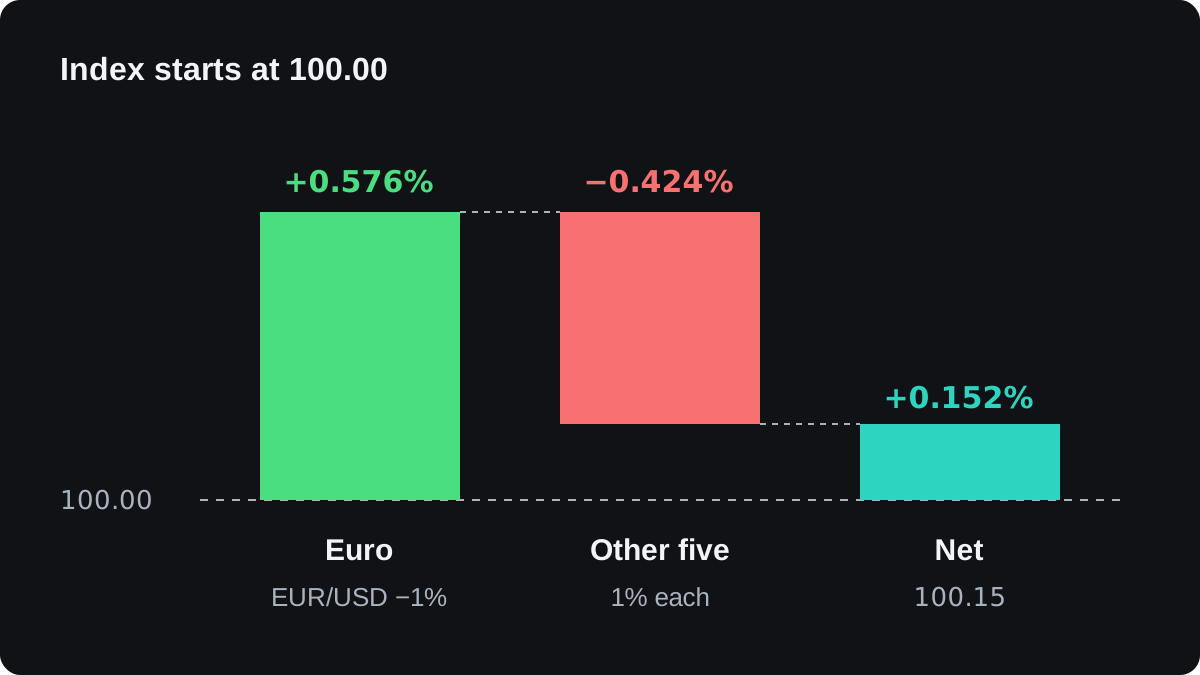
- Now EUR/USD falls 1%, and each of the other five pairs moves 1% in the direction that weakens the dollar. The euro adds about 0.576%, and the other five together take away about 0.424%.
- The net change is 0.576 − 0.424 = +0.152%, so the index ends near 100.15.
The dollar weakened against five of the six currencies, and the index still rose. The euro on its own outweighs the rest of the basket combined.
A mixed day works the same way. Say EUR/USD rises 0.5% and USD/JPY rises 1%, with the other pairs flat.
The euro move gives −0.576 × 0.5 = −0.288%. The yen move gives +0.136 × 1 = +0.136%. Together that is −0.152%, so the index slips from 100.00 to about 99.85.
That happened even though the dollar gained a full 1% against the yen. The euro profile covers what moves the currency that does most of the work here.
Charts of DXY and EUR/USD therefore often look like mirror images. Much of the index is the EUR/USD move turned upside down, a link the currency correlation lesson measures in more detail.
What does the dollar index leave out?
The basket has no Chinese yuan, Mexican peso, South Korean won or Indian rupee. China and Mexico are among the largest trading partners of the United States, yet neither currency counts at all.
The yen is the only Asian currency in the basket. Four European currencies, the euro, pound, krona and franc, hold 57.6 + 11.9 + 4.2 + 3.6 = 77.3% of the weight.
In practice DXY is mostly the dollar against Europe, plus the yen and the Canadian dollar. A big dollar move against emerging market currencies can leave it almost unchanged.
For a wider view, the Federal Reserve publishes trade-weighted dollar indexes with broader baskets and weights it reviews over time. Its own pages explain the current method.
The US dollar profile covers what moves the dollar itself, whichever index you use to measure it.
Can you trade the dollar index?
The index is a calculation, so there is no single thing to buy. ICE lists futures on it, and some retail brokers offer a CFD that tracks it, often named USDX or DXY.
Contract size, value per point, trading hours and swap all differ between brokers. Read the contract specification first, because a CFD follows its broker's own price feed, often based on the futures contract, and can differ from the ICE index figure.
You can also use the index without trading it, as a check on whether a move in your pair comes from the dollar or from the other currency. The next lesson, using the dollar index in your trading, works through that.
Questions
What does DXY mean?
DXY is the ticker widely used on charts for the US dollar index. The futures contract on ICE trades under the code DX.
What is a high or low reading for the dollar index?
There is no fixed good or bad level. The number compares the dollar with its March 1973 value of 100, so 105 means about 5% stronger against this basket and 95 means about 5% weaker.
Why is the euro 57.6% of the dollar index?
The euro inherited the combined weight of the five European currencies it replaced in 1999. The weights have not been changed since.
Does the dollar index include the Chinese yuan?
No. The basket holds only the euro, yen, pound, Canadian dollar, Swedish krona and Swiss franc.
Is the dollar index the same as EUR/USD?
No, but the two are closely linked. The euro is 57.6% of the index and the dollar is the second currency in EUR/USD, so the index often moves like EUR/USD turned upside down.