The US dollar.
The US dollar is on one side of most forex trades because it is the main reserve, trade and funding currency. Its value moves largely on what traders expect from the Federal Reserve, and those expectations shift with US jobs, inflation and growth data. In a global panic it often rises.

Look at almost any forex chart and the US dollar is in it. EUR/USD, USD/JPY and GBP/USD all move when the dollar moves, even when your trade idea was about the euro or the yen.
Knowing what drives the dollar therefore helps with almost every pair you trade, and it shows you when two trades are quietly the same bet.
Why is the dollar on one side of most trades?
The Bank for International Settlements surveys global forex turnover every three years. In its recent surveys the dollar has been on one side of close to 90% of all trades.
Part of the reason is history. After the Second World War, the Bretton Woods system tied other major currencies to the dollar and the dollar to gold. That gold link ended in 1971, yet the dollar kept its central role.
Several habits keep it there today:
- Central banks hold more of their foreign reserves in dollars than in any other currency. The IMF publishes the shares in its COFER data, where the dollar has long held more than half of the total.
- Oil benchmarks such as Brent and WTI are quoted in dollars, and much world trade is invoiced in dollars.
- Banks and companies outside the US borrow heavily in dollars, so they need dollars to repay.
- US Treasury bonds form a very large, liquid market where investors can park money.
Smaller currencies often trade through the dollar. A bank swapping Thai baht for Mexican pesos may sell baht for dollars, then dollars for pesos, because those two busy markets can be cheaper than one thin direct trade.
How does a dollar move show up on your chart?
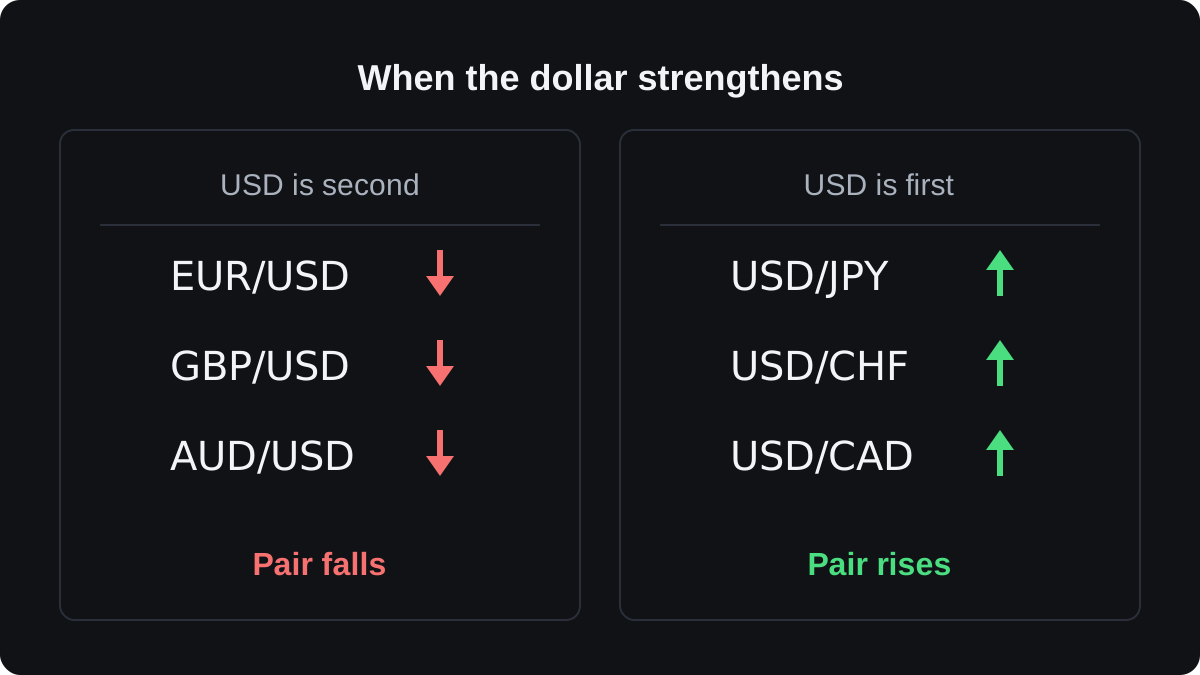
The dollar sits in a different place depending on the pair. In EUR/USD, GBP/USD, AUD/USD and NZD/USD it is the quote currency, the second name. In USD/JPY, USD/CHF and USD/CAD it is the base currency, the first name.
So a stronger dollar pushes the first group down and the second group up. When the dollar weakens, both directions flip.
Traders who want one number for the dollar's overall strength use the US dollar index.
The index measures the dollar against six currencies: the euro, yen, pound, Canadian dollar, Swedish krona and Swiss franc. The euro carries by far the largest weight, so the index moves a lot like an inverted EUR/USD.
What does the Federal Reserve do to the dollar?
The Federal Reserve, or Fed, is the central bank of the United States. Congress has given it two main goals: maximum employment and stable prices.
The Fed's target for stable prices is inflation of 2% a year. It measures inflation with the price index for personal consumption expenditures, usually shortened to PCE.
Its main tool is the federal funds rate, the rate banks charge each other for overnight loans. The Federal Open Market Committee (FOMC) sets a target range for it at eight scheduled meetings a year.
Rates matter to currencies because money tends to flow toward higher returns. Suppose, as a round illustration, US short-term rates are 4% and Japanese rates are 0.5%. Holding dollars instead of yen earns 3.5 percentage points more interest a year.
If traders then start to expect the Fed to cut to 3%, the gap shrinks to 2.5 points. Part of the reason to hold dollars fades, and USD/JPY tends to fall, often before the Fed actually moves.
The dollar reacts to changes in expected rates. A hike that everyone saw coming can leave the dollar flat, or even lower, because the price had already moved. The interest rates lesson covers this in more depth.
The Fed can also move the dollar without changing rates. Four times a year it publishes economic projections, including the dot plot of where each official expects rates to go. Speeches by the Fed chair can move the dollar too.
Which US data releases move the dollar?
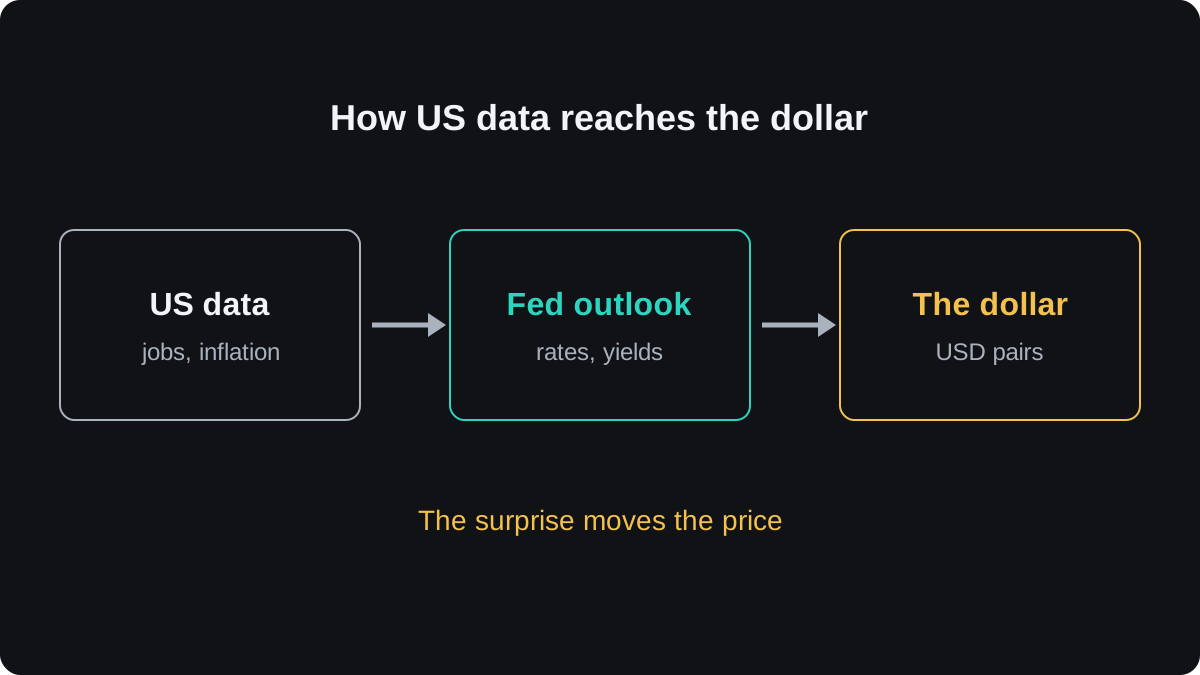
Data move the dollar because they change what traders expect the Fed to do. A strong jobs report or a hot inflation figure makes cuts less likely, US Treasury yields tend to rise, and the dollar often follows.
These are the releases most dollar traders watch:
| Release | Published by | How often | What it measures |
|---|---|---|---|
| Employment report (nonfarm payrolls) | Bureau of Labor Statistics | Monthly | Jobs added, unemployment rate, wages |
| Consumer price index (CPI) | Bureau of Labor Statistics | Monthly | Prices paid by consumers |
| PCE price index | Bureau of Economic Analysis | Monthly | The inflation measure the Fed targets |
| Gross domestic product (GDP) | Bureau of Economic Analysis | Quarterly | Growth of the whole economy |
| Retail sales | Census Bureau | Monthly | Consumer spending in shops and online |
| ISM purchasing managers indexes | Institute for Supply Management | Monthly | Surveys of business activity |
| FOMC rate decision | Federal Reserve | Eight times a year | The interest rate target |
Price reacts to the gap between the actual figure and the forecast. Take illustrative numbers: economists expect 150,000 new jobs and the report shows 250,000. That surprise of 100,000 jobs can lift the dollar quickly.
Had the forecast been 250,000, the same report might barely move it. The expectations lesson works through more cases.
Most of these releases come out at 8:30 New York time on dates fixed in advance. An economic calendar lists each one with its forecast and previous value.
Spreads can widen and prices can jump in the seconds after a big number.
Why does the dollar often rise in a crisis?
When markets panic, the dollar often gains even if the trouble starts elsewhere. Investors sell riskier assets and move into dollars and Treasuries, while borrowers around the world scramble for dollars to repay dollar debts.
An asset that investors run to in a scare is called a safe haven. The dollar rose against most currencies during the 2008 financial crisis and the market panic of March 2020. The risk-on, risk-off lesson explains the wider pattern.
This is a tendency with clear limits. The yen and the Swiss franc can rise more than the dollar in a scare.
A shock that starts in the US, or a Fed that cuts rates fast, can push the dollar down instead.
How can two trades turn into one dollar bet?
Because the dollar is in so many pairs, two trades that feel different can carry the same risk. The prices below are round and illustrative.
You expect the euro to rise, so you buy 0.10 lot of EUR/USD at 1.10000. You also expect the yen to rise, so you sell 0.10 lot of USD/JPY at 150.00.
Then a strong US jobs report lifts the dollar against both.
- EUR/USD: a pip is 0.0001, and 0.10 lot is 10,000 euros, so one pip is 10,000 × 0.0001 = $1.00.
- EUR/USD falls to 1.09400. The move is 1.10000 minus 1.09400 = 0.00600, or 60 pips, so the loss is 60 × $1.00 = $60.00.
- USD/JPY: a pip is 0.01, and 0.10 lot is 10,000 dollars, so one pip is 10,000 × 0.01 = ¥100.
- USD/JPY rises to 150.90. The move is 150.90 minus 150.00 = 0.90, or 90 pips, so the loss is 90 × ¥100 = ¥9,000.
- Converted at 150.90 yen per dollar, ¥9,000 ÷ 150.90 = $59.64.
- The total loss is $60.00 + $59.64 = $119.64.
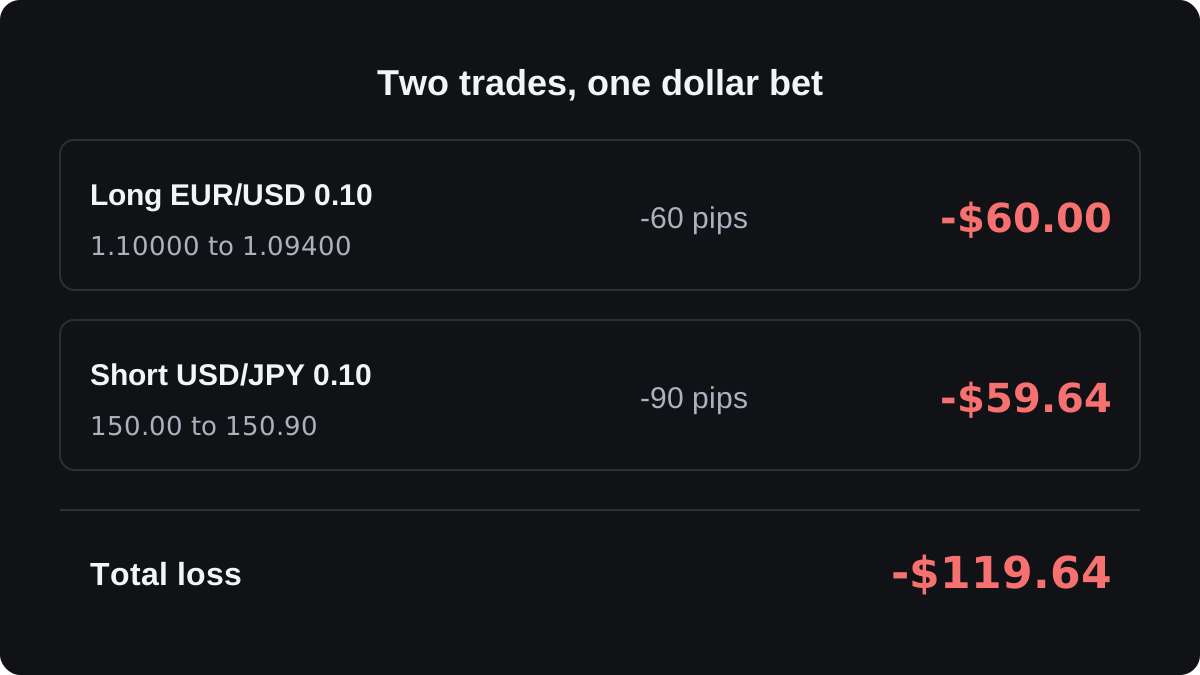
Both trades were short the dollar, so one piece of news hit both. You held roughly twice the dollar exposure you may have intended.
The currency correlation lesson shows how to check this overlap before opening a second trade.
Questions
Why is the US dollar called the world's reserve currency?
Central banks hold more of their foreign reserves in dollars than in any other currency, and much global trade, borrowing and commodity pricing uses dollars. The IMF's COFER data show the current shares.
What time does the US jobs report come out?
The employment report from the Bureau of Labor Statistics usually comes out on the first Friday of the month at 8:30 New York time. Check an economic calendar, because holidays and other events can shift the date.
Does a Fed rate hike always make the dollar stronger?
No. If traders expected the hike, the price usually moved beforehand. The dollar reacts most to surprises and to hints about future rates.
Which pairs rise when the dollar strengthens?
Pairs with the dollar first, such as USD/JPY, USD/CHF and USD/CAD, rise. Pairs with the dollar second, such as EUR/USD and GBP/USD, fall.
Is the US dollar always a safe haven?
It often rises in global panics, but not every time. The yen and Swiss franc can do better, and a shock that starts in the US can weaken the dollar.
Keep learning
 Chapter 4The euro.The euro is the shared currency of 21 European Union countries, managed by the European Central Bank in Frankfurt. The ECB sets one interest rate for economies that can need different ones, aiming for 2% inflation across the whole area. EUR/USD, the euro against the US dollar, is the world's most traded currency pair.
 Chapter 4The Japanese yen.The Japanese yen is shaped by decades of very low interest rates set by the Bank of Japan, which made it a popular funding currency for carry trades. It often rises when markets panic, though not always. Japan's Ministry of Finance sometimes intervenes, and on yen pairs a pip is 0.01.
 Chapter 4The British pound.The British pound, or sterling (GBP), moves mainly on Bank of England interest rate expectations and on data from a services-heavy UK economy. GBP/USD, nicknamed cable, is one of the most traded pairs. The pound has often swung further in a day than the euro, so a trade on it may need a wider stop and a smaller position.
 Chapter 4The Australian, Canadian and New Zealand dollars.The Australian, Canadian and New Zealand dollars are called commodity currencies because their countries export large amounts of raw materials. The Aussie tends to follow metals and Chinese demand, the loonie oil and the US economy, and the kiwi dairy prices. Interest rates and global risk appetite also move all three, and can outweigh commodities.
 Chapter 4The Swiss franc.The Swiss franc (CHF) is the currency of Switzerland, a small economy with a currency that investors often buy in times of stress. That safe-haven demand can push the franc too high, so the Swiss National Bank has fought it with negative rates and currency intervention, including a 1.20 floor on EUR/CHF that it dropped without warning in 2015.

