Sticking to your plan.
Sticking to your plan means following rules you wrote before the trade, even when a trade goes wrong. A short pre-trade checklist, a fixed risk per trade, stops you never widen and a daily loss limit turn the plan into habits. A journal then shows where you broke a rule and what it cost.
เนื้อหานี้ยังมีเฉพาะภาษาอังกฤษ

A plan is easy to follow while a trade is going your way. The real test comes when price moves against you, your stop is close, and moving it a little further feels harmless.
This lesson turns the plan from what goes into a trading plan into checks and rules you can follow under that pressure. All numbers here are round and illustrative.
Why a plan breaks during a losing trade
You write a plan when the market is closed and nothing is at stake. You follow it with money moving on the screen, which is a very different state of mind.
A losing trade invites tempting moves. You can widen the stop, add to the position to improve your average price, or close early and jump straight into a new trade to win the money back.
Each of these replaces a written rule with a decision made in the moment. The fix is to make as few decisions as possible while a trade is open, and to make them before it opens.
A checklist to run before every trade
A pre-trade checklist is a short list of yes or no questions you answer before you click buy or sell. If any answer is no, you skip the trade.
Keep it short enough to finish in about a minute. Five questions is plenty, and each one should come straight from your written plan. Here is an example:
- Does the setup match an entry rule in my plan?
- Is the stop loss level chosen and set in the order before entry?
- Is the risk 1% of the account or less?
- Is the economic calendar clear of the high impact releases my plan tells me to avoid?
- Am I still inside my daily loss limit?
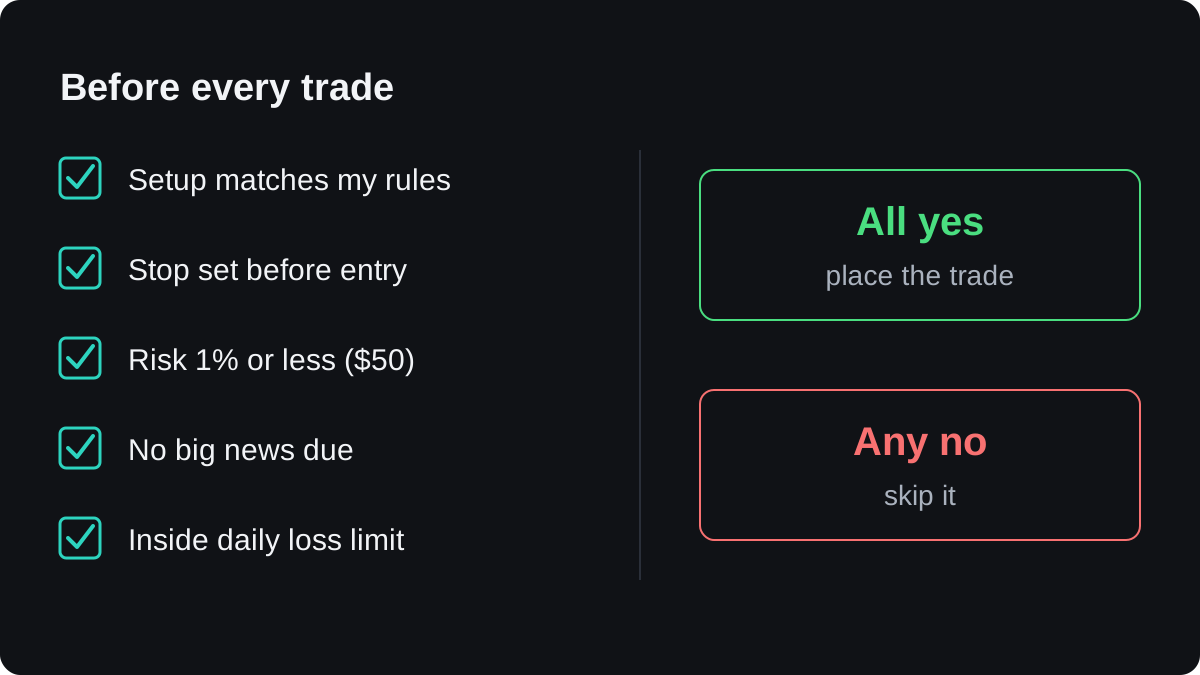
Yes or no questions leave little room for argument. "Does this feel right?" is a poor item, because the answer depends on your mood that day.
What to do when a trade moves against you
Write your rules for a losing trade as if-then sentences, so nothing is left to decide while the position is open:
- If price moves toward my stop, then the stop stays where it is.
- If a trade is losing, then I do not add to it.
- If my stop is hit, then I wait 15 minutes and run the checklist again before any new trade.
Here is what one broken rule can cost. Your account holds $5,000 in US dollars and your plan risks 1% per trade, which is $50.
- You buy EUR/USD at 1.10000 with a stop at 1.09750. The distance is 0.00250, or 25 pips.
- To risk $50 over 25 pips, each pip must be worth $50 ÷ 25 = $2. One standard lot of EUR/USD is worth $10 a pip in a US dollar account, so you trade 0.20 lot.
- If the stop is hit, you lose 25 × $2 = $50, which is 1% of the account.
- Say you move the stop to 1.09500 instead, and price reaches it. That is 50 pips, so the loss is 50 × $2 = $100, or 2%.
- Say you delete the stop and finally close at 1.09000. That is 100 pips, so the loss is 100 × $2 = $200, or 4%.
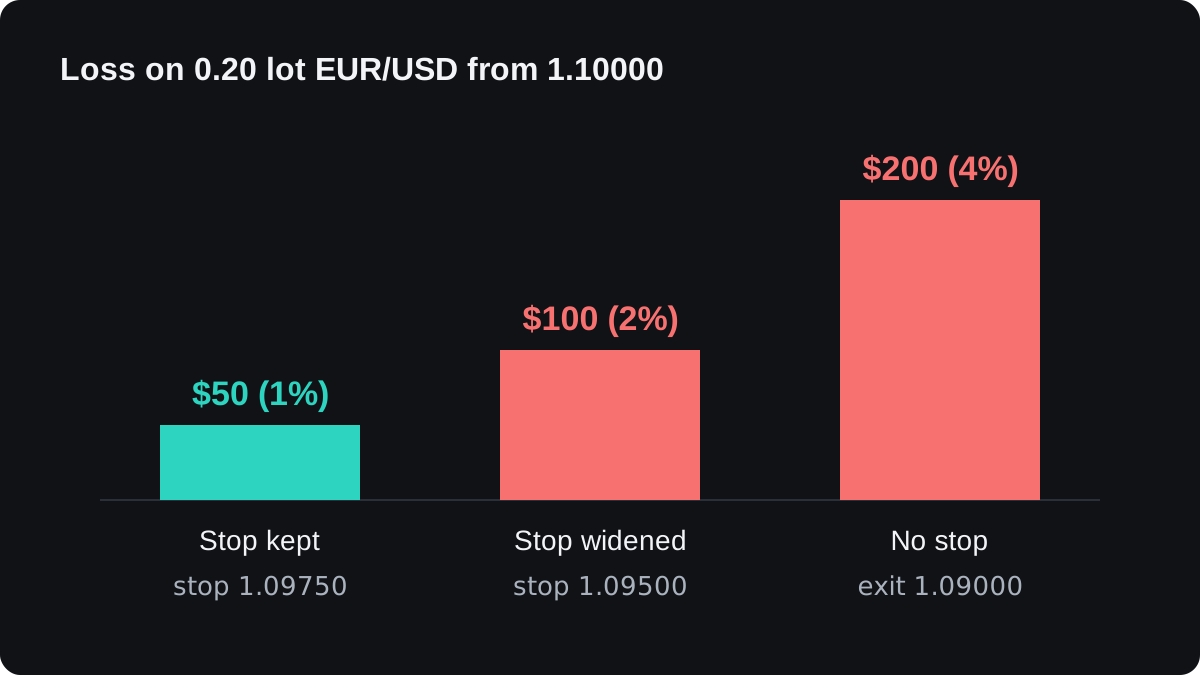
Widening the stop raised the stake after the position was already sized. Your position size was built for 25 pips, so every pip beyond that is risk you never agreed to.
You can check the sizing with the lot size calculator. A 4% loss also needs more than 4% to repair: from $4,800, earning back $200 takes 200 ÷ 4,800 = 4.17%.
The drawdown lesson shows how that gap grows with bigger losses. Moving a stop closer to lock in profit is a separate rule, and your plan should say in advance whether you do it.
A daily loss limit that ends the session
A loss limit caps how much you can lose in one day or one week, however good the next setup looks. When you reach it, you close the platform until the next session.
With the same $5,000 account, a daily limit of 3% is $150. At 1% risk per trade, that is three full losses in a row.
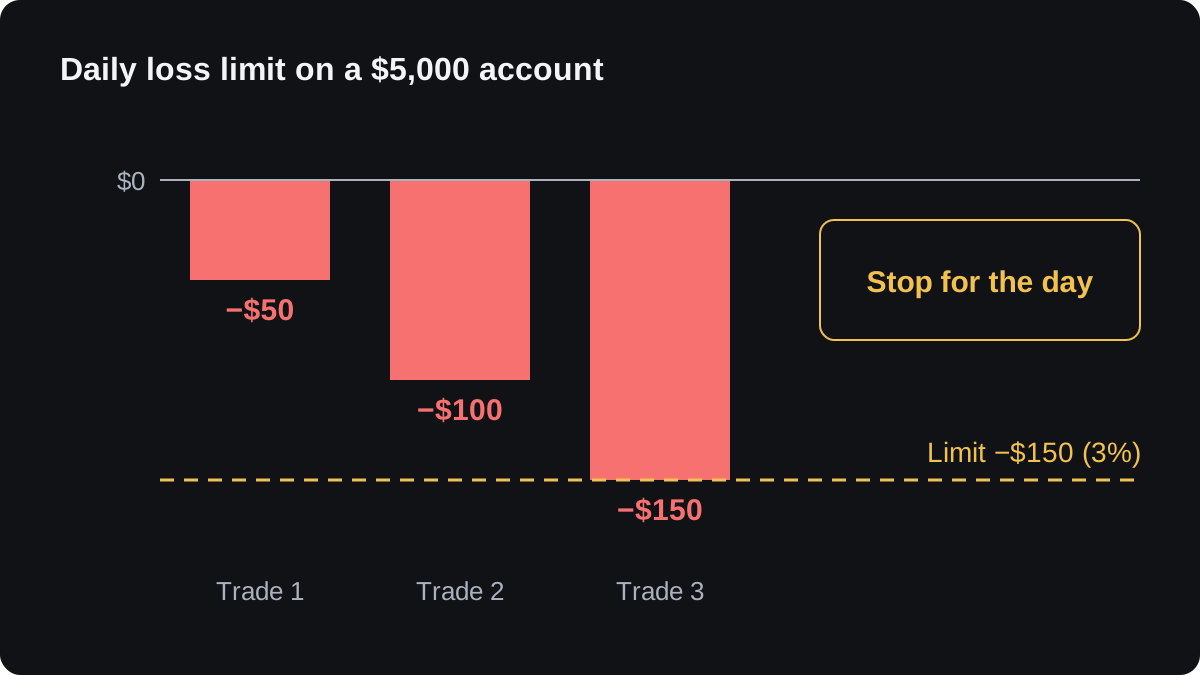
The limit does its job after a run of losses, when wanting the money back can push you into extra trades. A weekly limit, such as 6% or $300 in this example, catches a slow leak that a daily limit can miss.
Choose these numbers when you write the plan, so that a bad week still leaves the account able to trade. The risk per trade lesson covers how to pick the figure for each trade.
Measuring how well you follow the plan
Your results mix two things: the quality of your rules and how well you obey them. A journal lets you separate the two.
Add one column to your trading journal: did I follow every rule, yes or no? When the answer is no, write down which rule you broke.
Every 20 trades, count the yes answers. If 17 of 20 trades followed every rule, your rule-following score is 17 ÷ 20 = 85%.
Then compare the two groups. Say the 17 rule-following trades lost $40 in total and the 3 broken trades lost $260. In this illustration, most of the damage came from the broken rules.
A sample of 20 trades is small. Use the score to spot habits, and wait for many more trades before you judge the strategy itself.
When you are allowed to change the plan
Plans need updates as you learn, and the timing matters. Change rules only between sessions, with your platform closed, and never while a position is open.
Base each change on your journal instead of on the last trade. One painful loss is a single result, while a pattern across dozens of trades is evidence you can act on.
Change one rule at a time and write the date next to it, so you can tell which change made a difference. Try a new rule on a demo account or at a smaller size first.
คำถามที่พบบ่อย
Why can't I stick to my trading plan?
Often the plan leaves decisions for the moment, or its rules are vague. Turn each rule into a yes or no check you answer before the trade, and keep open-trade rules simple, such as never moving the stop further away.
Should I ever move my stop loss?
Moving it further from your entry increases the risk the position was sized for. Moving it closer to lock in profit is a separate choice, and your plan should say in advance whether and when you do it.
What is a good daily loss limit?
There is no standard figure. This lesson uses 3% as an illustration, equal to three losses at 1% each; pick a number that leaves your account able to keep trading after your worst week.
What should I do after breaking a rule?
Stop trading for the session and record the trade in your journal, with the rule you broke and what it cost compared with following it. Then, with the market closed, decide whether the rule or your process needs to change.
How long should a pre-trade checklist be?
Short enough to finish in about a minute. Five yes or no questions taken from your plan is a practical size.
เรียนต่อ
 บทที่ 1Why you need a trading plan.A trading plan is a written set of rules for what you trade, how much you risk and when you exit, decided before you open a position. It protects you from impulsive trades made under pressure, such as chasing a move or moving a stop, by capping what any single trade or day can cost.
 บทที่ 1What goes into a trading plan?A trading plan is a set of written rules you decide before you trade. It covers your goals, the markets and hours you trade, the exact setups that let you enter, your exits, your risk limits per trade, day and week, and the daily routine and review that keep you following it.

