What is a node?
A node is a computer that runs a blockchain's software and is connected to its network. A full node keeps its own copy of the chain, checks every new transaction and block against the rules, and passes valid ones to other nodes. Wallets ask nodes for balances, and miners and validators are nodes with an extra job.
Nội dung này hiện chỉ có bản tiếng Anh.
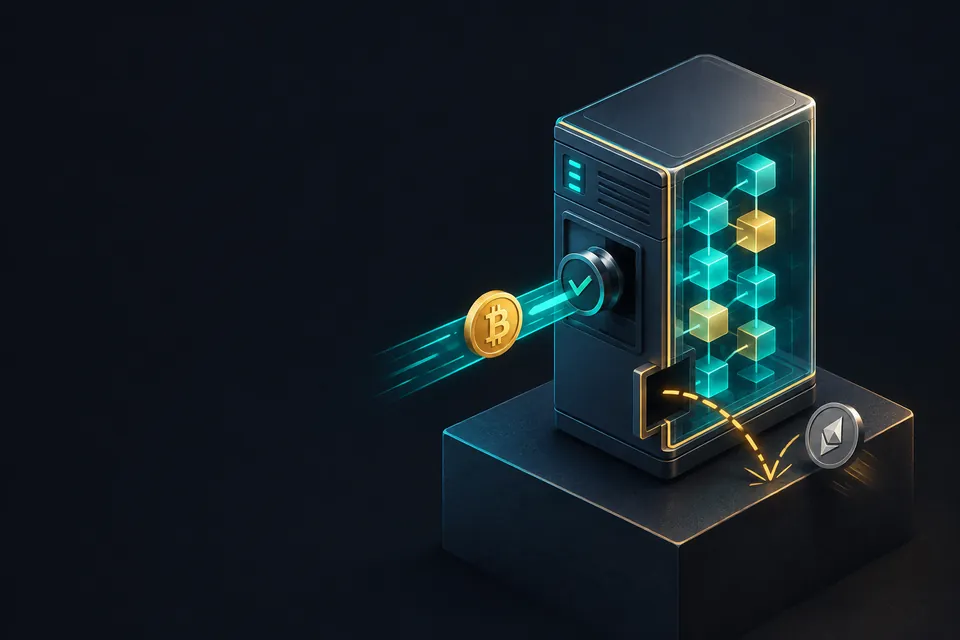
Your wallet app shows a balance of 0.25 BTC. To get that number, the app asked a node.
A node is a computer that keeps a copy of the Bitcoin blockchain. From that copy it can work out which coins your addresses control.
What a node does
A node is any computer that runs a blockchain's software and connects to its network. It can be a laptop, a small home server or a rented machine in a data centre.
A full node stores the chain and checks every new transaction and block against the network's rules. It then passes the valid ones on to its peers. Together, the nodes make up the blockchain network.
A node does not hold your coins or your keys. The coins are entries on the chain, and the keys live in your wallet. A node only keeps and checks the record.
The reference node software for Bitcoin is called Bitcoin Core. On Ethereum, a node runs two programs side by side: an execution client that processes transactions and a consensus client that follows proof of stake.
What a node checks: a worked example
Say a node receives this Bitcoin transaction, with round numbers for illustration. It spends one input of 0.50 BTC. It sends 0.30 BTC to a friend and 0.19 BTC back to the sender as change.
The node runs its checks:
- Does the 0.50 BTC input exist on the chain, and is it still unspent? Yes.
- Does the signature match the key that controls that input? Yes.
- Are the outputs no larger than the input? 0.30 + 0.19 = 0.49, which is less than 0.50. Yes.
- The gap, 0.50 minus 0.49 = 0.01 BTC, is the fee. It goes to whichever miner includes the transaction in a block.
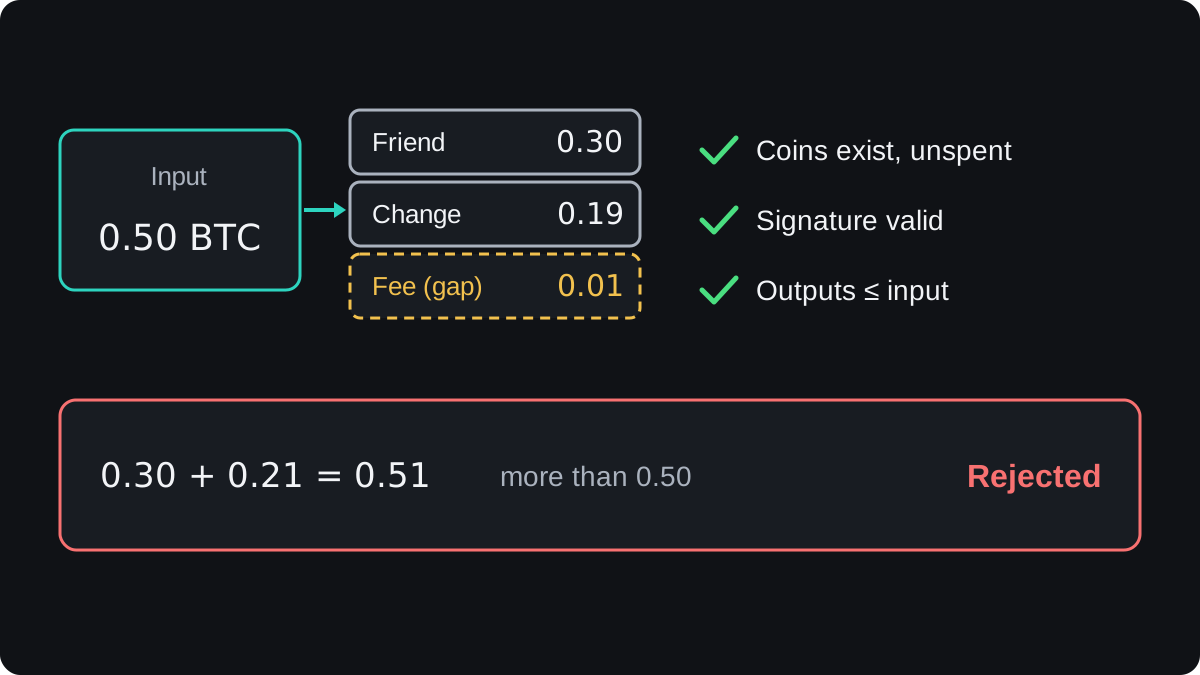
Now suppose the outputs were 0.30 + 0.21 = 0.51 BTC. The transaction would create 0.01 BTC from nothing. Every honest node rejects it and refuses to pass it on.
The full set of rules is in how a Bitcoin transaction works.
Types of node
Nodes differ in how much of the chain they keep and how much they check for themselves.
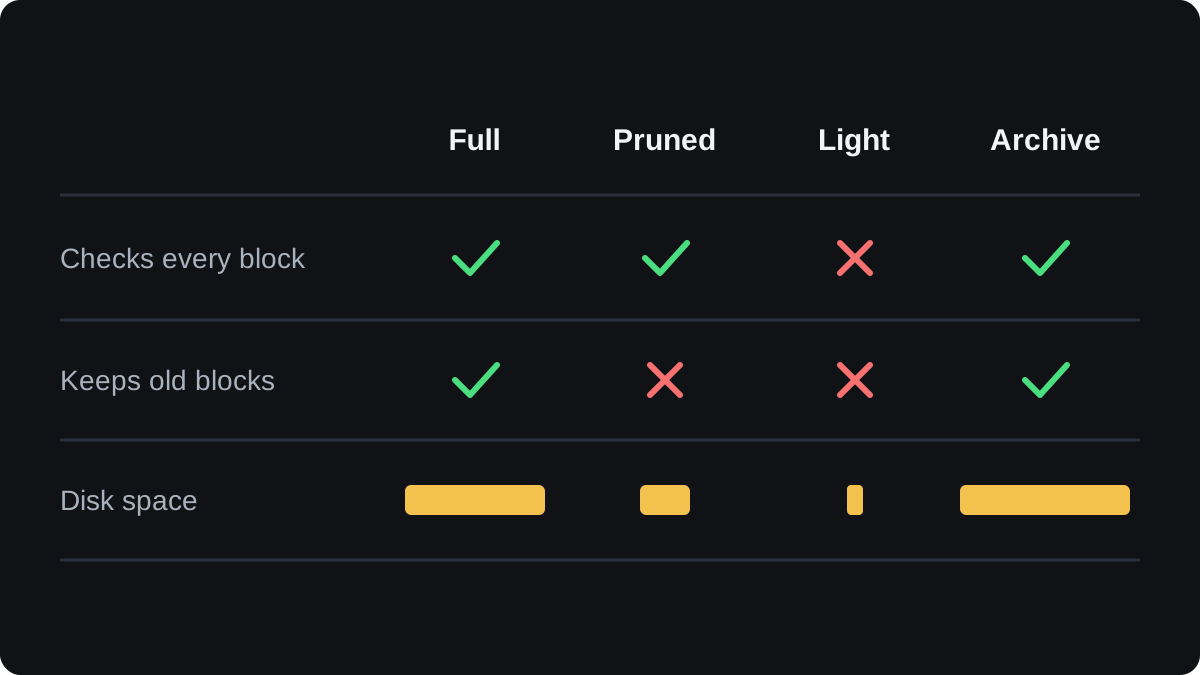
- A full node downloads every block and checks every rule.
- A pruned node also checks every rule, then deletes old block data it no longer needs. It keeps the current list of unspent coins and the recent blocks, so it needs far less disk space.
- A light client downloads only block headers and asks full nodes for the rest. It checks less and trusts more.
- An archive node, mostly an Ethereum term, keeps every past state of every account. Block explorers and data services use them to answer questions about history.
Miners and validators are nodes too
On Bitcoin, a mining pool or solo miner runs a full node beside its machines. That is how it knows which payments are valid and which block is newest. The mining lesson explains the rest.
On Ethereum, validators run an extra program on top of a node. Each validator is backed by a deposit, which lets it propose and vote on blocks. As of 2026, the protocol's minimum deposit is 32 ETH.
Breaking the rules can cost part of that deposit, as the staking lesson explains.
Most nodes produce nothing. A plain full node earns no reward at all, and people run one to check the chain for themselves.
Whose node does your wallet trust?
Most wallet apps connect to nodes run by the wallet company or a hired provider. That is convenient. It also means that node sees which addresses you ask about, and you rely on its answers being correct.
If you run your own node and point your wallet at it, your wallet asks your node instead. Your node checks every rule itself and tells nobody which addresses are yours.
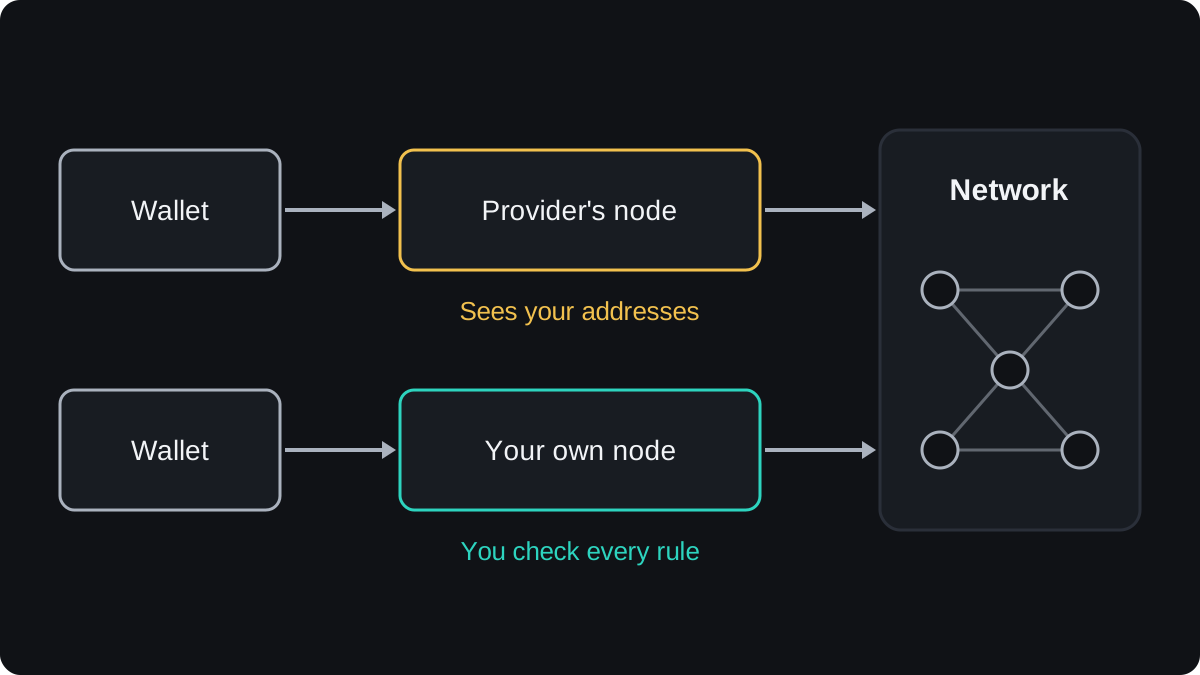
The default setup is simpler. Your own node adds privacy and independence, at the cost of some hardware and setup time.
What running a node takes
A Bitcoin full node runs on an ordinary computer with an always-on internet connection. The full chain needs a large drive and grows with every block, so check the node software's current requirements before you buy hardware.
The first download and check of every block, called the initial sync, is the slow part. How long it takes depends mostly on your disk, memory and connection.
A pruned node cuts the disk space to a small fraction of the full chain and still checks everything. Some people run one on a small single-board computer at home.
An Ethereum node usually needs more: two programs, a fast solid-state drive and more memory. A light wallet on your phone needs none of this, because it relies on a full node's work.
Câu hỏi thường gặp
Does running a node earn money?
A plain full node earns nothing. Only nodes that produce blocks, such as miners and validators, are paid, and they take on extra costs and risks to do so.
Is a node the same as a wallet?
No. A wallet holds your keys and signs transactions. A node keeps and checks the chain, and a wallet asks a node for balances and sends transactions through it.
How many Bitcoin nodes are there?
Nobody knows exactly, because nodes do not register anywhere. Public counters only see nodes that accept incoming connections, and many nodes do not.
Do I need to run a node to use crypto?
No. Most wallets connect to someone else's node for you. Running your own is optional and gives you more privacy and independence.
Học tiếp
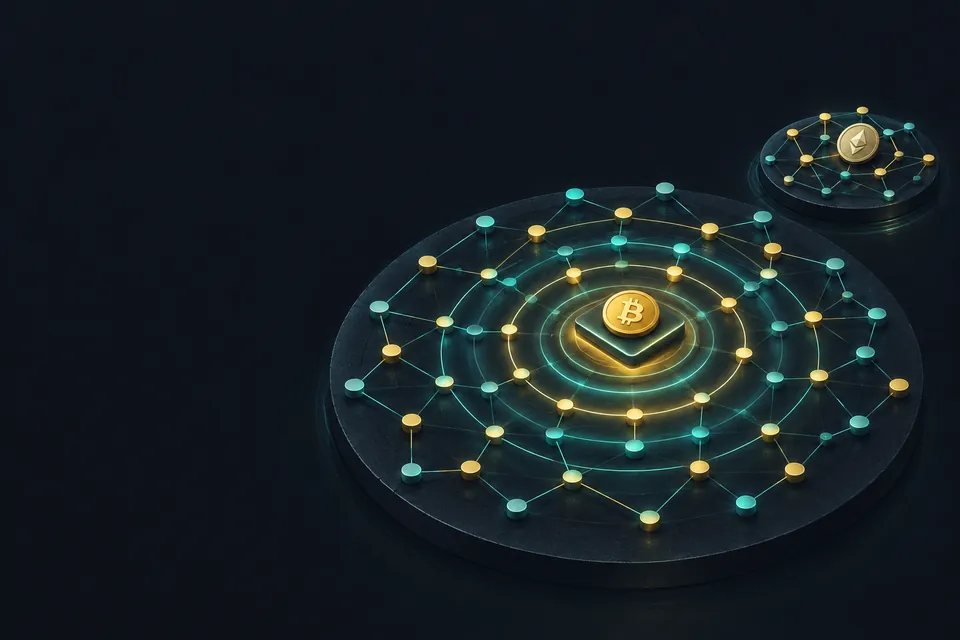 Chương 2What is a blockchain network?A blockchain network is the group of computers that run the same software, follow the same rules and keep the same copy of a blockchain. They pass transactions and blocks to each other directly, with no central server. Each network is separate, so coins sent on one network do not appear on another.
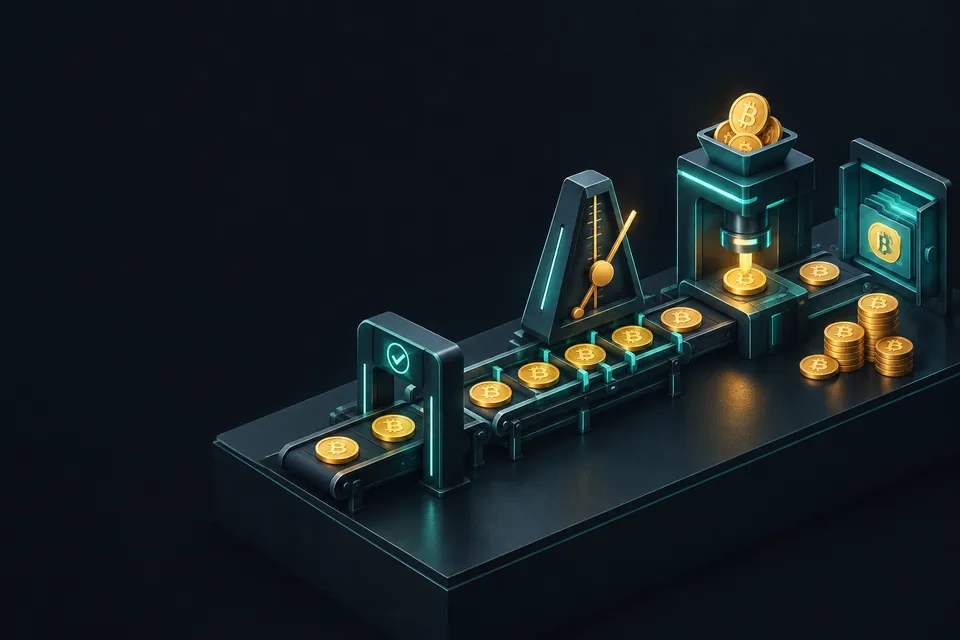 Chương 2What does the Bitcoin network do?The Bitcoin network checks every payment against shared rules, puts valid payments in order inside a new block about every 10 minutes, adjusts how hard mining is so that pace holds, and releases new bitcoin on a fixed, shrinking schedule. No company runs it, and it does not set the price, know who you are or reverse payments.

