What is a spot ether ETF?
A spot ether ETF is a fund that holds ether (ETH), the coin of the Ethereum network, with a custodian, and whose shares trade on a stock exchange. It works like a spot Bitcoin ETF. The main difference is staking: some funds lock part of their ether to earn network rewards, and others do not.
Nội dung này hiện chỉ có bản tiếng Anh.

Say a fund holds 10,000 ETH for its shareholders. Left in storage, that ether earns nothing, while locked into Ethereum's staking system it would earn a stream of new ether.
Whether the fund stakes is the biggest thing that sets a spot ether ETF apart from a Bitcoin fund.
What a spot ether ETF is
A spot ether ETF is an exchange-traded fund that holds ether, the native coin of Ethereum. Its shares trade on a stock exchange, and each share stands for a fixed amount of ether, minus fees.
It runs on the same machinery as a spot Bitcoin ETF. A custodian keeps the private keys, and large trading firms called authorized participants create and redeem shares to keep the price close to the value of the ether.
In the US, the first spot ether ETFs began trading in July 2024, about six months after the first spot Bitcoin funds. Canada had listed them in 2021.
Fees and trading hours work as they do for Bitcoin funds. The fund sells a little ether to pay its yearly fee, and its shares trade only in stock exchange hours, while ether itself trades nonstop.
Staking: what Bitcoin funds do not have
Since 2022, Ethereum has used proof of stake. Validators lock up ether as a deposit and take turns adding blocks, and the network pays them rewards in new ether.
Locking ether this way is called staking, and the lesson on proof of work vs proof of stake compares it with Bitcoin's mining.
Staking carries risks of its own. A validator that breaks the network's rules can lose part of its deposit, and leaving staking means joining an exit queue that can take days, or weeks when many validators leave at once.
A fund that stakes can pass the rewards on to shareholders, after keeping a share as its fee. A fund that does not stake gives up the reward, while its holders still pay the yearly fee.
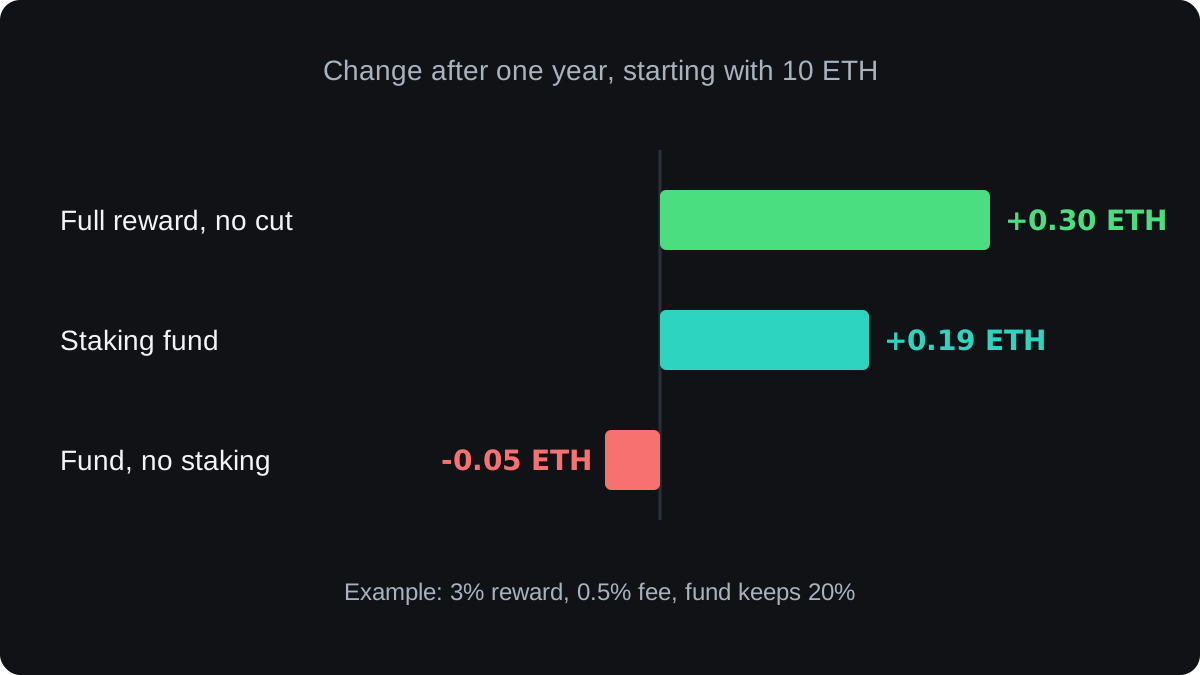
Here is one year from 10 ETH, ignoring compounding and price moves. The rates are round numbers for illustration: a 3% reward, a 0.5% yearly fee, and a staking fund that keeps 20% of rewards.
- Full reward, with nobody taking a cut: 10 × 3% = 0.30 ETH. You would end with 10.30 ETH.
- Staking fund: the 0.30 ETH reward minus the fund's 20% cut of 0.06 leaves 0.24. The fee is 10 × 0.5% = 0.05. You end with 10 plus 0.24 minus 0.05 = 10.19 ETH.
- Fund that does not stake: no rewards, and the same 0.05 fee. You end with 9.95 ETH.
Staking outside a fund has costs too. Running your own validator needs at least 32 ETH and some technical work, and staking services keep part of the reward.
Why some funds do not stake
The first reason is rules. Whether a fund may stake depends on its prospectus and on what its regulator allows, and those rules have changed over time.
US spot ether funds launched without staking in July 2024, and some began staking from October 2025. So read a fund's documents before you assume either way.
The prospectus says whether the fund stakes, how much of its ether it may stake and how rewards are shared.
The second reason is cash flow. Authorized participants can redeem shares within days, while staked ether can take longer to free up. A staking fund therefore keeps part of its ether unstaked as a buffer.
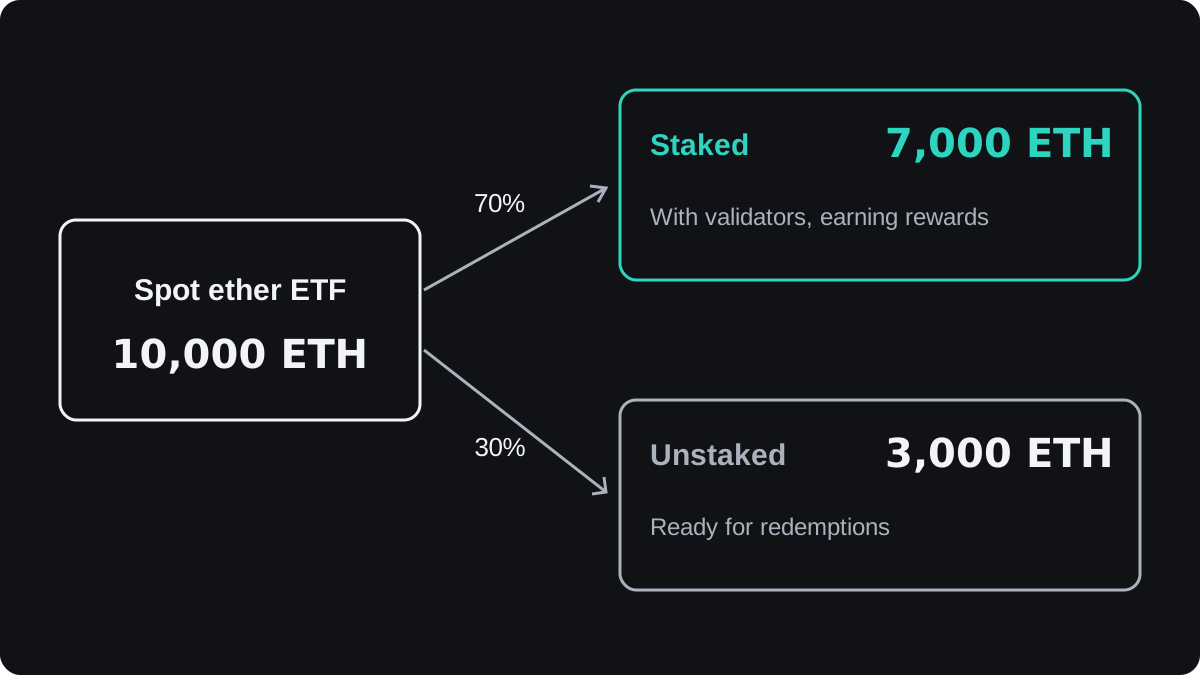
Say the 10,000 ETH fund stakes 7,000 and keeps 3,000 ready for redemptions, a split chosen here for illustration. Only 70% of its ether then earns rewards.
At a 3% network reward, the fund earns 3% × 0.7 = 2.1% on its whole holding.
Other risks reach shareholders too. A validator penalty or a staking provider's mistake falls on the fund, and the tax treatment of rewards differs between countries.
What moves a spot ether ETF
The share price follows the price of ether, minus the fee, plus any staking rewards passed on. Anything that moves ether moves the fund.
Ether's supply has no fixed cap. New ether is issued to validators, and part of every transaction fee is destroyed, so the total can grow or shrink over time. That differs from Bitcoin, whose new supply follows a fixed schedule.
Flows matter as well. When investors buy more shares than they sell, new shares are created and the fund buys ether. The lesson on ETF flows walks through that mechanism for Bitcoin.
Spot ether ETF or ether itself?
Holding ether directly lets you use it on Ethereum. You can pay network fees, use decentralised apps (dApps) and stake it yourself. Fund shares can do none of that.
The fund removes the work of keeping private keys safe and fits into a normal brokerage account. In exchange, you pay a yearly fee and can trade only in market hours, with the custodian holding the keys for you.
Câu hỏi thường gặp
Do spot ether ETFs pay staking rewards?
Some do and some do not. US funds launched without staking in 2024 and some added it from late 2025, so check each fund's prospectus for what it does now.
Is a spot ether ETF the same as owning ether?
Its price follows ether, but you own fund shares. You cannot send that ether, pay network fees with it or stake it yourself.
Why would a staking fund keep some ether unstaked?
Leaving staking can take days or longer, while authorized participants can redeem shares quickly. An unstaked buffer lets the fund pay out without waiting for the exit queue.
When did spot ether ETFs start trading in the US?
They began trading in July 2024, about six months after the first US spot Bitcoin ETFs.
Học tiếp
 Chương 1What is a Bitcoin futures ETF?A Bitcoin futures ETF is a fund listed on a stock exchange that tracks Bitcoin by holding Bitcoin futures contracts, plus cash as collateral. It owns no bitcoin. Because futures expire, the fund keeps replacing them, and when later contracts cost more, that roll makes the fund lag the Bitcoin price over time.
 Chương 1What is a spot Bitcoin ETF?A spot Bitcoin ETF is a fund that owns actual bitcoin, kept by a custodian, and whose shares trade on a stock exchange. Each share stands for a fixed slice of the fund's coins, minus fees. Large trading firms create and redeem shares to keep the share price close to the value of that bitcoin.
 Chương 1How do ETF flows move the Bitcoin price?When investors put more money into spot Bitcoin ETFs than they take out, new shares are created and bitcoin is bought to back them. Outflows work in reverse. That buying and selling can move the price, but hedged trades, other sellers and timing mean a flow figure never maps neatly onto a price change.

