Why was Bitcoin created?
Bitcoin was created so people could pay each other online without a bank or payment company in the middle. Its pseudonymous author, Satoshi Nakamoto, published the design in October 2008, during the global financial crisis. It solved a problem that earlier digital cash had not: stopping the same money being spent twice without a central referee.
Nội dung này hiện chỉ có bản tiếng Anh.
You can email the same photo to a hundred people, and each of them gets a perfect copy. That is handy for photos. For money it is a disaster, because a coin that anyone can copy is worth nothing.
Banks fixed this long ago by keeping one master ledger. Bitcoin's creator wanted digital money that worked with no one holding that ledger.
The double-spending problem
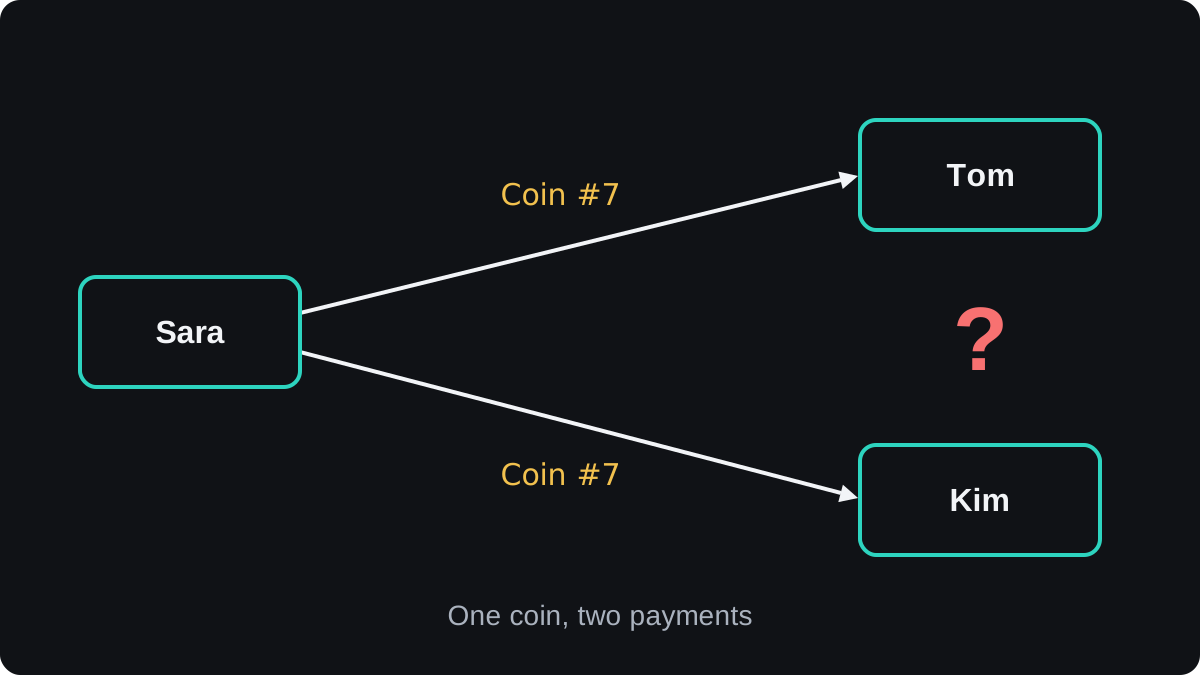
Picture Sara with one digital coin, stored as a file. Call it Coin #7. She sends it to Tom for a bike, and she sends a copy of the same file to Kim for a phone.
Both Tom and Kim receive a coin that looks valid. Only one of them can really have been paid, and nothing in the file says which. This is double spending: paying with the same money twice.
Online banking avoids the problem with a referee. Your bank keeps the one true ledger, checks your balance and refuses the second payment.
That works, and it means trusting the bank. The bank can freeze your account, and in a crisis the bank itself can fail. The question behind Bitcoin was whether strangers could agree on one ledger with no referee at all.
Digital cash before Bitcoin
People tried to build digital money for decades before 2008. In the 1980s and 1990s, the cryptographer David Chaum designed private electronic cash and offered it through his company, DigiCash.
It still depended on a central company, and DigiCash went bankrupt in 1998.
In the late 1990s, others worked on ideas that Bitcoin later combined. Adam Back's Hashcash, from 1997, made a computer do a small amount of work before it sent an email, a cost that spammers would feel.
Wei Dai's b-money, from 1998, and Nick Szabo's bit gold described money run by its own users, with no central issuer. Neither became a working network.
Bitcoin's design paper cites both b-money and Hashcash. Its new step was a way for strangers to agree on the order of payments, which none of the earlier designs had solved.
The 2008 paper and the first block
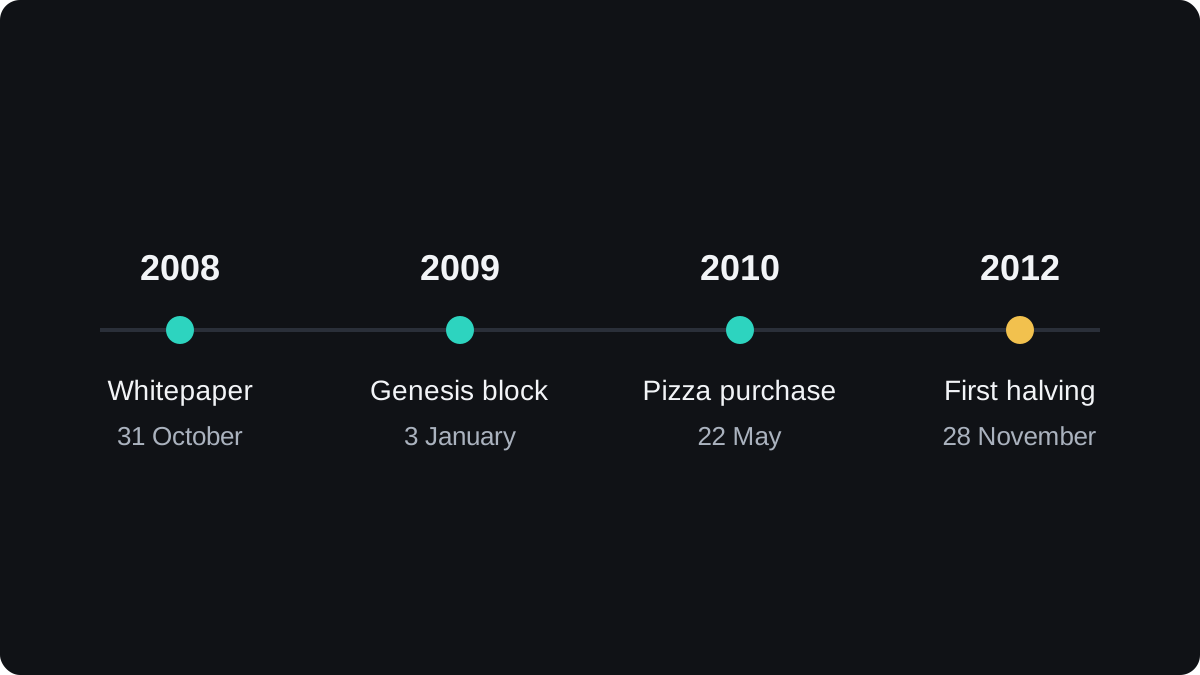
On 31 October 2008, someone using the name Satoshi Nakamoto shared a short paper, now called the Bitcoin whitepaper, on a cryptography mailing list. It was titled "Bitcoin: A Peer-to-Peer Electronic Cash System".
The timing stands out. Banks were failing, and governments were spending public money to rescue them. The paper itself argued that online payments leaned too heavily on trust in financial institutions.
The first block, known as the genesis block, is dated 3 January 2009. Satoshi put a headline from that day's edition of The Times, a British newspaper, inside it: "Chancellor on brink of second bailout for banks".
The headline proves the block was not made before that date, and it reads like a comment on the bailouts.
Satoshi released the software to the public a few days later, and other people began running it.
On 22 May 2010, a programmer paid 10,000 BTC for two pizzas, the first widely known purchase of goods with bitcoin. The first halving of the mining reward followed on 28 November 2012.
What the design set out to do
The paper and the first software aimed at a short list of goals:
- Two people can pay each other directly, with no bank or payment company approving the transfer.
- No one can reverse a payment once enough blocks sit on top of it.
- Anyone can check the full ledger, so a balance never rests on someone's word.
- New coins follow a fixed schedule that no one can change on a whim.
The hard part was agreeing on the order of payments. Bitcoin solves it with proof of work: miners spend real computing effort to add each block.
Nodes follow the chain with the most work behind it. To rewrite history, an attacker would have to redo that work faster than all the honest miners combined. The mining lesson shows how this works in practice.
Worked example: a fixed issuance schedule
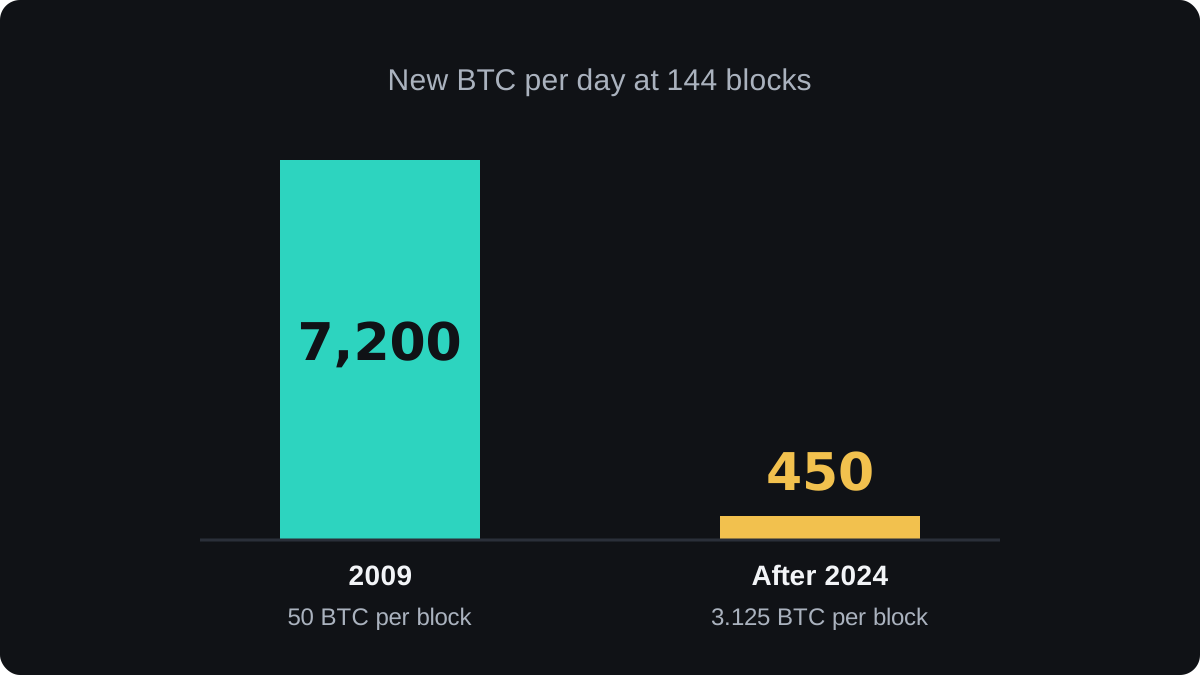
The fixed schedule is easy to check with round numbers. A block arrives about every 10 minutes, so a day holds roughly 24 × 60 ÷ 10 = 144 blocks.
- In 2009, each block paid 50 BTC, so about 144 × 50 = 7,200 new BTC appeared each day.
- After the 2024 halving, each block pays 3.125 BTC, so about 144 × 3.125 = 450 new BTC appear each day.
- After four halvings, the daily flow is 450 ÷ 7,200 = 1/16 of what it was at the start.
No central bank can speed this up in a crisis, and that was a design choice. It also means no one can add supply when demand jumps, which is one reason the price can swing so far.
The halving lesson covers the full schedule and what each cut means for miners.
Who is Satoshi Nakamoto?
The real identity behind the name is still unknown. Satoshi handed the project to other developers and stopped posting in public at the end of 2010. The last known private emails date from 2011.
Several people have been named as Satoshi over the years, and none has been proven. With no founder for anyone to pressure or arrest, Bitcoin's rules depend on the people who run its software.
Bitcoin today is used less as everyday cash than the paper imagined, and it is often held as an asset. The next lesson weighs what it solves and what it leaves open.
Câu hỏi thường gặp
Who created Bitcoin?
Bitcoin was created by a person or group using the name Satoshi Nakamoto, whose real identity is unknown. Satoshi published the design in 2008 and handed the project to other developers by 2011.
When was Bitcoin created?
The design paper came out on 31 October 2008. The genesis block, the first block of the chain, is dated 3 January 2009.
Why is the supply limited to 21 million?
It follows from a starting reward of 50 BTC per block and a halving every 210,000 blocks. The first 210,000 blocks pay 10.5 million. Each later period pays half as much, so the total stops just short of 21 million.
Was Bitcoin a reaction to the 2008 financial crisis?
The timing and the genesis block headline point that way. The paper itself never mentions the crisis, and its argument is about relying less on trusted third parties for online payments.
Học tiếp
 Chương 2What is Bitcoin?Bitcoin is the first cryptocurrency: digital money that runs on a public network with no central bank or company in charge. Its software caps the supply at 21 million coins and releases new ones to miners on a fixed schedule. Anyone who holds the private key to an address can send its bitcoin to anyone else, at any hour.
 Chương 2What problems does Bitcoin solve?Bitcoin lets two people move value over the internet without a bank or payment company approving the transfer. Its supply follows a schedule fixed in code that no one can speed up. It leaves other problems open: the price swings hard, and a lost key means lost coins, so it suits some jobs much better than others.

