What problems does Bitcoin solve?
Bitcoin lets two people move value over the internet without a bank or payment company approving the transfer. Its supply follows a schedule fixed in code that no one can speed up. It leaves other problems open: the price swings hard, and a lost key means lost coins, so it suits some jobs much better than others.
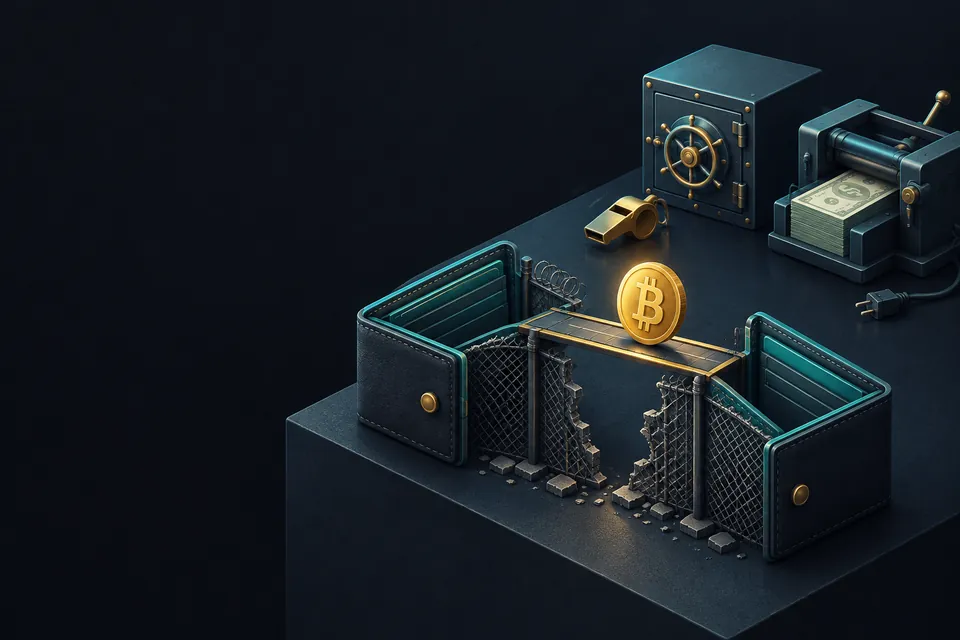
Think of a freelance designer paid by a client in another country. The payment can take several working days and pass through two or three banks, and each of them may take a fee.
Bitcoin was designed for payments like this, with no bank in the middle. It removes some of the friction, and it brings new costs and risks of its own.
Paying without a referee
The oldest problem with digital money is double spending: a file can be copied, so the same coin could be paid to two people. Before Bitcoin, the only working fix was a central ledger kept by a bank or company.
Bitcoin swaps that ledger for one that thousands of nodes keep together. Miners order payments into blocks with proof of work, and once a payment has several blocks on top, reversing it would take an enormous amount of computing power.
The lesson on why Bitcoin was created tells the story of that problem and the earlier attempts to solve it.
Payments no one has to approve
A bank or card network can block or reverse your payment. Sometimes that protects you, as when a bank stops a fraud. Sometimes it stops you, as when an account is frozen by mistake.
On Bitcoin, nobody approves a transfer. If the signature is valid and the coins are there, nodes accept it, whoever you are and wherever you live.
That is useful for people whom banks serve badly, and it cuts both ways. There are no chargebacks, so if you pay a scammer, no one can pull the money back. The common crypto scams lesson shows the usual tricks.
Moving money across borders, at any hour
Bitcoin settles on the same network whether the receiver is next door or on another continent. It runs at weekends and on holidays, and a new block arrives about every 10 minutes.
The fee works differently from a bank's. It depends on how much data the transaction takes up, measured in virtual bytes (vB), and on how busy the network is. It does not depend on how much money you send.
Payments that offer a higher fee rate leave the mempool sooner. Here is an example with round illustrative numbers, for a simple transaction of 200 vB and a bitcoin price of $50,000:
- On a quiet day the fee rate is 10 sats per vB. The fee is 200 × 10 = 2,000 sats, or 0.00002 BTC, which is $1.00.
- On a busy day the rate is 100 sats per vB. The fee is 200 × 100 = 20,000 sats, or 0.0002 BTC, which is $10.00.
- Each fee stays the same whether you send $50 or $500,000.
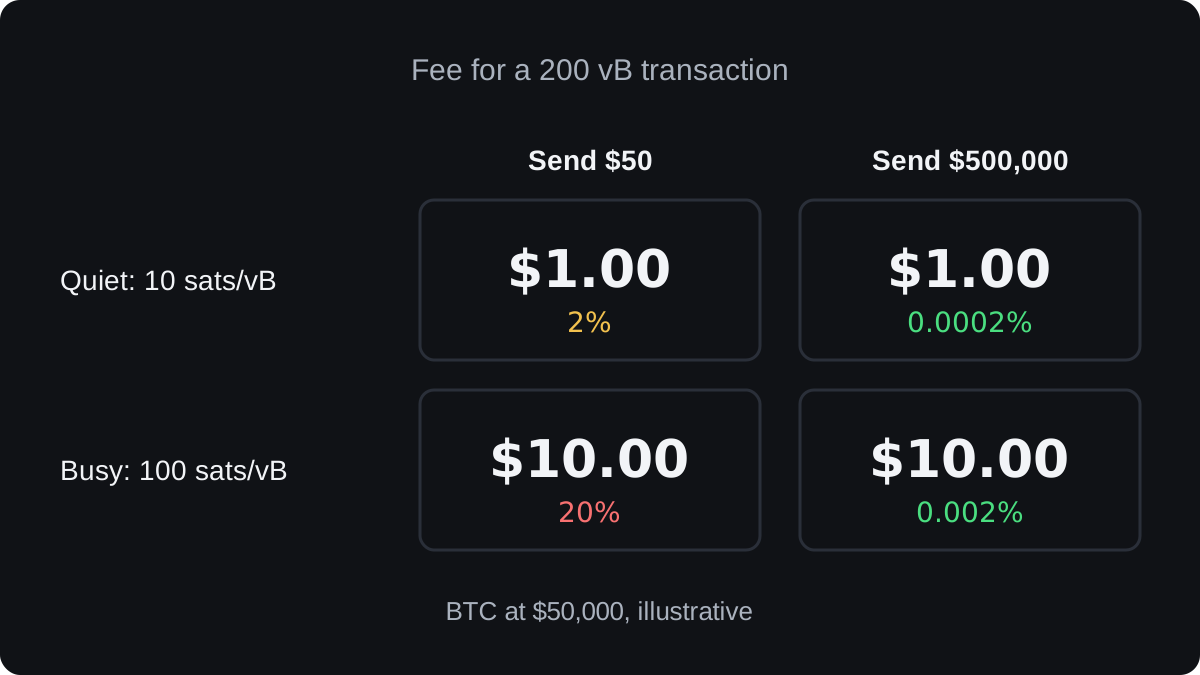
Large transfers are cheap this way. Small payments can become expensive at busy times: a $10 fee on a $50 payment is 20%. Second-layer networks such as Lightning were built to carry small payments more cheaply.
A supply no one can expand
Most money is managed by central banks, which can create more. When the money supply grows faster than the economy, prices tend to rise, and each unit buys less. The inflation and currencies lesson covers the link to exchange rates.
Bitcoin's supply follows a schedule fixed in code, and anyone running a node can check it. The cap is 21 million BTC.
On that schedule, 10.5 million BTC existed by the first halving in 2012, 15.75 million by 2016, about 18.38 million by 2020 and about 19.69 million by 2024. Each period adds half as much as the one before.
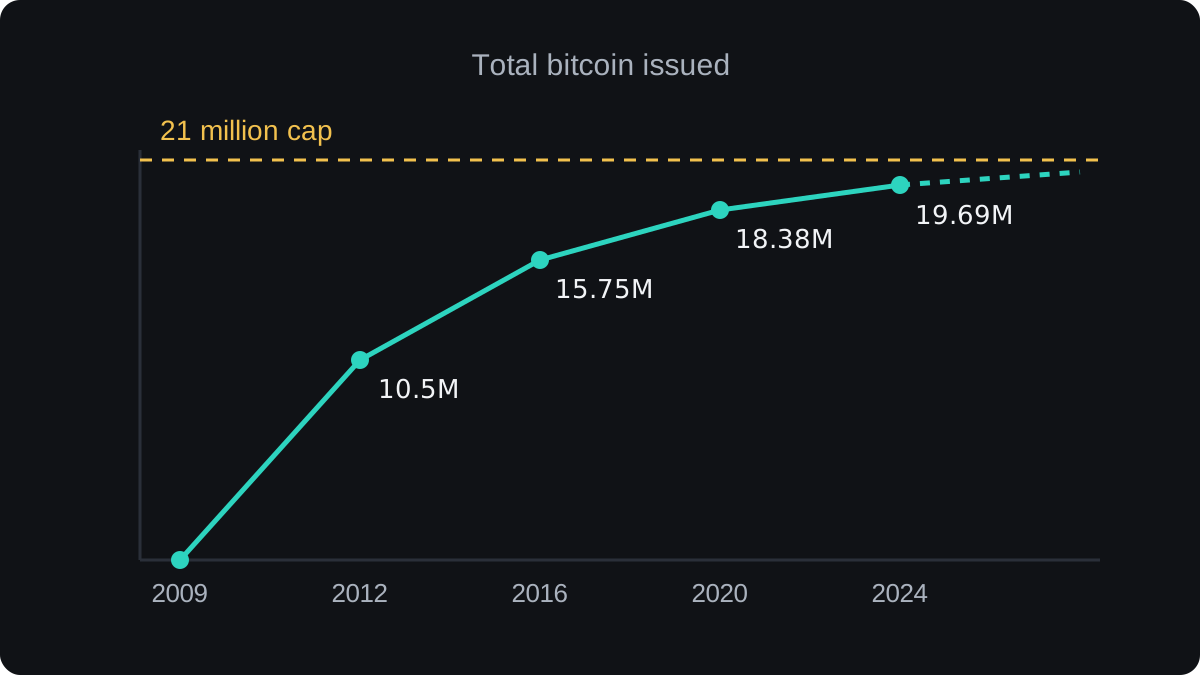
A fixed supply does not make the price stable. Demand still moves, so the value of one bitcoin, in dollars or in groceries, can halve or double within a year.
Owning something without a custodian
Money in a bank account is a promise from the bank. Bitcoin in your own wallet is controlled by your private key, and no company stands between you and your coins.
You can also verify your own balance. By running a node, you check every rule yourself and rely on no one else's report.
The trade-off is that the risk sits with you. If you lose the key and its seed phrase backup, there is no password reset and no help desk.
What Bitcoin does not solve
Bitcoin's design leaves several problems open:
- Price swings make it hard to use for salaries or shop prices.
- Each block has limited space, so fees rise when many people want to send at once.
- Payments are public. Addresses carry no names, but they can be traced and linked to people.
- Proof of work uses a large amount of electricity, and how much harm that does depends on where the power comes from.
- Mistakes are final, including payments that a scammer tricked you into sending.
The volatility lesson puts numbers on the first of these.
Questions
Can Bitcoin be used for everyday payments?
It can, and some shops accept it, but price swings and changing fees make it awkward for small purchases. Second-layer networks such as Lightning handle small, fast payments on top of Bitcoin.
Does Bitcoin protect against inflation?
No one can create bitcoin faster than the fixed schedule allows. Its price still moves with demand, and it fell sharply in 2022 while inflation was high, so it has not reliably protected purchasing power.
Why are Bitcoin transactions irreversible?
No company sits in the middle to undo them. Once a payment is in a block with several blocks on top, changing it means redoing the proof of work for those blocks faster than the rest of the network.
Is Bitcoin fully anonymous?
Bitcoin is pseudonymous, which means payments carry addresses instead of names. Every payment is public, and once an address is linked to a person, for example through an exchange account, their payment history can be followed.
Keep learning
 Chapter 2What is Bitcoin?Bitcoin is the first cryptocurrency: digital money that runs on a public network with no central bank or company in charge. Its software caps the supply at 21 million coins and releases new ones to miners on a fixed schedule. Anyone who holds the private key to an address can send its bitcoin to anyone else, at any hour.
 Chapter 2Why was Bitcoin created?Bitcoin was created so people could pay each other online without a bank or payment company in the middle. Its pseudonymous author, Satoshi Nakamoto, published the design in October 2008, during the global financial crisis. It solved a problem that earlier digital cash had not: stopping the same money being spent twice without a central referee.

